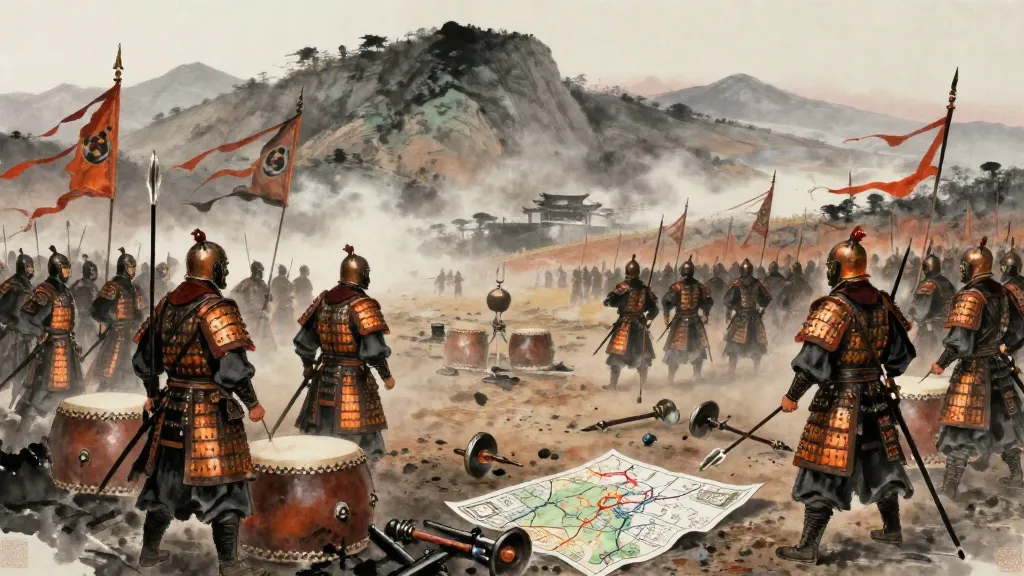
兵教上 (Military Training, Part I) — Chinese ink painting

尉繚子 Weiliaozi · Chapter 21

兵教上

Military Training, Part I

View:

教令與連坐

Training Orders and Collective Liability

兵之教令,分營居陳,有非令而進退者,加犯教之罪。前行者,前行教之;後行者,後行教之;左行者,左行教之;右行者,右行教之。教舉五人,其甲首有賞。弗教,如犯教之罪。羅地者,自揭其伍。伍內互揭之,免其罪。

The orders for military training: when dividing camps and deploying formations, anyone who advances or retreats without orders is charged with violating the training code. Those in the front rank are trained by the front rank instructor; those in the rear rank by the rear rank instructor; those on the left by the left instructor; those on the right by the right instructor. For each training group of five men, the squad leader receives a reward for successful training. If he fails to train them, he is charged as though he himself violated the training code. Those who fall to the ground report their own squad members; squad members who report each other are exempt from punishment.

Notes

1context

甲首 (jia shou): literally 'armored head,' meaning the squad leader who bears primary responsibility. The training system places the burden of collective performance on the squad leader: his men's failures are his crimes.

什伍至裨將之連坐

Collective Liability from Section to Deputy General

凡伍臨陳,若一人有不進死於敵,則教者如犯法者之罪。凡什保什,若亡一人,而九人不盡死於敵,則教者如犯法者之罪。自什己上至於裨將,有不若法者,則教者如犯法者之罪。凡明刑罰,正勸賞,必在乎兵教之法。

When a squad enters battle, if one man fails to advance and dies at the hands of the enemy without fighting, his trainer bears the same crime as the offender. When a section guarantees its section, if one man is lost and the remaining nine do not all die fighting the enemy, the trainer bears the same crime as the offender. From the section level upward to the deputy general, if any fail to comply with regulations, the trainer bears the same crime as the offender.

The correct application of punishments and proper encouragement through rewards must all be rooted in the system of military training.

Notes

2context

The principle is that failure in battle reflects failure in training. The 教者 (trainer/instructor) is held accountable for every breach of discipline by his trainees, creating a direct causal chain from preparation to performance. This makes instructors as invested in combat outcomes as the fighters themselves.

旗章標識

Flags and Badge Identification

將異其旗,卒異其章。左軍章左肩,右軍章右肩,中軍章胸前,書其章曰:「某甲某士」。前後章各五行,尊章置首上,其次差降之。

Generals are distinguished by their flags; soldiers are distinguished by their badges. The left division wears badges on the left shoulder, the right division on the right shoulder, and the center division on the chest. Each badge is inscribed: 'Such-and-such squad, such-and-such soldier.'

Front and rear badges are arranged in five ranks. The senior badge is placed on the head, with successively lower ranks descending in position.

Notes

3context

The inscribed badges (書其章曰「某甲某士」) constitute a personal identification system, linking each soldier to his specific squad. This is one of the earliest descriptions of military identification tags, enabling accountability for individual conduct on the battlefield.

逐級合練

Progressive Combined Training

伍長教其四人,以板為鼓,以瓦為金,以竿為旗。擊鼓而進,低旗則趨,擊金而退。麾而左之,麾而右之,金鼓俱擊而坐。伍長教成,合之什長。什長教成,合之卒長。卒長教成,合之伯長。伯長教成,合之兵尉。兵尉教成,合之裨將。裨將教成,合之大將。大將教之,陳於中野,置大表三,百步而一。既陳,去表百步而決,百步而趨,百步而鶩。習戰以成其節,乃為之賞法。

The squad leader trains his four men, using boards as drums, tiles as gongs, and poles as flags. He beats the drum and they advance; he lowers the flag and they double-time; he beats the gong and they retreat. He waves left and they go left; he waves right and they go right. When gong and drum sound together, they sit.

When the squad leader's training is complete, squads are combined under the section leader. When the section leader's training is complete, sections are combined under the platoon leader. When the platoon leader's training is complete, platoons are combined under the company commander. When the company commander's training is complete, companies are combined under the military commandant. When the commandant's training is complete, units are combined under the deputy general. When the deputy general's training is complete, they are combined under the supreme general.

The supreme general trains them deployed on open ground, with three great marker posts set at intervals of one hundred paces. Once in formation, they advance one hundred paces at a march, one hundred paces at quick-step, and one hundred paces at full charge. They drill for battle until they achieve proper cadence, and then rewards are determined.

Notes

4context

The progressive training system (伍→什→卒→伯→兵尉→裨將→大將) builds from the smallest unit upward. Using improvised materials (boards, tiles, poles) at the squad level shows that basic training requires no special equipment -- only discipline. The three speeds (決 march, 趨 quick-step, 鶩 charge) at 100-pace intervals match the drum tempos from Chapter 18.

旗功與立威

Captured Flags as Merit and Establishing Authority

自尉吏而下,盡有旗。戰勝得旗者,各視其所得之爵,以明賞勸之心。戰勝在乎立威,立威在乎戮力,戮力在乎正罰。正罰者,所以明賞也。

From the commandant and below, all have their own flags. Those who capture enemy flags in a victorious battle are awarded ranks corresponding to the flags they captured, to make clear the spirit of reward and encouragement.

Victory in battle depends on establishing authority. Establishing authority depends on united effort. United effort depends on correct punishment. Correct punishment is what makes rewards credible.

Notes

5context

The logical chain -- 戰勝→立威→戮力→正罰→明賞 (victory → authority → united effort → correct punishment → clear rewards) -- shows that in Wei Liao's system, punishment is not an end in itself but the foundation that makes the entire reward system function. Without credible punishment, rewards lose their motivating power.

令民死而不疑

Making the People Face Death Without Hesitation

令民背國門之限,決生死之分,教之死而不疑者,有以也。令守者必固,戰者必斗;奸謀不作,奸民不語;令行無變,兵行無猜;輕者若霆,奮敵若驚。舉功別德,明如白黑,令民從上令,如四肢應心也。

To make the people cross the threshold of the capital gate, face the boundary between life and death, and learn to die without hesitation -- there is a method for this. It ensures that those who defend will hold firm and those who fight will engage. Treacherous plots will not arise and seditious people will not speak. Orders are executed without alteration and troops march without suspicion. The light troops strike like thunder; the army assaults the enemy like a sudden shock.

Distinguishing merit and separating virtue is as clear as black from white. Making the people follow their superiors' orders is like the four limbs responding to the heart.

Notes

6context

如四肢應心 ('like the four limbs responding to the heart') is the Weiliaozi's ideal of military obedience: instant, reflexive, and without conscious deliberation. This organic metaphor appears across Warring States military and political texts as the standard for institutional responsiveness.

兵教之功

The Achievement of Military Training

前軍絕行亂陳,破堅如潰者,有以也。此之謂兵教,所以開封疆,守社稷,除患害,成武德也。

That the vanguard can shatter formations, scatter enemy ranks, and break through fortified positions as though they were crumbling -- there is a reason for this. This is what military training achieves: it is the means to expand the state's borders, protect the altars of grain and soil, eliminate threats and harm, and perfect martial virtue.

Notes

7context

社稷 (she ji, 'altars of grain and soil') is the standard metonym for the state itself. The four objectives -- expanding borders (開封疆), defending the state (守社稷), eliminating threats (除患害), and perfecting martial virtue (成武德) -- summarize the Weiliaozi's view of what military training ultimately serves.

Edition & Source

Text
《尉繚子》 Weiliaozi
Edition
中華古詩文古書籍網 transcription
Commentary
Traditional military commentaries