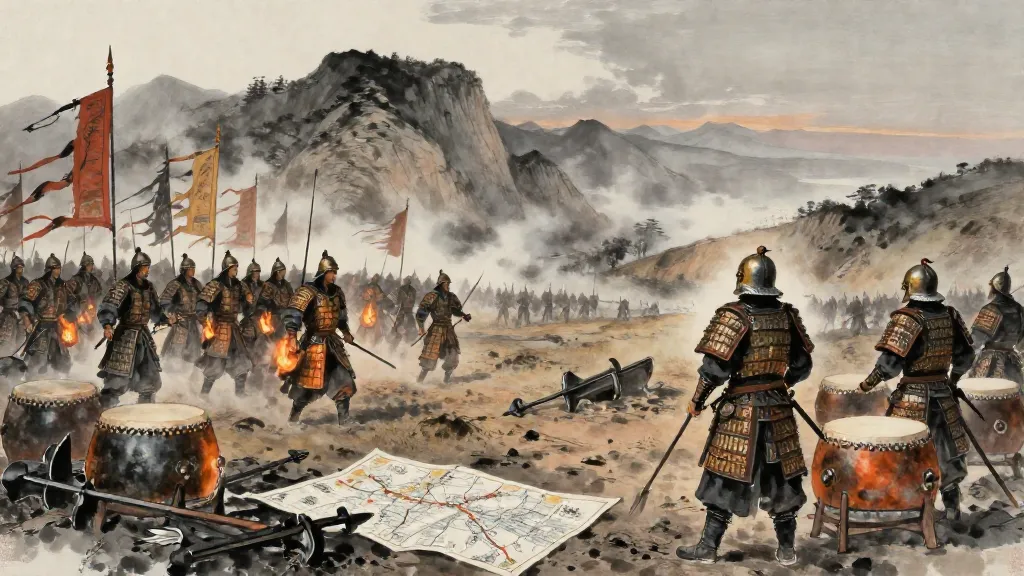
踵軍令 (Ordinance on the Follow-Up Army) — Chinese ink painting

尉繚子 Weiliaozi · Chapter 20

踵軍令

Ordinance on the Follow-Up Army

View:

踵軍之制

The System of the Follow-Up Army

所謂踵軍者,去大軍百里,期於會地,為三日熟食,前軍而行。為戰,合之表,合表乃起。踵軍饗士,使為之戰勢,是謂趨戰者也。

The so-called follow-up army stations itself one hundred li from the main army. It proceeds to the designated assembly point, carries three days of cooked rations, and marches ahead of the main force. When battle comes, it advances upon the signal of the rally markers; only when the markers align does it deploy. The follow-up army feasts the soldiers and creates the momentum for battle -- this is what is called 'rushing to battle.'

Notes

1context

踵軍 (zhong jun, 'follow-up army') literally means 'heel army' -- the force that follows on the heels of the advance force. Despite the name, it actually marches ahead of the main body (前軍而行), serving as the forward striking element. The 合表 (he biao, 'rally markers') were physical signal devices used to coordinate timing between separated forces.

2context

三日熟食 ('three days of cooked rations') indicates the follow-up army carries pre-cooked food to eliminate the need for campfires, maintaining operational security and enabling rapid movement.

興軍之制

The System of the Advance Army

興軍者,前踵軍而行,合表乃起。去大軍一倍其道,去踵軍百里,期於會地,為六日熟食,使為戰備。

The advance army marches ahead of the follow-up army, deploying upon the signal of the rally markers. It stations itself twice the distance from the main army, one hundred li from the follow-up army, proceeding to the designated assembly point. It carries six days of cooked rations and prepares for battle.

Notes

3context

The three-echelon system: 興軍 (advance army, 6 days rations, furthest forward), 踵軍 (follow-up army, 3 days rations, middle), and 大軍 (main army, rear). Each echelon is separated by 100 li (~40 km), creating a layered advance that provides early warning, forward striking capability, and a main reserve.

追擊與內衛

Pursuit and Internal Security

分卒據要害,戰利則追北,按兵而趨之。

踵軍遇有還者,誅之。所謂諸將之兵在四奇之內者勝也。

Detach troops to hold key terrain. If the battle is won, pursue the fleeing enemy, pressing the army forward to exploit the victory.

The follow-up army shall execute any soldier encountered moving to the rear. It is said: 'When all the generals' forces operate within the four flanking positions, victory is achieved.'

Notes

4context

The follow-up army serves a dual function: it is both a tactical reserve and a barrier against desertion. By executing anyone moving rearward (還者), it creates an impassable line behind the fighting troops. This 'blocking force' concept was practiced in multiple armies throughout history.

什伍分守

Squad and Section Deployment at Key Points

兵有什伍,有分有合,豫為之職,守要塞關梁而分居之。戰,合表起,即皆會也。大軍為計日之食,起,戰具無不及也。令行而起,不如令者有誅。

The army has its squads and sections, with designated assignments for dispersal and concentration. Posts are assigned in advance to guard strategic passes, fortifications, and bridges, with troops distributed among them. When battle comes and the rally markers give the signal, all converge at the assembly point.

The main army carries rations calculated by the number of days' march. When it deploys, all combat equipment must be complete. When the order is given and the army moves, anyone who does not comply is executed.

Notes

5context

計日之食 ('rations calculated by days') shows logistical planning based on the expected duration of the campaign. Unlike the forward forces which carry fixed rations (3 or 6 days), the main army's supply is calculated to the specific operational timeline.

分塞安內

Sector Control and Internal Security

凡稱分塞者,四境之內,當興軍踵軍既行,則四境之民無得行者。奉王之軍命,授持符節,名為順職之吏。非順職之吏而行者,誅之。戰,合表起,順職之吏乃行,用以相參。故欲戰,先安內也。

As for the sector control system: within the four borders of the state, once the advance army and follow-up army have departed, no civilian within those borders may travel. Those who carry the royal military mandate and bear tally-tokens are designated 'compliance officers.' Anyone who travels and is not a compliance officer is executed.

When battle begins and the rally markers give the signal, only then may the compliance officers move, and their movements serve as cross-checks on each other. Therefore, if you wish to wage war, first secure the interior.

Notes

6context

順職之吏 ('compliance officers') are the only authorized travelers during wartime mobilization. The complete civilian lockdown (四境之民無得行者) prevents intelligence leaks, desertion assistance, and internal disruption. The final maxim -- 欲戰先安內 ('to wage war, first secure the interior') -- encapsulates the chapter's operational philosophy.

Edition & Source

Text
《尉繚子》 Weiliaozi
Edition
中華古詩文古書籍網 transcription
Commentary
Traditional military commentaries