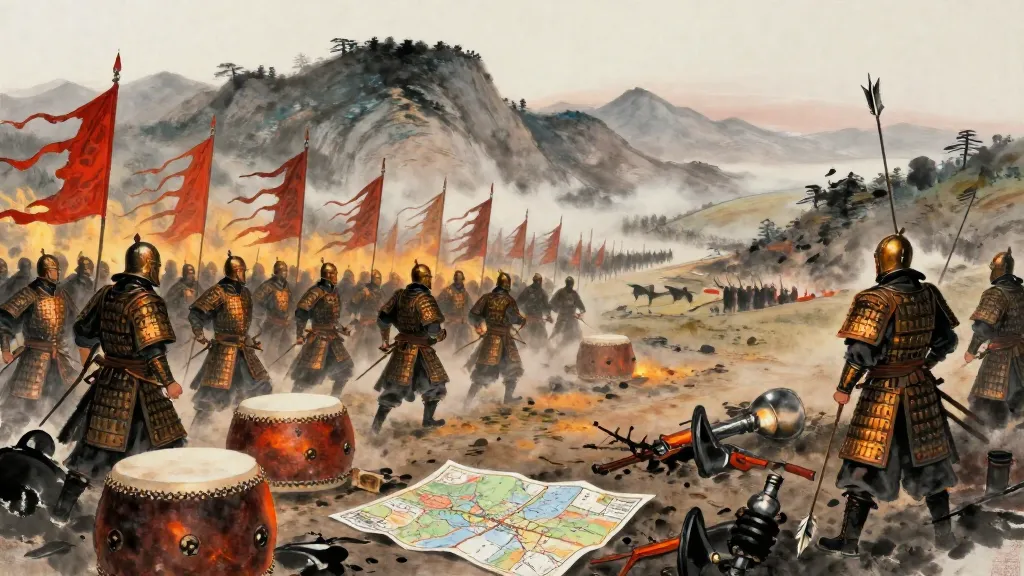
治兵 (Controlling the Army) — Chinese ink painting

吳子 Wuzi · Chapter 3

治兵

Controlling the Army

View:

四輕二重一信

Four Lightnesses, Two Weights, One Trust

武侯問曰:“進兵之道何先?”

起對曰:“先明四輕、二重、一信。”

曰:“何謂也?”

對曰:“使地輕馬,馬輕車,車輕人,人輕戰。明知險易,則地輕馬;芻秣以時,則馬輕車;膏鐧有餘,則車輕人;鋒銳甲堅,則人輕戰。進有重賞,退有重刑,行之以信。審能達此,勝之主也。”

Marquis Wu asked: "What is the first priority in advancing troops?"

Wu Qi replied: "First clarify the Four Lightnesses, Two Weights, and One Trust."

"What do these mean?"

Wu Qi replied: "Make the terrain light for the horses, the horses light for the chariots, the chariots light for the men, and the men light for battle. When you clearly understand which terrain is dangerous and which is easy, the terrain becomes light for the horses. When fodder and grain are supplied on time, the horses become light for the chariots. When axle grease and fittings are abundant, the chariots become light for the men. When blades are sharp and armor is strong, the men become light for battle. Advance earns heavy reward; retreat earns heavy punishment — and both are administered with absolute reliability. If you can truly achieve this, you hold the key to victory."

Notes

1translation

'Light' (輕) here means 'easy for' or 'responsive to' — the idea is an optimized chain where each element enables the next. The 'Two Weights' are heavy rewards for advancing and heavy punishments for retreating. The 'One Trust' (一信) is reliability in carrying out both.

以治為勝

Victory Through Discipline

武侯問曰:“兵何以為勝?”

起對曰:“以治為勝。”

又問曰:“不在眾寡?”

對曰:“若法令不明,賞罰不信,金之不止,鼓之不進,雖有百萬,何益於用?所謂治者,居則有禮,動則有威,進不可擋,退不可追,前卻有節,左右應麾,雖絕成陳,雖散成行。與之安,與之危,其眾可合而不可離,可用而不可疲,投之所往,天下莫當,名曰父子之兵。”

Marquis Wu asked: "What makes a military force victorious?"

Wu Qi replied: "Discipline is what makes it victorious."

He asked again: "Does it not depend on numbers?"

Wu Qi replied: "If orders are unclear, if rewards and punishments are unreliable, if the gong to halt is sounded and they do not stop, if the drum to advance is beaten and they do not advance — then even a million men are of no use. What I mean by discipline is this: at rest they observe propriety, in motion they project authority. Their advance cannot be blocked, their retreat cannot be pursued. Moving forward and falling back follow a measured rhythm; left and right respond to the commander's signal. Even when cut off they form a battle line; even when scattered they form ranks. In ease and in danger alike, the troops can be united but not divided, can be employed but not exhausted. Deploy them wherever you will and nothing in the realm can stand against them. This is called a father-and-sons army."

Notes

1translation

'Father-and-sons army' (父子之兵) describes a force where the bond between commander and troops is as close as that between father and children — absolute trust and mutual devotion, producing unbreakable cohesion.

行軍之道

The Principles of Marching

吳子曰:“凡行軍之道,無犯進止之節,無失飲食之適,無絕人馬之力。此三者,所以任其上令,任其上令,則治之所由生也。若進止不度,飲食不適,馬疲人倦而不解舍,所以不任其上令,上令既廢,以居則亂,以戰則敗。”

Wu Qi said: "The principles of marching are these: do not violate the proper rhythm of advancing and halting, do not miss the proper timing of food and water, and do not exhaust the strength of men and horses. These three enable the troops to carry out their commander's orders, and carrying out orders is the source from which discipline arises. If advancing and halting have no measure, if food and water are ill-timed, if horses are spent and men are weary with no rest granted — then they cannot carry out their commander's orders. Once orders go unheeded, in camp there will be disorder, and in battle there will be defeat."

必死則生

Certain Death Means Life

吳子曰:“凡兵戰之場,立屍之地,必死則生,幸生則死。其善將者,如坐漏船之中,伏燒屋之下,使智者不及謀,勇者不及怒,受敵可也。故曰:用兵之害,猶豫最大,三軍之災,生於狐疑。”

Wu Qi said: "The battlefield is a place where corpses stand upright. Accept certain death and you will live; cling to life and you will die. A skilled general creates urgency like sitting in a leaking boat or crouching beneath a burning roof — so that the clever have no time to scheme and the brave have no time to rage. Only then can the army receive the enemy. Therefore it is said: the greatest harm in employing military force is hesitation; the greatest disaster for an army is born from indecision."

教戰之法

The Method of Training for Battle

吳子曰:“夫人常死其所不能,敗其所不便。故用兵之法:教戎為先。一人學戰,教成十人;十人學戰,教成百人;百人學戰,教成千人;千人學戰,教成萬人;萬人學戰,教成三軍。以近待遠,以佚待勞,以飽待飢。圓而方之,坐而起之,行而止之,左而右之,前而後之,分而合之,結而解之。每變皆習,乃授其兵。是為將事。”

Wu Qi said: "Men usually die from what they cannot do, and are defeated by what they are not accustomed to. Therefore the first principle of employing military force is: training comes first. One man learns to fight and trains ten. Ten men learn to fight and train a hundred. A hundred train a thousand. A thousand train ten thousand. Ten thousand train the entire army. Wait for the distant with proximity; wait for the exhausted with fresh reserves; wait for the hungry while well-fed. Form them into circles, then into squares. Sit them down, then stand them up. March them forward, then halt them. Move them left, then right. Send them forward, then back. Split them apart, then join them. Assemble them, then disperse them. Every variation must be drilled until mastered — only then issue them weapons. This is the general's duty."

教戰之令

Orders for Battle Training

吳子曰:“教戰之令,短者持矛戟,長者持弓弩,強者持旌旗,勇者持金鼓,弱者給廝樣,智者為謀主。鄉里相比,什伍相保。一鼓整兵,二鼓習陳,三鼓趨食,四鼓嚴辯,五鼓就行。聞鼓聲合,然後舉旗。”

Wu Qi said: "The orders for battle training are as follows: short men carry spears and halberds; tall men carry bows and crossbows; strong men carry the banners; brave men carry the gongs and drums; the weak are assigned to supply duties; the intelligent serve as planners. Men from the same village are grouped together; squads of five and ten guarantee one another. At the first drum, the troops form up. At the second drum, they drill formations. At the third drum, they proceed to eat. At the fourth drum, they prepare equipment and stand ready. At the fifth drum, they fall into line of march. When the drums sound in unison, the banners are raised."

Notes

1context

The 什伍 (squad of five and ten) system was the basic organizational unit of Warring States armies. Men from the same locality were grouped together so that personal bonds reinforced military discipline — each member was collectively responsible for the others.

三軍進止

Advancing and Halting the Army

武侯問曰:“三軍進止,豈有道乎?”

起對曰:“無當天灶,無當龍頭。天灶者,大谷之口;龍頭者,大山之端。必左青龍,右白虎,前朱雀,後玄武。招搖在上,從事於下。將戰之時,審候風所從來,風順致呼而從之,風逆堅陳以待之。”

Marquis Wu asked: "Are there principles governing how the army advances and halts?"

Wu Qi replied: "Do not position yourself facing the Heavenly Furnace; do not position yourself facing the Dragon's Head. The Heavenly Furnace is the mouth of a great valley. The Dragon's Head is the peak of a great mountain. Deploy with the Azure Dragon on your left, the White Tiger on your right, the Vermilion Bird to your front, and the Dark Warrior to your rear. The command standard is raised above; operations are conducted below. When battle is imminent, carefully observe which direction the wind is blowing from. If the wind is favorable, raise the war cry and follow it. If the wind is against you, hold a solid formation and wait."

Notes

1context

The four directional animals — Azure Dragon (east/left), White Tiger (west/right), Vermilion Bird (south/front), Dark Warrior (north/rear) — were standard Chinese cosmological/military orientation markers. In practical terms, this means the army should face south with advantageous terrain on all sides.

2translation

招搖 refers to the command standard or banner of the commanding general, visible to the entire army as the focal point for coordination.

畜車騎之方

The Method of Managing Chariots and Cavalry

武侯問曰:“凡畜車騎,豈有方乎?”

起對曰:“夫馬,必安其處所,適其水草,節其饑飽。冬則溫廄,夏則涼廡。刻剔毛鬣,謹落四下,戢其耳目,無令驚駭,習其馳逐,閒其進止,人馬相親,然後可使。車騎之具,鞍,勒,銜、轡,必令完堅。凡馬不傷於末,必傷於始;不傷於飢,必傷於飽。日暮道遠,必數上下,寧勞於人,慎無勞馬,常令有餘,備敵覆我。能明此者,橫行天下。”

Marquis Wu asked: "Are there methods for managing chariots and cavalry?"

Wu Qi replied: "Horses must be kept in comfortable quarters, given suitable water and pasture, and their feeding carefully regulated. In winter, keep the stables warm; in summer, keep the shelters cool. Trim the mane, carefully shoe all four hooves, shield their ears and eyes so nothing startles them, accustom them to galloping and pursuit, and train them in advancing and halting. Men and horses must become familiar with each other before they can be employed. The equipment for chariots and cavalry — saddles, bridles, bits, and reins — must all be kept sound and sturdy. Horses are generally not ruined at the end of a campaign but at the beginning; not ruined by hunger but by overfeeding. When dusk falls and the road is long, dismount and remount frequently — better to tire the men than to tire the horses. Always keep a reserve of stamina, in case the enemy counterattacks. He who understands this can march unopposed across the realm."

Edition & Source

Text
《吳子》 Wuzi
Edition
《武經七書》(Seven Military Classics) canonical text
Commentary
Traditional military commentaries