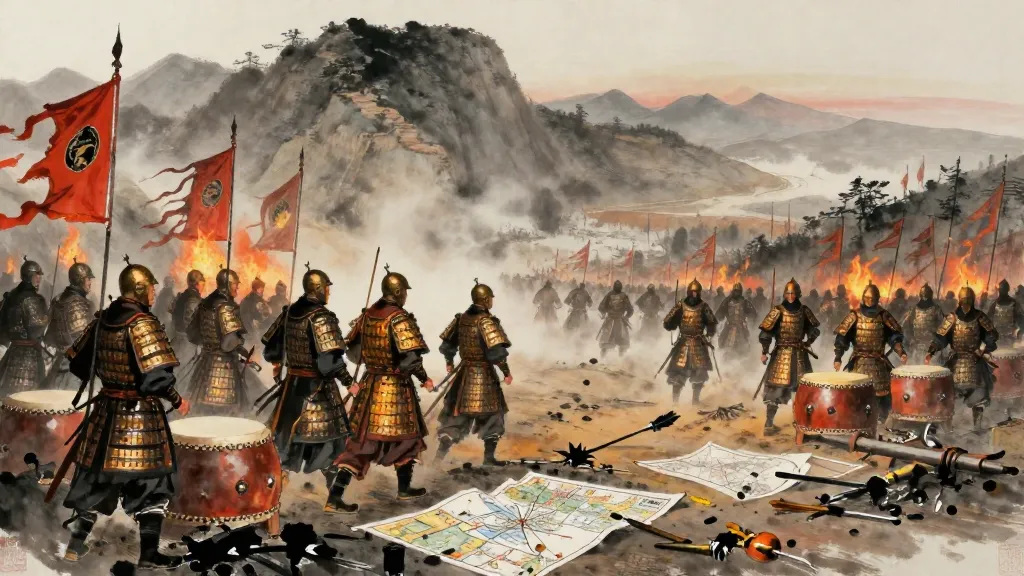
論將 (On Generals) — Chinese ink painting

吳子 Wuzi · Chapter 4

論將

On Generals

View:

將之所慎者五

The Five Things a General Must Be Careful About

吳子曰:“夫總文武者,軍之將也,兼剛柔者,兵之事也。凡人論將,常觀於勇,勇之於將,乃數分之一爾。夫勇者必輕合,輕合而不知利,未可也。故將之所慎者五:一曰理,二曰備,三曰果,四曰戎,五曰約。理者,治眾如治寡;備者,出門如見敵;果者,臨敵不懷生;戎者,雖克如始戰;約者,法令省而不煩。受命而不辭,敵破而後言返,將之禮也。故師出之日,有死之榮,無生之辱。”

Wu Qi said: "The general of an army must command both the civil and the martial. The conduct of warfare must combine both hardness and flexibility. When people evaluate a general, they usually look at his courage — but courage is only one of many qualities a general needs. A courageous man will rush into battle recklessly, and reckless engagement without understanding advantage is unacceptable. Therefore there are five things a general must be careful about: first, principle; second, preparedness; third, decisiveness; fourth, vigilance in arms; fifth, simplicity. Principle means governing a large force as though governing a small one. Preparedness means stepping out the gate as though the enemy were already in sight. Decisiveness means facing the enemy with no thought of personal survival. Vigilance in arms means that even after victory, you fight as though the battle were just beginning. Simplicity means keeping orders and regulations concise and uncomplicated. To accept a commission without hesitation, and to speak of returning only after the enemy is destroyed — this is the general's code of conduct. Therefore on the day the army marches out, there is the honor of death but no disgrace of survival."

四機

The Four Pivots of Warfare

吳子曰:“凡兵有四機:一曰氣機,二曰地機,三曰事機,四曰力機。三軍之眾,百萬之師,張設輕重,在於一人,是謂氣機。路狹道險,名山大塞,十夫所守,千夫不過,是謂地機。善行間諜,輕兵往來,分散其眾,使其君臣相怨,上下相咎,是為事機。車堅管轄,舟利櫓楫,士習戰陳,馬閒馳逐,是謂力機。知此四者,乃可為將。然其威、德、仁、勇,必足以率下安眾,怖敵決疑。施令而下不敢犯,所在而寇不敢敵。得之國強,去之國亡。是謂良將。”

Wu Qi said: "There are four pivots in warfare: first, the pivot of morale; second, the pivot of terrain; third, the pivot of stratagem; fourth, the pivot of capability. When the multitude of the three armies, a force of a million men, has its deployments of light and heavy units determined by a single man — this is the pivot of morale. When roads are narrow and passes are perilous, when famous mountains form great barriers, and ten men can hold what a thousand cannot pass — this is the pivot of terrain. When you skillfully employ spies, send light forces to probe back and forth, scatter the enemy's concentrations, and cause their ruler and ministers to blame each other and superiors and subordinates to find fault with one another — this is the pivot of stratagem. When chariots are sturdy with well-fitted axles, boats are swift with strong oars, soldiers are drilled in battle formations, and horses are trained in pursuit — this is the pivot of capability. He who understands these four can serve as a general. Yet his authority, virtue, compassion, and courage must be sufficient to lead subordinates, steady the masses, intimidate the enemy, and resolve uncertainty. When he issues orders, none below dare disobey. Wherever he is stationed, no enemy dares engage him. Gain such a man and the state grows strong; lose him and the state perishes. This is called a superior general."

Notes

1translation

機 (pivot/mechanism) here means the critical leverage point or hinge factor that determines the outcome. Each of the four 'pivots' represents a different domain of warfare where a decisive advantage can be created.

威耳威目威心

Command Through Ear, Eye, and Heart

吳子曰:“夫鼙鼓金鐸,所以威耳;旌旗麾幟,所以威目;禁令刑罰,所以威心。耳威於聲,不可不清;目威於色,不可不明;心威於刑,不可不嚴。三者不立,雖有其國,必敗於敵。故曰:將之所麾,莫不從移,將之所指,莫不前死。”

Wu Qi said: "Drums and bells command the ears. Banners and standards command the eyes. Prohibitions, orders, and punishments command the heart. Since the ears are commanded through sound, sounds must be clear. Since the eyes are commanded through display, displays must be distinct. Since the heart is commanded through penalties, penalties must be strict. If these three are not established, then even though you possess a state, you will inevitably be defeated by the enemy. Therefore it is said: where the general directs, all move to follow; where the general points, all advance to die."

因敵將之才用權

Exploiting the Enemy General's Character

吳子曰:“凡戰之要,必先占其將而察其才,因形用權,則不勞而功舉。其將愚而信人,可詐而誘。貪而忽名,可貨而賂。輕變無謀,可勞而困。上富而驕,下貧而怨,可離而間。進退多疑,其眾無依,可震而走。士輕其將而有歸志,塞易開險,可邀而取。進道易,退道難,可來而前。進道險,退道易,可薄而擊。居軍下濕,水無所通,霖雨數至,可灌而沈。居軍荒澤,草楚幽穢,風飈數至,可焚而滅。停久不移,將士懈怠,其軍不備,可潛而襲。”

Wu Qi said: "The key to any battle is to first assess the enemy general and analyze his character, then adapt your tactics to the situation — and victory will come without great exertion. If their general is stupid and trusts others easily, he can be deceived and lured. If he is greedy and careless of reputation, he can be bribed. If he changes plans impulsively and lacks forethought, he can be worn down and trapped. If the officers above are wealthy and arrogant while the soldiers below are poor and resentful, they can be divided through agents. If the general is full of doubt in advancing and retreating and his troops have nothing to rely on, he can be shocked into flight. If the soldiers despise their general and want to go home, block the easy routes and open the dangerous ones — then intercept and capture them. When the road forward is easy but the road back is difficult, lure them forward. When the road forward is dangerous but the road back is easy, press the attack. When the enemy camps on low, wet ground with no drainage and heavy rains come frequently, flood and drown them. When the enemy camps in desolate marshland with dense, tangled vegetation and strong winds blow frequently, burn and destroy them. When the enemy has stopped for a long time without moving, officers and men are slack, and the army's guard is down — infiltrate and strike."

相敵之將

Reading the Enemy General

武侯問曰:“兩軍相望,不知其將,我欲相之,其術如何?”

起對曰:“令賤而勇者,將輕銳以嘗之,務於北,無務於得。觀敵之來,一坐一起,其政以理,其追北佯為不及,其見利佯為不知,如此將者,名為智將,勿與戰矣。若其眾灌嘩,旌旗煩亂,其卒自行自止,其兵或縱或橫,其追北恐不及,見利恐不得,此為愚將,雖眾可獲。”

Marquis Wu asked: "When two armies face each other and I do not know the quality of the enemy general, how can I assess him?"

Wu Qi replied: "Send a low-ranking but brave officer to lead a light, elite force in a probing attack. His objective is to retreat, not to win. Then observe the enemy's response. If they sit and rise in orderly fashion, if their control is disciplined, if in pursuing the retreat they pretend they cannot catch up, and if upon seeing an advantage they pretend not to notice — such a general is called an intelligent general. Do not engage him in battle. But if their troops are noisy and disorderly, their banners are in confusion, their soldiers move and halt on their own, their weapons point every which way, they pursue the retreat in fear of not catching up, and they see an advantage in fear of not seizing it — this is a foolish general. Even if he has a large force, he can be captured."

Edition & Source

Text
《吳子》 Wuzi
Edition
《武經七書》(Seven Military Classics) canonical text
Commentary
Traditional military commentaries