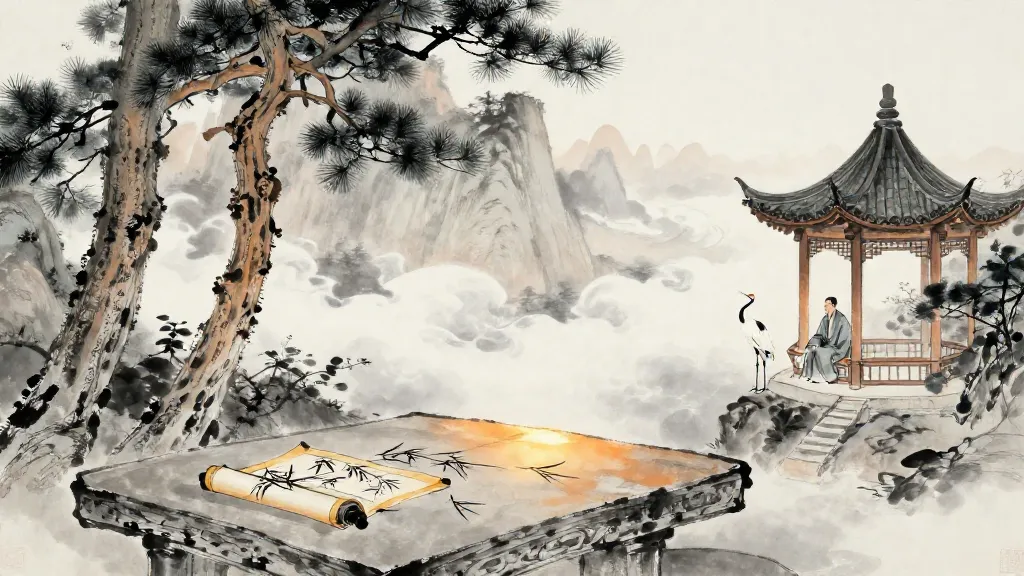
不苟 (Nothing Careless) — Chinese ink painting

荀子 Xunzi · Chapter 3

不苟

Nothing Careless

View:

君子行不貴苟難

The Gentleman Does Not Value Mere Difficulty

君子行不貴苟難,說不貴苟察,名不貴苟傳,唯其當之為貴。故懷負石而投河,是行之難為者也,而申徒狄能之;然而君子不貴者,非禮義之中也。"山淵平","天地比","齊秦襲","入乎耳,出乎口","鉤有須","卵有毛",是說之難持者也,而惠施鄧析能之。然而君子不貴者,非禮義之中也。盜跖貪凶,名聲若日月,與舜禹俱傳而不息;然而君子不貴者,非禮義之中也。故曰:君子行不貴苟難,說不貴苟察,名不貴苟傳,唯其當之為貴。

The gentleman does not value conduct merely because it is difficult, does not value doctrines merely because they are penetrating, does not value reputation merely because it endures — he values only what is fitting. Embracing a stone and throwing oneself into a river is an action difficult to perform, yet Shentu Di could do it. Still the gentleman does not esteem it, because it does not accord with ritual propriety and duty. 'Mountains and abysses are level,' 'Heaven and earth are equal,' 'Qi and Qin overlap,' 'What enters the ear exits the mouth,' 'Hooks have beards,' 'Eggs have feathers' — these are doctrines difficult to maintain, yet Hui Shi and Deng Xi could maintain them. Still the gentleman does not esteem them, because they do not accord with ritual propriety and duty. Robber Zhi was greedy and violent, yet his fame was like the sun and moon, transmitted alongside Shun and Yu without ceasing. Still the gentleman does not esteem it, because it does not accord with ritual propriety and duty. Therefore I say: the gentleman does not value conduct merely because it is difficult, doctrines merely because they are penetrating, or reputation merely because it endures — he values only what is fitting.

Notes

1person惠施Huì Shī

Hui Shi (惠施, c. 370-310 BC) was the leading representative of the School of Names (名家), known for paradoxical propositions. Deng Xi (鄧析, d. 501 BC) was a sophist of the state of Zheng.

君子養心莫善於誠

Nothing Better for Nurturing the Mind Than Sincerity

君子養心莫善於誠,致誠則無它事矣。惟仁之為守,惟義之為行。誠心守仁則形,形則神,神則能化矣。誠心行義則理,理則明,明則能變矣。變化代興,謂之天德。天不言而人推其高焉,地不言而人推其厚焉,四時不言而百姓期焉。夫此有常,以至其誠者也。君子至德,嘿然而喻,未施而親,不怒而威:夫此順命,以慎其獨者也。善之為道者,不誠則不獨,不獨則不形,不形則雖作於心,見於色,出於言,民猶若未從也;雖從必疑。天地為大矣,不誠則不能化萬物;聖人為知矣,不誠則不能化萬民;父子為親矣,不誠則疏;君上為尊矣,不誠則卑。夫誠者,君子之所守也,而政事之本也,唯所居以其類至。

For nurturing the mind, nothing is better than sincerity. When sincerity is brought to its fullest, there is nothing else to attend to. Guard only benevolence and practice only duty. When the sincere mind guards benevolence, it takes visible form; when it takes form, it becomes numinous; when numinous, it can transform others. When the sincere mind practices duty, it achieves order; when ordered, it becomes clear; when clear, it can adapt to change. Transformation and adaptation arising in succession — this is called the virtue of Heaven. Heaven does not speak, yet people credit it with height. Earth does not speak, yet people credit it with depth. The four seasons do not speak, yet the people rely upon them. These have constancy because they are the utmost in sincerity. The gentleman of perfect virtue is understood without speaking, inspires closeness without acting, and commands awe without anger — this comes from following one's nature and being watchful when alone. In the Way of goodness, without sincerity there is no integrity in solitude; without integrity in solitude there is no visible form; without visible form, even if goodness arises in the mind, appears on the face, and issues from speech, the people will still not follow — and even if they follow, they will do so with doubt. Heaven and earth are vast, yet without sincerity they cannot transform the myriad things. The sage is wise, yet without sincerity he cannot transform the myriad people. Between father and son there is kinship, yet without sincerity there is estrangement. The ruler holds the position of honor, yet without sincerity he is diminished. Sincerity is what the gentleman guards, and it is the root of government.

Notes

1context

The concept of 'being watchful when alone' (慎其獨) became one of the most important ethical ideas in later Confucianism, especially in the Great Learning and Doctrine of the Mean. Xunzi's formulation here emphasizes sincerity as the foundation of both personal cultivation and political authority.

Edition & Source

Text
《荀子》 Xunzi
Edition
《四部叢刊》本
Commentary
Traditional commentaries