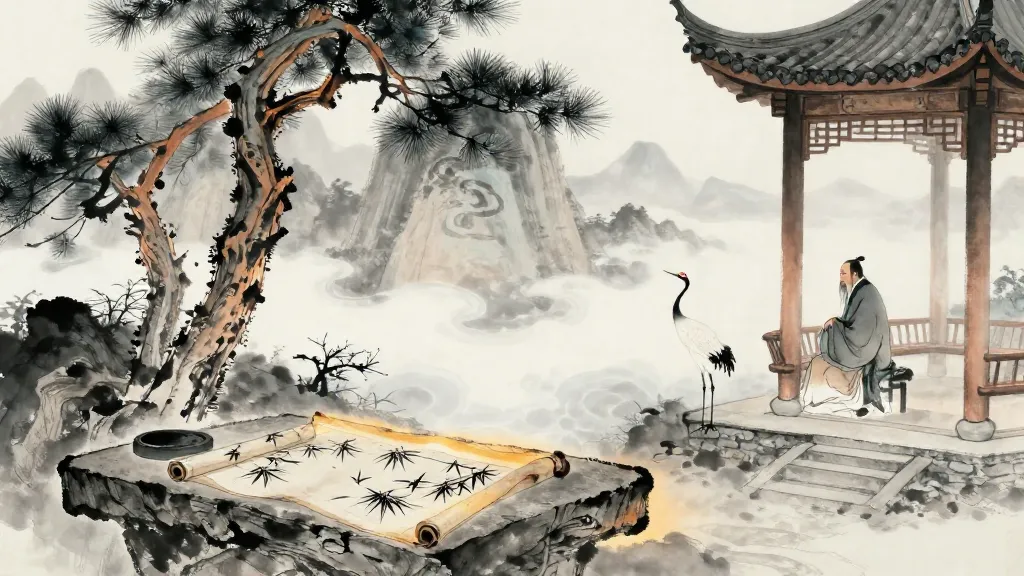
非相 (Against Physiognomy) — Chinese ink painting

荀子 Xunzi · Chapter 5

非相

Against Physiognomy

View:

相形不如論心

Judging Appearance Is Inferior to Evaluating Character

相人,古之人無有也,學者不道也。古者有姑布子卿,今之世梁有唐舉,相人之形狀顏色,而知其吉凶妖祥,世俗稱之。古之人無有也,學者不道也。故相形不如論心,論心不如擇術;形不勝心,心不勝術;術正而心順之,則形相雖惡而心術善,無害為君子也。形相雖善而心術惡,無害為小人也。君子之謂吉,小人之謂凶。故長短小大,善惡形相,非吉凶也。古之人無有也,學者不道也。

Physiognomy — the ancients did not practice it, and scholars do not discuss it. In antiquity there was Gubu Ziqing, and in the present age Liang has Tang Ju, who read people's physical appearance and coloring to predict their fortune — popular opinion praises them. But the ancients did not practice it, and scholars do not discuss it. Therefore judging by physical form is inferior to evaluating the mind, and evaluating the mind is inferior to examining one's methods. Physical form cannot overcome the mind, and the mind cannot overcome method. When one's method is correct and the mind follows it, then even if one's physical appearance is ugly and one's inner method is good, there is no obstacle to being a gentleman. Even if one's physical appearance is handsome and one's inner method is bad, there is no obstacle to being a petty person. The gentleman is what is called auspicious; the petty person is what is called inauspicious. Therefore height, size, beauty, and ugliness of physical form are not what determine fortune. The ancients did not practice this, and scholars do not discuss it.

人之所以為人者有辨也

What Makes Humans Human Is the Capacity for Distinction

人之所以為人者何已也?曰:以其有辨也。飢而欲食,寒而欲暖,勞而欲息,好利而惡害,是人之所生而有也,是無待而然者也,是禹桀之所同也。然則人之所以為人者,非特以二足而無毛也,以其有辨也。今夫狌狌形狀亦二足而無毛也,然而君子啜其羹,食其胾。故人之所以為人者,非特以其二足而無毛也,以其有辨也。夫禽獸有父子,而無父子之親,有牝牡而無男女之別。故人道莫不有辨。

What is it that makes humans human? I say: it is their capacity for making distinctions. To desire food when hungry, warmth when cold, rest when weary, to like profit and dislike harm — these are what humans are born with, what requires no effort to be so, and what Yu and Jie share equally. Yet what makes humans human is not merely that they walk on two feet and lack feathers — it is that they have the capacity for distinction. The orangutan also walks on two feet and lacks feathers, yet the gentleman drinks its broth and eats its meat. Therefore what makes humans human is not merely their two-footed, featherless form — it is their capacity for distinction. Animals have parents and offspring but not the bond of parent and child; they have males and females but not the distinctions between man and woman. Therefore in the human way, there is nothing without distinction.

辨莫大於分

No Distinction Is Greater Than Social Division

辨莫大於分,分莫大於禮,禮莫大於聖王;聖王有百,吾孰法焉?曰:文久而滅,節族久而絕,守法數之有司,極禮而褫。故曰:欲觀聖王之跡,則於其粲然者矣,後王是也。彼後王者,天下之君也;舍後王而道上古,譬之是猶舍己之君,而事人之君也。

No distinction is greater than social division; no social division is greater than ritual; no ritual is greater than the sage kings. There have been a hundred sage kings — which should I take as my model? I say: written records decay over time, ceremonial customs die out over time, and the officials who guard the regulations and numbers exhaust ritual and strip it bare. Therefore I say: if you wish to observe the traces of the sage kings, look to what is most brilliant and recent — the later kings. The later kings are the rulers of the whole world. To bypass the later kings and discourse on high antiquity is like abandoning your own ruler to serve someone else's.

Notes

1context

Xunzi's insistence on 'modeling the later kings' (法後王) rather than the ancient sage-kings marks a key methodological difference from Mencius, who looked to Yao and Shun. For Xunzi, the Zhou dynasty's institutions are the most complete and accessible model for governance.

Edition & Source

Text
《荀子》 Xunzi
Edition
《四部叢刊》本
Commentary
Traditional commentaries