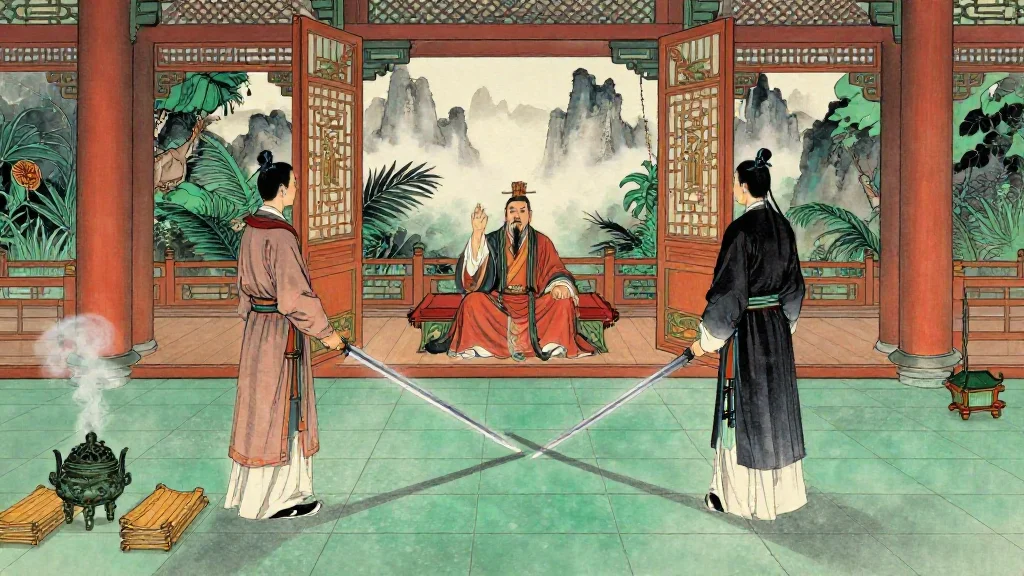
楚策一 (Stratagems of Chu I) — Chinese ink painting

Chapter 14 of 33 · Chu state

楚策一

Stratagems of Chu I

View:

齊楚構難

Qi and Chu in Conflict

齊楚構難,宋請中立。齊急宋,宋許之。子象為楚謂宋王曰:「楚以緩失宋,將法齊之急也。齊以急得宋,後將常急矣。是從齊而攻楚,未必利也。齊戰勝楚,勢必危宋;不勝,是以弱宋乾強楚也。而令兩萬乘之國,常以急求所欲,國必危矣。」

Qi and Chu were in conflict. Song requested neutrality, but Qi pressured Song, and Song submitted. Zi Xiang, speaking for Chu, said to the King of Song: "Chu lost Song through leniency, and will now copy Qi's coercive approach. But Qi won Song through coercion, and will henceforth always coerce you. Following Qi to attack Chu is not necessarily advantageous. If Qi defeats Chu, the resulting power shift will inevitably endanger Song. If Qi loses, then Song will have antagonized mighty Chu for a weak ally's sake. And to allow two states of ten thousand chariots to forever use coercion to get what they want — that path leads only to ruin for Song."

Notes

1context

Song's predicament here is the classic small-state squeeze: caught between two great powers, any alignment is a losing proposition. Zi Xiang's argument is essentially 'you're being shaken down, and once you pay, the shakedowns never stop.'

2person子象Zǐ Xiàng

Zi Xiang (子象) is otherwise unknown. He appears only in this passage, acting as a Chu diplomat to Song.

3translation

構難 means 'to build up enmity' or 'to enter into conflict.' It implies an escalating dispute rather than outright war.

五國約以伐齊

Five States Plan to Attack Qi

五國約以伐齊。昭陽謂楚王曰:「五國以破齊,秦必南圖楚。」王曰:「然則奈何?」對曰:「韓氏輔國也,好利而惡難,好利,可營也;惡難,可懼也。我厚賂之以利,其心必營。我悉兵以臨之,其心必懼我。彼懼我兵而營我利,五國之事必可敗也。約絕之後,雖勿與地可。」

楚王曰:「善。」乃命大公事之韓,見公仲曰:「夫牛闌之事,馬陵之難,親王之所見也。王苟無以五國用兵,請效列城五,請悉楚國之眾也,以圖於齊。」

齊之反趙、魏之後,而楚果弗與地,則五國之事困也。

Five states agreed to attack Qi. Zhao Yang said to the King of Chu: "If the five states destroy Qi, Qin will inevitably turn south and target Chu."

The king said: "Then what should we do?"

Zhao Yang replied: "Han is a supporting state — it loves profit and dreads trouble. Because it loves profit, it can be enticed. Because it dreads trouble, it can be intimidated. If we offer Han generous bribes, its heart will be swayed. If we mass our troops on its border, its heart will be filled with fear. Fearing our army and coveting our bribes, it will surely break the alliance of five. And once the pact is dissolved, we need not actually give over the land."

The King of Chu said: "Excellent." He then sent the Grand Steward to Han, where the envoy met Gongzhong and said: "The affair at Niulan and the disaster at Maling — Your Lordship witnessed these personally. If you ensure the five states do not deploy their armies, we offer five walled cities and will commit Chu's entire force to the campaign against Qi."

But after Qi repelled Zhao and Wei, Chu indeed did not give over the land, and the five-state pact collapsed.

Notes

1person昭陽Zhāo Yáng

Zhao Yang (昭陽) was a high-ranking Chu minister and general, serving as Lingyin (令尹, prime minister). He won a major victory against Wei at Xiangcheng around 323 BC.

2person公仲Gōng Zhòng

Gongzhong (公仲) is Gongsun Zhong, the chief minister of Han at this time.

3place

Maling (馬陵) was the site of a catastrophic Wei defeat in 341 BC, where Sun Bin ambushed and destroyed the Wei army under Pang Juan. Niulan (牛闌) was another battle site where Han suffered a defeat.

4context

Zhao Yang's strategy is a textbook bait-and-switch: promise Han land to break the coalition, then renege once the threat has passed. The text cheerfully notes that this is exactly what happened. The lesson is less about Chu's cleverness than about Han's gullibility — or, more charitably, about the irrelevance of promises in interstate relations.

荊宣王問群臣

King Xuan of Jing Asks His Ministers

荊宣王問群臣曰:「吾聞北方之畏昭奚恤也,果誠何如?」群臣莫對。江一對曰:「虎求百獸而食之,得狐。狐曰:『子無敢食我也。天地使我長百獸,今子食我,是逆天帝命也。子以我為不信,吾為子先行,子隨我後,觀百獸之見我而敢不走乎?』虎以為然,故遂與之行。獸見之皆走。虎不知獸畏己而走也,以為畏狐也。今王之地方五千里,帶甲百萬,而專屬之昭奚恤;故北方之畏昭奚恤也,其實畏王之甲兵也,猶百獸之畏虎也。」

King Xuan of Jing asked his ministers: "I hear that the northern states fear Zhao Xixu. Is this really so?"

None of the ministers answered. Jiang Yi replied: "A tiger was hunting for animals to eat and caught a fox. The fox said: 'You would not dare eat me. Heaven has made me lord of all animals. If you eat me, you defy the command of the Lord of Heaven. If you do not believe me, let me walk ahead and you follow behind — observe whether any animal that sees me dares not flee.' The tiger thought this was reasonable and went along with the fox. The animals all fled at the sight of them. The tiger did not realize the animals were fleeing from him — he thought they were fleeing from the fox.

"Now Your Majesty's territory extends five thousand li, with a million armored soldiers, and you have entrusted all of this to Zhao Xixu. So the northern states' fear of Zhao Xixu is really fear of Your Majesty's army — just as the animals feared the tiger, not the fox."

Notes

1context

This is the origin of the famous Chinese idiom 狐假虎威 (hújiǎhǔwēi) — 'the fox borrows the tiger's authority.' Jiang Yi deploys it with surgical precision: the fable simultaneously flatters the king (you are the tiger), cuts Zhao Xixu down to size (he is the fox), and implies that any minister wielding borrowed authority could be replaced at will.

2person楚宣王Chǔ Xuān Wáng

King Xuan of Jing (荊宣王) is King Xuan of Chu (楚宣王, r. 369–340 BC). 'Jing' (荊) is an alternate name for Chu, used in earlier periods. The Zhanguoce sometimes uses 荊 and 楚 interchangeably.

3person昭奚恤Zhāo Xīxù

Zhao Xixu (昭奚恤) was a powerful Chu minister under King Xuan. He appears frequently in Chu Yi, typically as the target of factional attacks by Jiang Yi and others.

4person江乙Jiāng Yǐ

Jiang Yi (江一, also written 江乙) was a persuader at the Chu court, apparently a persistent critic of Zhao Xixu. He appears in many episodes in this chapter, always working to undermine Zhao Xixu's position.

昭奚恤與彭城君議於王前

Zhao Xixu and the Lord of Pengcheng Debate Before the King

昭奚恤與彭城君議於王前,王召江乙而問焉,江乙曰:「二人之言皆善也,臣不敢言其後。此謂慮賢也。」

Zhao Xixu and the Lord of Pengcheng debated before the king. The king summoned Jiang Yi and asked for his opinion. Jiang Yi said: "Both men's arguments are sound. I dare not comment on the consequences. This is what is called careful deliberation."

Notes

1context

This is a masterclass in political non-commitment. Jiang Yi, who normally never misses a chance to undermine Zhao Xixu, here plays diplomat — praising both sides and refusing to pick a winner. The phrasing 'careful deliberation' is almost certainly code for 'I'm staying out of this one.'

2person彭城君Péngchéng Jūn

The Lord of Pengcheng (彭城君) was a Chu nobleman. Pengcheng is modern Xuzhou, Jiangsu province.

邯鄲之難

The Crisis at Handan

邯鄲之難,昭奚恤謂楚王曰:「王不如無救趙,而以強魏。魏強,其割趙必深矣。趙不能聽,則必堅守,是兩弊也。」

景舍曰:「不然。昭奚恤不知也。夫魏之攻趙也,恐楚之攻其後。今不救趙,趙有亡形,而魏無楚憂。是楚、魏共趙也,害必深矣,何以兩弊也?且魏令兵以深割趙,趙見亡形,而有楚之不救己也,必與魏合而以謀楚。故王不如少出兵,以為趙援。趙恃楚勁,必與魏戰。魏怒於趙之勁,而見楚救之不足畏也,必不釋趙。趙、魏相弊,而齊、秦應楚,則魏可破也。」

楚因使景舍起兵救趙。邯鄲拔,楚取睢、濊之間。

During the crisis at Handan, Zhao Xixu said to the King of Chu: "Your Majesty should not rescue Zhao, but let Wei grow strong. If Wei grows powerful, it will demand deeper concessions from Zhao. If Zhao refuses, it will dig in and defend — and both will exhaust themselves."

Jing She disagreed: "That is wrong. Zhao Xixu does not understand. Wei attacks Zhao precisely because it fears Chu striking from behind. If we do not rescue Zhao, Zhao faces destruction while Wei has no worry about Chu. Chu and Wei will in effect be jointly destroying Zhao — the damage will be severe. How is that mutual exhaustion? Moreover, if Wei carves up Zhao deeply, Zhao, facing extinction and seeing that Chu will not save it, will inevitably submit to Wei and plot against Chu together. Your Majesty should instead commit a small force as Zhao's reinforcement. Zhao, emboldened by Chu's support, will fight Wei resolutely. Wei, angered by Zhao's resistance yet seeing Chu's aid is too limited to fear, will not give up its siege of Zhao. Zhao and Wei will exhaust each other, and when Qi and Qin rally to Chu, Wei can be broken."

Chu accordingly sent Jing She to raise an army and rescue Zhao. Handan was relieved, and Chu took the territory between the Sui and Hui rivers.

Notes

1place

Handan (邯鄲) was the capital of Zhao, located in modern Handan, Hebei. This episode likely refers to the famous siege of 354 BC (or a later siege in 259 BC), when Wei besieged the Zhao capital.

2person景舍Jǐng Shè

Jing She (景舍) was a Chu general and strategist. His counter-argument to Zhao Xixu is a fine example of the 'limited commitment' school of military intervention: send just enough to encourage your ally to keep fighting, but not enough to provoke the enemy into turning on you.

3context

Jing She's strategy is elegant in its cynicism: commit just enough troops to keep Zhao fighting, but not enough to actually win their war for them. The goal is to bleed both Zhao and Wei — then sweep in for the territorial spoils. The result proves him right: Chu gained the Sui-Hui corridor while Zhao and Wei did the dying.

江尹欲惡昭奚恤於楚王

Jiang Yin Seeks to Slander Zhao Xixu

江尹欲惡昭奚恤於楚王,而力不能,故為梁山陽君請封於楚。楚王曰:「諾。」昭奚恤曰:「山陽君無功於楚國,不當封。」江尹因得山陽君與之共惡昭奚恤。

Jiang Yin wanted to turn the King of Chu against Zhao Xixu, but lacked the leverage to do so. He therefore petitioned on behalf of the Lord of Shanyang of Wei for a fief in Chu. The king agreed. Zhao Xixu objected: "The Lord of Shanyang has rendered no service to Chu and does not deserve a fief." Jiang Yin thereby gained the Lord of Shanyang as an ally in his campaign against Zhao Xixu.

Notes

1context

This is a neat little trap. Jiang Yin knows Zhao Xixu will block the appointment on principle, which gives Jiang Yin an aggrieved ally. The whole point of the petition was never to get the Lord of Shanyang his fief — it was to create an enemy for Zhao Xixu.

2person江尹Jiāng Yǐn

Jiang Yin (江尹) may be the same person as Jiang Yi (江乙). '尹' was a Chu official title (roughly 'governor' or 'prefect').

魏氏惡昭奚恤於楚王

A Wei Agent Slanders Zhao Xixu

魏氏惡昭奚恤於楚王,楚王告昭子。昭子曰:「臣朝夕以事聽命,而魏入吾君臣之間,臣大懼。臣非畏魏也!夫泄吾君臣之交而天下信之,是其為人也近苦矣!夫苟不難為之外,豈忘為之內乎?臣之得罪無日矣。」王曰:「寡人知之,大夫何由?」

A Wei agent slandered Zhao Xixu before the King of Chu. The king told Zhao Xixu about it. Zhao Xixu said: "I serve Your Majesty morning and night, awaiting your commands, and yet Wei inserts itself between ruler and minister. I am deeply alarmed. It is not Wei I fear — it is that our bond as ruler and minister has been exposed so that All-Under-Heaven believes the gossip. Whoever did this is someone willing to endure bitter consequences! If such a person does not hesitate to act from outside, how would he forget to act from within? The day of my disgrace draws near."

The king said: "I understand. My lord need not worry."

Notes

1context

Zhao Xixu's response is cleverly constructed: rather than denying the slander, he reframes the entire incident as a security threat. The real danger, he argues, is not the accusation but the fact that a foreign agent has access to the inner court at all. This shifts the king's attention from 'is the slander true?' to 'who let a Wei operative get this close?'

江乙惡昭奚恤

Jiang Yi Slanders Zhao Xixu with the Parable of the Dog

江乙惡昭奚恤,謂楚王曰:「人有以其狗為有執而愛之。其狗嘗溺井,其鄰人見狗之溺井也,欲入言之。狗惡之,當門而噬之。鄰人憚之,遂不得入言。邯鄲之難,楚進兵大梁,取矣。昭奚恤取魏之寶器,以居魏知之,故昭奚恤常惡臣之見王。」

Jiang Yi slandered Zhao Xixu, saying to the King of Chu: "There was a man who thought his dog was loyal and loved it. But the dog once urinated in the well. A neighbor saw this and wanted to go in and tell the owner. The dog hated the neighbor for it and stood at the gate biting him. The neighbor, intimidated, could not get in to deliver the warning.

"During the crisis at Handan, Chu advanced on Daliang and took it. Zhao Xixu seized Wei's treasures for himself, and he knows that Wei knows this. That is why Zhao Xixu always blocks me from seeing Your Majesty."

Notes

1context

Jiang Yi casts himself as the helpful neighbor and Zhao Xixu as the guard dog with something to hide. It is a vivid accusation — embezzlement of war spoils — wrapped in an animal fable that makes the accusation seem self-evidently true. Whether there is any truth to it, the text does not say.

2place

Daliang (大梁) was the capital of Wei, modern Kaifeng, Henan.

江乙欲惡昭奚恤於楚

Jiang Yi Uses the Parable of Good and Evil Speech

江乙欲惡昭奚恤於楚,謂楚王曰:「下比周,則上危;下分爭,則上安。王亦知之乎?願王勿忘也。且人有好揚人之善者,於王何如?」王曰:「此君子也,近之。」江乙曰:「有人好揚人之惡者,於王何如?」王曰:「此小人也,遠之。」江乙曰:「然則且有子殺其父,臣弒其主者。而王終已不知者,何也?以王好聞人之美而惡聞人之惡也。」王曰:「善。寡人願兩聞之。」

Jiang Yi, seeking to turn Chu against Zhao Xixu, said to the King of Chu: "When those below form factions, those above are endangered. When those below quarrel among themselves, those above are safe. Does Your Majesty understand this? Please do not forget it.

"Suppose there is a man who loves to praise others' virtues. What would Your Majesty think of him?"

The king said: "He is a gentleman. I would keep him close."

Jiang Yi said: "And suppose there is a man who loves to expose others' faults?"

The king said: "He is a petty person. I would keep him at a distance."

Jiang Yi said: "And yet there are sons who murder their fathers, and ministers who assassinate their lords — and Your Majesty never learns of it until too late. Why? Because Your Majesty loves to hear praise and hates to hear blame."

The king said: "Well put. I am willing to hear both."

Notes

1context

This is a brilliant piece of rhetorical maneuvering. Jiang Yi gets the king to condemn his own instinct to reward flatterers and punish critics — which is to say, Jiang Yi gets a royal license to say nasty things about people (i.e., Zhao Xixu) and be rewarded for it. He has rebranded slander as civic duty.

2translation

比周 means 'to form factions' or 'to collude.' The Analerta uses the same phrase: 君子周而不比 ('the gentleman is inclusive but does not form cliques').

江乙說於安陵君

Jiang Yi Advises the Lord of Anling

江乙說於安陵君曰:「君無咫尺之地,骨肉之親,處尊位,受厚祿,一國之眾,見君莫不斂衽而拜,撫委而服,何以也?」曰:「王過舉而已。不然,無以至此。」

江乙曰:「以財交者,財盡而交絕;以色交者,華落而愛渝。是以嬖女不敝席,寵臣不避軒。今君擅楚國之勢,而無以深自結於王,竊為君危之。」安陵君曰:「然則奈何?」「願君必請從死,以身為殉,如是必長得重於楚國。」曰:「謹受令。」

三年而弗言。江乙復見曰:「臣所為君道,至今未效。君不用臣之計,臣請不敢復見矣。」安陵君曰:「不敢忘先生之言,未得間也。」

於是,楚王游於雲夢,結駟千乘,旌旗蔽日,野火之起也若雲霓,兕虎嗥之聲若雷霆,有狂兕車依輪而至,王親引弓而射,壹發而殪。王抽旃旄而抑兕首,仰天而笑曰:「樂矣,今日之游也!寡人萬歲千秋之後,誰與樂此矣?」安陵君泣數行而進曰:「臣入則編席,出則陪乘。大王萬歲千秋之後,願得以身試黃泉,蓐螻蟻,又何如得此樂而樂之。」王大說,乃封壇為安陵君。

君子聞之曰:「江乙可謂善謀,安陵君可謂知時矣。」

Jiang Yi said to the Lord of Anling: "You have no territory of your own, no ties of royal blood, yet you hold a position of honor, receive generous emoluments, and when the people of the whole state see you, they all fold their robes and bow, press their hands together and submit. Why is this?"

The Lord of Anling said: "The king elevated me beyond my merits. Otherwise I could never have reached this station."

Jiang Yi said: "Relationships built on wealth end when the wealth is gone. Relationships built on beauty end when the beauty fades. That is why favored consorts never wear out their sleeping mats, and favored ministers never step away from the royal carriage. You command the power of Chu's state, yet you have nothing to bind yourself deeply to the king. I fear for your safety."

The Lord of Anling said: "Then what should I do?"

"You must request the honor of following the king in death — offering yourself as a sacrifice. Do this, and you will always be valued in Chu."

"I respectfully accept your counsel."

Three years passed and he had not spoken. Jiang Yi came again and said: "The advice I gave you still has not been acted upon. If you will not follow my plan, I ask leave never to see you again."

The Lord of Anling said: "I have not dared forget your words. I simply have not found the right moment."

Then the King of Chu went hunting at Yunmeng. A thousand chariots, each with four-horse teams, filled the grounds; banners and flags blotted out the sun; the wildfires they set blazed like rainbows; the roars of rhinoceroses and tigers were like thunder. A maddened rhinoceros charged directly at the king's wheels. The king personally drew his bow and shot, killing it with a single arrow. He pulled out the royal standard and pressed down on the rhinoceros's head, then looked up at the sky and laughed: "What joy this hunt has been today! After ten thousand years and a thousand autumns, who will share this pleasure with me?"

The Lord of Anling wept, tears streaming down his face, and came forward: "When Your Majesty is at court, I arrange your mats. When you go out, I ride beside your carriage. After Your Majesty's ten thousand years and thousand autumns, I would willingly test the Yellow Springs with my own body and bed down with the mole crickets and ants. How could I ever find such joy again?"

The king was overjoyed and enfeoffed the altar to make him the Lord of Anling.

A gentleman who heard of this remarked: "Jiang Yi may be called a fine strategist, and the Lord of Anling may be called a man who understood timing."

Notes

1person安陵君Ānlíng Jūn

The Lord of Anling (安陵君) was a male favorite (幸臣) of the King of Chu. The language of the passage — 'sleeping mats,' 'the beauty fades,' 'following in death' — uses the same vocabulary applied to royal consorts, making the nature of the relationship fairly transparent.

2place

Yunmeng (雲夢) was a vast marshland and hunting preserve in ancient Chu, located in the area of modern Hubei province near the Yangtze. It was the premier royal hunting ground.

3context

The 'follow in death' gambit is ice-cold: the Lord of Anling offers to die with the king, which costs nothing in the present moment (the king is healthy) but signals absolute devotion. The king, moved by the theatrical timing — right after a triumphant kill, in the euphoria of the hunt — grants a permanent fief. Jiang Yi engineered the whole thing. The concluding 'gentleman's' verdict is unusually generous: 'fine strategist' and 'understood timing' are high praise for what amounts to a loyalty performance timed for maximum emotional manipulation.

4translation

黃泉 ('Yellow Springs') is the Chinese underworld, the realm of the dead. 蓐螻蟻 means to 'bed down with mole crickets and ants,' i.e., to lie in the grave.

江乙為魏使於楚

Jiang Yi as Wei's Envoy to Chu

江乙為魏使於楚,謂楚王曰:「臣入竟,聞楚之俗,不蔽人之善,不言人之惡,誠有之乎?」王曰:「誠有之。」江乙曰:「然則白公之亂,得無遂乎?誠如是,臣等之罪免矣。」楚王曰:「何也?」江乙曰:「州侯相楚,貴甚矣而主斷,左右懼曰無有,如出一口矣。」

Jiang Yi, serving as Wei's envoy to Chu, said to the King of Chu: "When I entered your borders, I heard that it is the custom in Chu never to conceal a person's virtues and never to speak of a person's faults. Is this really so?"

The king said: "It is indeed."

Jiang Yi said: "If so, then the rebellion of the Lord of Bai must have succeeded! And if that is the case, then our crimes are forgiven."

The king said: "What do you mean?"

Jiang Yi said: "The Marquis of Zhou serves as Chu's prime minister, wielding immense power and controlling all decisions. Those around him, out of fear, all say 'yes' as if speaking with one mouth."

Notes

1person白公勝Bái Gōng Shèng

The Lord of Bai (白公) refers to Bai Gong Sheng (白公勝), who staged a revolt in Chu in 479 BC. The rebellion was eventually suppressed. Jiang Yi invokes it as a historical precedent for what happens when no one at court dares speak the truth.

2context

Jiang Yi neatly traps the king: if the 'custom' of never criticizing anyone is real, then coups succeed because no one warns the king. The compliment about Chu's graciousness is bait for a very sharp hook — a critique of the Marquis of Zhou's monopoly on power, delivered under diplomatic cover.

鄙人有獄三年不決

The Commoner's Case Unsettled for Three Years

鄙人有獄三年不決者,故令請其宅,以卜其罪。客因為之謂昭奚恤曰:「郢人某氏之宅,臣願之。」昭奚恤曰:「郢人某氏,不當服罪,故其宅不得。」

客辭而去。昭奚恤已而悔之,因謂客曰:「奚恤得事公,公何為以故與奚恤?」客曰:「非用故也。」曰:「謂而不得,有悅色,非故如何也?」

A commoner had a legal case that went unresolved for three years. Someone therefore had an agent request the commoner's house, using that as a test of the man's guilt. The agent said to Zhao Xixu: "I would like the house of a certain person in Ying."

Zhao Xixu said: "That person in Ying is not guilty, so his house is not available."

The agent took his leave and departed. Zhao Xixu then regretted his response and said to the agent: "I was happy to serve you, sir. Why did you use a trick to test me?"

The agent said: "It was no trick."

Zhao Xixu replied: "You asked and were refused, yet you looked pleased. If that is not a trick, what is it?"

Notes

1context

A clever little sting operation. The agent asks for the house, knowing Zhao Xixu will either reveal the verdict (innocent) or expose his own corruption. Zhao Xixu passes the test — he declares the man innocent — but then catches on. His irritation at being manipulated is almost endearing: he notices the agent's satisfied expression and calls out the ruse.

2place

Ying (郢) was the capital of Chu, located near modern Jingzhou, Hubei.

城渾出周

Cheng Hun Leaves Zhou

城渾出周,三人偶行,南遊於楚,至於新城。城渾說其令曰:「鄭、魏者,楚之耎國;而秦,楚之強敵也,鄭、魏之弱,而楚以上樑應之;宜陽之大也,楚以弱新城圍之。蒲反、平陽,相去百里,秦人一夜而襲之,安邑不知;新城、上樑相去五百里,秦人一夜而襲之,上樑亦不知也。今邊邑之所恃者,非江南泗上也。故楚王何不以新城為主郡也?邊邑甚利之。」新城公大說,乃為具駟馬乘車五百金之楚。城渾得之,遂南交於楚,楚王果以新城為主郡。

Cheng Hun left Zhou. Three men traveled together, going south to Chu, and arrived at Xincheng. Cheng Hun persuaded its governor, saying: "Zheng and Wei are weak states that Chu regards lightly, while Qin is Chu's formidable enemy. Zheng and Wei are weak, yet Chu stations Shangliang to counter them. Yiyang is a major stronghold, yet Chu defends it only with the weak garrison at Xincheng. Pufan and Pingyang are a hundred li apart, yet Qin troops struck overnight and Anyi knew nothing of it. Xincheng and Shangliang are five hundred li apart — if Qin attacked overnight, Shangliang would likewise know nothing. The border towns cannot rely on forces south of the Yangtze and the Si River. Why does the King of Chu not make Xincheng a regional military headquarters? The border towns would benefit greatly."

The Lord of Xincheng was delighted. He provided a four-horse chariot and five hundred in gold for the journey to Chu. Cheng Hun obtained this, then went south to negotiate with Chu, and the King of Chu did indeed make Xincheng a regional headquarters.

Notes

1person城渾Chéng Hún

Cheng Hun (城渾) was a wandering strategist from Zhou. The text notes he traveled with two companions, suggesting he was a relatively minor figure who needed to talk his way into patronage.

2place

Xincheng (新城) was a Chu frontier town, likely in the area of modern Yicheng or Lushan, Henan province. The strategic argument is that it was too far from its supporting base at Shangliang to receive timely reinforcement.

3context

Cheng Hun's strategy is essentially a consulting pitch: identify a client's security gap, propose yourself as the solution, and collect a fee. The Lord of Xincheng pays for the privilege of being promoted to regional headquarters, and Cheng Hun pockets a nice commission.

韓公叔有齊魏

The Han Minister Gongshu and the Succession Struggle

韓公叔有齊、魏,而太子有楚、秦以爭國。鄭申為楚使於韓,矯以新城,陽人予太子。楚王怒,將罪之。對曰:「臣矯予之,以為國也。臣為太子得新城、陽人,以與公叔爭國而得之。齊、魏必伐韓。韓氏急,必懸命於楚,又何新城、陽人之敢求?太子不勝,然而不死,今將倒冠而至,又安敢言地?」楚王曰:「善。」乃不罪也。

In Han, the minister Gongshu had the backing of Qi and Wei, while the Crown Prince had the backing of Chu and Qin in the succession struggle. Zheng Shen, serving as Chu's envoy to Han, took it upon himself — without authorization — to offer Xincheng and Yangren to the Crown Prince.

The King of Chu was furious and was about to punish him. Zheng Shen replied: "I made the unauthorized offer for the sake of the state. By obtaining Xincheng and Yangren for the Crown Prince, I gave him what he needed to defeat Gongshu and win the throne. Once he wins, Qi and Wei will attack Han. In its desperation, Han will stake its survival on Chu — and then how would it dare demand Xincheng and Yangren? And if the Crown Prince loses but survives, he will come to Chu hat in hand as a fugitive — would he dare speak of territory then?"

The King of Chu said: "Well argued." And he did not punish him.

Notes

1person鄭申Zhèng Shēn

Zheng Shen (鄭申) was a Chu diplomat who exceeded his instructions — the character 矯 means 'to falsify an order' or 'to act without authorization.' His defense is that the unauthorized promise was, in every scenario, cost-free.

2context

Zheng Shen's argument is a beautiful no-lose proposition: if the Crown Prince wins, Han becomes a Chu dependency and won't press for the land; if the Crown Prince loses, he's a refugee in no position to demand anything. Either way, Chu pays nothing. The king, once he sees the logic, can only approve.

3translation

倒冠而至 — literally 'arrive with his cap reversed,' meaning to come in desperate haste as a fugitive.

楚杜赫說楚王以取趙

Du He Proposes to Win Zhao for Chu

楚杜赫說楚王以取趙。王且予之五大夫,而令私行。陳軫謂楚王曰:「赫不能得趙,五大夫不可收也,得賞無功也。得趙而王無加焉,是無善也。王不如以十乘行之,事成,予之五大夫。」王曰:「善。」乃以十乘行之。

杜赫怒而不行。陳軫謂王曰:「是不能得趙也。」

Du He of Chu proposed to the King of Chu a plan to win over Zhao. The king was about to grant him the rank of Fifth-Rank Grandee and send him on an unofficial mission. Chen Zhen said to the king: "If Du He fails to win Zhao, the rank of Fifth-Rank Grandee cannot be taken back — he will have been rewarded for nothing. If he does win Zhao and the king has already given the reward, there is nothing left to give — which means no incentive. Your Majesty should instead send him with a retinue of ten chariots and promise the rank of Fifth-Rank Grandee upon success."

The king said: "Excellent." He sent Du He with ten chariots.

Du He was furious and refused to go. Chen Zhen said to the king: "This proves he cannot win Zhao."

Notes

1person陳軫Chén Zhěn

Chen Zhen (陳軫) was an influential Chu strategist and diplomat who appears throughout the Zhanguoce. He frequently served as a counterweight to Zhang Yi's pro-Qin diplomacy.

2context

Chen Zhen's trap is perfectly constructed. If Du He is confident, he accepts performance-based pay. If he refuses, he reveals that he wanted the title, not the mission. Du He's angry refusal tells the king everything he needs to know. This is management consulting, Warring States style.

楚王問於范環

The King of Chu Asks Fan Huan About Appointing a Qin Minister

楚王問於范環曰:「寡人慾置相於秦,孰可?」對曰:「臣不足以知之。」王曰:「吾相甘茂可乎?」范環對曰:「不可。」王曰:「何也?」曰:「夫史舉,上蔡之監門也。大不如事君,小不如處室,以苛廉聞於世,甘茂事之順焉。故惠王之明,武王之察,張儀之好譖,甘茂事之,取十官而無罪,茂誠賢者也,然而不可相秦。秦之有賢相也,非楚國之利也。且王嘗用滑于越而納句章,昧之難,越亂,故楚南察瀨胡而野江東。計王之功所以能如此者,越亂而楚治也。今王以用之于越矣,而忘之於秦,臣以為王鉅速忘矣。王若欲置相於秦乎?若公孫郝者可。夫公孫郝之於秦王,親也。少與之同衣,長與之同車,被王衣以聽事,真大王之相已。王相之,楚國之大利也。」

The King of Chu asked Fan Huan: "I wish to install a prime minister in Qin. Who would be suitable?"

Fan Huan replied: "I am not wise enough to know."

The king said: "What about making Gan Mao the prime minister?"

Fan Huan answered: "That will not do."

"Why not?"

"Consider Shi Ju, the gatekeeper of Shangcai — a man inadequate in serving his lord and in running his household, yet famous throughout the world for harsh incorruptibility. Gan Mao served under such a man and thrived. Under King Hui's brilliance, King Wu's scrutiny, and Zhang Yi's love of slander, Gan Mao held ten offices without ever being charged with wrongdoing. Gan Mao is truly capable — and precisely for that reason, he must not become Qin's prime minister. A capable prime minister in Qin is not in Chu's interest.

"Moreover, Your Majesty once used an agent to sow disorder in Yue, placing a puppet in Goujang. When the crisis at Mei erupted, Yue fell into chaos, and Chu was able to extend south to the Lai and Hu rivers and dominate the lands east of the Yangtze. The reason Your Majesty achieved all this was that Yue was in disorder while Chu was well governed. Your Majesty applied this strategy to Yue but forgets it when it comes to Qin — I think Your Majesty forgets rather quickly.

"If you wish to install a prime minister in Qin, someone like Gongsun Hao would be suitable. Gongsun Hao is personally close to the King of Qin. As boys they shared clothes; as men they shared carriages. He wears the king's robes when handling affairs — he is already Your Majesty's perfect choice for prime minister. Placing him there would be greatly to Chu's advantage."

Notes

1person范環Fàn Huán

Fan Huan (范環) was a Chu advisor. His counsel here reveals the logic of 'installing' friendly ministers in rival states — a common Warring States practice.

2person甘茂Gān Mào

Gan Mao (甘茂) was a prominent Qin statesman who served under Kings Hui and Wu. He was known for his competence and political survival skills — exactly the qualities that make Fan Huan oppose his appointment.

3context

Fan Huan's argument is bracingly cynical: you don't install a competent minister in a rival state — you install an incompetent crony. Gongsun Hao's chief qualification is that he is close to the Qin king and presumably pliable, not that he would govern well. The entire concept of 'placing a prime minister' in another state reveals how thoroughly the great powers interfered in each other's domestic politics.

蘇秦為趙合從說楚威王

Su Qin Persuades King Wei of Chu to Join the Vertical Alliance

蘇秦為趙合從,說楚威王曰:「楚,天下之強國也。大王,天下之賢王也。楚地西有黔中、巫郡,東有夏州、海陽,南有洞庭、蒼梧,北有汾、陘之塞、郇陽。地方五千里,帶甲百萬,車千乘,騎萬匹。粟支十年,此霸王之資也。夫以楚之強與大王之賢,天下莫能當也。今乃欲西面而事秦,則諸侯莫不南面而朝於章台之下矣。秦之所害於天下莫如楚,楚強則秦弱,楚弱則秦強,此其勢不兩立。故為王至計,莫如從親以孤秦。大王不從親,秦必起兩軍:一軍出武關;一軍下黔中。若此,則鄢、郢動矣。臣聞治之其未亂,為之其未有也;患至而後憂之,則無及已。故願大王早計之。」

「大王誠能聽臣,臣請令山東之國,奉四時之獻,以承大王之明制,委社稷宗廟,練士厲兵,在大王之所用之。大王誠能聽臣之愚計,則韓、魏、齊、燕、趙、衛之妙音美人,必充後宮矣。趙、代良馬囊他,必實於外廄。故從合則楚王,橫成則秦帝。今釋霸王之業,而有事人之名,臣竊為大王不取也。

夫秦,虎狼之國也,有吞天下之心。秦,天下之仇讎也。橫人皆欲割諸侯之地以事秦,此所謂養仇而奉讎者也。夫為人臣而割其主之地,以外交強虎狼之秦,以侵天下,卒有秦患,不顧其禍。夫外挾強秦之威,以內劫其主,以求割地,大逆不忠,無過此者。故從親,則諸侯割地以事楚;橫合,則楚割地以事秦。此兩策者,相去遠矣,有億兆之數。兩者大王何居焉?故弊邑趙王,使臣效愚計,奉明約,在大王命之。」

楚王曰:「寡人之國,西與秦接境,秦有舉巴蜀、並漢中之心。秦,虎狼之國,不可親也。而韓、魏迫於秦患,不可與深謀,恐反人以入於秦,故謀未發而國已危矣。寡人自料,以楚當秦,未見勝焉。內與群臣謀,不足恃也。寡人臥不安席,食不甘昧,心搖搖而懸旌,而無所終薄。今君欲一天下,安諸侯,存危國,寡人謹奉社稷以從。」

Su Qin, building the Vertical Alliance for Zhao, persuaded King Wei of Chu, saying: "Chu is the most powerful state in All-Under-Heaven. Your Majesty is the worthiest king in All-Under-Heaven. Chu's territory stretches west to Qianzhong and Wu Commandery, east to Xiazhou and Haiyang, south to Dongting and Cangwu, and north to the passes of Fen and Xing and the city of Xunyang. Its territory extends five thousand li, with a million armored soldiers, a thousand war chariots, and ten thousand cavalry. Its granaries can sustain the army for ten years. These are the resources of a hegemon-king.

"With Chu's might and Your Majesty's wisdom, no one in All-Under-Heaven can stand against you. Yet now you would turn west and serve Qin — in which case every feudal lord will face south and pay court at the foot of Qin's Zhangtai Palace. Of all the states Qin would harm, none more so than Chu. When Chu is strong, Qin is weak; when Chu is weak, Qin is strong — the two cannot coexist. Therefore, the best plan for Your Majesty is to join the Vertical Alliance and isolate Qin. If Your Majesty does not join, Qin will certainly send two armies: one out of Wuguan Pass, one down to Qianzhong. When that happens, Yan and Ying will tremble. I have heard it said: govern before disorder breaks out; act before the situation develops. To worry only after disaster strikes is too late. I beg Your Majesty to plan early."

"If Your Majesty will truly heed me, I will arrange for the states east of the mountains to offer seasonal tribute, to submit to Your Majesty's wise commands, to entrust their altars of state and ancestral temples to your protection, to train their soldiers and sharpen their weapons — all at Your Majesty's disposal. If Your Majesty truly heeds my humble plan, then the finest musicians and most beautiful women of Han, Wei, Qi, Yan, Zhao, and Wey will fill your rear palace. The best horses of Zhao and Dai will fill your outer stables. Thus: if the Vertical Alliance succeeds, Chu reigns as king; if the Horizontal alignment prevails, Qin rules as emperor. To abandon the enterprise of hegemony for the reputation of serving another — I humbly consider this beneath Your Majesty.

"Qin is a state of tigers and wolves with ambitions to devour All-Under-Heaven. Qin is the enemy of All-Under-Heaven. The Horizontal partisans all seek to carve up the feudal lords' territory to serve Qin — this is what is called nourishing your enemy and serving your foe. To be a minister and carve up your lord's territory, to form alliances abroad with the tiger-wolf Qin in order to dominate All-Under-Heaven, heedless of the eventual Qin calamity — to use Qin's power from without to coerce your own lord from within, demanding territorial concessions — there is no greater treason or disloyalty than this. Therefore: in the Vertical Alliance, the feudal lords cede territory to serve Chu; in the Horizontal alignment, Chu cedes territory to serve Qin. These two strategies are as far apart as the distance between millions. Which does Your Majesty choose? The King of Zhao, from our humble city, has sent me to present this plan and offer a clear covenant, subject to Your Majesty's command."

The King of Chu said: "My state borders Qin to the west. Qin has designs on Ba, Shu, and Hanzhong. Qin is a state of tigers and wolves — it cannot be trusted. Yet Han and Wei are pressed by Qin's threat and cannot be relied upon for deep planning — I fear any scheme would leak back to Qin, putting my state in danger before the plan is even launched. I calculate that if Chu alone faces Qin, I see no prospect of victory. Deliberating with my own ministers offers no assurance either. I cannot sleep in peace or eat with appetite; my heart dangles like a banner in the wind with nowhere to rest. Now you wish to unite All-Under-Heaven, bring peace to the feudal lords, and preserve endangered states. I respectfully commit my state to follow."

Notes

1person蘇秦Sū Qín

Su Qin (蘇秦, d. 284 BC) was the most famous advocate of the north-south Vertical Alliance (合縱) against Qin. The Zhanguoce depicts him persuading each of the six states in turn, though the historical accuracy of these speeches is debatable. This is his pitch to Chu.

2person楚威王Chǔ Wēi Wáng

King Wei of Chu (楚威王, r. 339–329 BC) was one of Chu's more capable rulers, but the dating of Su Qin's missions is uncertain and may be anachronistic.

3context

Su Qin's sales pitch follows the standard template: flatter the client, enumerate their assets, describe the threat, present your solution as the only option. King Wei's response is refreshingly honest — he basically admits he can't sleep, can't eat, doesn't trust his allies, doesn't trust his own ministers, and sees no path to victory alone. This is not the language of a confident sovereign but of a deeply anxious one, which is exactly the emotional state Su Qin needs.

4translation

心搖搖而懸旌 — 'my heart sways and dangles like a banner' — a vivid metaphor for anxiety and indecision. 虎狼之國 ('state of tigers and wolves') is the standard epithet for Qin in anti-Qin rhetoric.

5place

Zhangtai (章台) was a palace in the Qin capital Xianyang (modern Xi'an area). 'Paying court at the foot of Zhangtai' means submitting to Qin hegemony.

張儀為秦破從連橫

Zhang Yi Breaks the Vertical Alliance for Qin's Horizontal Strategy

張儀為秦破從連橫,說楚王曰:「秦地半天下,兵敵四國,被山帶河,四塞以為固。虎賁之士百餘萬,車千乘,騎萬匹,粟如丘山。法令既明,士卒安難樂死。主嚴以明,將知以武。雖無出兵甲,席捲常山之險。折天下之脊,天下後服者先亡。且夫為從者,無以異於驅群羊而攻猛虎也。夫虎之與羊,不格明矣。今大王不與猛虎而與群羊,竊以為大王之計過矣。

「凡天下強國,非秦而楚,非楚而秦,兩國敵侔交爭,其勢不兩立。而大王不與秦,秦下甲兵,據宜陽,韓之上地不通;下河東,取成皋,韓必入臣於秦。韓入臣,魏則從風而動。秦攻楚之西,韓、魏攻其北,社稷豈得無危哉?

「且夫約從者,聚群弱而攻至強也。夫以弱攻強,不料敵而輕戰,國貧而驟舉兵,此危亡之術也。臣聞之,兵不如者,勿與挑戰;粟不如者,勿與持久。夫從人者,飾辯虛辭,高主之節行,言其利而不言其害,卒有楚禍,無及為已,是故願大王之熟計之也。秦西有巴蜀,方船積粟,起於汶山。循江而下,至郢三千餘里。舫船載卒,一肪載五十人,與三月之糧,下水而浮,一日行三百餘里;里數雖多,不費馬汗之勞,不至十日而距扞關;扞關驚,則從竟陵已東,盡城守矣,黔中、巫郡非王之有已。秦舉甲出之武關,南面而攻,則北地絕。秦兵之攻楚也,危難在三月之內。而楚恃諸侯之救,在半歲之外,此其勢不相及也。夫恃弱國之救,而忘強秦之禍,此臣之所以為大王之患也。且大王嘗與吳人五戰三勝而亡之,陳卒盡矣;有偏守新城而居民苦矣。臣聞之:攻大者易危,而民弊者怨於上。夫守易危之功而逆強秦之心,臣竊為大王危之。

「且夫秦之所以不出甲尉函谷關十五年以攻諸侯者,陰謀有吞天下之心也。楚嘗與秦構難,戰於漢中。楚人不勝,通侯、執珪死者七十餘人,遂亡漢中。楚王大怒,興師襲秦,戰於蘭田,又卻。此所謂兩虎相搏者也。夫秦、楚相弊,而韓、魏以全制其後,計無過於此者矣,是故願大王熟計之也。

「秦下兵攻衛、陽晉,必開肩天下之匈,大王悉起兵以攻宋,不至數月而宋可舉。舉宋而東指,則泗上十二諸侯,盡王之有已。

「凡天下所信約從親堅者蘇秦,封為武安君而相燕,即陰與燕王謀破齊共分其地。乃佯有罪,出走入齊,齊王因受而相之。居兩年而覺,齊王大怒,車裂蘇秦於市。夫以一詐偽反覆之蘇秦,而欲經營天下,混一諸侯,其不可成也亦明矣。

「今秦之與楚也,接境壤界,固形親之國也。大王誠能聽臣,臣請秦太子入質於楚,楚太子入質於秦,請以秦女為大王箕帚之妾,效萬家之都,以為湯沐之邑,長為昆弟之國,終身無相攻擊。臣以為計無便與此者,故敝邑秦王,使使臣獻書大王之從車下風,須以決事。」

楚王曰:「楚國僻陋,托東海之上。寡人年幼,不習國家之長計。今上客幸教以明制,寡人聞之,敬以國從。」乃遣使車百乘,獻雞駭之犀,夜光之壁於秦王。

Zhang Yi, breaking the Vertical Alliance for Qin's Horizontal alignment, persuaded the King of Chu: "Qin's territory covers half of All-Under-Heaven. Its army matches four states combined. Backed by mountains and girded by the Yellow River, four passes make it impregnable. It has over a million elite warriors, a thousand war chariots, ten thousand cavalry, and grain piled like hills. Its laws are clear, its soldiers accept hardship and welcome death. Its ruler is stern and wise, its generals are astute and martial. Even without deploying a single soldier, Qin commands the strategic heights of Mount Chang. It holds the spine of All-Under-Heaven — whoever submits last perishes first.

"The Vertical Alliance is nothing more than driving a flock of sheep to attack a fierce tiger. That the tiger will prevail over the sheep is obvious. Your Majesty aligns with the sheep instead of the tiger — I humbly consider this a miscalculation.

"Of all the powerful states, there is either Qin or Chu — no others. The two are evenly matched rivals; they cannot both stand. If Your Majesty does not side with Qin, Qin will send down its armored troops: seize Yiyang, cut off Han's upper territory; take Hedong, capture Chenggao — Han will submit to Qin. Once Han submits, Wei will follow like the wind. Qin attacks Chu from the west, Han and Wei from the north — can the state avoid danger?

"The Vertical Alliance gathers the weak to attack the strongest. Using the weak to attack the strong, underestimating the enemy, fighting recklessly, impoverishing the state with constant mobilization — this is the path to ruin. When your armies are outmatched, do not provoke battle. When your granaries are outmatched, do not fight a long war. The Vertical advocates dress up their arguments with empty rhetoric, inflating their lords' honor while speaking of benefits and concealing the dangers. When Chu's disaster comes, it will be too late. I beg Your Majesty to consider carefully.

"Qin controls Ba and Shu to the west. It can launch barges loaded with grain from Mount Wen, float down the Yangtze for three thousand li to Ying. Each barge carries fifty soldiers with three months' rations. Traveling downstream, they cover three hundred li a day. Though the distance is great, it costs no effort from horse or man. In less than ten days they reach Hanguang Pass. Once Hanguang Pass is alarmed, from Jingling eastward, every city will go on the defensive. Qianzhong and Wu Commandery will no longer be Your Majesty's. Then Qin sends its armored troops out Wuguan Pass, attacking southward to sever the northern territory. Qin's attack on Chu reaches crisis within three months. But Chu's hope for rescue from the feudal lords takes half a year or more — the two timelines do not match. To rely on weak states' rescue while ignoring mighty Qin's threat — this is what I fear for Your Majesty.

"Moreover, Your Majesty once fought Wu five times, winning three, yet was nearly destroyed. Your army was exhausted; defending outlying Xincheng, the people suffered. When a state overextends, it courts danger. When the people are exhausted, they resent their rulers. To cling to precarious gains while provoking mighty Qin — I fear for Your Majesty.

"The reason Qin has not sent troops beyond Hangu Pass for fifteen years is not benevolence — it is because Qin secretly plans to swallow All-Under-Heaven. Chu once clashed with Qin and fought at Hanzhong. Chu lost; over seventy holders of the ranks of Tonghou and Zhigui died. Chu lost Hanzhong entirely. The King of Chu, enraged, attacked Qin at Lantian and was repulsed again. This is what is called two tigers mauling each other. When Qin and Chu exhaust each other, Han and Wei — fresh and whole — control the aftermath. No strategy could be worse. I beg Your Majesty to think carefully.

"If Qin attacks Wei and Yangjin, it opens a corridor through the heart of All-Under-Heaven. Your Majesty raises all your forces and attacks Song — within months Song falls. Take Song and point east: the twelve lords along the Si River all become Your Majesty's.

"Now, the man everyone trusted to bind the Vertical Alliance was Su Qin. He was enfeoffed as Lord Wu'an and made prime minister of Yan, but secretly plotted with the King of Yan to destroy Qi and divide its territory. He feigned disgrace, fled to Qi, and the King of Qi received him as prime minister. After two years the plot was discovered. The King of Qi, in a fury, had Su Qin torn apart by chariots in the marketplace. If a single deceitful, treacherous Su Qin claimed to manage All-Under-Heaven and unite the feudal lords, the impossibility of his project is obvious.

"Qin and Chu share a border — they are natural neighbors. If Your Majesty will truly listen, I propose that the Qin Crown Prince be sent as hostage to Chu and the Chu Crown Prince to Qin. I propose a Qin princess as Your Majesty's consort, and a city of ten thousand households as her dowry. Our two states shall be brothers forever, never attacking each other. I consider no plan more advantageous. Therefore the King of Qin, from our humble city, has sent me to present this document and humbly await Your Majesty's decision."

The King of Chu said: "Chu is a remote and rustic state at the edge of the Eastern Sea. I am young and inexperienced in matters of state. Now an honored guest has graciously instructed me with a clear plan. Having heard it, I respectfully commit my state to follow." He dispatched a hundred chariots as envoys, presenting rhinoceros horn of the Jinghai variety and a luminous jade disc to the King of Qin.

Notes

1person張儀Zhāng Yí

Zhang Yi (張儀, d. 309 BC) was the chief advocate of the Horizontal alignment (連橫), binding individual states to Qin through bilateral deals. He served as Qin's prime minister and was Su Qin's great rival. His speech here is the counterpart to Su Qin's pitch in the preceding section — same king, opposite conclusion.

2context

The Zhanguoce places Su Qin's Vertical pitch and Zhang Yi's Horizontal pitch back to back, and the King of Chu agrees enthusiastically to both. The editorial juxtaposition is surely deliberate: the reader is meant to notice that the king is swayed by whoever spoke last. The combined effect is less a celebration of either strategist than a portrait of a ruler buffeted by rhetoric.

3place

Hangu Pass (函谷關) was the main pass defending the approach to Qin from the east, located in modern Lingbao, Henan. Wuguan (武關) was the southern pass. The 'four passes' making Qin impregnable were Hangu, Wuguan, Xiaoguan, and Sanguan.

4place

Lantian (蘭田, modern Lantian, Shaanxi) was the site of a major Chu defeat when it attacked Qin in retaliation for losing Hanzhong, around 312 BC.

5context

Zhang Yi's account of Su Qin's demise — torn apart by chariots in the Qi marketplace — is deployed as a rhetorical weapon: 'the last man who sold you the Vertical Alliance was a con artist who died for it.' Whether the account is accurate is another matter, but it is devastatingly effective as an argument.

6translation

箕帚之妾 — literally 'a concubine with dustpan and broom,' a self-deprecating term for offering a woman in marriage. The phrase is diplomatic humility, not a description of actual duties.

張儀相秦

Zhang Yi as Qin's Prime Minister Threatens Zhao Xixu

張儀相秦,謂昭睢曰:「楚無鄢、郢、漢中,有所更得乎?」曰:「無有。」曰:「無昭睢、陳軫,有所更得乎?」曰:「無所更得。」張儀曰:「為儀謂楚王逐昭睢、陳軫,請復鄢、郢、漢中。」昭睢歸報楚王,楚王說之。

有人謂昭睢曰:「甚矣,楚王不察於爭名者也。韓求相工陳籍而周不聽;魏求相綦母恢而周不聽,何以也?周是列縣畜我也。今楚,萬乘之強國也;大王,天下之賢主也。今儀曰逐君與陳軫而王聽之,是楚自行不如周,而儀重於韓、魏之王也。且儀之所行,有功名者秦也,所欲貴富者魏也。欲為攻於魏,必南伐楚。故攻有道,外絕其交,內逐其謀臣。陳軫,夏人也,習於三晉之事,故逐之,則楚無謀臣矣。今君能用楚之眾,故亦逐之,則楚眾不用矣。此所謂內攻之者也,而王不知察。今君何不見臣於王,請為王使齊交不絕。齊交不絕,儀聞之,其效鄢、郢、漢中必緩矣。是昭睢之言不信也,王必簿之。」

Zhang Yi, as Qin's prime minister, said to Zhao Sui: "If Chu had no Yan, Ying, or Hanzhong, could it find replacements?"

"No."

"If Chu had no Zhao Sui or Chen Zhen, could it find replacements?"

"No."

Zhang Yi said: "Tell the King of Chu to expel Zhao Sui and Chen Zhen, and I will arrange the return of Yan, Ying, and Hanzhong."

Zhao Sui returned and reported this to the King of Chu, who was pleased.

Someone said to Zhao Sui: "The King of Chu is astonishingly blind to those who contest for influence. When Han requested that the Zhou court appoint Chen Ji as minister, Zhou refused. When Wei requested Qimu Hui, Zhou refused. Why? Because Zhou regarded them as vassal counties to be managed. Now Chu is a state of ten thousand chariots, and Your Majesty is a worthy ruler — yet when Zhang Yi says 'expel your ministers,' the king listens. This makes Chu's conduct worse than Zhou's, and elevates Zhang Yi above the kings of Han and Wei.

"Moreover, Zhang Yi's service and reputation belong to Qin, but his desire for wealth and status pulls him toward Wei. To attack on Wei's behalf, he must first subdue Chu to the south. So his strategy has method: from outside, sever Chu's alliances; from inside, expel its advisors. Chen Zhen is a man of Xia, versed in the affairs of the Three Jin — expel him, and Chu has no strategist. You, my lord, can command Chu's armies — expel you, and Chu's forces are useless. This is what is called attacking from within, and the king does not see it.

"Why not introduce me to the king? I will ensure Chu's alliance with Qi remains intact. If the Qi alliance holds, Zhang Yi, hearing of it, will delay returning Yan, Ying, and Hanzhong indefinitely. Then Zhao Sui's promise will prove unreliable, and the king will certainly turn against you."

Notes

1person昭睢Zhāo Suī

Zhao Sui (昭睢, also written 昭雎) was a senior Chu minister. Not to be confused with Zhao Xixu (昭奚恤) from earlier sections, though both belong to the powerful Zhao clan of Chu.

2context

Zhang Yi's gambit is audacious: offer to return territory Qin already conquered, in exchange for Chu expelling its own best minds. The anonymous advisor sees through it immediately — this is 'internal attack,' dismantling a state's capacity by removing its talent. The parallel to corporate raiding tactics is hard to miss.

3translation

三晉 ('Three Jin') refers to Han, Wei, and Zhao — the three states formed when the Jin state was partitioned in 403 BC.

威王問於莫敖子華

King Wei Asks Mo'ao Zihua About Loyal Ministers

威王問於莫敖子華曰:「自從先君文王以至不穀之身,亦有為爵勸,不以祿勉,以憂社稷者乎?」莫敖子華對曰:「如華不足知之矣。」王曰:「不於大夫,無所聞之。」莫敖子華對曰:「君王將何問者也?彼有廉其爵,貧其身,以憂社稷者;有崇其爵,豐其祿,以憂社稷者;有斷脰決腹,壹瞑而萬世不視,不知所益,以憂社稷者;有勞其身,愁其志,以憂社稷者;亦有不為爵勸,不為祿勉,以憂社稷者。」

王曰:「大夫此言,將何謂也?」

莫敖子華對曰:「昔令尹子文,緇帛之衣以朝,鹿裘以處;未明而立於朝,日晦而歸食;朝不謀夕,無一月之積。故彼廉其爵,貧其身,以憂社稷者,令尹子文是也。

「昔者葉公子高,身獲於表薄,而財於柱國;定白公之禍,寧楚國之事,恢先君以掩方城之外,四封不侵,名不挫於諸侯。當此之時也,天下莫敢以兵南鄉。葉公子高,食田六百畛。故彼崇其爵,豐其祿,以憂社稷者,葉公子高是也。

「昔者吳與楚戰於柏舉,兩御之間夫卒交。莫敖大心撫其御之手,顧而大息曰:『嗟乎子乎,楚國亡之月至矣!吾將深入吳軍,若撲一人,若捽一人,以與大心者也,社稷其為庶幾乎?』故斷脰決腹,壹瞑而萬世不視,不知所益,以憂社稷者,莫敖大心是也。

「昔者吳與楚戰於柏舉,三戰入郢。寡君身出,大夫悉屬,百姓離散。棼冒勃蘇曰:『吾被堅執銳,赴強敵而死,此猶一卒也,不若奔諸侯。』於是贏糧潛行,上崢山,逾深溪,蹠穿膝暴,七日而薄秦王之朝。雀立不轉,晝吟宵哭。七日不得告。水漿無入口,瘨而殫悶,旄不知人。秦王聞而走之,冠帶相及,左奉其首,右濡其口,勃蘇乃蘇。秦王身問之:『子孰誰也?』棼冒勃蘇對曰:『臣非異,楚使新造盩棼冒勃蘇。吳與楚人戰於柏舉,三戰入郢,寡君身出,大夫悉屬,百姓離散。使下臣來告亡,且求救。』秦王顧令不起:『寡人聞之,萬乘之君,得罪一士,社稷其危,今此之謂也。』遂出革車千乘,卒萬人,屬之子滿與子虎。下塞以東,與吳人戰於濁水而大敗之,亦聞於遂浦。故勞其身,愁其思,以憂社稷者,棼冒勃蘇是也。

「吳與楚戰於柏舉,三戰入郢。君王身出,大夫悉屬,百姓離散。蒙谷給斗於宮唐之上,舍斗奔郢曰:『若有孤,楚國社稷其庶幾乎!』遂入大宮,負離次之典以浮於江,逃於雲夢之中。昭王反郢,五官失法,百姓昏亂;蒙谷獻典,五官得法,而百姓大治。此蒙谷之功,多與存國相若,封之執圭,田六百畛。蒙谷怒曰:『谷非人臣,社稷之臣。苟社稷血食,余豈悉無君乎?』遂自棄於磨山之中,至今無冒。故不為爵勸,不為祿勉,以憂社稷者,蒙谷是也。」

王乃大息曰:「此古之人也。今之人,焉能有之耳?」

莫敖子華對曰:「昔者先君靈王好小要,楚士約食,馮而能立,式而能起,食之可欲。忍而不入;死之可惡,然而不避。章聞之,其君好發者,其臣抉拾。君王直不好,若君王誠好賢,此五臣者,皆可得而致之。」

King Wei asked Mo'ao Zihua: "From the time of our ancestor King Wen down to my own unworthy person, has there ever been one who worried for the state without being enticed by rank or motivated by salary?"

Mo'ao Zihua replied: "One such as Zihua is hardly wise enough to know."

The king said: "If I cannot learn it from you, my lord, there is no one to ask."

Mo'ao Zihua replied: "What does Your Majesty wish to ask about? There are those who held their rank lightly and impoverished themselves in worry for the state. There are those who held high rank and received generous stipends yet still worried for the state. There are those who had their throats cut and their bellies slashed — eyes closed for ten thousand ages, never to open again, not knowing what good it did — yet worried for the state. There are those who exhausted their bodies and afflicted their spirits in worry for the state. And there are those who were neither enticed by rank nor motivated by salary, yet worried for the state."

The king said: "What do you mean by this?"

Mo'ao Zihua replied: "In former times, Prime Minister Ziwen wore black silk robes to court and deerskin at home. He stood at court before dawn and returned to eat only after dark. He never planned for tomorrow's meal and had no month's provisions stored. He who held his rank lightly and impoverished himself in worry for the state — that was Prime Minister Ziwen.

"In former times, the Lord of She, Zigao, won glory in battle and attained the rank of Pillar of the State. He suppressed the rebellion of the Lord of Bai, restored order to Chu, extended the borders of our former kings beyond Fangcheng, kept the four frontiers from invasion, and maintained Chu's reputation among the feudal lords. In that era, none in All-Under-Heaven dared march south with their armies. The Lord of She, Zigao, received six hundred parcels of farmland. He who held high rank and generous stipends yet worried for the state — that was the Lord of She, Zigao.

"When Wu fought Chu at Boju, with the charioteers of both sides not yet engaged, Mo'ao Daxin clasped his charioteer's hand, looked back, and sighed deeply: 'Alas, my friend — the month of Chu's destruction has arrived! I will plunge deep into the Wu army. If I can strike down one man, seize one man — anyone who is with Daxin — perhaps the state may yet survive.' He who had his throat cut and belly slashed, eyes closed for ten thousand ages never to open again, not knowing what good it did, yet worried for the state — that was Mo'ao Daxin.

"When Wu fought Chu at Boju, three battles and they entered Ying. Our lord fled in person, all the ministers were scattered, the people dispersed. Fen Mao Bosu said: 'If I don armor and take up weapons and rush at the enemy to die, I am merely one soldier. Better to run to the feudal lords for help.' So he packed provisions and traveled in secret, climbing steep mountains, crossing deep valleys, his feet worn through and his knees blistered. After seven days he reached the court of the King of Qin. He stood like a sparrow, motionless, moaning by day and weeping by night. For seven days he could not obtain an audience. No water or broth passed his lips. He grew faint, his mind went dark, and he lost consciousness entirely. The King of Qin heard of it and rushed to him, barely getting his cap and belt on in time. He cradled Bosu's head with one hand and moistened his lips with the other. Bosu revived. The King of Qin asked personally: 'Who are you?' Fen Mao Bosu replied: 'I am no one special — I am the Chu envoy from Xinzao and Zhou, Fen Mao Bosu. Wu fought Chu at Boju, three battles and entered Ying. Our lord fled in person, all the ministers were scattered, the people dispersed. He sent your humble servant to report the calamity and beg for rescue.' The King of Qin looked around and ordered his attendants not to rise: 'I have heard that when a lord of ten thousand chariots offends a single gentleman, the state is endangered. This is exactly such a case.' He then dispatched a thousand war chariots and ten thousand soldiers, placing them under Zi Man and Zi Hu. They descended through the passes to the east and fought the Wu forces at Zhuo River, defeating them decisively, with word reaching Suipu as well. He who exhausted his body and afflicted his spirit in worry for the state — that was Fen Mao Bosu.

"When Wu fought Chu at Boju, three battles and entered Ying. The king fled in person, all the ministers were scattered, the people dispersed. Meng Gu was fighting at the Temple of Gongtang. He abandoned the fight and ran toward Ying, saying: 'If the young prince survives, Chu's state may yet endure!' He entered the Great Palace, shouldered the Lici statutes, and floated down the Yangtze, hiding in the marshes of Yunmeng. When King Zhao returned to Ying, the five offices had lost their codes and the people were in chaos. Meng Gu presented the statutes; the five offices recovered their codes and the people were well governed. Meng Gu's achievement was comparable to saving the state itself. He was enfeoffed as Holder of the Jade Tablet with six hundred parcels of farmland. Meng Gu was furious: 'I am not a minister of men — I am a minister of the state. So long as the altars of state receive blood sacrifice, do I not have a lord?' He abandoned his post in the mountains of Mo, and to this day his line has no titles. He who was neither enticed by rank nor motivated by salary, yet worried for the state — that was Meng Gu."

The king sighed deeply: "These were men of antiquity. How could men of today ever match them?"

Mo'ao Zihua replied: "In former times our ancestor King Ling loved slender waists. The men of Chu ate sparingly: they would lean on something to stand and brace themselves to rise. They desired food but endured without eating; they dreaded death but did not shrink from it. I have heard it said: when a lord loves archery, his ministers take up the bow-ring and arm-guard. It is simply that Your Majesty does not love these things. If Your Majesty truly loved virtue, these five kinds of ministers could all be obtained and summoned to your service."
Notes

1person莫敖子華Mò'áo Zǐhuá

Mo'ao Zihua (莫敖子華) was a Chu court official. The title Mo'ao (莫敖) was an ancient Chu military rank. Zihua's taxonomy of loyal ministers is the most elaborate such classification in the Zhanguoce.

2person令尹子文Lìngyǐn Zǐwén

Prime Minister Ziwen (令尹子文) served as Chu's Lingyin in the early 7th century BC. He was famous for his personal austerity — the 'no provisions for tomorrow' detail appears in the Zuozhuan as well.

3person葉公子高Shè Gōng Zǐgāo

The Lord of She, Zigao (葉公子高, Shè Gōng Zǐgāo) suppressed the rebellion of the Lord of Bai (白公勝) in 479 BC. He is also famous in Chinese tradition for the story of 'Lord She loves dragons' (葉公好龍) — a man who claimed to love dragons but fled when a real one appeared.

4place

Boju (柏舉) was the site of a devastating Chu defeat by Wu in 506 BC. The Wu army, led by Wu Zixu and Sun Wu (the author of the Art of War), captured Ying and nearly destroyed Chu entirely. This catastrophe is the shared backdrop for the last three exemplary ministers.

5person棼冒勃蘇Fén Mào Bósū

Fen Mao Bosu (棼冒勃蘇) made the desperate seven-day journey to Qin to beg for rescue after Boju. The scene of him standing motionless at the Qin court for seven days without food or water, collapsing, and being revived by the King of Qin himself is one of the most vivid episodes in classical Chinese literature.

6person蒙谷Méng Gǔ

Meng Gu (蒙谷) rescued the legal codes of Chu during the Wu invasion, preserving the administrative foundations of the state. His furious rejection of the reward — 'I am a minister of the state, not a minister of men' — is one of the great declarations of principled service in Chinese literature.

7context

Zihua's final point is devastatingly well-aimed. King Ling of Chu (楚靈王) loved slender waists, and the men of Chu starved themselves to please him — a famous cautionary tale about the power of royal taste. Zihua's argument: if a king's perverse preferences can drive men to self-destruction, imagine what a king's love of virtue could accomplish. The implied rebuke is clear: the problem is not the age, it is the king.

8translation

不穀 is a royal self-deprecation meaning 'unworthy one' or 'the unvirtuous,' used by rulers of Chu in particular. It is functionally equivalent to 寡人.

9place

Fangcheng (方城) was a major defensive line in northern Chu, a wall-and-pass system in the area of modern Fangcheng County, Henan.

Edition & Source

Text
《戰國策》 Zhanguoce
Edition
中華古詩文古書籍網 transcription
Commentary
鮑彪 (Bao Biao) Song dynasty commentary