齊負郭之民有孤狐咺者
Among the People Outside Qi's Walls Was Guhu Xuan
齊負郭之民有孤狐咺者,正議閔王,斮之檀街,百姓不附。齊孫室子陳舉直言,殺之東閭,宗族離心。司馬穰苴為政者也,殺之,大臣不親。以故燕舉兵,使昌國君將而擊之。齊使向子將而應之。齊軍破,向子以輿一乘亡。達子收余卒,復振,與燕戰,求所以償者,閔王不肯與,軍破走。
王奔莒,淖齒數之曰:「夫千剩、博昌之間,方數百里,雨血沾衣,王知之乎?」王曰:「不知。」「嬴、博之間,地坼至泉,王知之乎?」王曰:「不知。」「人有當闕而哭者,求之則不得,去之則聞其聲,王知之乎?」王曰:「不知。」淖齒曰:「天雨血沾衣者,天以告也;地坼至泉者,地以告也;人有當闕而哭者,人以告也。天地人皆以告矣,而王不知戒焉,何得無誅乎?」於是殺閔王於鼓裡。
太子乃解衣免服,逃太史之家為溉園。君王后,太史氏女,知其貴人,善事之。田單以即墨之破亡余卒,破燕兵,紿騎劫,遂以復齊,遽迎太子於莒,立之以為王。襄王即位,君王后以為後,生齊王建。
Among the people living outside Qi's walls is a man named Guhu Xuan. He offers frank criticism of King Min and is butchered in Tan Street. The people withdraw their allegiance. Chen Ju, a scion of the Qi royal house, speaks bluntly and is killed at the Eastern Gate. The royal clan becomes estranged. Sima Rangju, a statesman, is killed — and the great ministers cease to be loyal.
Because of this, Yan raises its armies and sends the Lord of Changguo to command the attack. Qi sends Xiang Zi to lead the defense. The Qi army is shattered; Xiang Zi flees in a single carriage. Da Zi rallies the remnants, regroups, and fights Yan again. He requests rewards for his troops; King Min refuses to provide them. The army breaks and flees.
The king escapes to Ju. Nao Chi confronts him: "In the region between Qiansheng and Bochang, an area of several hundred li, rain of blood fell and stained men's clothes. Did the king know of this?"
The king says: "I did not know."
"In the region between Ying and Bo, the earth split open down to the springs. Did the king know of this?"
"I did not know."
"There was a person weeping at the palace gate — when sought, no one was found; when people left, the voice was heard again. Did the king know of this?"
"I did not know."
Nao Chi says: "Heaven rained blood to give warning. The earth split to give warning. A person wept at the gate to give warning. Heaven, earth, and humanity all gave warning, yet the king did not take heed. How can he escape punishment?"
And so King Min is killed at Guli.
The Crown Prince strips off his court robes, flees to the household of the Grand Historian, and works as a garden waterer. The Grand Historian's daughter, later known as Queen Dowager Jun, recognizes him as a person of noble birth and serves him devotedly. Tian Dan, with the broken remnants of Jimo, defeats the Yan army, outwits Qi Jie, and thereby restores Qi. He hastens to welcome the Crown Prince from Ju and enthrones him as king. King Xiang ascends the throne, takes the Grand Historian's daughter as his queen, and she gives birth to King Jian of Qi.
Notes
King Min of Qi (齊閔王, r. 301–284 BC) is presented here as a tyrant who systematically destroyed every source of honest counsel — killing critics from the common people, the royal clan, and the ministerial class in turn. His paranoid purges left Qi defenseless against the Yan invasion of 284 BC.
The Lord of Changguo (昌國君) is Yue Yi (樂毅), the brilliant Yan general who conquered nearly all of Qi in 284 BC, taking over seventy cities in a campaign remembered as one of the most spectacular military triumphs of the Warring States.
Nao Chi (淖齒) was a Chu general sent to 'aid' Qi during the Yan invasion. Instead of helping, he killed King Min — an act that earned him universal condemnation but was arguably also an act of rough justice against a tyrant.
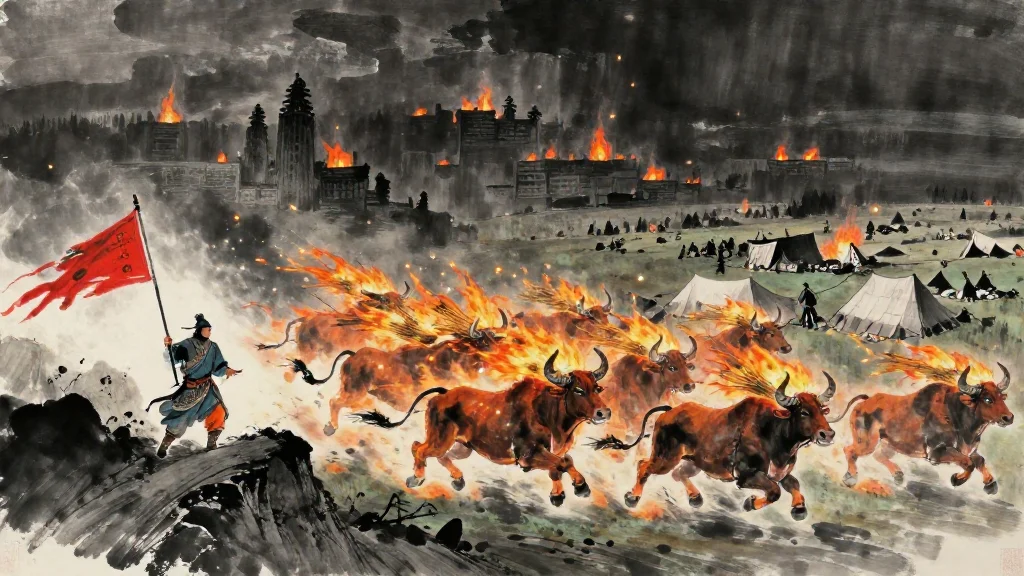
Tian Dan (田單) was the Qi commander who, from the last holdout city of Jimo (即墨), organized a legendary counterattack using fire oxen and psychological warfare to rout the Yan occupiers and restore the Qi state. His campaign is one of the most celebrated come-from-behind victories in Chinese military history.
Nao Chi's three omens — blood rain, earth splitting, a ghost weeping at the gate — function as a mock-prosecution. The real charges are political: King Min killed his honest advisors and lost his state. The supernatural framing gives the execution a veneer of cosmic justice, but the actual cause of doom is straightforward misgovernment.