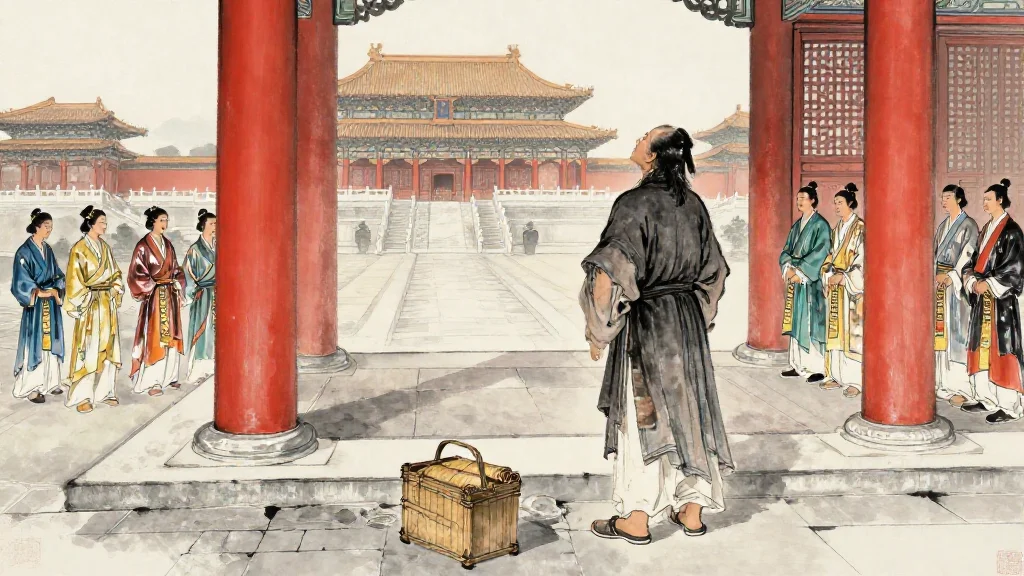
楚策三 (Stratagems of Chu III) — Chinese ink painting

Chapter 16 of 33 · Chu state

楚策三

Stratagems of Chu III

View:

蘇子謂楚王

Su Qin Advises the King of Chu on Loyal Ministers

蘇子謂楚王曰:「仁人之於民也,愛之以心,事之以善言。孝子之於親也,愛之以心,事之以財。忠臣之於君也,必進賢人以輔之。今王之大臣父兄,好傷賢以為資,厚賦斂諸臣百姓,使王見疾於民,非忠臣也。大臣播王之過於百姓,多賂諸侯以王之地,是故退王之所愛,亦非忠臣也,是以國危。臣願無聽群臣之相惡也,慎大臣父兄;用民之所善,節身之嗜欲,以百姓。人臣莫難於無妒而進賢。為主死易,垂沙之事,死者以千數。為主辱易,自令尹以下,事王者以千數。至於無妒而進賢,未見一人也。故明主之察其臣也,必知其無妒而進賢也。賢之事其主也,亦必無妒而進賢。夫進賢之難者,賢者用且使己廢,貴且使己賤,故人難之。」

Su Qin said to the King of Chu: "A benevolent man loves the people with his heart and serves them with good words. A filial son loves his parents with his heart and serves them with his wealth. A loyal minister must recommend worthy men to assist his lord.

"Now Your Majesty's senior ministers and kinsmen love to injure the worthy as a way of building their own positions. They impose heavy taxes on ministers and common people alike, causing Your Majesty to be hated by the people. These are not loyal ministers. Senior ministers who broadcast Your Majesty's faults to the people and bribe the feudal lords with Your Majesty's territory, who drive away those Your Majesty favors — these too are not loyal ministers. This is why the state is in danger.

"I urge Your Majesty not to listen when ministers slander each other. Be watchful of your senior ministers and kinsmen. Employ those the people consider good. Restrain your personal desires for the people's sake.

"Nothing is harder for a minister than to recommend the worthy without jealousy. Dying for one's lord is easy — at the battle of Chuisha, the dead numbered in the thousands. Suffering humiliation for one's lord is easy — from the Prime Minister on down, those who serve Your Majesty number in the thousands. But to recommend the worthy without jealousy — I have not seen a single one. Therefore, a wise ruler evaluating his ministers must identify those who recommend the worthy without jealousy. And a worthy minister serving his lord must likewise recommend the worthy without jealousy. The reason recommending the worthy is so difficult is that the worthy, once employed, will make oneself obsolete; once honored, will make oneself diminished. That is why people find it hard."

Notes

1place

Chuisha (垂沙) was the site of a major Chu defeat, probably the battle of 301 BC where Qi, Han, and Wei jointly defeated Chu. The Chu general Tang Mei was killed and tens of thousands of Chu soldiers died.

2context

Su Qin's central insight is brutally clear: dying for your lord is cheap (thousands do it), but recommending someone who might replace you is almost impossible. It is an observation about institutional incentives that has lost none of its force. The speech also contains a veiled warning — your ministers are actively undermining you and you do not see it.

蘇秦之楚三日

Su Qin's Three Days in Chu

蘇秦之楚,三日乃得見乎王。談卒,辭而行。楚王曰:「寡人聞先生,若聞古人。今先生乃不遠千里而臨寡人,曾不肯留,願聞其說。」對曰:「楚國之食貴於玉,薪貴於桂,謁者難得見如鬼,王難得見如天帝。今令臣食玉炊桂,因鬼見帝。」王曰:「先生就舍,寡人聞命矣。」

Su Qin went to Chu. After three days he finally obtained an audience with the king. When the conversation ended, he took his leave and prepared to depart.

The King of Chu said: "I have heard of you, sir, as one hears of the ancients. Now you have come a thousand li to visit me, yet you will not stay. I wish to hear your counsel."

Su Qin replied: "In Chu, food costs more than jade and firewood costs more than cassia. Your gatekeepers are as hard to find as ghosts, and Your Majesty is as hard to see as the Lord of Heaven. You now ask me to eat jade, cook with cassia, seek out ghosts, and petition the Lord of Heaven."

The king said: "Please go to your lodgings, sir. I have received the message."

Notes

1context

Su Qin's complaint — that everything in Chu is impossibly expensive and the king impossibly inaccessible — is a complaint about how foreign diplomats are treated. But it is phrased as a witticism rather than a grievance, which is exactly why it works. The king takes the hint immediately and offers hospitality. 'Eating jade and cooking with cassia' (食玉炊桂) became a proverbial expression for outrageous living costs.

楚王逐張儀於魏

The King of Chu Drives Zhang Yi to Wei

楚王逐張儀於魏。陳軫曰:「王何逐張子?」曰:「為臣不忠不信。」曰:「不忠,王無以為臣;不信,王勿與為約。且魏臣不忠不信,於王何傷?忠且信,於王何益?逐而聽則可,若不聽,是王令困也。且使萬乘之國免其相,是城下之事也。」

The King of Chu demanded that Wei expel Zhang Yi. Chen Zhen said: "Why does Your Majesty want Zhang Yi expelled?"

"Because he is a disloyal and untrustworthy minister."

"If he is disloyal, Your Majesty has no reason to employ him. If he is untrustworthy, Your Majesty need not make treaties with him. Besides, if a Wei minister is disloyal and untrustworthy, what harm is that to Your Majesty? If he were loyal and trustworthy, what benefit to Your Majesty? If Wei complies with the expulsion, fine. But if it does not, Your Majesty's authority is humiliated. To make a state of ten thousand chariots dismiss its own prime minister — that is the demand of a besieging army, not a diplomatic request."

Notes

1context

Chen Zhen's logic is airtight: an incompetent enemy minister helps you, a competent one hurts you, and demanding his removal is a lose-lose proposition. If Wei complies, you lose a useful incompetent; if Wei refuses, you lose face. The final comparison — that this is the kind of demand you make at the gates of a conquered city, not across a diplomatic table — is devastating.

張儀之楚貧

Zhang Yi Goes to Chu in Poverty

張儀之楚,貧。舍人怒而歸。張儀曰:「子必以衣冠之敝,故欲歸。子待我為子見楚王。」當是之時,南後、鄭袖貴於楚。

張子見楚王,楚王不說。張子曰:「王無所用臣。臣請北見晉君。」楚王曰:「諾。」張子曰:「王無求於晉國乎?」王曰:「黃金珠璣犀象出於楚,寡人無求於晉國。」張子曰:「王徒不好色耳?」王曰:「何也?」張子曰:「彼鄭、周之女,粉白墨黑,立於衢閭,非知而見之者,以為神。」楚王曰:「楚,僻陋之國也,未嘗見中國之女如此其美也。寡人之獨何為不好色也?」乃資之以珠玉。

南後、鄭袖聞之大恐,令人謂張子曰:「妾聞將軍之晉國,偶有金千斤,進之左右,以供芻秣。」鄭袖亦以金五百斤。

張子辭楚王曰:「天下關閉不通,未知見日也,願王賜之觴。」王曰:「諾。」乃觴之。張子中飲,再拜而請曰:「非有他人於此也,願王召所便習而觴之。」王曰:「諾。」乃召南後、鄭袖而觴之。張子再拜而請曰:「儀有死罪於大王。」王曰:「何也?」曰:「儀行天下遍矣,未嘗見人如此其美也。而儀言得美人,是欺王也。」王曰:「子釋之。吾固以為天下莫若是兩人也。」

Zhang Yi went to Chu, but was poor. His attendant was angry and wanted to leave. Zhang Yi said: "You want to leave because of your shabby clothes. Wait for me — I will get you an audience with the King of Chu."

At that time, the Southern Queen and Zheng Xiu held the most influence in Chu.

Zhang Yi met the King of Chu, but the king was not pleased. Zhang Yi said: "Your Majesty has no use for me. Allow me to go north and visit the lord of Jin."

The king said: "Very well."

Zhang Yi said: "Does Your Majesty have no requests for the state of Jin?"

The king said: "Gold, pearls, rhinoceros horn, and ivory all come from Chu. I have no need of anything from Jin."

Zhang Yi said: "Your Majesty simply does not care for beautiful women?"

"Why do you say that?"

"The women of Zheng and Zhou — powdered white, painted black, standing at the crossroads — those who see them without knowing who they are take them for goddesses."

The King of Chu said: "Chu is a remote and rustic state. I have never seen women of the Central States so beautiful. How could I not desire them?" He furnished Zhang Yi with pearls and jade for the journey.

The Southern Queen and Zheng Xiu heard of this and were terrified. They sent someone to tell Zhang Yi: "We have heard you are going to Jin. We happen to have a thousand catties of gold, which we offer to your retinue for provisions." Zheng Xiu also sent five hundred catties of gold.

Zhang Yi took leave of the King of Chu: "The world's roads are closed and impassable — I do not know when I will see the sun again. I beg Your Majesty to grant me a farewell banquet."

The king agreed and held a banquet. Midway through the drinking, Zhang Yi bowed twice and said: "There is no one else here. I wish Your Majesty would summon those he is most intimate with to share the banquet."

The king agreed and summoned the Southern Queen and Zheng Xiu. Zhang Yi bowed twice and said: "I have committed a capital offense against Your Majesty."

"What offense?"

"I have traveled the entire world and never seen anyone as beautiful as these two. Yet I told Your Majesty I could find beautiful women — that was deceiving Your Majesty."

The king said: "Think nothing of it. I have always believed there are no two people in All-Under-Heaven to match them."

Notes

1context

This is one of the Zhanguoce's most entertaining con jobs. Zhang Yi arrives broke, manufactures a threat (beautiful foreign women) that panics the two most powerful women at court into paying him off, then caps the whole performance by publicly 'confessing' his deception in a way that flatters the king, reassures the consorts, and leaves everyone feeling good — while Zhang Yi walks away with pearls, jade, and fifteen hundred catties of gold. The man literally arrived with nothing and played three separate marks in one trip.

2person南後Nán Hòu

The Southern Queen (南後) was King Huai's primary queen. She and Zheng Xiu (鄭袖) were rivals for the king's favor but united here against the threat of beautiful replacements from the north.

楚王令昭雎之秦重張儀

The King of Chu Sends Zhao Sui to Qin to Honor Zhang Yi

楚王令昭雎之秦重張儀。未至,惠王死,武王逐張儀。楚王因收昭雎以取齊。桓臧為雎謂楚王曰:「橫親之不合也,儀貴惠王而善雎也。今惉王死,武王立。儀走,公孫郝、甘茂貴。甘茂善魏,公孫郝善韓。二人固不善雎也,必以秦合韓、魏。韓、魏之重儀,儀有秦而雎以楚重之。今儀困秦而雎收楚。韓、魏欲得秦,必善二人者。將收韓、魏輕儀而伐楚,方城必危。王不如復雎,而重儀於韓、魏。儀據楚勢,挾魏重,以與秦爭。魏不合秦,韓亦不從,則方城無患。」

The King of Chu sent Zhao Sui to Qin to bolster Zhang Yi's position. Before Zhao Sui arrived, King Hui of Qin died and King Wu expelled Zhang Yi. The King of Chu then recalled Zhao Sui to pursue an alliance with Qi instead.

Huan Zang, speaking for Zhao Sui, said to the King of Chu: "The Horizontal alignment has collapsed. Zhang Yi rose under King Hui and was close to Zhao Sui. Now King Hui is dead and King Wu has taken the throne. Zhang Yi has fled; Gongsun Hao and Gan Mao are now in power. Gan Mao is allied with Wei, Gongsun Hao with Han. Neither is friendly to Zhao Sui. They will certainly use Qin to align with Han and Wei.

"Han and Wei valued Zhang Yi because he had Qin; Zhao Sui was valued because he had Chu. Now Zhang Yi has lost Qin and Zhao Sui has lost Chu's favor. Han and Wei, wanting Qin's support, will court Gongsun Hao and Gan Mao. They will draw in Han and Wei, sideline Zhang Yi, and attack Chu — putting Fangcheng in danger.

"Your Majesty should instead restore Zhao Sui to favor and elevate Zhang Yi's standing in Han and Wei. Zhang Yi, backed by Chu's power and wielding Wei's influence, can contest with Qin. If Wei does not align with Qin, Han will not follow either, and Fangcheng will be safe."

Notes

1person秦武王Qín Wǔ Wáng

King Wu of Qin (秦武王, r. 310–307 BC) expelled Zhang Yi shortly after taking the throne. King Wu famously died trying to lift a bronze tripod, after a reign of only three years.

2context

Huan Zang's argument is a lesson in how quickly the diplomatic chessboard reshuffles when a king dies. One death in Qin changes every alliance calculation. His advice is counterintuitive — support a disgraced Zhang Yi — but the logic is sound: a Zhang Yi who owes his rehabilitation to Chu is more useful than a Zhang Yi who has nothing to lose.

張儀逐惠施於魏

Zhang Yi Expels Hui Shi from Wei

張儀逐惠施於魏。惠子之楚,楚王受之。

馮郝謂楚王曰:「逐惠子者,張儀也。而王親與約,是欺儀也,臣為王弗取也。惠子為儀者來,而惡王之交於張儀,惠子心弗行也。且宋王之賢惠子也,天下莫不聞也。今之不善張儀也,天下莫不知也。今為事之故,棄所貴於讎人,臣以為大王輕矣。且為事耶?王不如舉惠子而納之於宋,而謂張儀曰:『請為子勿納也。』儀必德王。而惠子窮人,而王奉之,又必德王。此不失為儀之實,而可以德惠子。」楚王曰:「善。」乃奉惠子而納之宋。

Zhang Yi expelled Hui Shi from Wei. Hui Shi fled to Chu, and the King of Chu received him.

Feng Hao said to the King of Chu: "The one who expelled Hui Shi was Zhang Yi. For Your Majesty to now embrace Hui Shi is to deceive Zhang Yi — I would advise against it. Hui Shi came here because of Zhang Yi, and he will resent Your Majesty's friendship with Zhang Yi. His heart will not be committed. Moreover, the King of Song's admiration for Hui Shi is known throughout All-Under-Heaven, and Hui Shi's hostility toward Zhang Yi is equally well known.

"To abandon someone you value to an enemy for the sake of expediency — I consider this beneath Your Majesty. Instead, why not escort Hui Shi and present him to Song? Then tell Zhang Yi: 'I refused to shelter him on your behalf.' Zhang Yi will be grateful. And Hui Shi, a man in desperate straits whom Your Majesty has honored with an escort, will also be grateful. This way you do Zhang Yi's bidding in substance while earning Hui Shi's gratitude."

The King of Chu said: "Excellent." He accordingly escorted Hui Shi and presented him to Song.

Notes

1person惠施Huì Shī

Hui Shi (惠施, c. 370–310 BC) was a famous philosopher of the School of Names (名家), known for his paradoxes and logical puzzles. He also served as Wei's prime minister. His philosophical friendship (and rivalry) with Zhuangzi is one of the great intellectual relationships in Chinese thought.

2context

Feng Hao's solution is elegant: you cannot keep Hui Shi (it offends Zhang Yi) and you cannot turn him away (it looks heartless). So escort him to a third country where he is wanted. Everyone benefits: Zhang Yi is appeased, Hui Shi is helped, and the King of Chu earns two debts of gratitude while actually doing nothing except arranging transport.

五國伐秦

Five States Attack Qin

五國伐秦。魏欲和,使惠施之楚。楚將入之秦而使行和。杜赫謂昭陽曰:「凡為伐秦者楚也。今施以魏來,而公入之秦,是明楚之伐而信魏之和也。公不如無聽惠施,而陰使人以請聽秦。」昭子曰:「善。」因謂惠施曰:「凡為攻秦者魏也,今子從楚為和,楚得其利,魏受其怨。子歸,吾將使人因魏而和。」

惠子反,魏王不說。杜赫謂昭陽曰:「魏為子先戰,折兵之半,謁病不聽,請和不得,魏折而人齊、秦,子何以救之?東有越累,北無晉,而交未定於齊、秦,是楚孤也。不如速和。」昭子曰:「善。」因令人調和於魏。

Five states attacked Qin. Wei wanted peace and sent Hui Shi to Chu. Chu intended to pass him through to Qin to broker a settlement. Du He said to Zhao Yang: "The driving force behind the attack on Qin was Chu. Now Hui Shi comes from Wei, and you forward him to Qin — this exposes Chu as the aggressor while crediting Wei with the peace effort. Better not to receive Hui Shi, and instead secretly send your own envoy to negotiate with Qin."

Zhao Yang said: "Excellent." He then told Hui Shi: "The driving force behind the attack on Qin was actually Wei. Now you come from Chu to make peace — Chu gets the benefit, Wei takes the blame. Go home. I will send someone to make peace through Wei."

Hui Shi returned, and the King of Wei was not pleased.

Du He then said to Zhao Yang: "Wei fought on your front line, lost half its army, pleaded illness, was not heeded, sought peace and was denied. Wei will break away and turn to Qi and Qin. How will you cope? To the east you have the burden of Yue, to the north you have no Jin ally, and your relations with Qi and Qin are unsettled — Chu is isolated. Better to make peace quickly."

Zhao Yang said: "Excellent." He then sent an envoy to negotiate peace through Wei.

Notes

1context

Du He plays both sides of the same situation with impressive agility. First he tells Zhao Yang to reject Hui Shi's peace mission to control the narrative. Then, once that creates a diplomatic mess, he tells Zhao Yang to make peace through Wei anyway — because Chu is now isolated. The net effect is that Du He looks prescient either way, while Zhao Yang has simply rotated 360 degrees back to where he started, having annoyed Wei for no gain.

陳軫告楚之魏

Chen Zhen Leaves Chu for Wei

陳軫告楚之魏,張儀惡之於魏王曰:「軫猶善楚,為求地甚力。」左爽謂陳軫曰:「儀善於魏王,魏王甚信之。公雖百說之,猶不聽也。公不如以儀之言變資,而得復楚。」陳軫曰:「善。」因使人以儀之言聞於楚。楚王喜,欲復之。

Chen Zhen left Chu for Wei. Zhang Yi slandered him before the King of Wei: "Chen Zhen still favors Chu and works hard to obtain territory for it."

Zuo Shuang said to Chen Zhen: "Zhang Yi is close to the King of Wei, and the king trusts him completely. Even if you argued a hundred times, the king would not listen. You should instead use Zhang Yi's slander as leverage to return to Chu."

Chen Zhen said: "Excellent." He had someone relay Zhang Yi's words to Chu. The King of Chu was pleased and wanted to recall him.

Notes

1context

A beautiful judo move: Zhang Yi slanders Chen Zhen by saying he is secretly loyal to Chu. Rather than deny it, Chen Zhen uses the slander as proof of his loyalty — he sends Zhang Yi's accusation directly to the King of Chu, who naturally reads it as a recommendation. Zhang Yi's weapon becomes Chen Zhen's passport home.

秦伐宜陽

Qin Attacks Yiyang

秦伐宜陽。楚王謂陳軫曰:「寡人聞韓侈巧士也,習諸侯事,殆能自免也。為其必免,吾欲先據之以加德焉。」陳軫對曰:「舍之。王勿據也。以韓侈之知,於此困矣。今山澤之獸,無鮚於麋。麋知獵者張罔,前而驅己也,因還走而冒人。至數,獵者知其詐,偽舉罔而進之,麋因得矣。今諸侯明知此多詐,偽舉罔而進者必眾矣。舍之,王勿據也。韓侈之知,於此困矣。」楚王聽之,宜陽果拔,陳軫先知之也。

Qin attacked Yiyang. The King of Chu said to Chen Zhen: "I hear Han Shi is a clever man, versed in the affairs of the feudal lords, and will probably be able to save himself. Since he will certainly escape, I want to preemptively offer support to gain his gratitude."

Chen Zhen replied: "Leave it alone. Your Majesty should not intervene. Despite Han Shi's cleverness, in this situation he is stuck. Consider the animals of the mountains and marshes — none is craftier than the elk. The elk, knowing the hunter has spread nets ahead to drive it forward, turns around and charges back through the beaters. But after several times, the hunters learn its trick: they pretend to raise the nets and advance, and the elk is caught.

"Now the feudal lords well know that such tricks are common. Those who pretend to raise their nets and advance will be many. Leave it alone, Your Majesty. Han Shi's cleverness is trapped here."

The King of Chu followed this advice. Yiyang did indeed fall, and Chen Zhen's foresight was proven right.

Notes

1place

Yiyang (宜陽) was a key Han fortress controlling access to the Luoyang area (modern Yiyang, Henan). Its fall to Qin in 308 BC was a strategic catastrophe for Han.

2context

The elk parable is about the limits of cleverness: any trick, used often enough, becomes predictable. Chen Zhen's deeper point is that the king should not bet on Han Shi escaping, because his opponents have already learned his playbook. The advice to do nothing is among the hardest to accept — and often the wisest.

唐且見春申君

Tang Ju Meets Lord Chunshen

唐且見春申君曰:「齊人飾身修行得為益,然臣羞而不學也,不避絕江河,行千餘里來,竊慕大君之義,而善君之業。臣聞之賁、諸懷錐刃而天下為勇,西施衣褐而天下稱美。今君相萬乘之楚,御中國之難,所欲者不成,所求者不得,臣等少也。夫梟棊之所以能為者,以散棋佐之也。夫一梟之不如不勝五散,亦明矣,今君何不為天下梟,而令臣等為散乎?」

Tang Ju met Lord Chunshen and said: "The people of Qi cultivate their appearance and refine their conduct to win advancement. I am too proud for that. I have crossed great rivers and traveled over a thousand li, privately admiring Your Lordship's righteousness and wishing to serve your enterprise.

"I have heard that Zhuan Zhu and Zhu Hai carried blades in their bosoms, and All-Under-Heaven called them brave. Xi Shi wore coarse cloth, and All-Under-Heaven called her beautiful. Now Your Lordship serves as prime minister of Chu, a state of ten thousand chariots, managing the crises of the Central States. Yet what you desire, you cannot achieve; what you seek, you cannot obtain. It is because men like me are too few.

"The reason the king piece in chess is powerful is that the common pieces support it. A single king piece that does not deploy its five common pieces will surely lose. Why does Your Lordship not become the king piece of All-Under-Heaven and let men like me serve as your common pieces?"

Notes

1person春申君Chūnshēn Jūn

Lord Chunshen (春申君, d. 238 BC) was Huang Xie, one of the 'Four Lords' (四公子) of the late Warring States. He served as Chu's prime minister for over twenty-five years before being assassinated by Li Yuan.

2person唐且Táng Jū

Tang Ju (唐且, also written 唐雎) was a persuader known for his boldness. The Zhanguoce records several of his encounters.

3context

Tang Ju's pitch is a job application wrapped in a chess metaphor: you are powerful but failing because you lack supporting pieces — hire me and my kind. The references to Zhuan Zhu (the assassin) and Xi Shi (the legendary beauty) suggest that greatness comes from inherent quality, not external polish. It is a not-very-subtle dig at the polished courtiers of Qi.

4person專諸Zhuān Zhū

Zhuan Zhu (專諸) was an assassin who killed King Liao of Wu on behalf of Prince Guang (later King Helu) in 515 BC, stabbing him with a dagger hidden inside a roasted fish. Zhu Hai (朱亥) killed the Wei general Jin Bi with a concealed iron mace.

Edition & Source

Text
《戰國策》 Zhanguoce
Edition
中華古詩文古書籍網 transcription
Commentary
鮑彪 (Bao Biao) Song dynasty commentary