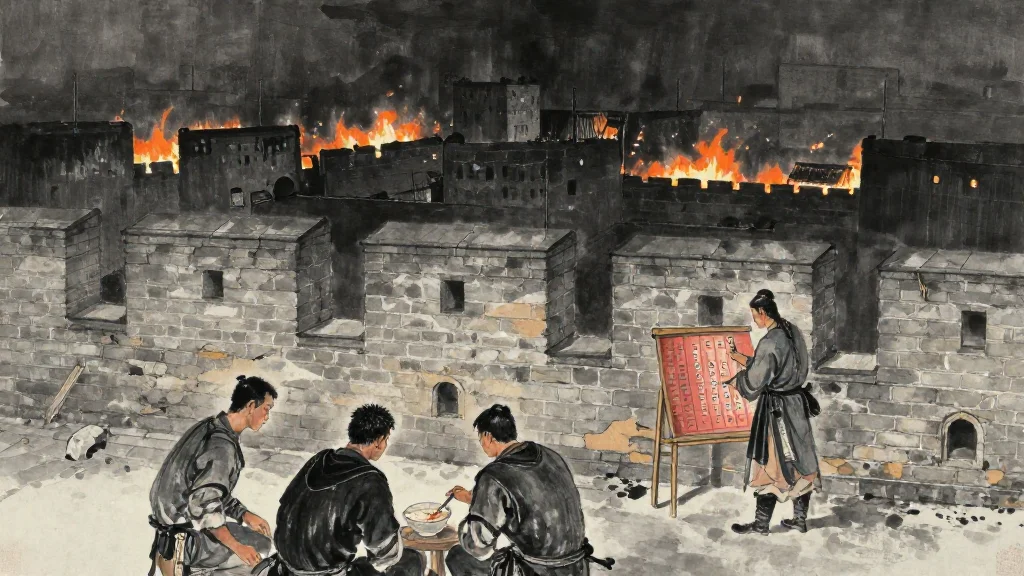
楚圍雍氏五月
Chu Besieges Yongshi for Five Months
楚圍雍氏五月。韓令使者求救於秦,冠蓋相望也,秦師不下崤。韓又令尚靳使秦,謂秦王曰:「韓之於秦也,居為隱蔽,出為雁行。今韓已病矣,秦師不下崤。臣聞之,脣揭者其齒寒,願大王之熟計之。」宣太后曰:「使者來者眾矣,獨尚子之言是。」召尚子入。宣太后謂尚子曰:「妾事先王也,先王以其髀加妾之身,妾困不疲也;盡置其身妾之上,而妾弗重也,何也?以其少有利焉。今佐韓,兵不眾,糧不多,則不足以救韓。夫救韓之危,日費千金,獨不可使妾少有利焉。」
尚靳歸書報韓王,韓王遣張翠。張翠稱病,日行一縣。張翠至,甘茂曰:「韓急矣,先生病而來。」張翠曰:「韓未急也,且急矣。」甘茂曰:「秦重國知王也,韓之急緩莫不知。今先生言不急,可乎?」張翠曰:「韓急則折而入於楚矣,臣安敢來?」甘茂曰:「先生毋復言也。」
甘茂入言秦王曰:「公仲柄得秦師,故敢捍楚。今雍氏圍,而秦師不下崤,是無韓也。公仲且抑首而不朝,公叔且以國南合於楚。楚、韓為一,魏氏不敢不聽,是楚以三國謀秦也。如此則伐秦之形成矣。不識坐而待伐,孰與伐人之利?」秦王曰:「善。」果下師於崤以救韓。
Chu besieges Yongshi for five months. Han sends envoy after envoy to request rescue from Qin — an unbroken procession of carriages and caps — but Qin's army does not descend from the Xiao Pass.
Han then sends Shang Jin to Qin. He tells the King of Qin: "Han's relation to Qin is this: at rest, we are your shield; in war, we march in formation at your side. Now Han is in distress, yet Qin's army does not descend from the Xiao Pass. I have heard the saying: 'When the lips are gone, the teeth grow cold.' I urge Your Majesty to consider carefully."
Queen Dowager Xuan says: "Many envoys have come, but only Master Shang's words are to the point." She summons Shang Jin.
Queen Dowager Xuan says to him: "When I served the late king, the late king would lay his thigh across my body, and I found it tiring but not exhausting. When he placed his whole body upon mine, I did not find it heavy. Why? Because there was a little benefit in it for me. Now, to help Han — if the troops are few and the supplies meager, that is not enough to save Han. Rescuing Han from danger costs a thousand pieces of gold per day. Can you not arrange for me to derive a little benefit as well?"
Shang Jin returns and reports to the King of Han by letter. The King of Han dispatches Zhang Cui. Zhang Cui feigns illness and travels only one county per day.
When Zhang Cui arrives, Gan Mao says: "Han must be desperate — you have come despite your illness."
Zhang Cui says: "Han is not yet desperate. But it soon will be."
Gan Mao says: "Qin is a great state that understands your king. Whether Han is desperate or not, we know perfectly well. Can you really claim it is not desperate?"
Zhang Cui says: "If Han were truly desperate, it would have broken off and gone over to Chu. How would I dare come here?"
Gan Mao says: "Say no more."
Gan Mao goes in and tells the King of Qin: "Gongzhong has relied on Qin's army to dare resist Chu. Now Yongshi is besieged and Qin's army has not descended from the Xiao Pass — which means Han is lost. Gongzhong will hang his head and cease attending Qin's court. Gongshu will take the state south and ally with Chu. If Chu and Han become one, Wei will not dare refuse to follow. That means Chu will be plotting against Qin with three states. When that happens, the conditions for attacking Qin will be complete. I do not know which is better: sitting and waiting to be attacked, or attacking first."
The King of Qin says: "Very well." He sends the army down from the Xiao Pass to rescue Han.
Notes
Queen Dowager Xuan (宣太后, d. 265 BC) was the mother of King Zhaoxiang of Qin and one of the most powerful women in Warring States history. She dominated Qin politics for decades. Her sexual analogy to Shang Jin is one of the most famous passages in the Zhanguoce — she is making explicit what diplomacy usually keeps decorously veiled: Qin will only help Han if Qin gets something out of it.
Zhang Cui's negotiating technique is brilliantly counterintuitive. By traveling slowly and claiming Han is 'not yet' desperate, he signals that Han still has options — specifically, the option of defecting to Chu. Gan Mao, who is nobody's fool, instantly grasps the implied threat. The paradox: if Han were truly on the verge of collapse, it would have no leverage. By pretending calm, Zhang Cui preserves Han's bargaining position.
The 'lips and teeth' (脣亡齒寒) proverb, attributed to an earlier diplomatic crisis, became one of the most enduring metaphors in Chinese strategic thought. It describes the relationship between a buffer state and the power it shields — precisely Han's value to Qin.
Yongshi (雍氏) was a Han fortress city, modern Yuzhou, Henan. The Xiao Pass (崤) was the main mountain pass separating Qin's core territory from the eastern states — when Qin's army 'descended from Xiao,' it was entering the Central Plain.