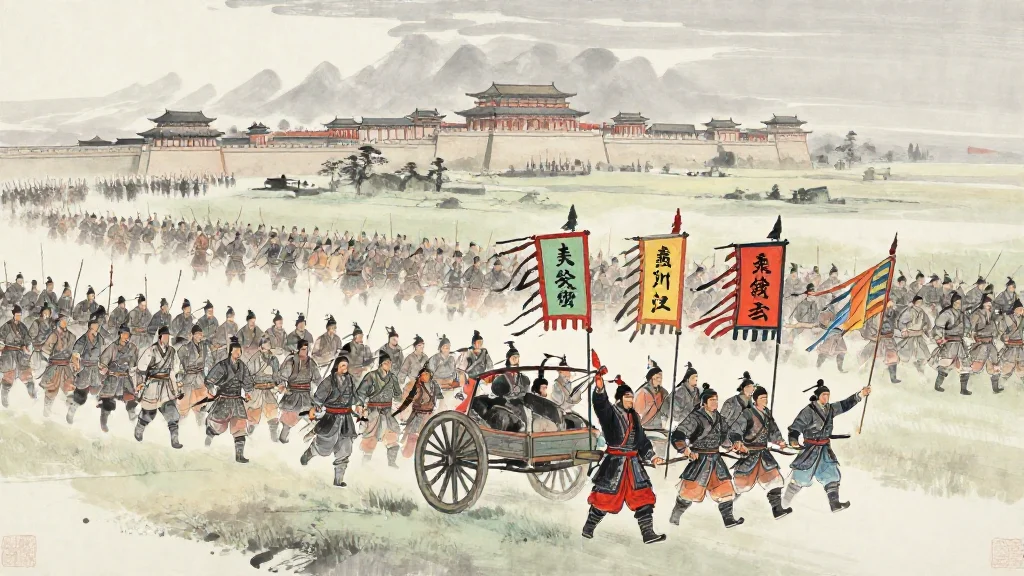
秦召燕王
Qin Summons the King of Yan
秦召燕王,燕王欲往。蘇代約燕王曰:「楚得枳而國亡,齊得宋而國亡,齊、楚不得以有枳、宋事秦者,何也?是則有功者,秦之深讎也。秦取天下,非行義也,暴也。
「秦之行暴於天下,正告楚曰:『蜀地之甲,輕舟浮於汶,乘夏水而下江,五日而至郢。漢中之甲,乘舟出於巴,乘夏水而下漢,四日而至五渚。寡人積甲宛,東下隨,知者不及謀,勇者不及怒,寡人如射隼矣。王乃待天下之攻函谷,不亦遠乎?』楚王為是之故,十七年事秦。
「秦正告韓曰:『我起乎少曲,一日而斷太行。我起乎宜陽而觸平陽,二日而莫不盡繇。我離兩周而觸鄭,五日而國舉。』韓氏以為然,故事秦。
「秦正告魏曰:『我舉安邑,塞女戟,韓氏、太原卷。我下枳,道南陽、封、冀,包兩周,乘夏水,浮輕舟,強弩在前,銛戈在後。決榮口,魏無大梁;決白馬之口,魏無濟陽;決宿胥之口,魏無虛、頓丘。陸攻則擊河內,水攻則滅大梁。』魏氏以為然,故事秦。
「秦欲攻安邑,恐齊救之,則以宋委於齊,曰:『宋王無道,為木人以寫寡人,射其面。寡人地絕兵遠,不能攻也。王苟能破宋有之,寡人如自得之。』已得安邑,塞女戟,因以破宋為齊罪。
「秦欲攻齊,恐天下救之,則以齊委於天下曰:『齊王四與寡人約,四欺寡人,必率天下以攻寡人者三。有齊無秦,無齊有秦,必伐之,必亡之!』已得宜陽、少曲,致藺、石,因以破齊為天下罪。
「秦欲攻魏,重楚,則以南陽委於楚曰:『寡人固與韓且絕矣!殘均陵,塞鄳隘,苟利於楚,寡人如自有之。』魏棄與國而合於秦,因以塞鄳隘為楚罪。
「兵困於林中,重燕、趙,以膠東委於燕,以濟西委於趙。趙得講於魏,至公子延,因犀首屬行而攻趙。兵傷於離石,遇敗於馬陵,而重魏,則以葉、蔡委於魏。已得講於趙,則劫魏,魏不為割。困則使太后、穰侯為和,贏則兼欺舅與母。適燕者曰:『以膠東。』適趙者曰:『以濟西。』適魏者曰:『以葉、蔡。』適楚者曰:『以塞鄳隘。』適齊者曰:『以宋。』此必令其言如循環,用兵如刺蜚繡,母不能制,舅不能約。龍賈之戰,岸門之戰,封陸之戰,高商之戰,趙莊之戰,秦之所殺三晉之民數百萬。今其生者,皆死秦之孤也。西河之外、上雒之地、三川,晉國之禍,三晉之半。秦禍如此其大,而燕、趙之秦者,皆以爭事秦說其主,此臣之所大患。」
燕昭王不行,蘇代復重於燕。燕反約諸侯從親,如蘇秦時,或從或不,而天下由此宗蘇氏之從約。代、厲皆以壽死,名顯諸侯。
Qin summons the King of Yan, and the king is inclined to go. Su Dai restrains the King of Yan, saying:
"Chu gained Zhi — and lost its state. Qi gained Song — and lost its state. The reason Qi and Chu could not leverage their possession of Zhi and Song to serve Qin is this: those who achieve gains become Qin's bitterest enemies. Qin's method of conquering All-Under-Heaven is not righteousness — it is violence.
"Here is how Qin has practiced violence upon All-Under-Heaven. It issued a direct warning to Chu: 'Our armored troops from Shu can float downriver in light boats on the Wen, ride the summer floodwaters down the Yangtze, and reach Ying in five days. Our troops from Hanzhong can embark from Ba, ride the summer waters down the Han, and reach Wuzhu in four days. I have massed troops at Wan and can advance east through Sui — before the wise can formulate a plan, before the brave can work up their anger, I will have struck like an arrow hitting a falcon. Is Your Majesty really going to wait for All-Under-Heaven to attack Hangu Pass? Is that not rather far off?' Because of this, the King of Chu served Qin for seventeen years.
"Qin issued a direct warning to Han: 'I can launch from Shaoqu and cut the Taihang range in a single day. I can launch from Yiyang and strike Pingyang — in two days everything will be under my control. I can separate the Two Zhous and strike Zheng, and in five days your state is finished.' Han regarded this as true, and so served Qin.
"Qin issued a direct warning to Wei: 'I can take Anyi, block Nuji, and roll up Han and Taiyuan. I can descend upon Zhi, march through Nanyang, Feng, and Ji, encircle the Two Zhous, ride the summer floodwaters in light boats — powerful crossbows in front, sharp halberds behind. If I breach the Rong dike, Wei loses Daliang. If I breach the Baima dike, Wei loses Jiyang. If I breach the Suxu dike, Wei loses Xu and Dunqiu. A land attack strikes Hanei; a water attack drowns Daliang.' Wei regarded this as true, and so served Qin.
"When Qin wanted to attack Anyi but feared Qi would rescue it, it handed Song to Qi on a platter, saying: 'The King of Song is lawless — he carved a wooden figure in my likeness and shot it in the face. My territory is distant and my troops are far; I cannot attack him myself. If Your Majesty can destroy Song and take it, I will consider it as good as having done it myself.' Once Qin had secured Anyi and blocked Nuji, it then turned around and made the destruction of Song into Qi's crime.
"When Qin wanted to attack Qi but feared All-Under-Heaven would rescue it, it handed Qi to All-Under-Heaven on a platter, saying: 'The King of Qi made treaties with me four times and deceived me four times. Three times he led All-Under-Heaven to attack me. Either Qi survives and Qin perishes, or Qi perishes and Qin survives — we must attack them, we must destroy them!' Once Qin had secured Yiyang and Shaoqu and taken Lin and Shi, it then made the destruction of Qi into All-Under-Heaven's crime.
"When Qin wanted to attack Wei and needed to placate Chu, it handed Nanyang to Chu on a platter, saying: 'I am already on the verge of breaking with Han! I will devastate Junling and block the Meng Pass — whatever benefits Chu, I will consider my own.' Then when Wei abandoned its allies and aligned with Qin, Qin made the blocking of Meng Pass into Chu's crime.
"When Qin's forces were bogged down at Linzhong and it needed to placate Yan and Zhao, it offered Jiaodong to Yan and Jixi to Zhao. When Zhao made peace with Wei and it came to Prince Yan, Qin used Xishou to organize a march and attack Zhao. When its forces were mauled at Lishi and it suffered defeat at Maling and needed Wei, it offered Ye and Cai to Wei. Once it had made peace with Zhao, it coerced Wei, and Wei refused to cede territory. When pressed, Qin sends the Queen Dowager and the Marquis of Rang to negotiate peace; when winning, it cheats uncle and mother alike.
"To those going to Yan, the envoy says: 'You get Jiaodong.' To those going to Zhao: 'You get Jixi.' To those going to Wei: 'You get Ye and Cai.' To those going to Chu: 'We will block the Meng Pass for you.' To those going to Qi: 'You get Song.' Qin's rhetoric revolves in an endless circle; its military strikes like a needle through embroidery. Neither the Queen Mother can control it, nor the uncle can restrain it.
"The Battle of Longjia, the Battle of Anmen, the Battle of Fenglu, the Battle of Gaoshang, the Battle of Zhaozhuang — Qin has killed millions of the Three Jin's people in these engagements. Those who survive today are all orphans of Qin's dead. The lands west of the Yellow River, the territory of Shangluo, the Three Rivers region — these are Jin's calamities, half the Three Jin lost. Qin's devastation has been this vast, and yet those in Yan and Zhao who serve Qin's interests all compete to please their rulers by urging service to Qin. This is what I find most alarming."
King Zhao of Yan does not go. Su Dai's influence is restored in Yan. Yan reverses course and leads the lords in a north-south coalition, as in the time of Su Qin. Some join and some do not, but from this point All-Under-Heaven looks to the Su clan's coalition diplomacy. Both Dai and Li die of natural causes, their reputations renowned among the lords.
Notes
Su Dai (蘇代) was the younger brother of Su Qin, the legendary architect of the north-south coalition (合縱). He inherited his brother's diplomatic portfolio and operated primarily in Yan's interest, though — like all the Zhanguoce persuaders — his loyalty was ultimately to whoever was paying.
King Zhao of Yan (燕昭王, r. 311–279 BC) was the great rebuilder of Yan after its near-destruction by Qi. He recruited talent aggressively — most famously Yue Yi — and eventually launched the devastating five-state attack on Qi in 284 BC.
Su Dai's speech is a comprehensive indictment of Qin's diplomatic method: make promises to isolate your target, conquer the target, then reframe your promises as the other party's crime. The speech catalogues every major state being played this way — Chu, Han, Wei, Qi — and the pattern is always identical. Qin's words 'revolve in an endless circle' because the con never changes, only the mark does.
Ying (郢) was the capital of Chu, located near modern Jiangling, Hubei. Qin captured it in 278 BC, forcing Chu to relocate its capital eastward.
The Two Zhous (兩周) refers to East Zhou and West Zhou, the two successor mini-states of the once-mighty Zhou dynasty, by this period mere buffer zones between the great powers.
Daliang (大梁, modern Kaifeng, Henan) was the capital of Wei. Its location on flat ground near major waterways made it notoriously vulnerable to flooding — a weakness Qin explicitly threatens to exploit here, and which it eventually did use to destroy the city in 225 BC.
The Marquis of Rang (穰侯) was Wei Ran, the maternal uncle of King Zhaoxiang of Qin. He and the Queen Dowager Xuan dominated Qin court politics for decades. Su Dai's point is that even Qin's own royal family cannot restrain the state's predatory momentum.
The 'Three Jin' (三晉) refers to Han, Wei, and Zhao — the three states that partitioned the old state of Jin in 403 BC. Su Dai's casualty count of 'millions' is probably exaggerated, but the named battles were real and catastrophic. His rhetorical point stands: the survivors in these states are literally the orphans of men Qin killed.