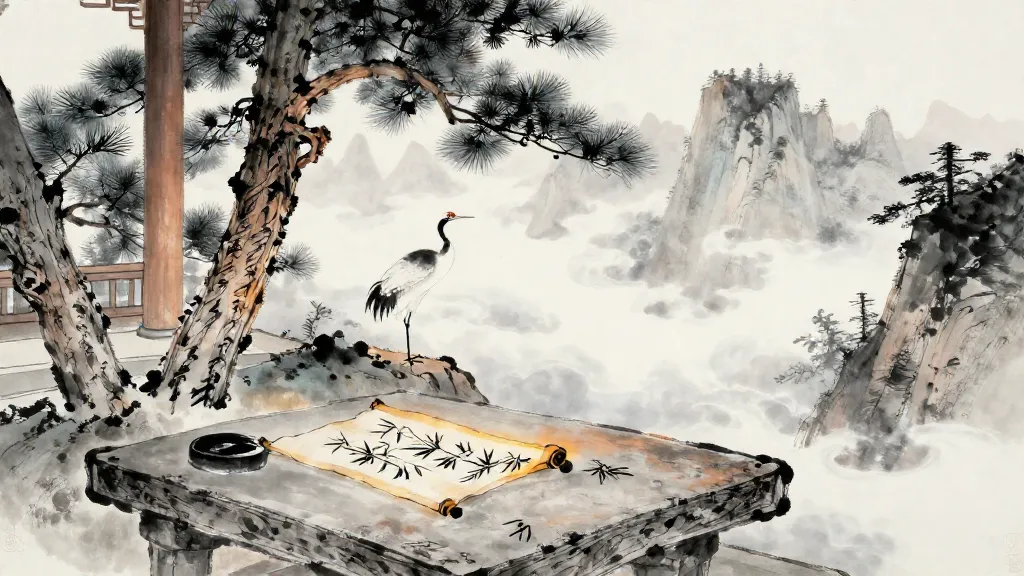
應帝王 (Fit for Emperors and Kings) — Chinese ink painting

莊子 Zhuangzi · Chapter 7

應帝王

Fit for Emperors and Kings

View:

無名人論治天下

The Nameless Man on Governing

天根游於殷陽,至蓼水之上,適遭無名人而問焉,曰:"請問為天下。"無名人曰:"去!汝鄙人也,何問之不豫也!予方將與造物者為人,厭則又乘夫莽眇之鳥,以出六極之外,而游無何有之鄉,以處壙埌之野。汝又何帛以治天下感予之心為?"又復問,無名人曰:"汝游心於淡,合氣於漠,順物自然而無容私焉,而天下治矣。"

Tian Gen was wandering on the sunny side of Yin Mountain. When he reached the banks of the Liao River, he happened to meet a Nameless Man and asked: 'Please tell me how to govern the world.' The Nameless Man said: 'Go away! You are a boor! What an unpleasant question! I am just about to set off with the Creator as my companion. When I tire of that, I shall mount the bird of Vastness and Obscurity, fly out beyond the six directions, and wander in the village of Nothing Whatsoever, dwelling in the wilds of Open Emptiness. What business do you have disturbing my heart-mind with talk of governing the world?' Tian Gen asked again. The Nameless Man said: 'Let your mind wander in the flavorless, merge your vital breath with the boundless, follow the natural course of things and allow no room for personal interest — then the world will be governed.'

壺子與季鹹

Huzi and the Shaman Ji Xian

鄭有神巫曰季鹹,知人之死生、存亡、禍福、壽夭,期以歲月旬日若神。鄭人見之,皆棄而走。列子見之而心醉,歸,以告壺子,曰:"始吾以夫子之道為至矣,則又有至焉者矣。"壺子曰:"吾與汝既其文,未既其實。而固得道與?眾雌而無雄,而又奚卵焉!而以道與世亢,必信,夫故使人得而相汝。嘗試與來,以予示之。"

In the state of Zheng there was a spirit-shaman named Ji Xian. He could tell whether people would live or die, survive or perish, meet fortune or misfortune, die young or live long — predicting the year, month, week, and day as though he were a god. The people of Zheng fled at the sight of him. Liezi went to see him and was intoxicated. He returned and told Huzi: 'I used to think your Way was the ultimate, Master, but now I have found something even more ultimate!' Huzi said: 'I have taught you the outward form but not yet the substance. Have you really attained the Way? You have many hens but no rooster — how will you get fertile eggs? You have been matching the Way against the world, insisting on being believed, and that is why people can read your face. Try bringing him to see me, and let him examine me.'

Notes

1person壺子Hú Zǐ

Huzi (壺子) is Liezi's teacher, a master of Daoist arts. Over four visits, he demonstrates to the shaman Ji Xian four progressively deeper states of being, until the shaman flees in terror. This parable teaches that true mastery is unfathomable — no external technique can read it.

渾沌之死

The Death of Hundun

南海之帝為儵,北海之帝為忽,中央之帝為渾沌。儵與忽時相與遇於渾沌之地,渾沌待之甚善。儵與忽謀報渾沌之德,曰:"人皆有七竅以視聽食息,此獨無有,嘗試鑿之。"日鑿一竅,七日而渾沌死。

The emperor of the South Sea was called Shu. The emperor of the North Sea was called Hu. The emperor of the Center was called Hundun. Shu and Hu from time to time met in the territory of Hundun, and Hundun treated them very generously. Shu and Hu discussed how to repay Hundun's kindness: 'All people have seven openings for seeing, hearing, eating, and breathing. Hundun alone has none. Let us try boring some for him.' Each day they bored one opening, and on the seventh day Hundun died.

Notes

1context

This is the closing parable of the Inner Chapters and one of the most powerful in the entire Zhuangzi. Hundun (渾沌, Chaos/Primordial Wholeness) represents the undifferentiated natural state before human intervention. Shu (儵, Swift) and Hu (忽, Sudden) — whose names suggest the frantic pace of purposeful action — destroy Hundun by trying to improve him. The moral: well-intentioned interference with natural wholeness is fatal. Every 'improvement' is a wound. The seven openings (七竅) represent the sensory organs through which we discriminate and differentiate — the very faculties that shatter primordial unity.

Edition & Source

Text
《莊子》 Zhuangzi
Edition
《四部叢刊》本
Commentary
Traditional Daoist commentaries