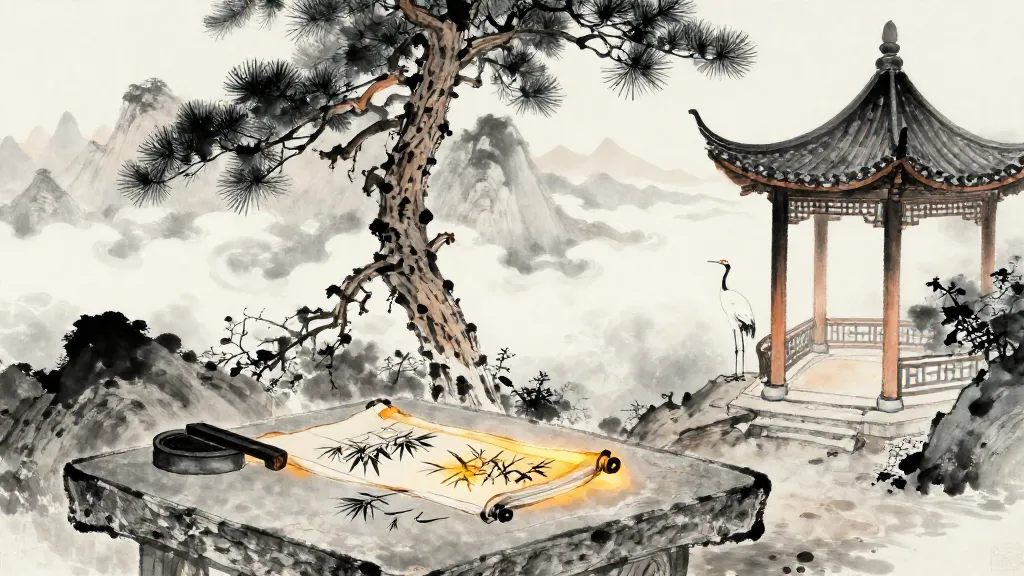
天道 (The Way of Heaven) — Chinese ink painting

莊子 Zhuangzi · Chapter 13

天道

The Way of Heaven

View:

虛靜恬淡

Emptiness, Stillness, Serenity, Blandness

天道運而無所積,故萬物成;帝道運而無所積,故天下歸;聖道運而無所積,故海內服。明於天,通於聖,六通四辟於帝王之德者,其自為也,昧然無不靜者矣!聖人之靜也,非曰靜也善,故靜也。萬物無足以撓心者,故靜也。

The Way of Heaven turns and does not accumulate, so the myriad things come to completion. The Way of the emperor turns and does not accumulate, so the whole world submits. The Way of the sage turns and does not accumulate, so all within the seas defer. Those who understand Heaven, who are versed in sagehood, who extend in the six directions and open in all four seasons the virtue of emperors and kings — they act spontaneously, in deep unconscious stillness. The sage's stillness is not because he says 'Stillness is good' and therefore is still. It is because nothing among the myriad things is sufficient to disturb his heart-mind — therefore he is still.

輪扁斫輪

Wheelwright Bian Carves a Wheel

桓公讀書於堂上,輪扁斫輪於堂下,釋椎鑿而上,問桓公曰:"敢問:公之所讀者,何言邪?"公曰:"聖人之言也。"曰:"聖人在乎?"公曰:"已死矣。"曰:"然則君之所讀者,古人之糟粕已夫!"

Duke Huan was reading a book in his hall. Wheelwright Bian was carving a wheel in the yard below. He laid down his mallet and chisel, went up to the hall, and asked Duke Huan: 'May I ask what words my lord is reading?' The duke said: 'The words of the sages.' 'Are the sages alive?' 'They are dead.' 'Then what my lord is reading is nothing but the dregs and sediment of the ancients!'

Notes

1context

Wheelwright Bian's argument — that the essential knowledge of the sages died with them and cannot be transmitted through words — is one of the most important epistemological claims in the Zhuangzi. It prefigures the Buddhist idea that truth must be realized experientially, not through scripture.

Edition & Source

Text
《莊子》 Zhuangzi
Edition
《四部叢刊》本
Commentary
Traditional Daoist commentaries