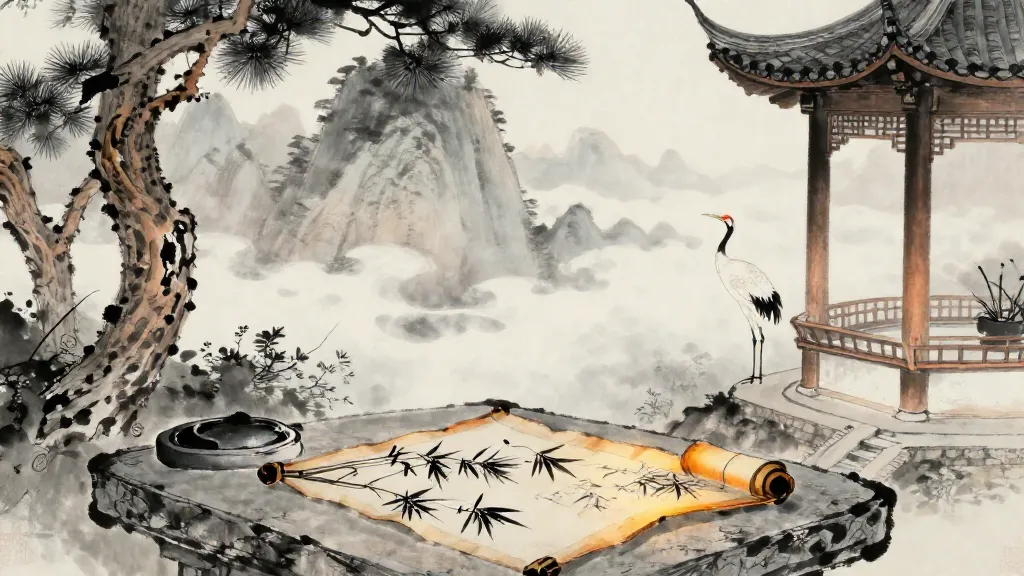
達生 (Mastering Life) — Chinese ink painting

莊子 Zhuangzi · Chapter 19

達生

Mastering Life

View:

佝僂者承蜩

The Hunchback Catches Cicadas

仲尼適楚,出於林中,見佝僂者承蜩,猶掇之也。仲尼曰:"子巧乎,有道邪?"曰:"我有道也。五六月累丸二而不墜,則失者錙銖;累三而不墜,則失者十一;累五而不墜,猶掇之也。吾處身也,若蹶株拘;吾執臂也,若槁木之枝。雖天地之大,萬物之多,而唯蜩翼之知。吾不反不側,不以萬物易蜩之翼,何為而不得!"孔子顧謂弟子曰:"用志不分,乃凝於神。其佝僂丈人之謂乎!"

Confucius was traveling to Chu and emerged from a forest to find a hunchback catching cicadas with a sticky pole as effortlessly as if he were picking them up with his hand. Confucius said: 'How skillful! Is there a Way to this?' The man said: 'I have a Way. For five or six months I practice balancing two balls on the tip of my pole without dropping them — then I miss very few. When I can balance three without dropping them, I miss no more than one in ten. When I can balance five, it is like picking them up with my hand. I hold my body like a stiff tree trunk. My arm is like a dead branch. Though heaven and earth are vast and the ten thousand things are many, I am aware of nothing but cicada wings. I do not turn aside, I do not waver, I would not trade the cicada's wings for all the ten thousand things — how could I fail to get them?' Confucius turned to his disciples and said: 'When the will is undivided, it crystallizes into spirit. This is what the hunchback gentleman means!'

梓慶為鐻

Woodworker Qing Carves a Bell Stand

梓慶削木為鐻,鐻成,見者驚猶鬼神。魯侯見而問焉,曰:"子何術以為焉?"對曰:"臣,工人,何術之有!雖然,有一焉:臣將為鐻,未嘗敢以耗氣也,必齊以靜心。齊三日,而不敢懷慶賞爵祿;齊五日,不敢懷非譽巧拙;齊七日,輒然忘吾有四枝形體也。當是時也,無公朝。其巧專而外骨消,然後入山林,觀天性形軀,至矣,然後成鐻,然後加手焉,不然則已。則以天合天,器之所以疑神者,其是與!"

Woodworker Qing carved wood to make a bell stand. When it was finished, all who saw it were as amazed as though it were the work of gods and spirits. The Marquis of Lu saw it and asked: 'What art did you use to make this?' The woodworker replied: 'I am just a craftsman — what art would I have? But there is one thing. When I am going to make a bell stand, I never dare waste my vital energy on anything else. I fast in order to still my mind. After three days of fasting, I no longer think of congratulations or rewards, titles or stipends. After five days, I no longer think of praise or blame, skill or clumsiness. After seven days, I suddenly forget that I have four limbs and a body. By this time, there is no court or government for me. My skill is concentrated and all outside distractions fade away. Only then do I go into the mountain forest and observe the natural forms of the trees. When I find the perfect form, the bell stand appears before my eyes — then I apply my hand to it; if not, I give up. In this way I match Heaven with Heaven — and that is probably why people suspect the result is the work of spirits!'

Notes

1context

'Matching Heaven with Heaven' (以天合天) is the key phrase. The woodworker's fasting progressively strips away all human concerns — ambition, reputation, even bodily awareness — until only the pure natural faculty (天) remains. When this meets the natural form (天) of the tree, the result transcends mere craftsmanship. Like Cook Ding, the woodworker illustrates that the Way is found through total absorption in one's work.

Edition & Source

Text
《莊子》 Zhuangzi
Edition
《四部叢刊》本
Commentary
Traditional Daoist commentaries