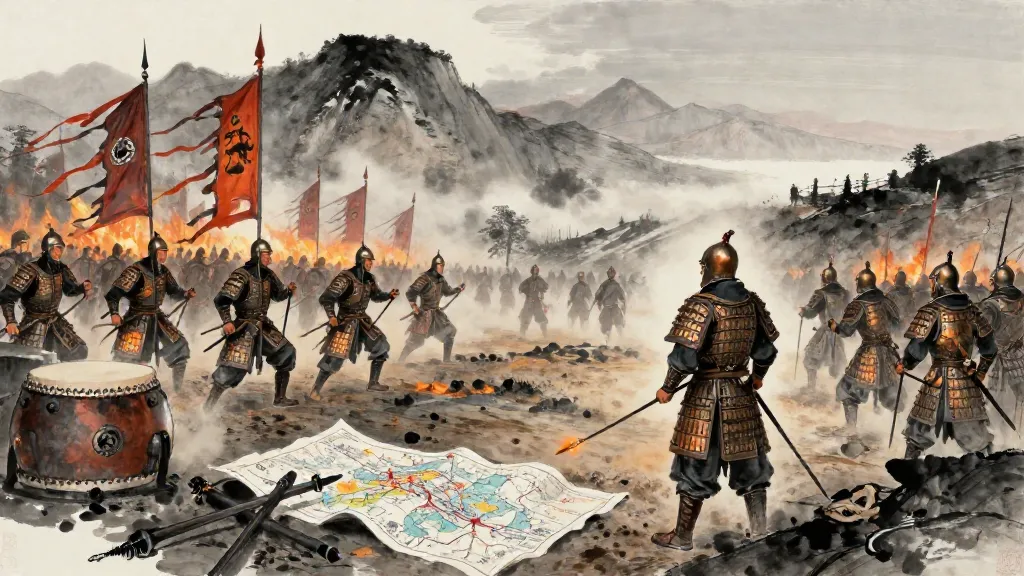
必出 (Certain Escape) — Chinese ink painting

六韜 Liutao · Chapter 34

必出

Certain Escape

View:

必出之道

The Method of Certain Escape

武王問太公曰:「引兵深入諸侯之地,敵人四合而圍我,斷我歸道,絕我糧食,敵人既眾,糧食甚多,險阻又固,我欲必出,為之奈何?」太公曰:「必出之道,器械為寶,勇鬥為首。審知敵人空虛之地,無人之處,可以必出。將士人持玄旗,操器械,設銜枚,夜出,勇力、飛足、冒將之士居前平壘,為軍開道;材士強弩,為伏兵居後;弱卒車騎居中。陣畢徐行,慎無驚駭。以武沖扶胥前後拒守,武翼大櫓以蔽左右。敵人若驚,勇力冒將之士疾擊而前,弱卒車騎以屬其後,材士強弩隱伏而處。審候敵人追我,伏兵疾擊其後,多其火鼓,若從地出,若從天下,三軍勇鬥,莫我能御。」

King Wu asked Taigong: "If we lead our army deep into hostile territory and the enemy converges from all sides to encircle us, cuts off our route home and our food supply, is numerous and well-provisioned, and holds strong defensive positions — if we absolutely must break out, what should be done?" Taigong said: "The method of certain escape treats equipment as paramount and courageous fighting as foremost. Carefully identify the enemy's weak points and unguarded areas — these are where you can certainly break out. Officers and soldiers carry black banners, wield their weapons, and place gag-bits between their teeth. Move out at night. Brave, swift, and daring soldiers lead the way to clear the ramparts and open a path for the army. Elite crossbowmen serve as ambush troops in the rear. Weaker soldiers and chariots stay in the center. When the formation is complete, advance slowly and take care not to cause alarm. Use Martial Assault Fushi to guard front and rear, and Martial Wing Great Shields to screen left and right. If the enemy is startled, the brave and daring soldiers strike forward with full force; the weaker soldiers and chariots follow behind them; the elite crossbowmen remain hidden in ambush positions. When you have confirmed the enemy is pursuing, the ambush troops strike hard at their rear, with fires blazing and drums thundering as if rising from the earth or descending from heaven. The three armies fight with fury, and nothing can withstand us."

渡水突圍

Breaking Through Across Water

武王曰:「前有大水、廣塹、深坑,我欲逾渡,無舟楫之備,敵人屯壘,限我軍前,塞我歸道,斥堠常戒,險塞盡守,車騎要我前,勇士擊我後,為之奈何?」太公曰:「大水、廣塹、深坑,敵人所不守,或能守之,其卒必寡。若此者,以飛江、轉關與天潢以濟吾軍。勇力材士從我所指,沖敵絕陣,皆致其死。先燔吾輜重,燒吾糧食,明告吏士,勇鬥則生,不勇則死。已出,令我踵軍設雲火遠候,必依草木、丘墓、險阻,敵人車騎,必不敢遠追長驅。因以火為記,先出者令至火而止,為四武沖陣。如此,則吾三軍皆精銳勇鬥,莫我能止。」武王曰:「善哉!」

King Wu said: "If there is a great river, wide moat, or deep pit ahead, and I wish to cross but have no boats or oars, while the enemy camps at their ramparts blocking my front, seals my route home, maintains constant scouting vigilance, guards every pass, with chariots and cavalry blocking my front and elite soldiers striking my rear — what should be done?" Taigong said: "Great rivers, wide moats, and deep pits are places the enemy does not guard, or if they guard them, the garrison must be small. In such cases, use Flying River pontoons, winch pulleys, and Heaven's Pool boats to ferry the army across. Brave and elite soldiers follow my direction, charging through the enemy and breaking their formations, each one resolved to fight to the death. First burn our supply wagons and provisions, and announce clearly to all officers and soldiers: fight bravely and you live, fail to fight and you die. Once we have broken out, order the trailing forces to set signal fires as distant sentinels, sheltering among trees, burial mounds, and rough terrain. The enemy's chariots and cavalry will not dare pursue far. Use the fires as markers — those who break out first halt at the fire positions and form the Four Martial Assault Formation. Thus our three armies will all fight as elite and courageous warriors, and nothing can stop us." King Wu said: "Excellent!"

Edition & Source

Text
《六韜》 Liutao
Edition
中華古詩文古書籍網 transcription
Commentary
Traditional military commentaries