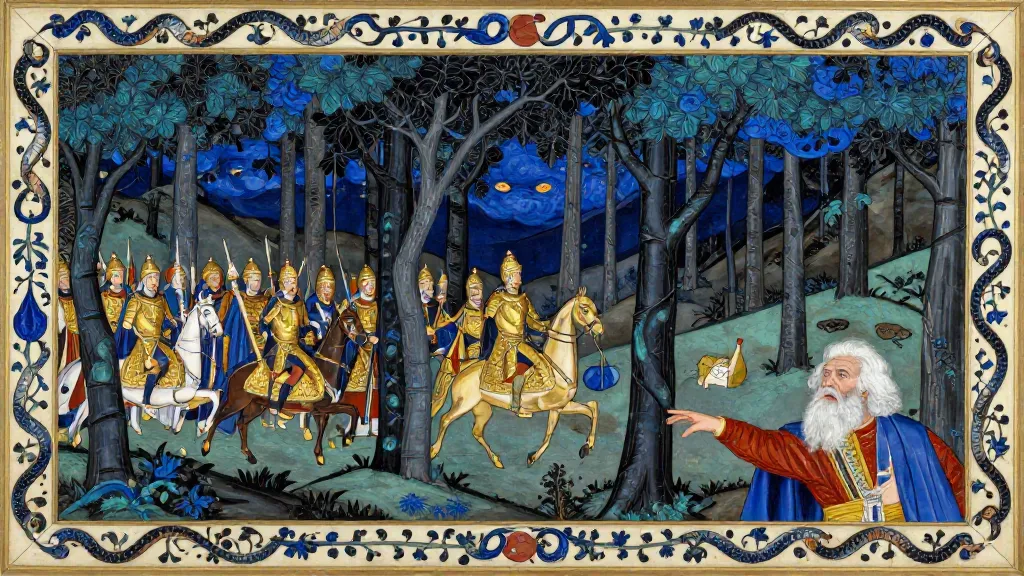
Shahnameh · 2 chapters · Mythological era (Kay Kavus)
The Seven Trials
A king's hubris drags the nation into catastrophe; a champion's individual excellence must clean up the institutional failure — but the champion's competence only enables the next round of royal recklessness.
Commentary
Kay Kavus is warned in the clearest possible terms. Zal, the oldest and wisest counselor in Iran, rides to the throne and lays out the case with historical precision: no king in the entire Kayanid line — not Jamshid, not Fereydun, not Manuchehr, not Kay Qobad — ever attempted to conquer Mazandaran. The land is demon-haunted, spell-bound, and unconquerable by sword, by treasure, or by wisdom. The argument is not vague caution; it is a specific institutional memory spanning generations of kingship, delivered by a man whose own life stretches across centuries. Kavus listens, dismisses every point, and marches his entire army into the trap. His reasoning is pure overconfidence: my army is larger, my heart bolder, my fortune greater. He does not refute Zal's evidence; he simply asserts that he is the exception. This is the archetype of the impetuous ruler who mistakes personal vitality for strategic judgment — a figure Ferdowsi will return to again and again, but never more starkly than here, where the gap between the counsel given and the disaster that follows is measured in a single scene.
The catastrophe is swift and total. Kavus's army sacks the border cities of Mazandaran with terrifying ease — an ease that is itself the trap. The initial plunder is so rich, the resistance so light, that Kavus congratulates himself and presses deeper. Then the White Div descends. A cloud of supernatural darkness engulfs the Iranian host. Two-thirds of the army is blinded. The king himself loses his sight. The treasury is seized, the army taken captive, and Kavus is left groaning in chains, repeating the words that define his character for the rest of the epic: 'This fault was mine.' The White Div does not kill him. He keeps Kavus alive specifically so that the king can suffer the full weight of his own folly — a punishment more devastating than death, because it forces consciousness of error without the possibility of correction. The institutional failure is complete: the king who was supposed to protect Iran has instead delivered its entire military apparatus into enemy hands.
The Seven Trials exist because of this institutional collapse. Rostam must ride alone down the shorter, more dangerous road to Mazandaran because the conventional army has already been destroyed by the conventional route. Each trial escalates in a deliberate progression from the physical to the spiritual. The lion tests animal ferocity; the desert tests endurance and faith; the dragon tests the bond between warrior and mount, nearly destroying it when Rostam threatens to kill Rakhsh for waking him; the sorceress tests perception, defeated not by strength but by the involuntary power of God's name on Rostam's lips; Oulad tests strategic intelligence, converting an enemy into a guide through promise and intimidation; Arzhang tests raw battlefield dominance; and the White Div tests everything at once — courage, stamina, timing, and the willingness to fight a creature whose body fills a cavern from wall to wall. The progression is not accidental. Ferdowsi is constructing an argument about what individual heroism actually requires when institutions have failed: not just physical power, but spiritual clarity, tactical patience, and the ability to improvise alliances in hostile territory.
The champion's paradox is the structural engine of the entire Kayanid age. Rostam's competence rescues Kavus completely. He kills the White Div, restores the army's sight with three drops of the demon's heart-blood, defeats Arzhang's forces, carries the sorcerer-king of Mazandaran as a boulder on his shoulders, and hands the whole campaign back to Kavus as a victory. The king prostrates himself before God, distributes treasure, holds court in the conquered land, and returns to Iran in triumph. But the rescue is so total that it insulates Kavus from the consequences of his own judgment. He suffers, he repents, he acknowledges his error — and then, as Ferdowsi's audience knows, he will almost immediately attempt to fly to heaven on an eagle-borne throne, requiring Rostam's intervention yet again. The champion's excellence does not educate the king; it merely resets the cycle. Each rescue confirms to Kavus that the system will catch him, that there is always a Rostam at the end of the road, and that royal recklessness carries a price someone else will pay.
The cross-civilizational parallel is precise. In the Warring States period, the state of Zhao sent its entire army to Changping under a young and overconfident commander, Zhao Kuo, who had been explicitly warned by his own mother that he was not equal to the task. The result was the annihilation of four hundred thousand men by Qin's Bai Qi — a catastrophe born from the same structural failure: a ruler who ignored institutional counsel and bet the nation on personal confidence. The difference is that Zhao had no Rostam. There was no champion capable of riding alone into Qin territory to undo the disaster. The Shahnameh's mythological framework allows for individual rescue in a way that history does not — but Ferdowsi is honest enough to show that the rescue solves the immediate crisis while deepening the long-term problem. A king who can always be saved is a king who never learns. The Seven Trials are magnificent as individual feats of heroism; as institutional policy, they are a catastrophe deferred.
Chapters in this Arc
Zal warns Kavus that no king in Iranian history has dared invade Mazandaran; Kavus dismisses every argument and marches his army into the demon-haunted land, where the White Div blinds and captures the entire host.
Rostam completes the final four trials — sorceress, Oulad, Arzhang Div, and the White Div — then restores the army's sight and leads Kavus to total victory over the King of Mazandaran.