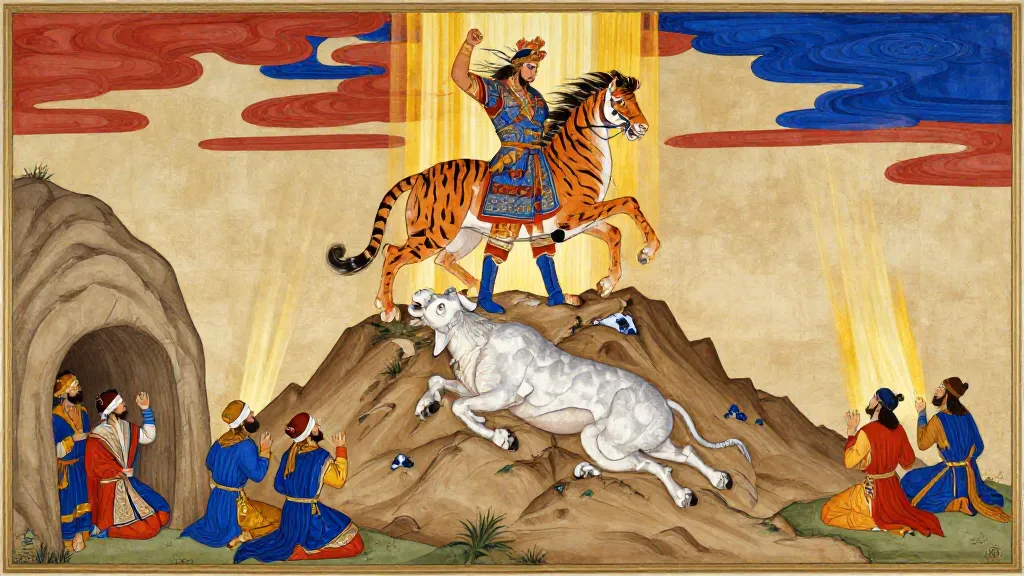
The Mazandaran Campaign (Part 2) — Persian miniature painting

Shahnameh · Fall of the Sasanians

The Mazandaran Campaign (Part 2)

رفتن کاوس به مازندران ۲

Rostam enters the White Div's cavern — a pit like the mouth of hell, its bottom lost in darkness — and finds a creature whose bulk fills the space from wall to wall. He does not kill it in its sleep; he roars to wake it, because the warrior's code demands a named combat even against a monster. The fight that follows is the longest single combat in the early Shahnameh: the Div hurls a millstone, Rostam severs a leg, and the two grapple in mud made of their own blood until Rostam tears out the demon's liver. Three drops of heart-blood poured into the eyes of Kavus and his army restore their sight — the demon's own vital essence undoing his sorcery. The cure completes the symbolic arc: metaphorical blindness led to literal blindness, and only the destruction of the source of darkness can restore vision. But the restoration is also the mechanism by which Kavus escapes consequence entirely, his kingdom handed back to him intact by the one man he did not listen to.

View:

خوان چهارم: کشتن رستم زنی جادو را

Fourth Trial: Rostam Kills the Sorceress

چو از آفرین گشت پرداخته بیآورد مر رخش را ساخته نشست از بر زین وره بر گرفت چمان منزل جادوان در گرفت همی رفت پویان براه دراز چو خورشید تابان بگشت از فراز درخت وگیا دید وآب روان چنان چون بود جای مرد جوان چو چشم تذروان یکی چشمه دید بجامی چو خون کبوتر نبید همی غرم بریان ونان از برش نمکدان وریچار گرد اندرش فرود آمد از اسپ وزین بر گرفت بفرم وبنان اندر آمد شکفت خور جادوان چو رستم رسید از آواز او دیو شد ناپدید نشست از بر چشمه بر گرد نی یکی جام یاقوت پر کرده می ابا می یکی نغز طنبور بود بیابان چنان خانهٔ ور بود تهمتن مر آن را ببر در گرفت بزد رود وگفتارها برگرفت که آوارهٔ بد نشان رستم است که از روز شادیش بهره کم است همه جای جنگست میدان اوی بیابان وکوهست بستان اوی همه جنگ با دیو ونرّ اژدها زدیو وبیابان نیابد رها می وجام وبویا گل ومرغزار نکردست بخشش مرا روزگار همیشه بجنگ نهنگ اندرم دگر با پلنگان بجنگ اندرم

When his prayer was done, Rostam saddled Rakhsh, mounted, and took the road. He rode onward until the blazing sun began to descend, and he came upon trees and grass and running water — a place fit for a young man's rest. He found a spring bright as the eye of a pheasant, and beside it a goblet of wine red as pigeon's blood, roasted game and bread, a salt-cellar and condiments arranged around it.

He dismounted, unsaddled Rakhsh, and fell upon the food in wonder. The demons who had prepared this feast fled at the sound of his approach. He sat beside the spring amid the reeds, found a ruby goblet full of wine and a fine tambur beside it — the desert had become a lord's banquet hall.

Rostam took up the instrument, plucked the strings, and began to sing: "Rostam is a wanderer of ill fortune, whose share of happy days is small. His arena is always a battlefield; his garden is the desert and the mountain. His wars are with demons and great dragons — from demons and deserts he finds no release. Wine and goblets and fragrant flowers and meadows — fate has never granted these to me. Always I am in the jaws of crocodiles; always at war with leopards."

The song and the sound of the strings reached the ears of a sorceress. She adorned her face like spring — though by nature her looks held no beauty — and came before Rostam full of color and scent, and sat down beside him. Rostam, not knowing what she was, gave thanks to God that in the desert of Mazandaran he had found a feast, wine, music, and a young companion. He did not know she was a foul sorceress — Ahriman hidden beneath a painted surface.

He placed a goblet of wine on his palm and invoked the name of God the Merciful. The moment she heard the name of the Lord, her face transformed — her soul could not endure praise, her tongue could not bear prayer. She turned black when she heard the name of God. Rostam saw it in an instant. He flung the loop of his lasso and caught the sorceress by the head. He demanded: "Show yourself as you truly are." A hideous old crone appeared in the noose — wrinkled, full of trickery and malice. He cut her in half with his dagger, and terror filled the hearts of all the sorcerers.

Notes

1context

The Fourth Trial (Khan-e Chaharom). The enchanted table and wine in the wilderness are a classic fairy-tale trap. The trial tests not strength but perception — Rostam's instinctive invocation of God's name is what unmasks the sorceress.

2translation

Rostam's song is a rare moment of self-pity from the Shahnameh's greatest hero. 'His garden is the desert' — the lyric inverts the courtly ideal of the warrior at rest in a rose garden. Ferdowsi gives the superhuman champion a human loneliness.

3context

The sorceress (zan-e jadu) who transforms into a beautiful woman is a recurring motif in Iranian mythology. The test is spiritual: evil cannot endure the name of God. The moment Rostam speaks God's name over the wine, the illusion shatters.

4context

The tambur (طنبور) is a long-necked lute, ancestor of the modern tar and setar. That Rostam plays it reminds us he is not merely a brute warrior — the Shahnameh's heroes are expected to be cultured as well as strong.

خوان پنجم: گرفتار شدن اولاد به دست رستم

Fifth Trial: Rostam Captures Oulad

وز آنجا سو راه بنهاد روی چنان چون بود مردم راه جوی همی رفت پویان بجائی رسید که اندر جهان روشنائی ندید شب تیره چون روی زنگی سیاه ستاره بخمّ کمند اندرست عنان رخشرا داد وبنهاد روی نه افراز دید از سیاهی نه جوی وز آنجا سوی روشنائی رسید زمین پرنیان دید یکر زخوید جهانی زپیری شده نوجوان همه سبزه وآبهای روان برون کرد ببر بیان از برش بخوی اندرون غرقه بد مغفرش بگسترد هر دو ابر آفتاب بخواب وبه آرامش آمد شتاب لگام از سر اسپ بر کرد خوار رها کرد بر خوید وبر کشتزار چو در سبزه دید اسپرا دشتبان کشاده زبان شد دمان ودنان سوی رتم ورخش بنهاد روی یکی چوب زد گرم بر پای اوی چو از خواب بیدار شد پیلتن بدو دشتبان گفت کای اهرمن چرا اسپ در خوید بگذاشتی بر رنج نابرده بر داشتی

From there Rostam set his face to the road like a wayfarer. He rode on until he reached a place where no light existed in the world — a night as black as the face of a Zangi, the stars caught in the loop of a lasso. He gave Rakhsh the reins and pressed forward, seeing neither height nor stream in the blackness.

At last he emerged into light. The ground spread before him like silk, thick with young wheat — a world that had turned from old age back to youth, all greenery and running water. His clothes were soaked through like water itself; his helmet was drenched in sweat. He stripped off the tiger-skin armor and spread both garments in the sun. Sleep and rest came upon him in a rush. He removed Rakhsh's bridle and let him loose upon the wheat and the sown fields.

When a field-warden saw the horse in the crop, his tongue flew loose in fury. He ran toward Rostam and Rakhsh and struck the sole of Rostam's foot hard with a stick. The elephant-bodied one woke. The field-warden shouted: "You demon! Why did you turn your horse loose in the wheat? You reap where you never labored!"

Rostam's temper flashed. He leapt up, seized both the man's ears, squeezed, and tore them from his head without a word. The field-warden snatched up his ears and fled, howling in astonishment.

In that region a warrior named Oulad held command — a young, bold, and famous champion. The field-warden ran to him, blood pouring from his head and hands, his ears ripped away. He cried: "A man like a black demon — clad in a leopard-skin coat and an iron helm — sits yonder. He is Ahriman from head to foot, or a dragon sleeping in armor. I went to drive his horse from the field, and he leapt up, tore off my ears, and went back to sleep."

Oulad gathered his warriors and rode out to see this stranger for himself. When they neared, Rostam mounted Rakhsh and drew his glittering sword like a roaring thundercloud. Oulad demanded his name: "What manner of man are you? Who is your king? Why did you tear off my field-warden's ears and let your horse trample the crop? I will bring the sky down dark upon you."

Rostam answered: "My name is the thundercloud — if a thundercloud should fight like a lion. I rain down lance and sword; I bring proud heads into the dust. If my name should pass your ears, the blood in your veins would freeze." Then he fell upon Oulad's host. Like a lion among sheep, he slaughtered all who stood around him, cutting down two heads at a single blow. The army shattered and scattered to the mountains and ravines.

Rostam pursued Oulad like a raging elephant, lasso coiled on his arm. When Rakhsh drew close, Oulad's day went dark. Rostam cast his long lasso, caught the chief by the head, pulled him from his horse, bound both his hands, threw him to the ground, and said: "If you speak truth, I will release you. When I have defeated the demons, I will give the land of Mazandaran into your hands. Show me where the White Div dwells, where Pulad Ghandi and Bid keep their posts, where Kay Kavus is held in chains. If you are true, you shall be king of this land. If you lie, I will make a river of blood run from your eyes."

Oulad answered: "Clear the anger from your mind and open your eyes. You will find from me every sign you seek. It is one hundred farsangs to the place where Kay Kavus groans in captivity, and another hundred to the mountain pass of the demons. Between two mountains lies a place of terror. Twelve thousand war-demons stand guard there by night. Pulad Ghandi is their general and Bid their sentinel. The chief of all the demons is the White Div — at his approach the mountains tremble like willows. His body is like a mountain; his shoulders and neck are ten ropes across. You, with all your height and strength — it is not wise to make war on such a demon."

Rostam laughed at his words and said: "If you are my guide, you will see what a single elephant-bodied man can do against that famous Ahriman."

Notes

1personاولادOulad

Oulad, a local chieftain or warlord in the borderlands of Mazandaran. After Rostam defeats and captures him, Oulad becomes his guide through the remaining trials. Rostam promises him the throne of Mazandaran as reward.

2context

The Fifth Trial (Khan-e Panjom) is unusual: it is not a supernatural encounter but a human confrontation. The comic violence of tearing off the field-warden's ears gives way to the strategic capture of Oulad, who becomes essential to the mission as a guide.

3translation

'My name is the thundercloud' — Rostam refuses to give his real name at first, following the heroic convention of concealing one's identity to increase the enemy's terror. When the name 'Rostam' is finally revealed, it is meant to paralyze.

4personپولاد غندیPulad Ghandi

Pulad Ghandi (پولاد غندی) and Bid (بید), lesser demon commanders who guard the approaches to the White Div's mountain stronghold.

5context

Oulad's description of the White Div — 'his body is like a mountain, his shoulders ten ropes across, at his approach mountains tremble like willows' — establishes the scale of the final trial. The farsang distances (200 total) emphasize the remoteness of the demon stronghold.

خوان ششم: جنگ رستم و ارژنگ دیو

Sixth Trial: Rostam Fights Arzhang Div

یکی مغفر خسروی بر سرش خوی آلوده ببر بیان در برش به ارژنگ سالار بنهاد روی چو آمد بر لشکر جنگجوی یکی نعره زد در میان گروه که گفتی بدرّید دریا و کوه برون جست از خیمه ارژنگ دیو چو آمد از آنسان بگوشش غریو چو رستم بدیدش بر انگیخت اسپ بر آمد بر او چو آذرگشسپ سر وگوش بگرفت بیالش دلیر سر از تن بکندش بکردار شیر پر از خون سر دیو کنده زتن بینداخت از آن سو که بد انجمن چو دیوان بدیدند گوپال اوی بدرّید دلشان زچنگال اوی نکردند یاد از بر وبوم ورست پدر بر پسر همی راه جست برآمیخت شمشیر کین پیلتن زدیوان بپرداخت آن انجمن

With the royal helmet on his head and the sweat-stained tiger-skin upon his breast, Rostam set his face toward Arzhang, commander of the demon host. He rode up to their camp and let loose a war-cry in their midst so tremendous that you would have said the sea and the mountains split apart.

Arzhang Div burst from his tent at the sound. The moment Rostam saw him, he spurred Rakhsh forward and fell upon the demon like the sacred fire of Adur Gushnasp. He seized Arzhang by the head and ears, and tore his head from his body as a lion tears its prey. He flung the blood-drenched head toward the assembled demons.

When the demons beheld his mace and the savagery of his claws, their hearts were ripped apart with terror. They forgot their homeland and their kin — fathers trampled over sons to find a way of escape. Rostam's sword of vengeance mingled among them, and he emptied that assembly of demons entirely.

When the sun lit the world again, he rode hard to Mount Aspruz, untied Oulad from his bonds, and they sat beneath a tall tree. Rostam asked Oulad the way to the city where Kay Kavus was held. When he heard it, he set his face in that direction, with Oulad running on foot before him to show the road.

When they entered the city, Rakhsh let loose a neigh so mighty that its sound pierced all the way to the place where Kavus was hidden. The king heard it and rejoiced, for he knew that deliverance had come. He told his companions, but they refused to believe him, thinking grief had disordered his wits. But not long did they doubt, for soon Rostam himself stood before them. When the nobles heard his voice and his step they repented of their disbelief.

Kay Kavus embraced Rostam and asked of his journey and of Zal. Then he said: "We cannot waste time with sweet words. You must go at once to the White Div, for if he hears that Arzhang has fallen, he will march from his mountain stronghold with the whole multitude of demons, and even your might may not stand before them all. Go to the Seven Mountains and destroy the White Div before the news reaches him. You alone can save Iran — for I cannot help you, nor can my warriors, for our eyes are filled with darkness. A physician has told me that only the blood of the White Div's heart, dropped into our eyes — three drops — will wash away the darkness and restore our sight. Go forth, my son, and may God be gracious to you."

Notes

1context

The Sixth Trial (Khan-e Sheshom) is the swiftest and most brutal of the seven. Arzhang Div, the demon commander who has been guarding Kavus's plundered treasure, is dispatched in a single movement — head torn off barehanded. The speed underscores Rostam's escalating power as he approaches the climax.

2personارژنگ دیوArzhang Div

Arzhang Div (ارژنگ دیو), the military commander of Mazandaran's demon forces. His name may derive from the legendary painter Arzhang, or from the Manichaean illuminated book Arzhang — in either case, an ironic name for a creature of ugliness.

3context

The cure for the Iranians' blindness — three drops of the White Div's heart-blood in the eyes — is a motif of sympathetic magic. The demon who brought darkness can alone restore light. This sets up the final trial as both a combat and a medical quest.

4placeهفت کوهHaft Kuh

The Seven Mountains (هفت کوه), the White Div's stronghold, deep in the interior of demon territory. The name evokes the Zoroastrian cosmic geography of seven climes (haft keshvar).

خوان هفتم: کشتن رستم دیو سپید را

Seventh Trial: Rostam Kills the White Div

وز آنجایگه تنگ بسته کمر بیآمد پر از کینه وجنگ سر ابا خویشتن برد اولاد را همیراند آن رخش چو باد را چو رخش اندر آمد بدآن هفت کوه بدآن نرّه دیوان گروها گروه بنزدیک آن غار بی بن رسید بگرد اندرش لشکر دیو بدید به اولاد گفت آنچه پرسیدمت همه بر ره راستی دیدمت کنون چون گه رفتن آمد فراز مرا راه بنمای وبکشای راز بدو گفت اولاد چون آفتاب شوم گرم دیو اندر آید بخواب بر ایشان تو پیروز باشی بجنگ کنون یکزمان کرد باید درنگ نکرد ایچ رستم برفتن شتاب بدآن تا بیآمد بلند آفتاب سر وپای اولاد را کرد بست بخمّ کمد آنگهی بر نشست بر آمیخت جنگی نهنگ از نیام بغرّید چون رعد وبر گشت نام میان سپاه اندر آمد چو گرد سرانرا بخنجر همی دور کرد نه اتاد کس پیش او در بجنگ نجستند با او یکی نام وننگ وز آنجایگه سوی دیو سپید بیآمد بکردار تابنده شید بمانند دوزخ یکی چاه دید بن چاه از تیرگی ناپدید

Rostam girded his belt tight, his head full of vengeance and war, and took Oulad with him. He drove Rakhsh like the wind until they reached the Seven Mountains, where demon warriors swarmed in groups beyond counting. He came to the edge of a bottomless cavern and saw the demon host deployed around it.

He said to Oulad: "Everything I have asked of you, I have found to be true. Now the time to advance has come — show me the way and reveal the last secret." Oulad answered: "When the sun grows hot, the demons fall asleep. That is when you will have victory over them. Wait a little while."

Rostam did not rush forward. He waited until the sun stood high overhead. He bound Oulad hand and foot, then mounted Rakhsh and drew the war-serpent from its sheath. He roared like thunder and shouted his name, and plunged into the demon army like a dust-storm, sweeping heads from shoulders with his blade. Not one stood before him in combat; none sought to match him in honor or shame.

From there he advanced toward the White Div, shining like the sun itself. He found a pit like the mouth of hell, its bottom lost in darkness. He stood for a time with sword in hand — there was no room for battle and no room for retreat. He rubbed his eyelids, washed his eyes, and searched through the dark cave. In the blackness he saw a shape like a mountain, its bulk filling the cavern from wall to wall — face dark as jet, hair white as a lion's, the whole world full of his height and breadth.

The White Div lay asleep. Rostam did not hurry to kill him in his slumber. He roared like a leopard. The demon woke and came to battle. He advanced on Rostam like a mountain army — arms of iron, helm of iron. He seized a millstone and hurled it. Rostam was seized with dread and said to himself: "If I survive today, I will live forever."

He raged like a furious lion and struck a blow with his sharp sword upon the demon's waist. By the force of Rostam's arm, one leg and one foot fell away from the creature's body. Maimed, the White Div grappled with him. Like an exalted elephant and a savage lion they wrestled. The demon fought on one leg against the champion, turning the whole cavern upside down. He seized Rostam's arms and shoulders, striving to bring the hero down. They tore flesh from each other; blood turned the ground to mud.

Rostam said in his heart: "If I survive today, I am alive forever." The White Div said in his heart: "I must give up hope of my sweet life. If I escape the claws of this dragon with my skin and sinews torn, then neither great nor small in all Mazandaran shall ever see me again."

In this way the two battled, blood and sweat running in streams. At last Rostam called upon the strength of the Creator. He strained with all his might through pain and vengeance, twisted the demon down, seized him like a roaring lion, lifted him up by the neck, and hurled him to the ground so that the life left his body. He drove his dagger in and split the demon's chest open, and tore the liver from the dark body.

The cavern was nothing but corpses; the world had become a sea of blood. He returned to Oulad, loosed his bonds, and tied the liver to his saddle. Oulad cried: "O lion — you have conquered the world with your sword. Release this servant, for your bonds have bitten into my flesh. Remember your promise." Rostam answered: "I will — but there is still much to do. I must yet overthrow the King of Mazandaran. When that is done, I will fulfill my word."

They rode back to where Kavus was held. When the king heard that Rostam had returned with victory on his brow, he shouted for joy, and all the host shouted with him. Rostam came before them, took the blood of the White Div's heart, and poured it into their eyes. The eyes of Kay Kavus and his men were opened, and they beheld once more the glory of day.

Notes

1context

The Seventh Trial (Khan-e Haftom), the climax of the Haft Khan. Oulad's tactical advice — wait for the midday heat when demons sleep — proves decisive. The battle with the White Div is the longest single combat in the early Shahnameh.

2translation

'If I survive today, I am alive forever' (گر امروز جان بماند بمن زنده ام جاودان) — Rostam's interior thought during the fight is a rare admission of mortal fear from the Shahnameh's supreme hero. The White Div has the same thought in mirror image — both combatants understand this is a fight to the death.

3context

The White Div's liver (جگر, jegar) is the cure for the Iranians' blindness. In Persian medical and poetic tradition, the liver is the seat of courage and life-force. Three drops of its blood restore sight — the demon's own vital essence undoes his sorcery.

4context

The restoration of sight completes the symbolic arc: Kavus's metaphorical blindness (ignoring Zal's counsel) led to literal blindness (the White Div's spell), and only the destruction of evil itself can restore vision. The Seven Trials have purged the consequences of the king's pride.

آمدن رستم نزدیک شاه مازندران به پیغمبری

Rostam Goes as Envoy to the King of Mazandaran

چو نامه بمهر اندر آورد شاه جهانجوی رستم بپیمود راه بزین اندر افگند گرز گران چو آمد بنزدیک مازندران بشاه آگهی شد که کاؤس کی فرستاده ونامه افگند پی فرستادهٔ چون هزبر دژم کمندی بغتراک بر شست خم بزبر اندرون بارهٔ گام زن یکی ژنده پیلستت گوئی بتن چو بشنید سالار مازندران زلشکر گزین کرد چندی سران بفرمودشان تا جبیره شدند هزبر ژیانرا پذیره شدند بیآراسته لشکری چو بهار برفتند نزدیک آن نامدار چو چشم تهمتن بدیشان رسید بره بر درختی گشن شاخ دید گرفتش هم آنگه دو شاخ درخت به تندی مر آنرا بپیچید سخت درخت از بن وبیخ بر کند زود که اورا بتن بر زیانی نبود بکند وچوژپین بکف در گرفت بماندند لشکر همه زو شکفت بینداخت چون نزد ایشان رسید سواران بسی زیر شاخ آورید

Kay Kavus now wrote a letter to the King of Mazandaran, counseling him to submit and make peace. He told him that Arzhang was slain, the White Div destroyed, and that Rostam would slay the king himself if he did not pay tribute to Iran. He sealed the letter with the royal seal and Rostam bore it forth.

Word reached the King of Mazandaran that Kay Kavus had sent an envoy — a messenger fierce as a raging lion, with a coiled lasso at his saddle-horn, mounted on a tall war-horse, his body like a maddened elephant. The king selected a company of his finest warriors and sent them out in splendor, arrayed like a spring garden, to receive this famous envoy.

When Rostam's eyes fell upon them, he saw beside the road a tree of thick branches. He seized two limbs, wrenched them violently, and tore the tree out by its roots without the slightest strain to his body. He held it in his hand like a javelin. The welcoming party stood in astonishment. When he reached them, he flung the tree among the riders and brought many horsemen crashing to the ground.

One of the champions of Mazandaran — a man who had been foremost among their lords — stepped forward and seized Rostam's hand to test his grip. Rostam laughed and squeezed. The blood left the man's face, and his veins stood out. Then the king sent Kalahour, his mightiest knight, to retrieve their honor. Kalahour pressed Rostam's hand like a vise, and Rostam felt the sting of it. But he would not let the men of Mazandaran see him yield. He gripped Kalahour's hand and crushed it until the nails fell from his fingers like leaves from a tree. Kalahour returned to the king with his hand hanging ruined, and counseled him to make peace with a land that sent such messengers.

But the king would not sue for peace. He summoned Rostam before him. He studied the envoy's arms and chest and said: "Surely you are Rostam, for you have the shoulders of a champion." Rostam replied: "I am but a servant, unworthy to serve even in his retinue. He is a champion great and strong, the like of whom the earth has never seen."

Then he handed over the letter. When the king read it, he was wild with anger. He said: "Surely the man who sent you is mad. If he is master in Iran, I am lord of Mazandaran, and never shall he call me vassal. It was his own arrogance that delivered him into my hands, yet he has learned nothing. Go tell him the King of Mazandaran will meet him on the battlefield."

Rostam departed without accepting the rich gifts the king offered, for he too was angered. He rode back to Kavus with a heart hungry for vengeance and reported everything he had seen and heard. He told the king: "Worry no more. Prepare for war. Those warriors and champions are contemptible in my eyes — they are not worth a grain of dust. With this mace I will bring ruin upon them all."

Notes

1context

The embassy scene follows the standard Shahnameh diplomatic sequence: letter, envoy display of strength, audience with the enemy king, rejection, war. Rostam's feats of strength — uprooting the tree, the handshake contest — are deliberate provocations designed to demoralize.

2personکلاهورKalahour

Kalahour (کلاهور), the mightiest knight of Mazandaran, sent to crush Rostam's hand. His failure and mangled fingers become the proof that resistance is futile.

3translation

Rostam's claim to be 'merely a servant' of the true champion is a classic piece of Persian diplomatic intimidation — ta'arof inverted into a threat. If the servant is this strong, what must the master be?

4context

The King of Mazandaran's refusal to submit despite the destruction of both Arzhang and the White Div represents the final obstinacy of evil — a refusal to accept reality that mirrors Kavus's own earlier refusal to heed Zal's wisdom.

جنگ کاوس با شاه مازندران

Kavus Battles the King of Mazandaran

چو رستم زمازندران گشت باز شه جادوان رزم را کرد ساز سراپرده از شهر بیرون کشید سپه را همه سوی هامون کشید چو گرد سپاه از میان بر دمید همان رنگ خورشید شد ناپدید نه هامون پدید ونه دشت نه وکوه زمین گشت از پای پیلان ستوه بیک هفته دو لشکر نامجوی بروی اندر آورده زین گونه روی بهشتم جهاندار کاؤس شاه زسر بر گرفت آن کیانی کلاه به پیش جهانداور رهنمای بیآمد همی بود گریان بپای وز آنپس بمالید بر خاک روی چنین گفت کای داور راست گوی برین نرّه دیوان بی ترس وباک ابا آفرینندهٔ باد وخاک مرا ده تو فیروزی و فرّهی بمن تازه کن تخت شاهنشهی چو رعد خروشنده شد بوق وکوس خور اندر سراپردهٔ آبنوس از آنسو که بد شاه مازندران بشد پیلتن با سپاهی گران بر آورد گرز وبر آورد جوش هوا گشت از آواز او پر خروش از آواز آن گرد سالار کش نه با دیو جان و نه با پیل هش وز آنپس تهمتن یکی نیزه خواست سوی شاه مازندران تاخت راست یکی نیزه زد بر کمربند اوی زگبر اندر آمد بپیوند اوی شد از جادوئی تنش یک لخت کوه از ایران نظاره بر آن بر گروه

When Rostam returned from his embassy, the sorcerer-king of Mazandaran prepared for war. He drew his pavilions out of the city and marshaled his entire army upon the plain. When the dust of the host rose between the two forces, the color of the sun itself vanished. Neither plain nor mountain could be seen; the ground groaned beneath the feet of war-elephants.

The two armies drew up their lines. Kavus placed Tus on the right wing, where the mountain echoed with the wail of trumpets. Gudarz and Keshvad held the left, clad entirely in iron. Kavus himself stood in the center. Before the army rode Rostam, who had never known defeat, the heavy mace upon his shoulder.

A demon champion named Juya rode out before the host, his armor blazing, the heat of his sword scorching the earth. He passed before the Iranian lines and bellowed: "Who will seek combat with me? Who can raise dust from water?" Not one warrior came forward — not a vein stirred in them, not a drop of blood. Kavus rebuked his champions: "What has happened to you, warriors and men of war, that this demon has made your heads spin and his voice has darkened your faces?"

None answered. Then Rostam turned his reins, raised his gleaming lance, and asked the king's leave. Kavus said: "This serpent is yours — no one in Iran will seek this fight. Go, and may the Creator be your ally." Rostam spurred Rakhsh to the dueling ground like a maddened elephant, a leopard beneath a dragon. He cried to Juya: "The one who bore you shall weep — now is the time for grief, not rest." Juya snarled back, but when Rostam shouted his name and charged like a moving mountain, the demon's spirit went dark. He turned to flee, but Rostam was already at his back. He drove his lance through the demon's belt and armor, lifted him from the saddle as a hawk snatches a bird, and hurled him to the ground — mouth full of blood, armor torn to shreds.

The whole army surged forward. For seven days the battle raged — swords and maces flashing like lightning from a thundercloud, screams of demons and shouts of warriors, drums and trumpets and the neighing of horses, blood turning the plain into a lake. Victory leaned to neither side.

On the eighth day, Kavus removed the Kayanid crown from his head and prostrated himself before God. He wept and prayed: "O just Creator, grant me victory and glory over these fearless demons. Renew the throne of kingship for me — not for my sake, who am unworthy, but for the sake of Iran."

He placed the crown back on his head and returned to his army. The trumpets sounded. Rostam surged forward like an elephant. Tus brought up the war-elephants and drums from the rear. Gudarz, Giv, Gorgin, Grazeh, Farhad, and all the named champions pressed the attack. From dawn until the sun stood high, blood ran like water in the channels. Shame and mercy and affection vanished from the world; you would have said the heavens themselves rained maces.

Where the King of Mazandaran held his ground, Rostam advanced with a great force. He raised his mace and roar, and the air filled with his thunderous voice. At the sound, the demons lost their souls and the elephants lost their senses. Elephant trunks and demon corpses lay strewn across miles of the field.

Then Rostam called for a lance and charged straight at the King of Mazandaran. The two came together like thunder — the sorcerer-king and Rostam the champion. Rostam drove his lance through the king's belt and into his body. But as the blow struck, the king used his arts of magic and transformed his body into a slab of rock before the eyes of the entire army.

Rostam was confounded. Kavus arrived with his elephants and standards and asked what had happened. Rostam explained: "I struck him with my lance and thought him finished — but he turned to stone before me." Kavus ordered the strongest men in the army to raise the rock, but none could move it. Then Rostam the elephant-limbed opened his hands — he needed no test of strength. He lifted the great stone and carried it on foot across the seven hills while the army shouted in amazement and scattered jewels and gold upon him.

Before Kavus's pavilion, Rostam set the stone down and said: "Come forth, O King of Mazandaran — or I will shatter you to atoms with my mace." The king heard the threat and was afraid. He emerged from the rock and stood before Rostam in all his ugliness. Rostam took his hand, smiled, and led him before Kavus, saying: "I bring you this piece of rock, whom fear of my blows has brought to submission."

Kavus looked upon the King of Mazandaran — a hideous, long-bodied creature with a neck like a boar — and remembered all the old sufferings. His heart broke and his lips filled with cold sighs. He ordered the executioner to take a sharp sword and cut the demon-king to pieces. Rostam seized the creature by the beard and dragged him out, and the sentence was carried out.

Kavus sent men to the enemy camp and had all the treasure brought forth — crown, throne, gold, jewels, horses, weapons — heaped like mountains. He distributed the spoils to each man according to his suffering. Every ungrateful demon was beheaded. Then Kavus went to the place of prayer and for one week prostrated himself before God in thanksgiving. In the second week he opened the treasuries and gave to all in need. In the third he called for wine and celebration, and held court in Mazandaran.

Then Kavus said to Rostam: "O champion of the entire world, you showed valor at every turn. Through you I have won back my throne. May your heart, your faith, and your creed be radiant." Rostam replied: "Every man has his part to play. But my success came from Oulad, who guided me truly at every step. He has been promised Mazandaran. Now let the king's robe of honor come first — a sealed covenant that he shall be king of this land."

Kavus heard the words of his champion, struck his hand upon his chest in agreement, and bestowed the crown of Mazandaran upon Oulad. Then Kavus turned his face toward Pars and departed, and there was peace in Iran once more.

Notes

1context

The final battle follows the Shahnameh's grand battle formula: seven days of inconclusive combat, a royal prayer on the eighth day, and divine intervention tipping the balance. The pattern recurs throughout the epic.

2context

The King of Mazandaran's transformation into rock is the last act of demonic sorcery in the story. That Rostam can carry the boulder on foot — when the entire army cannot move it — is the final proof that human heroism, allied with divine favor, overcomes all magic.

3personجویاJuya

Juya (جویا), a demon champion who challenges the Iranian army to single combat before the decisive battle. His defeat by Rostam opens the way for the general engagement.

4context

Rostam's insistence that Oulad receive the throne of Mazandaran fulfills his promise from the Fifth Trial and demonstrates the Shahnameh's ethic of loyalty to one's word. The champion's honor depends not only on martial prowess but on keeping faith.

5context

The story ends with Kavus's repentance and thanksgiving — but the Shahnameh's audience knows this is not the last of his follies. He will soon attempt to fly to heaven on an eagle-borne throne, requiring Rostam's rescue yet again. The cycle of royal pride and heroic rescue defines the Kayanid age.

Edition & Source

Author
فردوسی (Ferdowsi, c. 977–1010 CE)
Edition
شاهنامه — تصحیح ژول مل (Jules Mohl critical edition)