Shahnameh · 2 chapters · Mythological era
Tyranny and Revolt
Tyranny is not merely cruel — it is a system that feeds on its own subjects. Zahhak's serpent-shoulders literalize what every empire eventually discovers: the regime that devours its people's minds to sustain itself creates the conditions for its own overthrow.
Commentary
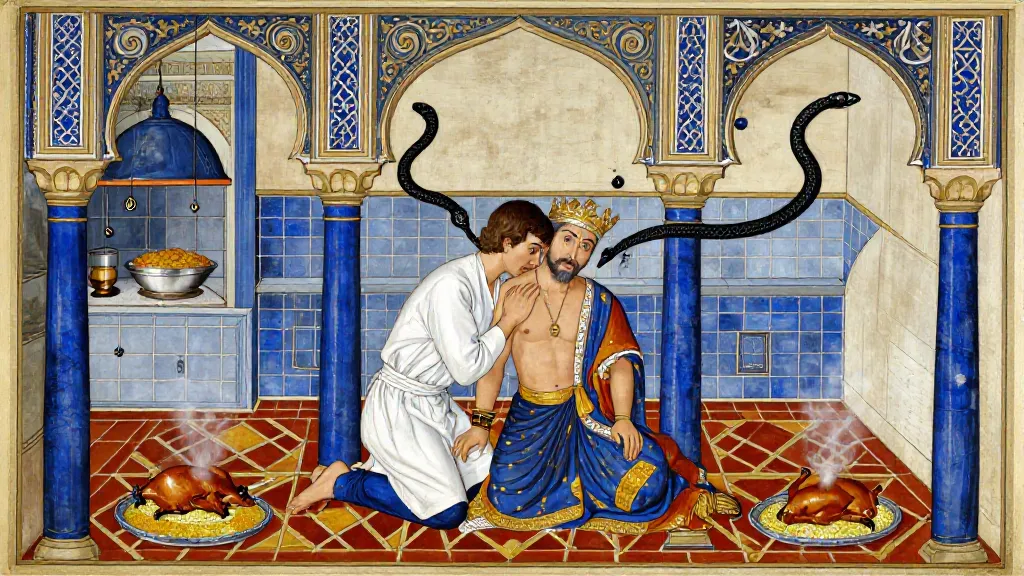
The devil does not conquer — he cooks. This is the political insight buried inside the Shahnameh's most mythological story. Iblis does not appear before Zahhak with an army or an ultimatum. He appears as a young man of clean body and eloquent speech, offering pleasure. First the yolk of eggs, then partridge and white pheasant, then lamb, then the loin of a young bull with saffron and rosewater and aged wine. Each dish is more exquisite than the last. Each draws Zahhak further from the vegetarian innocence of the old world and deeper into dependency on the one who feeds him. By the time Iblis asks to kiss the king's shoulders — a request so strange it should raise alarm — Zahhak's judgment has already been surrendered. He has been eating from the devil's hand for four days. He has praised the cook. He has offered him any reward. The corruption is complete before the serpents even appear. Ferdowsi is describing something more sophisticated than temptation: he is describing the mechanism by which a ruler is captured by the apparatus that serves him. The cook becomes indispensable. The indispensable servant makes one small request. And from that request grow two black serpents that can never be removed.
The serpent-shoulders are the story's central image, and their meaning is political before it is mythological. The snakes cannot be cut away — they grow back like branches of a tree. Every physician in the kingdom tries and fails. Then Iblis returns, this time disguised as a healer, and delivers the prescription that will define Zahhak's thousand-year reign: feed them the brains of men. The regime that began with fine cooking now requires human sacrifice to sustain itself. Two young men slaughtered each day, their skulls opened, their brains served to the serpents on the king's shoulders. This is not allegory straining for relevance — it is a precise description of how tyrannical states operate. The apparatus must be fed. The feeding requires the destruction of the governed. The destruction is not incidental to the regime; it is the regime. Zahhak does not choose cruelty as a policy; cruelty is the biological condition of his continued existence. The serpents are hungry, and they are attached to his body. He cannot rule and not kill.
What makes the Zahhak story structurally interesting as political narrative is that the overthrow comes from below, not from a rival king or a palace coup. Kaveh the blacksmith is not a nobleman, not a general, not a priest. He is a man who works with his hands, whose eighteen sons have been fed one by one to the serpents until only one remains. His rebellion begins not with a battle plan but with a speech — a public accounting delivered to the tyrant's face in the tyrant's own court. 'You must settle your account with me, so that the world may stand in wonder.' He demands that Zahhak justify himself by arithmetic: count the sons taken, show the cause. When Zahhak, shaken, tries to buy him off by returning his last son and asking him to sign the declaration of the king's justice, Kaveh tears the document apart and tramples it. His leather apron — the worthless hide a blacksmith ties behind his legs — goes up on a lance-point and becomes the Kaviani Banner, the royal standard of Iran for a thousand years. The revolt is founded on a craftsman's tool, not a warrior's weapon. Ferdowsi is making a claim about the source of political legitimacy: it rises from the working population, from the people whose children are consumed by the state, and no amount of royal pageantry can manufacture what Kaveh's torn apron authentically possesses.
The cross-civilizational parallel with Qin Shi Huang is structural rather than superficial. Both Zahhak and the First Emperor represent regimes of total extraction — systems that subordinate every human resource to the maintenance of centralized power. Qin's legalist state codified every procedure, conscripted every laborer, burned the books that might generate alternative loyalties. Zahhak's regime literally consumes the brains of its subjects. In both cases, the system is powerful and self-defeating: the more efficiently it extracts, the more completely it alienates the population whose cooperation it requires. The Chen Sheng uprising that ended Qin and the Kaveh revolt that ends Zahhak share the same structural origin — a regime so thorough in its oppression that a single act of public defiance cracks it open. Chen Sheng was a conscript laborer; Kaveh was a blacksmith. Neither had institutional power. Both discovered that the regime's apparent strength was also its brittleness.
Fereydun's victory completes the pattern but adds a crucial qualification. He does not merely defeat Zahhak in battle — the angel Sorush intervenes twice to prevent him from killing the tyrant, instructing him instead to bind Zahhak in chains beneath Mount Damavand. Evil cannot be destroyed; it can only be contained. And Fereydun's legitimacy is established not through conquest alone but through his first act as king: a proclamation ordering soldiers back to soldiering and craftsmen back to craft, restoring the social order that tyranny had scrambled. The most famous couplet of the entire cycle drives the point home — 'Blessed Fereydun was no angel; he was not fashioned of musk and ambergris. Through justice and generosity he won that goodness. Practice justice and generosity — and you are Fereydun.' Kingship is not inherited or seized. It is earned through just governance. The farr — the divine royal glory that departed from Jamshid when he claimed divinity — settles on Fereydun because he restores the proper relationship between ruler and ruled. The tyrant feeds on his people. The just king feeds them.
Chapters in this Arc
Iblis corrupts Zahhak through escalating culinary pleasure, then kisses his shoulders and vanishes — leaving two black serpents that must be fed human brains to survive.
Kaveh the blacksmith publicly defies Zahhak, tears up the declaration of royal justice, and raises his leather apron as a banner — rallying the people to Fereydun, who binds the tyrant beneath Mount Damavand.