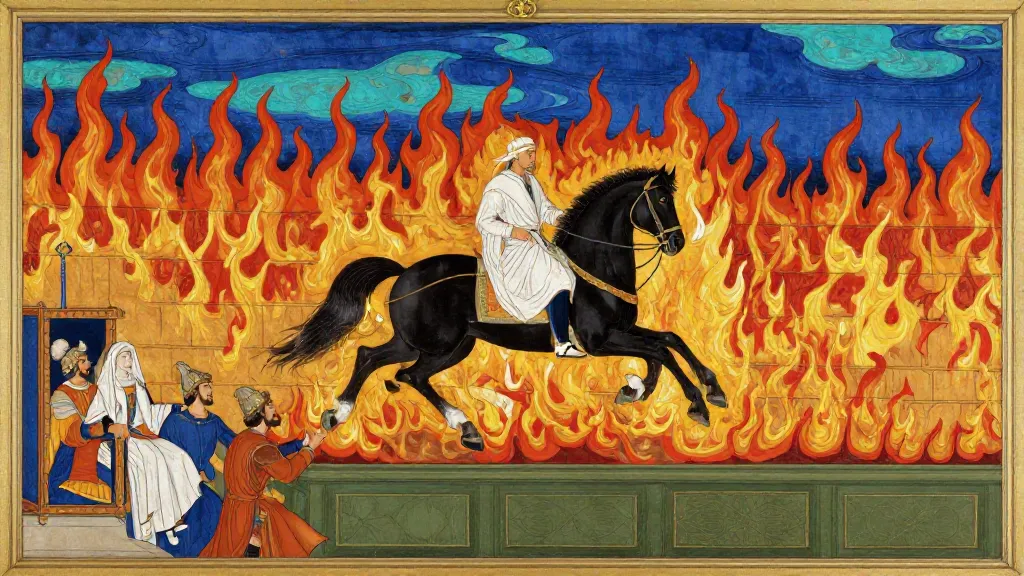
The Story of Siavash (Part 2) — Persian miniature painting

Shahnameh · Fall of the Sasanians

The Story of Siavash (Part 2)

داستان سیاوش ۲

Siavash rides through the wall of fire in white funeral garments — camphor-scented, dressed for his own death — and emerges without a singed hair or a thread of smoke on his robes. The Zoroastrian fire ordeal is the most absolute judicial technology available: sacred fire physically cannot harm the innocent. The crowd roars, the king weeps, and Sudabeh is dragged toward the gallows. Then Siavash intervenes to save her. Not from compassion — from the structural insight that his father will eventually regret the execution and redirect his grief at the son who caused it. The fire proved everything. It changed nothing.

View:

چاره ساختن سودابه و زن جادو

Sudabeh's Plot with the Sorceress

چو دانست سودابه گو گشت خوار نیآویخت در وی دل شهریار یکی چاره جست اندر آن کار زشت ز کینه درختی بنوئی بکشت زنی بود با وی بپرده درون پر از چاره و رنگ و بند و فسون گران بود و اندر شکم بچّه داشت همی از گرانی بسختی گذاشت بدو راز بکشاد و زو چاره جست بدو گفت پیمانت خواهم نخست چو پیمان ستد زرّ بسیار داد سخن گفت ازین در مکن هیچ یاد یکی داروی ساز کین بفگنی مهی یابی ار عهد من نشکنی مگر اینچنین بند و چندین دروغ بدین بچّهٔ تو بگیرد فروغ بکاؤس گویم که این از منست چنین کشته بر دست آهرمنست مگر کین شود بر سیاوش درست کنون چارهٔ این ببایدت جست

When Sudabeh understood that she had been diminished in the king's eyes and that his heart no longer clung to her, she sought a new stratagem for her foul purpose. From the root of hatred she planted a fresh tree of malice.

There was a woman within the harem curtains, full of tricks and cunning and sorcery. She was heavy with child and suffering under the weight of her pregnancy. Sudabeh opened her secret to this woman and sought her help. First she demanded an oath, and when she had it, she gave the woman much gold. She said: "Speak to no one of this. Prepare a drug that will bring on a miscarriage. You will gain a month's reward if you keep my pact. Perhaps through this scheme and these lies, your child will serve to cast a light on my design. I will tell Kavus that the dead infants are mine, killed by the hand of the Evil Spirit — and perhaps this charge will stick to Siavash."

When night fell, the woman drank the drug and the infants of the devil fell from her — two stillborn creatures, deformed as demon-spawn. Sudabeh brought a golden basin, told none of her attendants, placed the monstrous infants in the basin, threw herself down upon her garments, hid the woman away, and let out a wail from the depths of the palace.

All the servants in the hall rushed to Sudabeh's side. They saw two dead infants in the golden basin, and the shrieking rose from the palace to the heavens. When Kay Kavus heard the cry from the harem, he trembled in his sleep and opened his ears. They told the king what had befallen the beautiful queen. He was stricken and did not breathe a word all night. At dawn he rose, grim-faced, and came to find Sudabeh lying there, the harem in uproar, the two infants cast in the golden basin — discarded and wretched.

Sudabeh wept and said: "Now see the sun for what it is! I told you what he did, and you foolishly trusted his words."

The king's heart darkened with suspicion. He withdrew and sat alone in thought, saying: "What remedy can I make for this? I cannot take this lightly."

Notes

1context

Sudabeh's plot with the sorceress represents an escalation from false accusation to manufactured evidence. The use of a pregnant woman's miscarried infants as 'proof' of Siavash's violence is one of the most disturbing episodes in the Shahnameh.

2translation

'From the root of hatred she planted a fresh tree of malice' (ز کینه درختی بنوئی بکشت) — the tree metaphor recurs throughout the Shahnameh. Planting a tree of hatred is the inverse of planting a tree of righteousness; the harvest will be blood.

3context

The 'Evil Spirit' (اهرمن, Ahriman) is the Zoroastrian principle of cosmic evil. Sudabeh frames the miscarriage as demonic violence — implying Siavash's assault caused it — exploiting Zoroastrian cosmology for her deception.

فریب دادن سودابه کاوس را

Sudabeh Deceives Kavus

بزد دست وجامه بدرّید پاک بناخن رخان همی کرد چاک برآمد خروش از شبستان اوی فغانش برآمد از ایوان بگوی یکی غلغل وبانگ زایوان بخاست تو گفتی شب رستخیز است راست بگوش سپهبد رسید آگهی فرود آمد از تخت شاهنشهی پر اندیشه از تخت زرّین برفت بسوی شبستان خرامید تفت بیآمد چو سودابه را دید روی خراشیده وکاخ پر گفتگوی زهر کس بپرسید وشد تنگ دل ندانست کردار آن سنگدل خروشید سودابه در پیش اوی همی ریخت آب وهمی کند موی

Sudabeh struck her hands together, tore her garments clean through, and raked her cheeks with her nails until they bled. A shriek arose from her quarters that rang through the whole palace. Such a clamor and uproar rose from the hall that you would have said it was the night of resurrection itself.

The news reached the king. He came down from his throne full of dark thought and hurried to the harem. He found Sudabeh's face scratched and the palace in tumult. He questioned everyone and his heart grew tight, for he could not fathom the workings of that stone-hearted woman.

Sudabeh wailed before him, tearing her hair and weeping. She said: "Siavash came to my throne and seized me with force. He said: 'My life and heart are full of love for you. Why do you shrink from me, O beautiful one? I desire no one but you.' He tore the crown from my musky hair. See how my garments are torn upon me."

The king was full of thought. He said to himself: "If she speaks truth, then Siavash's head must be severed. But what will wise men say now? A stream that ran clear has turned to blood." He summoned those senior women of the harem who were prudent and clear-minded. He remained alone in the palace and called both Siavash and Sudabeh before him.

The king said to Siavash with calm reason: "This secret must not be hidden from me. Is it not the case that I brought this evil upon us? Why did I send you to the harem? Now grief is mine, and traps and schemes are yours. Show me the truth; tell me how things passed."

Siavash told him everything — all that Sudabeh had done in her frenzy, every secret word that had been spoken. Sudabeh countered: "This is not true. He desired nothing from the beauties but my body alone. I told him everything the king intended to give him — daughters, crown, treasures, gold. I said I would bestow all good things upon his daughter. He said: 'I have no need of possessions. I have no desire to see your daughter. It is you I want, and without you no treasure and no person matters.' He tried to force himself upon me, and when I resisted, he tore my hair and scratched my face."

The king, troubled and uncertain, thought: "The words of both cannot be true. There is no room for haste in this matter, for a tight heart puts wisdom to sleep. I must first look into this carefully; the heart will testify when the truth becomes clear." He examined Siavash first — smelled his hands, his face, his chest, his body everywhere. From Sudabeh he detected the scent of wine, musk, and rosewater. From Siavash he found nothing of the sort; there was no mark of an embrace upon him.

The king grew grim and held Sudabeh in contempt. But then he reflected: from Hamaveran, war and turmoil would arise. And when he had been in captivity, she alone had served him when no kin or friend remained. She had attended him night and day without complaint. Third, his heart was still full of love for her. Fourth, she had borne him young children whose grief could not be counted small.

Siavash was innocent of the charge; the king knew this by the prince's wisdom. He said to him: "Think no more of this grief. Arm yourself with prudence and the ways of wisdom. Speak of this no more and to no one, lest the tale take on color and scent."

Notes

1context

Kay Kavus's four reasons for not punishing Sudabeh reveal the political and personal paralysis of a king caught between justice and attachment: (1) fear of war with Hamaveran, (2) loyalty she showed during his captivity, (3) his love for her, (4) their young children. This paralysis will force Siavash to prove his innocence through ordeal.

2context

The 'smell test' is repeated from the earlier confrontation. Ferdowsi uses it as objective forensic evidence — Siavash bears no physical trace of contact, while Sudabeh reeks of the seduction she staged. Yet even clear evidence cannot overcome the king's emotional bonds.

3translation

'A stream that ran clear has turned to blood' (جوی خرّم این داستان گشت خون) — a Persian image for innocence corrupted by false accusation.

گذشتن سیاوش بر آتش

Siavash Passes Through Fire

پر اندیشه شد شاه کاؤس کی زفرزند وسودابهٔ شو پی ازین دو یکی گر شود نابکار ازین پس که خواند مرا شهریار چو فرزند وزن باشد وخون ومغز کرا بیش بیرون شود کار نغز همان به کزین زشت اندیشه دل بشویم کنم چارهٔ دل گسل چه گفت آن سپهدار نیکو سخن که با بد دلی شهریاری مکن بدستور فرود تا ساروان هیون آرد از دشت صد کاروان هیونان بهیزم کشیدن شدند همه شهر ایران بدین شدند بصد کاروان اشتر سرخ موی همی هیزم آورد پرخاشحوی نهادند هیزم چو چرخ بلند شمارش گذر کرد بر چون وچند بدور از دو فرسنگ هرکس بدید همی گفت که اینست بدرا کلید

Kay Kavus was consumed with thought about his son and the tenacious Sudabeh. He said: "If either of these two proves a wrongdoer, who will call me king after this? When it comes to son and wife, blood and brains, whose affair turns out well?" He resolved to wash the foul suspicion from his heart and find a remedy that would sever doubt.

As the eloquent commander once said: "Do not rule with an evil heart." He gave orders, down to the last camel-driver, to bring a hundred caravans of wood from the plains. The camels went forth to haul firewood, and all the city of Iran turned out for the spectacle. A hundred caravans of red-haired camels brought load after load. They piled the wood high as the vault of heaven — so vast that the eye could see it from a distance of two leagues, and men said: "This is the key to evil."

The poet pauses: "When you have heard this tale through to the end, you will find it better not to trust a woman. In all the world seek only a virtuous wife, for an evil-natured woman brings shame upon your face."

They raised two mountains of firewood on the plain, with a crowd of onlookers all around. A passage ran between them just wide enough for a mounted warrior to ride through at close quarters. Then the king commanded that black naphtha be poured upon the wood. Two hundred men came to set it alight, and when they blew upon it, you would have said night had turned to day. First came the black smoke, then the tongues of flame leaped up behind it. The earth grew brighter than the sky, the world cried out, and the fire roared. The entire plain blazed, and those who saw Siavash's smiling face wept at the sight.

Siavash came before his father wearing a golden helm, dressed in white garments — bright-minded, lips full of laughter, heart full of hope — mounted upon a black horse whose hooves raised dust to the moon. He had scattered camphor upon himself, as is the custom and dress of a funeral shroud.

When he dismounted before Kay Kavus and bowed, shame filled the king's face and his words to his son grew soft. Siavash said: "Do not grieve, for such is the turning of fortune. My head is full of shame and ruin. If I am innocent, deliverance is mine. But if I am guilty of this deed, the Creator of the world will not protect me. By the power of God the giver of good, from this mountain of fire I shall feel no heat."

Siavash approached the fire and spoke to the Judge who needs nothing: "Grant me passage through this mountain of flame. Free my body from the shame my father has put upon me." When he had made his prayer, he spurred the black horse forward like smoke.

A cry of anguish rose from the plain and the city. Sudabeh heard the clamor and came to her rooftop to watch, praying that evil would befall Siavash. The whole world fixed its eyes on Kay Kavus, their mouths full of curses, their lips trembling with rage.

Siavash rode on undaunted. His white robes and black horse shone between the flames, the fire reflected on his golden helm. He rode until he reached the end of the path and came forth — not a hair on his head singed, not a thread of his garments touched by smoke.

When the people saw him alive, they rent the sky with their shouting. Siavash rode to where his father stood. Kay Kavus dismounted — the king on foot, the army on foot. Siavash came before the Creator and pressed his face to the dust, for he had survived the mountain of fire and all the designs of his enemies were brought low.

The king said: "O brave youth, you are of pure seed and radiant soul. You are as one born of a virtuous mother who is destined to rule the world." He embraced Siavash and begged forgiveness for what had come to pass. They went to the palace in gladness. Wine was brought and minstrels were summoned, and for three days the king celebrated with Siavash — the treasury seal unbroken, everything open and free.

Notes

1context

The ordeal by fire (var) is an ancient Zoroastrian judicial practice. The accused rides through a blazing corridor; survival proves innocence, as Atar (sacred fire) is incapable of harming the righteous. This is the most famous fire-ordeal in Persian literature.

2translation

'He had scattered camphor upon himself, as is the custom and dress of a funeral shroud' — Siavash dresses in white and applies camphor as if preparing for death, signaling his willingness to die rather than live under false accusation. This is both a funeral ritual and an act of supreme moral confidence.

3context

Ferdowsi's aside about women ('you will find it better not to trust a woman') reflects the medieval Persian narrator's voice, not a universal statement. The Shahnameh itself contains many virtuous women, including Farangis, who will prove heroically loyal to Siavash.

4context

The crowd's reaction is politically significant: the people curse Kay Kavus and sympathize with Siavash. The king's authority is damaged even though Siavash survives. This erosion of legitimacy foreshadows the later split between father and son over the Turanian peace.

بخش جان سودابه خواستن سیاوش از پدر

Siavash Begs His Father to Spare Sudabeh

چهارم بتخت کئی بر نشست یکی گرزهٔ گاو پیکر بدست برآشفت وسودابه را پیش خواند گذشته سخنها بروبر براند که بی شرمی وبد بسی کردهٔ فراوان دل من بیآزردهٔ چه بازی نمودی بفرجام کار که بر جان فرزند من زینهار بخوردی وبر آتش انداختی بدینگونه بر جادوئی ساختی nیآید ترا پوزش اکنون بکار بپرداز جان وبر آرای کار نباید که باشی تو اندر زمین جز آویختن نیست پاداش این

On the fourth day, Kay Kavus mounted the Kayanid throne with the ox-headed mace in his hand. He summoned Sudabeh in fury and cast the past before her face: "You have done shameless and wicked things beyond count and tormented my heart again and again. What games you played in the end — conspiring against the life of my own son! You swore oaths and threw him into the fire. You fashioned sorcery of the vilest kind. No plea for pardon will avail you now. Prepare your soul and set your affairs in order, for you must not remain upon this earth. Nothing but the gallows awaits you."

Sudabeh said: "O king, do not rain fire upon my head. If my head must be cut off, do not prolong this torment. Command it — I have resigned my heart. I ask only that you not hold a grudge. Siavash speaks truth; his words wash the king's heart clean of fire. But it was the sorcery of Zal that protected him in the flames — the fire itself held no enmity toward him." The king said: "You still have your tricks. Your back does not bend — you are a stubborn hunchback."

Kay Kavus announced to the nobles of Iran what Sudabeh had done in secret and asked what punishment she deserved. They all blessed the king and said: "Her reward is to lose her life and writhe from her own evil deeds." He commanded the executioner to hang her.

When they turned Sudabeh's face away, the women of the harem raised a cry. The king's heart filled with pain; he hid his feelings, but his face turned sallow. And when they had brought Sudabeh out in disgrace and all the assembly had turned their faces from her, Siavash said to himself: "If Sudabeh is destroyed by the king's hand, in the end he will repent, and he will see this grief as coming from me."

Siavash said to the king: "Do not burden your heart with sorrow over this. Grant Sudabeh to me as a pardon for her crime. Perhaps she will accept counsel and find the right path." The king was looking for any excuse to forgive her, longing to pardon the past. He said to Siavash: "I grant her to you, though I had already seen her blood."

Siavash kissed the foot of his father's throne, rose, and went out. He brought Sudabeh back to her place and by the king's command led her into the inner chambers. All the women of the harem ran to Sudabeh and bowed before her one by one.

A span of time passed in this fashion, and the king's heart grew warmer toward her. His love for Sudabeh returned so powerfully that he could not take his eyes from her face. Once more, in secret, she fashioned sorcery before the king of the world, working to bring evil upon Siavash as befitted her evil nature. From her talk the king grew suspicious again, though he told no one in private.

The poet reflects: "Where such a matter has fallen, one needs wisdom, knowledge, faith, and justice. As it is with a God-fearing man, the man of affairs will have his heart's desire. In the cup that time fills with poison, do not eagerly seek a sweet draught. Such is the way of the turning heavens — they will not open their face to you in kindness."

Notes

1context

Siavash's plea to spare Sudabeh is one of the story's most morally complex moments. He acts not from forgiveness but from political calculation: he knows his father will eventually regret killing her and blame the son. This prescience, which characterizes Siavash throughout, cannot save him from the larger fate the stars have decreed.

2personزالZal

Zal, father of Rostam, known for his white hair and upbringing by the Simorgh. Sudabeh accuses Zal of having taught Siavash protective magic — an attempt to reframe the ordeal's clear verdict.

3context

The cycle of Sudabeh's pardon and return to power mirrors the larger pattern of the Shahnameh: mercy toward the wicked is punished, not rewarded. Kay Kavus's inability to act decisively against Sudabeh will push Siavash out of Iran entirely.

آگاه شدن کاوس از کار سیاوش

Kavus Learns of Siavash's Affairs

چو آگاهی آمد بکاوُس شاه که شد روزگار سیاوش تباه بکردار مرغان سرش را ز تن جدا کرد سالار آن انجمن ازین بی‌گناهیش نخچیر زار گرفتند شیون بهر کوهسار بنالید همی بلبل از شاخ سرو چو درّاج زیر گلان با تذرو همه بوم توران پر از داغ و درد ببیشه درون برگ گلنار زرد یکی طشت بنهاد زرّین گروی بپیچید چون گوسفندانش روی بریدند از آن تن سر شاهوار نه فریادرس بود و نه خواستار چو این گفته بشنید کاوُس شاه سر تاجدارش نگون شد ز گاه ببر جامه بدرید و رخ را بکند بخاک اندر آمد ز تخت بلند

When word reached Kay Kavus that Siavash's time had been ruined — that the chief of that assembly had severed his head from his body like a bird's — the innocent game of the wild took up lamentation on every mountaintop. The nightingale cried from the cypress bough; the partridge and pheasant wailed beneath the blossoms. All the land of Turan was filled with brands and grief, and in the thickets the pomegranate leaves turned yellow.

Goruy had set down a golden basin. He twisted Siavash's face like that of a sheep and severed that royal head from its body. There was no one to cry out for help, no one to intervene.

When Kay Kavus heard these tidings, the crowned head fell from its throne. He tore his garments, clawed his face, and tumbled from his high throne to the dust. The Iranians went forth with mourning, their waists bound in grief, their eyes full of blood, their cheeks sallow, their spirits chilled with cold sighs for Siavash. Tus, Gudarz, the brave Giv, Shapur, Farhad, Bahram the Lion — all wore garments of dark blue and black, and heaped dust upon their heads in place of crowns.

The poet breaks the narrative frame to give the reader a flash-forward: this is how the story ends. Siavash, who passed unharmed through fire, will not survive the betrayal of those he trusted. The grief of Iran begins here.

Notes

1context

This section is a narrative prolepsis — a flash-forward to Siavash's death and Kay Kavus's grief. Ferdowsi breaks the chronological sequence to show the audience what is at stake before the story turns to Siavash's military campaign. The effect is devastating: the reader knows the ending before the hero does.

2personگرویGoruy

Goruy (گروی), also known as Goruy Zerah, the Turanian warrior who will ultimately execute Siavash by Afrasiab's command. His name becomes a byword for cruelty in Persian literature.

3translation

'He twisted Siavash's face like that of a sheep' (بپیچید چون گوسفندانش روی) — the slaughter imagery equates the killing of a prince with the butchering of an animal, emphasizing its sacrilege and violence.

4context

The mourning colors — dark blue (کبود) and black (سیاه) — and the gesture of pouring dust on one's head are traditional Persian expressions of grief. The named mourners (Tus, Gudarz, Giv, Farhad, Bahram) are the very warriors who will later ride to avenge Siavash under his son Kay Khosrow.

لشکر کشیدن سیاوش

Siavash Leads the Army

برآمد خروشیدن بوق وکوس بیآمد سپهبد سرافراز طوس بدرگاه بر انجمن شد سپاه در گنج دینار بکشاد شاه زشمشیر وگرز وکلاه وکمر همان خود ودرع وسنان وسپر بگنجی که بد جامهٔ نابرید فرستاد نزد سیاوش کلید که بر خان وبر خواسته کدخدای توئی ساز کن تا چو آیدت رای گزین کرد از آن نامداران سوار دلیران جنگی ده ودو هزار همه پهلی پارس وکوج وبلوج زگیلان جنگی ودشت سروج سپرور پیاده ده ودو هزار گزین کرد شاه از در کارزار

The trumpets and war-drums sounded. The proud commander Tus assembled the army at the court, and the king opened the treasury of gold coins. Swords, maces, crowns, belts, helmets, coats of mail, spearheads, and shields — all were brought forth. The king sent the keys of the treasury of uncut cloth to Siavash, saying: "You are the master of the table and the riches. Prepare yourself as you see fit."

Siavash selected twelve thousand renowned mounted warriors — bold fighters from Pars, Kuch, Baluch, warlike Gilani, and the plain of Saruj — and twelve thousand shield-bearing infantry chosen by the king for battle. Among them were all who were of noble birth, bold, wise, and free-spirited — young men of Siavash's age and stature, prudent and alert. From the champions and men of renown came Bahram and Zangeh of Shavaran, and five priests of Iran.

The army marched out from the city to the plain and the open country. The earth was so covered that there seemed no room except for the hooves of horses. The Kayanid banner rose into the sky like a shining moon. Kay Kavus rode out from the city and made a swift circuit of his army. He saw them arrayed like a bride, with war elephants and the sound of drums. The king called down blessings upon them: "O renowned warriors of blessed fortune, may only good luck accompany you. May the sight of your enemies grow dark. Go in good omen and health; return in victory and gladness."

The young commander bound the drum to the elephant and mounted. Kay Kavus rode one day along the road with him, and at last the two embraced like clouds of spring, weeping blood from their eyes. The heart testified at that parting that no meeting would come after it. Such is the way of the turning world — sometimes it brings sweet fruit, sometimes poison.

Kay Kavus turned his face toward the throne. Siavash with his war-seeking army drew the host toward Zabulestan, to the house of Rostam's father Zal. There he stayed a while with wine and music, sometimes with Rostam, sometimes with Zavareh, sometimes on the throne of Zal, sometimes hunting in the reed-beds. When a month had passed, he marched the army onward. Rostam went with him, and Zal stayed behind. From Zabul, from Kabul, and from Hindustan, armies came to join the champion.

Siavash came to the city of Herat and gathered more warriors and footmen. He entrusted Zangeh of Shavaran with the vanguard and marched to Talaqan and Marv-rud. From there he came near to Balkh, speaking harshly to no one.

On the other side, Garsivaz and Barman had drawn up the Turanian army swift as the wind. Sepahram was behind them, Barman in the van. Word reached them that a new king had come with an army from Iran, with Rostam the elephant-bodied champion at his side. The Turanian commander sent a rider swift as fire to Afrasiab, reporting that a great army had come from Iran with Siavash at its head and Rostam at his hand — one hand on the sword, the other on the shroud. If the king commanded, he would mount his army and give battle.

Siavash did not tarry. He drove his army toward Balkh like the wind. When the Iranian army pressed close, Garsivaz saw no course but to fight. The two armies clashed at the gates of Balkh. Three days of heavy battle followed. On the fourth day, Siavash the world-illuminating sent infantry to every gate, and a great army entered Balkh. Sepahram fled across the river to Afrasiab.

Notes

1personزنگهZangeh

Zangeh of Shavaran (زنگهٔ شاوران), one of the Iranian champions who will serve as Siavash's trusted envoy throughout the Turanian campaign.

2placeبلخBalkh

Balkh (بلخ), ancient Bactra, in modern northern Afghanistan. One of the oldest cities in the world, it was a major center in both the Iranian and Turanian spheres.

3context

Siavash's departure from Iran marks the point of no return. The scene of Kay Kavus weeping as his son rides away — the heart testifying that no meeting would follow — is one of the Shahnameh's most poignant moments of dramatic irony.

4personبارمانBarman

Barman and Sepahram are Turanian commanders under Garsivaz. Their retreat after the three-day battle at Balkh prompts Afrasiab's diplomatic overture.

نامهٔ سیاوش به کاوس

Siavash's Letter to Kavus

سیاوش چو در بلخ شد با سپاه یکی نامه فرمود نزدیک شاه نوشتن بمشک وگلاب وعبیر چنان چون سزاوار بد در حریر نخست آفرین کرد بر کردگار کزویست فیروز وبه روزگار خداوند خورشید وگردنده ماه فروزندهٔ تاج وتخت وکلاه کسیرا که خواهد کند سربلند دگررا کند سوگوار ونژند چرا نه بفرمان او در نه چون خرد کرد باید بدین رهنمون از آن دادگر کو جهان آفرید ابا آشکارا نهان آفرید همی آفرین باد بر شهریار همه نیکوئی باد فرجام کار ببلخ آمدم شاد وفیروز بخت بفرّ جهاندار با تاج وتخت سه روز اندر آن جنگ شد روزگار سپهرم بترمد شد وبارمان بکردار ناوک بجست از کمان کنون تا بجیحون سپاه منست جهان زیر فرّ کلاه منست بسغد است با لشکر افراسیاب سپاه وسپهبد برآن روی آب گرایدون که فرمان دهد شهریار سپه بگذرانم کنم کارزار

When Siavash entered Balkh with his army, he ordered a letter written to the king — inscribed with musk, rosewater, and ambergris upon silk, as was fitting.

First he praised the Creator, from whom come victory and good fortune — the Lord of the sun and the turning moon, who illuminates crown and throne and diadem. One He raises high, another He casts into sorrow and wretchedness. There is no why or how to His command; wisdom must serve as guide upon this road.

"May blessings be upon the king from God the just, who created the world and all that is seen and unseen. May all good things attend the end of your affairs. I have come to Balkh, fortunate and victorious, by the glory of the world-lord, with crown and throne. Three days were spent in battle. Sepahram fled to Termez, and Barman sprang away like an arrow from the bow. Now from here to the Oxus the army is mine, and the world lies beneath the shadow of my helm. Afrasiab with his host is at Samarkand, his army and commander on the far bank of the river. If the king commands, I will cross the army over and give battle."

Notes

1placeجیحونJayhun

The Oxus River (جیحون, Jayhun), modern Amu Darya, the great boundary between Iran and Turan in the Shahnameh's geography.

2placeسغدSoghd

Samarkand (سمرقند) and Sogdiana (سغد, Soghd), the heartland of Turan in the Shahnameh. Afrasiab has retreated to these territories beyond the Oxus.

3context

Siavash's letter is both a victory dispatch and a request for orders. His question — shall I cross the Oxus and attack? — will set off the crisis with Kay Kavus, who demands total war while Siavash has already begun negotiating peace.

Edition & Source

Author
فردوسی (Ferdowsi, c. 977–1010 CE)
Edition
شاهنامه — تصحیح ژول مل (Jules Mohl critical edition)