Shahnameh · 5 chapters · Mythological era (Kay Kavus – Afrasiab)
The Innocent Abroad
Siavash is destroyed not by malice alone but by the structural impossibility of remaining virtuous in a world that punishes virtue — false accusation at home, false friendship abroad, and no third option.
Commentary
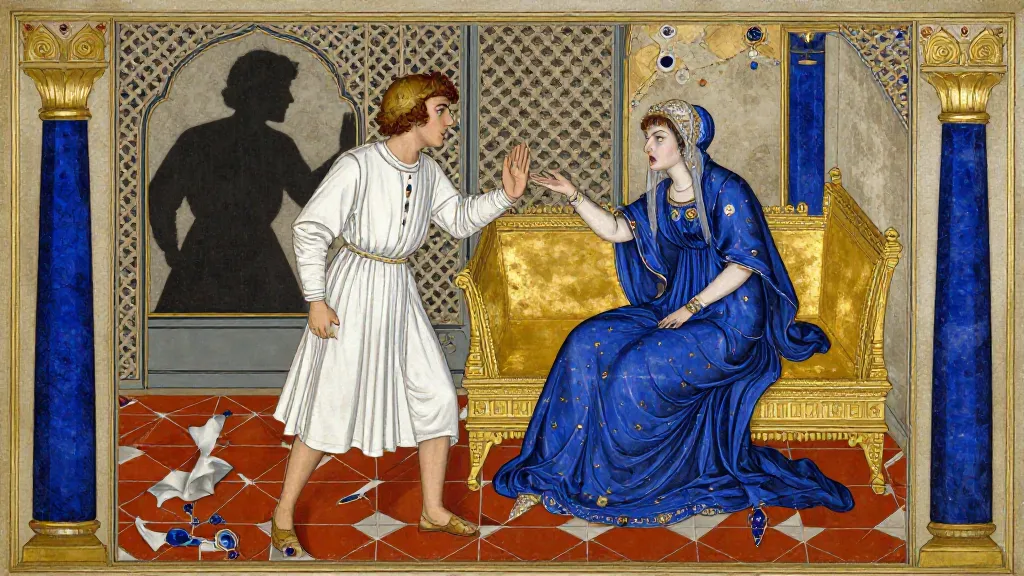
Sudabeh's seduction of Siavash follows a pattern so ancient that it appears independently in at least three civilizations: Potiphar's wife in Genesis, Phaedra in Greek tragedy, and here in the Shahnameh. But Ferdowsi's version is structurally richer than either parallel because he refuses to reduce Sudabeh to simple villainy. She is a queen from Hamaveran — a foreign bride in a court where her children's succession depends entirely on the king's favor. Siavash, the prince raised by Rostam in Zabulestan, returns to court as a figure of such beauty and martial brilliance that he threatens every established arrangement. Sudabeh's desire is real, but so is her political calculation: if the king's son cannot be co-opted, he must be destroyed. When seduction fails, she tears her own clothes, scratches her own face, and stages an assault — manufacturing the physical evidence that her words alone could not provide. The escalation continues through the plot with the sorceress and the stillborn infants, fabricating proof of a crime that never occurred. This is not passion; it is institutional self-defense conducted through the only channels available to a woman in a patriarchal court.
The fire ordeal is the Persian judicial technology that should resolve everything. Siavash rides through a corridor of flame piled high enough to be visible from two leagues away, dressed in white camphor-scented garments as if for his own funeral, and emerges without a singed thread. The Zoroastrian logic is absolute: sacred fire cannot harm the righteous. The crowd roars vindication. But vindication solves nothing, because Kay Kavus cannot bring himself to punish Sudabeh. He has four reasons, and Ferdowsi lists them with the precision of a court document: fear of war with Hamaveran, gratitude for her loyalty during his captivity, his continuing love for her, and the existence of their young children. Siavash, seeing this paralysis, intervenes to spare Sudabeh's life — not from mercy but from the correct political calculation that his father will eventually regret killing her and blame the son who provoked it. This is a young man of extraordinary moral clarity operating within a system that converts every correct decision into a worse outcome. Sudabeh is spared, regains the king's affection, and resumes her campaign against Siavash. The verdict of fire changes nothing because the problem was never evidentiary; it was structural.
The crisis that finally exiles Siavash is not Sudabeh but the Turanian war. Siavash leads the Iranian army to Balkh, wins a decisive three-day battle, and then — against every expectation — negotiates a genuine peace with Afrasiab. He demands and receives a hundred blood-hostages, territorial withdrawal from Bukhara, Samarkand, and the Oxus provinces, and a cessation of hostilities. It is a remarkable diplomatic achievement. Kay Kavus rejects it entirely, demanding that Siavash kill the hostages and resume the offensive. The king recalls Rostam in disgrace and sends Tus as replacement commander. Siavash is now trapped between his oath to Afrasiab and his duty to his father, between keeping faith with an enemy and obeying a king whose judgment he knows to be reckless. He chooses the oath. He crosses into Turan and places himself in the hands of the man whose kingdom he was sent to destroy.
Afrasiab's hospitality is genuine — and that is precisely what makes it lethal. The Turanian king comes on foot into the street to greet Siavash, seats him on his own throne, showers him with gifts, gives him a kingdom stretching to the Sea of China, and eventually gives him his daughter Farangis in marriage. Siavash builds cities — Siavashgerd and the impregnable Gang Dezh — paints murals of both courts on his palace walls, and creates a life of real substance. But the whole edifice sits above a fault line. Afrasiab's generosity is driven partly by a terrifying prophetic dream warning that Siavash's line will destroy Turan. The hospitality is an attempt to neutralize the threat through incorporation. It works only as long as no one disturbs the arrangement.
Garsivaz is the one who disturbs it, and his method is not force but information warfare. He is Afrasiab's brother, displaced from the king's inner circle by the newcomer's charm. His campaign against Siavash is a masterclass in reputational destruction through dual deception. He tells Siavash that Afrasiab is secretly planning to kill him, weeping crocodile tears and invoking the precedent of Aghrirath — Afrasiab's own brother, murdered without cause. He tells Afrasiab that Siavash refuses to receive him, does not read his messages, corresponds secretly with Iran, and commands armies from Rum and China. Both principals respond rationally to fabricated threats. Siavash writes a polite letter citing Farangis's illness; Garsivaz suppresses it and delivers his own version. The mechanism requires no conspiracy beyond one man positioned between two trusts, willing to betray both. The whisper campaign works because both Siavash and Afrasiab are already predisposed to anxiety — Siavash because he knows he is a foreigner in enemy territory, Afrasiab because his prophetic dream has never stopped gnawing at him.
Siavash's prophetic dream — the burning city, the river, Afrasiab fanning the flames — is the moment when knowledge and helplessness become the same thing. He tells Piran everything: his own murder, the wars of vengeance, the destruction of both kingdoms, the rivers of blood that will flow because of his death. He tells Farangis to name their unborn son Kay Khosrow and prophesies the boy's rise to power. He speaks to his horse Shabrang Behzad, instructing it to accept no rider until the avenger comes. Then he burns his own treasures and palaces so that his murderers will inherit nothing. This is not fatalism in the passive sense. Siavash has exhausted every alternative. Iran is ruled by Sudabeh's influence and Kavus's weakness. Turan sits above Garsivaz's poison. There is no third court, no neutral ground, no place in the world where virtue can survive the machinery of suspicion. His acceptance of death is a structural analysis delivered in the language of prophecy.
The cross-civilizational resonance is exact. Wu Zixu's father, Wu She, was falsely accused and killed by his own king in Chu — a loyal minister destroyed by court intrigue, whose death triggered a son's campaign of vengeance that ultimately brought ruin to the kingdom. The Warring States pattern of talented men destroyed by slander recurs across the Zhanguoce and the Shiji: Shang Yang executed by the state he built, Bai Qi forced to suicide by the king he served, Li Si betrayed by the system he designed. The Joseph parallel in Genesis is the most famous — the false accusation, the exile, the eventual vindication through a son's power — but it ends in reconciliation, which the Shahnameh does not permit. Hippolytus in Euripides comes closest to the full arc: the stepmother's false accusation, the father's credulity, the son's death, and the cosmic disorder that follows. What makes Siavash's story distinctive is the second act — the exile that is not punishment but genuine opportunity, the new life built on real foundations, and the discovery that even genuine hospitality cannot overcome the structural suspicion between enemy kingdoms.
The generational consequences are the point. Siavash's blood, overturned from a golden basin onto the earth, sprouts a plant — the 'blood of Siavash' that became a real botanical name in Persian. His unborn son Kay Khosrow will grow up under Piran's protection, escape to Iran, claim the throne, and lead the wars of vengeance that dominate the next several hundred pages of the Shahnameh. Afrasiab's kingdom, Garsivaz's life, Goruy's head — all will be consumed. The cosmos itself responds to the murder with a black wind that blots out the sun. Ferdowsi's verdict is delivered not through editorial commentary but through consequence: a single act of injustice, committed against a man who had no remaining options, generates a cascade of destruction that neither kingdom can survive. The innocent abroad has no country, and the world pays for his homelessness in blood.
Chapters in this Arc
Sudabeh's seduction escalates through three encounters — offering princesses, unveiling herself, then threatening ruin — until Siavash's rejection provokes her to tear her own clothes and accuse him of assault before the king.
Siavash rides through a mountain of fire in white funeral garments and emerges unscathed — then pleads for Sudabeh's life, knowing his father will eventually blame him for her death.
Siavash negotiates a genuine peace with Afrasiab — hostages, territorial withdrawal, cessation of war — only for Kay Kavus to reject the deal and demand that Siavash kill the hostages and resume the offensive.
Siavash receives a kingdom, marries Farangis, and builds Siavashgerd — a city with murals of both Iranian and Turanian courts on its walls, the visible expression of a man who belongs fully to neither world.
Garsivaz poisons both sides through dual deception, Siavash dreams of his own burning city, prophesies the wars of vengeance to Farangis and Piran, burns his treasures, and goes to meet the army that will kill him.