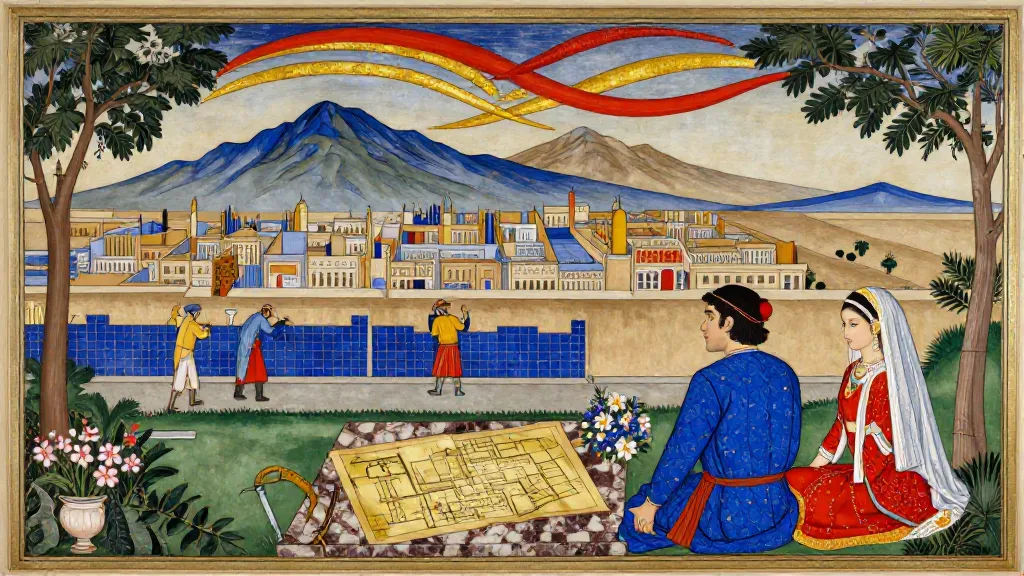
The Story of Siavash (Part 4) — Persian miniature painting

Shahnameh · Fall of the Sasanians

The Story of Siavash (Part 4)

داستان سیاوش ۴

View:

کشوری دادن افراسیاب سیاوش را

Afrasiab Gives Siavash a Kingdom

برین کار بگذشت یکهفته نیز سپهبد برآراست بسیار چیز از اسپان تازی واز گوسفند هم از جوشن وخود وگرز وکمند زدینار واز بدرهای درم زپوشیدنیها واز بیش وکم وز آن مرز تا پیش دریای چین همه نام بردند شهر وزمین

Another week passed, and Afrasiab prepared a great abundance of things: Arab horses and flocks, coats of mail, helmets, maces, and lassoes, gold coins and purses of silver, garments and every kind of provision. They named every city and territory from that border all the way to the Sea of China — a hundred leagues in length, its breadth beyond measure. They wrote a charter on silk in the manner of kings and the glory of the Kayanids.

Afrasiab sent it all to Siavash with a golden throne and golden crown. Then he prepared a great celebration and feast, and for a week all who came, near and far, found food, wine, and entertainment. They would eat, take what they wished, and go home rejoicing, guests for a week. He opened the sealed prisons and set the captives free.

On the eighth day Siavash came early with Piran to the king's broad palace. They blessed the king: "O renowned lord of the earth, may your days be forever in gladness and your enemies bent-backed." Then they departed in joy, speaking much of the world-lord.

Another year the turning heavens passed thus, wakeful with justice and love. Then a messenger came from Afrasiab to Siavash, saying: "The king asks after you. He says: 'O renowned lord, I have given you all from here to the edge of the world. Ride around and look upon the land. In whatever city you find ease and desire, where all your wishes come to fulfillment — dwell there in gladness and stay in comfort. Do not empty your heart of joy for even a moment.'"

Siavash was delighted. He sounded the trumpets and drums and loaded the baggage train. Weapons in abundance and golden crowns went with him, along with treasures carried on the road. Behind the curtains the beauties were adorned. He seated Farangis in a litter, loaded the train, and set forth. They went in gladness toward Khotan, where Piran's city lay — a man free from all suspicion. For one month Siavash was his guest. The king feasted every day — sometimes wine, sometimes the hunting ground.

At the month's end the drums sounded at dawn. Siavash marched toward his own realm with the army behind him and Piran in the vanguard. When the people of that land heard the news, the great men came out to the road to greet their king. Joy rose from the kingdom as though it were the night of resurrection — so much was the music and the singing of harp and reed that you would have said the heart itself was trembling in its place.

They came to a place that was prosperous, with a fine and auspicious foundation — one side facing the sea, one side facing the mountains, one side facing hunting grounds far from any crowd. There were trees of many kinds and running water, and the spirit of an old man grew young again.

Siavash opened his heart to Piran: "What a splendid and blessed foundation this is. I will build here a fine place, an abode of gladness. I will raise a broad city with many palaces and gardens, and a seat of government rising to the moon, as befits crown and throne."

Piran said: "O wise one, wherever your thought leads, follow it. If you command, I will build it for you exactly as you wish, raised to the very moon. I ask for no lands or treasure of my own — time and earth are but a caravanserai that I hold in trust from you."

Siavash said: "O fortunate one, you bring the tree of greatness to fruit. My treasure and all good things are yours. In every place I see your labor first. I will build a city in this spot that will leave the assembly in wonder."

Notes

1placeختنKhotan

Khotan (ختن), the oasis city on the southern edge of the Tarim Basin, here presented as Piran's domain. In the Shahnameh's geography, it marks the eastern extent of Turanian territory.

2context

Afrasiab's gift of a kingdom stretching to the Sea of China is both generous and strategic — it places Siavash far from the Turanian capital, giving him autonomy but also isolation. This distance will prove fatal when Garsivaz's slander takes effect.

3personپیرانPiran

Piran serves as both political patron and surrogate father to Siavash in Turan. His declaration that 'time and earth are but a caravanserai that I hold in trust from you' expresses a selfless loyalty that contrasts with every other relationship in the story.

سخن گفتن پیران با سیاوش از فرنگیس

Piran Speaks with Siavash About Farangis

یکی روز پیران پرهیزگار سیاوخش را گفت که ای شهریار تو دانی که سالار توران سپاه زاوج فلک بر فرازد کلاه شب وروز روشن روانش توئی دل وتوش وهوش وتوانش توئی

One day the pious Piran said to Siavash: "O king, you know that the commander of Turan raises his crown to the vault of heaven. Day and night, you are his bright spirit — his heart, his sustenance, his mind, his strength. If you become bound to him by blood, you will grow greater with every step.

"Although my daughter Jarireh is adorned and chosen for you from this assembly, and although she is your wife, yet you deserve something higher — you should seek a jewel in the skirt of the king himself. Farangis is the foremost of the king's beauties. You will not see such a moonlike face in all the world. She is taller than a straight cypress, with a crown of dark musk upon her head. Her skills and knowledge exceed all measure; she keeps wisdom as her handmaid.

"If you ask Afrasiab, it is fitting — for where in Kashmir or Kabul is there her equal? When the king becomes your true kinsman, your glory and fortune will shine brighter. If you command, I will speak to him and seek this honor at his court."

Siavash looked at Piran and said: "The command of God cannot be hidden. If heaven has decreed this path for me — no one can set foot on the secrets of the sky. If I am never to see Iran again, never to see the face of Kay Kavus, if I must be cut off from Zal who raised me, and from Rostam who is my joyful spring, from Bahram and Zangeh of Shavaran, from Giv, Shapur, and the warriors — if I must cut myself from their faces and choose a home in Turan — then be my father and arrange this household. But speak of this to no one except in secret."

He spoke, and his lashes filled with tears, and cold sighs rose from between his words. Piran said: "A man of work and wisdom comes to terms with time. You cannot escape the turning heavens, from whom come peace and strife and love. Though you had friends in Iran, your seat and your place are here now. The throne of Iran is in your hands."

Notes

1personجریرهJarireh

Jarireh (جریره), Piran's daughter and Siavash's first wife in Turan. She is the mother of Foroud, who will later die fighting for Siavash's cause. Though mentioned briefly, she represents Siavash's first bond with Turanian society.

2personفرنگیسFarangis

Farangis (فرنگیس), Afrasiab's daughter, whom Piran proposes as Siavash's second wife. She will become the mother of Kay Khosrow, Siavash's avenger. Her name may derive from a word meaning 'Frankish' or 'foreign.'

3context

Piran's counsel that Siavash should marry Afrasiab's daughter is both politically shrewd and fatally ironic. The marriage will produce Kay Khosrow, the very avenger that Afrasiab's prophetic dream warned him about. Piran's good intentions thus hasten the doom of the kingdom he serves.

عروسی فرنگیس با سیاوش

Wedding of Farangis and Siavash

چو خروسید را چرخ گردان ببر بر آورد برسان زرّین سپر سپهدار پیران میانرا ببست یکی بارهٔ تیز رو بر نشست بکاخ سیاوخش بنهاد روی بسی آفرین کرد بر فرّ اوی

When the rooster of the turning sky raised its golden shield above the earth, Commander Piran girded his waist, mounted a swift horse, and rode to the palace of Siavash, calling down many blessings upon his glory. He said: "Today, set the matter in motion. If you command, I am worthy of the task — let us bind our waists in care for it."

Siavash's heart filled with a tender respect, for Piran's daughter was already his wife. He said: "Go and do as you see fit. You know there is no secret between us."

Piran went home and set to work at once. He gave the key of the treasury of uncut cloth to Gulshahr, his wife — the lady of the champion's household, a praiseworthy woman of bright spirit. From the treasuries they selected a thousand bolts of Chinese gold-weave, platters of emerald, cups of turquoise, containers of musk and raw aloe-wood, two crowns set with royal gems, two golden necklaces, three sets of gold-woven robes all patterned in red with gold and studded with many-colored jewels, thirty camel-loads of silver and gold vessels, ten Persian-ware platters, a golden throne and four golden stools, three pairs of golden slippers inlaid with emerald, two hundred serving-girls carrying golden cups, three hundred attendants in golden tiaras, a hundred of Piran's closest kin standing at the thresholds. There were ten loads of musk and a hundred of saffron. Gulshahr bore all this with the sisters in golden litters of fine brocade.

Gulshahr brought offerings on behalf of the bride: ten thousand gold coins. They brought the gifts before Farangis, and blessings filled every tongue. Gulshahr kissed the ground and said: "The sun has been paired with Venus."

Meanwhile Piran and Afrasiab prepared the wedding on the other side. They gave the daughter according to their own custom, as befitted their faith. They made witnesses to the bond, and when the terms and pledges were complete, Piran sent word swift as smoke to Gulshahr to go to Farangis at once and bring her to the prince that very night — to adorn his chamber with the moon.

So they adorned her, setting musk upon roses and crowning her dark hair. Farangis came like the new moon to the new king. They dwelt together in joy, and their love grew with each passing hour. For a week all the birds and fish slept while the world celebrated, and not one head emerged from hiding.

The earth from end to end became a garden.

Notes

1personگلشهرGulshahr

Gulshahr (گلشهر), wife of Piran, who serves as the chief organizer of the wedding on the bride's side. Her title 'lady of the champion's household' (کدبانوی پهلوان) marks her high status.

2translation

'The sun has been paired with Venus' (خورشید را گشت ناهید جفت) — an astrological metaphor for the marriage, with Siavash as the sun and Farangis as Venus (Nahid). In Persian cosmology, this conjunction signifies beauty united with splendor.

3context

The wedding is described with lavish detail — gold, gems, silk, musk — emphasizing the high point of Siavash's fortune in Turan. This moment of maximum happiness marks the beginning of the descent, as Ferdowsi characteristically places catastrophe immediately after fulfillment.

بنا کردن سیاوش سیاوشگرد را

Siavash Builds Siavashgerd

چو آتش بیآمد بهنگام خواب یکی نامه نزد سیاوش بمهر نوشته بکردار روشن سپهر که تا تو برفتی نیم شادمان از اندیشه بیغم نیم یکزمان

When Afrasiab retired for the night, a sealed letter came from him to Siavash, written like the bright heavens: "Since you departed, I have not been glad. I have not been free from care for a single moment. But I have sought throughout Turan a place worthy of you. If the place where you have gone is pleasant and your heart is free of worry, turn back to your kingdom and cast the dust upon the heads of the ill-intentioned."

Siavash loaded the baggage train and set forth as the commander had directed. A thousand red-haired she-camels bore the freight — color and fragrance, silver and gold. A hundred mules carried purses of silver coins, and forty bore loads of gold. Ten thousand chosen horsemen from both Iran and Turan rode as escort. Before the army went the treasure-train: golden torques, gem-studded crowns, ambergris, aloe-wood, musk, brocade, bolts of silk, Egyptian, Chinese, and Persian work — thirty camel-loads.

They set their heads toward the green and joyful spring. When they arrived at the chosen place, Siavash laid out a city two leagues in length and breadth. He raised it of tall palaces and fine halls and precious gardens. On the walls of the palace he had painted many images: scenes of kings, feasts, and battles. On one side, Kay Kavus on his throne with his mace and crown, and beside his throne Rostam the elephant-bodied, with Zal, Gudarz, and the assembly. On the other side, Afrasiab with his host, Piran and the vengeful Garsivaz. It became a byword throughout Iran and Turan.

In every corner he raised a dome whose pinnacle pierced the clouds. Warriors and lords stood guard at every post. They named it Siavashgerd, and all the people were glad of heart.

Notes

1placeسیاوشگردSiavashgerd

Siavashgerd (سیاوشگرد), the city Siavash builds in his Turanian kingdom. The name means 'made by Siavash.' The murals depicting both Iranian and Turanian courts symbolize Siavash's position between two worlds.

2context

The paintings on the palace walls — Kay Kavus and Rostam on one side, Afrasiab and Piran on the other — are a visual expression of Siavash's divided identity. He belongs fully to neither kingdom, and his city is an attempt to create a space between them.

3context

City-building in the Shahnameh is both a mark of civilization and a temptation of fate. Siavash's creation of a magnificent city echoes the pattern of Jamshid and other kings whose greatest achievements precede their greatest falls.

ساختن سیاوش گنگ دژ را

Siavash Builds Gang Dezh

کنون برکشایم در داستان زگنگ سیاوخش گویم سخن وز آن شهر وآن داستان کهن برو آفرین کو چهان آفرید ابا آشکارا نهان آفرید

The poet opens a new chapter: "Now I unlock the gate of the tale and speak of the Gang of Siavash, of that city and that ancient story. Blessings upon the One who created the world, the seen and the unseen. The Lord who holds both being and non-being — all things are in pairs, but God is one."

He addresses his companions: "The world is emptied of those righteous men. Do not tell the tale of dwelling here forever. Where are the thrones of the kings of kings? Where are those bold and chosen lords? Where are the sages and the knowers, the laboring readers of books? Where are those beauties full of grace and modesty, of sweet speech and gentle voice? Where are those whose lair was on the mountaintop, who fled from rest and ease and fame? Where are those who pressed their heads against the clouds, those whose prey was the lion?

"All have the earth for their pillow and brick. Blessed is he who sowed only the seed of good. We are of dust and must return to dust. Everywhere is fear, sorrow, and dread. You departed and the world stretches on. No one can tell the hidden from the visible. The world from end to end is lesson and wisdom — why is our portion nothing but heedlessness?"

When Siavash was past sixty-six years and his face was turning from too much effort and hardship, he had grasped for increase in the world, and many fellow-travelers had passed him by. Yet he would not rest content.

"Now hear the tale of Gang Dezh. Be a partner in this story. For there is no place in the world like Gang Dezh, no site so delightful. Siavash built it, and endured great labors within it.

"Past the desert, past the expanse like a sea, you come to a broad waterless plain. Beyond that, you see prosperous cities from which one can draw sustenance. Then a high mountain appears whose summit exceeds all measure. In the middle of this mountain lies Gang Dezh. The mountain is a hundred leagues around, and the eye grows weary looking up at its height. From every direction there is no path up — all around it is the same. For thirty-three leagues the road narrows between walls of stone on either side. If even a few men stood guard upon this road, a hundred thousand armored cavalry could not pass.

"Beyond this passage you see a broad city — all gardens, orchards, palaces, and halls. The whole city has baths, streams, and canals, and in every quarter there is pleasure and color and fragrance. The mountains are full of game, the plains full of deer. Pheasants, peacocks, and mountain partridges await you on the heights. The heat is not hot, the cold is not cold — everywhere is joy and rest and nourishment. You will not see a sick person in that city. It is a garden that is nothing less than paradise. All the waters are clear and sweet, and the land is always in the bloom of spring.

"Its length and breadth are thirty times thirty, if a Persian should measure it. The height of the mountain is half a league, enough to exhaust a man in climbing. On the far side a plain appears, more beautiful than any place anyone has seen.

"When Siavash traveled and saw this place, he chose it above all of Turan. He raised walls of stone and mortar and a substance whose name we do not know. The walls are more than two hundred cubits high and thirty-eight cubits wide. No catapult can reach them, no arrow can touch them. From the summit to the ground below is two leagues, and all around it is an abyss. No eye from below can see the top of the mountain, and even a bird grows weary trying to fly over it.

"He bore great labor in that place, for the sake of greatness and crown and throne. He built within it an enchanting abode — a city in that beautiful place — with palaces, halls, and polo grounds, and planted trees beyond number. He fashioned a place like paradise, planting roses, hyacinths, narcissus, and tulips."

Notes

1placeگنگ دژGang Dezh

Gang Dezh (گنگ دژ), the impregnable fortress-city Siavash builds deep in Turan, described as a paradise enclosed within an unscalable mountain. It will later become Afrasiab's stronghold and the site of Kay Khosrow's final confrontation with the Turanian king.

2context

Ferdowsi's philosophical meditation on mortality ('Where are the thrones of the kings of kings?') is one of the most celebrated passages in the Shahnameh. It interrupts the narrative to remind the reader that all of Siavash's building — cities, fortresses, kingdoms — is ultimately dust.

3translation

'All have the earth for their pillow and brick. Blessed is he who sowed only the seed of good' (همه خاک دارند بالین وخشت / خنک آنکه جز تخم نیکی نکشت) — perhaps the most quoted couplet from the Shahnameh, expressing Ferdowsi's central moral vision.

4context

The description of Gang Dezh as a natural paradise — temperate climate, no illness, running water, game-filled mountains — draws on the Persian tradition of the 'Var' or enclosed garden-fortress, which Yima built in Zoroastrian myth to preserve life from a cosmic winter.

فرستادن افراسیاب گرسیوز نزد سیاوش

Afrasiab Sends Garsivaz to Siavash

بگرسیوز آن داستانها بگفت نهفته برون آورید از نهفت برو شادمان تا سیاوخش گرد ببین تا چه کردست وبر گرد گرد

Afrasiab told Garsivaz all the stories — bringing the hidden into the open — and said: "Go in gladness to Siavashgerd. See what he has built, and make a circuit of it. Siavash has set his heart in Turan and no longer remembers Iran at all. He has said farewell to throne and crown, to Gudarz and Bahram and Kay Kavus, and will never again see Rostam, son of Zal, nor take mace and war-club in hand.

"In a place that was all thorns and wasteland, he has built a city like a verdant spring. He has raised tall palaces for Farangis and holds her in honor.

"Rise and prepare, and go to this noble Siavash. When you see him, speak much praise. Look upon his greatness with the eye of respect. When there is hunting and wine, plain and mountain, let the Iranians sit before you. Among the great men, hold him dear; praise him and honor him by name.

"Prepare a great number of gifts: gold coins, jewels, horses, belts, crowns of splendor, Chinese brocade, swords, maces, signet rings, carpets, color, and fragrance — see what your treasury can yield. Prepare gifts for Farangis in the same fashion. Go with a tongue full of blessings. If your host is generous, stay in that fair city and be content."

Garsivaz the renowned gathered a thousand chosen horsemen of Turan. He assembled a celebrated host and rode to Siavashgerd. When Siavash heard he was coming, he rode out swiftly to meet him with his army. They embraced, and Siavash asked him for news of the king. They retired to the palace, and Siavash arranged quarters for the army.

The next morning Garsivaz came early, bearing the gifts and the king's message. Siavash looked at the royal gifts and bloomed like a rose in spring. He mounted a prancing horse, and the Iranian horsemen assembled. He showed Garsivaz the city quarter by quarter and then turned toward the palace.

Notes

1context

Afrasiab's mission for Garsivaz is entirely benign — a diplomatic visit bearing gifts and praise. But the visit will be the trigger for Garsivaz's jealousy. Seeing Siavash's splendid city and the love poured upon him by Afrasiab will inflame the envy that drives him to slander.

2context

Afrasiab's description of Siavash's settlement ('He has set his heart in Turan and no longer remembers Iran') is both reassuring to himself and ominous: it is precisely the charge Garsivaz will later twist into evidence of treachery.

آمدن گرسیوز نزد سیاوش

Garsivaz Comes to Siavash

بیآورد گرسیوز آن خواسته که روی زمین زو شد آراسته دمان تا لب رود جیحون رسید بدآن تا رساند بشاه آگهی که گرسیوز آمد بدآن فرّهی

Garsivaz brought the riches that adorned the face of the earth. He raced to the bank of the Oxus and sent word ahead to the king that Garsivaz was coming in splendor. He crossed the river by boat in a single day and rode to Balkh with a heart full of haste.

A messenger came to the court and told Siavash that Garsivaz was on the road. Siavash summoned Rostam and spoke at length about the matter.

When Garsivaz came to the court, Siavash ordered the way opened. He saw Garsivaz, rose to his feet, smiled, and made many apologies. Garsivaz kissed the dust from afar, his face full of shame and his heart full of dread. Siavash seated him below the throne.

When Garsivaz heard the new king's words and saw his crown, his throne, and his new glory, he said to Rostam: "Afrasiab, when he heard news of you, sent in haste a gift — a memento for the king. It is with me on the road." They ordered the gifts brought forth. From the city gate to the audience hall, the road was covered with silver, horses, slaves, and soldiers. No one could count the measure — gold coins, crowns, and tall thrones, slaves wearing belts and crowns, serving-girls wearing bracelets and golden torques.

Siavash was pleased and opened his face. He listened to the message. Rostam said: "Stay with us happily for a week, and then we will bring a reply to mind. In this matter much thought is needed, and we must consult with many people."

Garsivaz heard this and rubbed his face and hair upon the throne in gratitude. A chamber was prepared for him.

Siavash and Rostam went apart from the assembly. They sat together, alert and wakeful, and deliberated on the greater and the lesser. Rostam grew suspicious of the affair, for Garsivaz had come in such haste. They posted scouts in every direction and prepared themselves as was necessary.

Siavash asked Rostam: "Let us bring this secret out of hiding. What is this peace-seeking for? Let us discover what is the antidote to this poison. Let him send us a hundred renowned men of his own blood as hostages — that will illuminate this dark counsel. Do you not see that he is afraid of us, beating his drum under a blanket? When we have accomplished this, we must send a trustworthy man to the king, to bring him news of all this, and perhaps his mind will be emptied of hatred."

Rostam said: "This is the right counsel. No other path will bring the pact to fulfillment."

Notes

1context

This section describes an earlier diplomatic exchange (placed here in the narrative chronology before Siavash's exile). Rostam's suspicion of Garsivaz's haste and his demand for hostages show the experienced warrior's instinct for treachery — an instinct that will prove correct.

2translation

'Beating his drum under a blanket' (همی طبل کوبد بزیر گلیم) — a Persian idiom meaning to act aggressively while pretending to be passive. Siavash sees through Afrasiab's peace overture to the fear that drives it.

3context

The demand for blood-hostages is a standard practice in the Shahnameh's diplomacy. It provides security against treachery by ensuring that the hostage-giver's own kin will suffer if the pact is broken.

Edition & Source

Author
فردوسی (Ferdowsi, c. 977–1010 CE)
Edition
شاهنامه — تصحیح ژول مل (Jules Mohl critical edition)