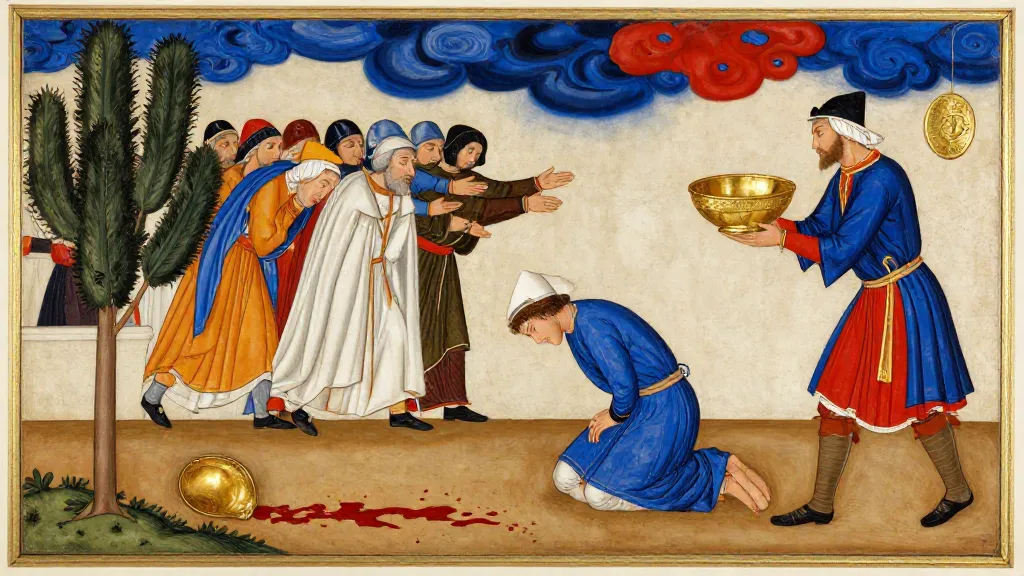
باز آمدن گرسیوز به نزد سیاوش
Garsivaz Returns to Siavash
برآراست گرسیوز دام ساز دلی پر زکینه سری پر زراز چو نزدیک شهر سیاوش رسید زلشکر زبان آوری بر گزید بدو گفت رو با سیاوش بگوی که ای نامور زادهٔ نامجوی
Garsivaz the trap-maker set forth with a heart full of hatred and a head full of secrets. When he drew near Siavash's city, he chose a smooth-tongued man from the army and said: "Go to Siavash and say: 'O renowned son of a glory-seeker — by the life and head of the king of Turan, by the life and head and crown of Kay Kavus — do not rise from your throne on my account, and do not come out to meet me on the road. For you are higher than I in dignity and fortune, in glory, lineage, crown, and throne. It is not fitting that you should gird yourself for every wind and empty the seat of kings.'"
The messenger came to Siavash and kissed the ground. When he delivered Garsivaz's message, Siavash grew uneasy in secret. He sat for a long time in wakeful thought, saying: "There is something hidden beneath this. I do not know what Garsivaz has said about me at court."
When Garsivaz arrived at the gate, Siavash came on foot from the palace into the street. He asked about the road and the king, the army, the throne, and the crown. Garsivaz delivered the message of the Turanian king, and Siavash was gladdened by it. He answered: "With his memory, I would not turn my face from the blade of steel. I am ready to depart at once, my bridle tied to your charger. Let us spend three days in this gold-painted garden with wine, for the world is but a caravanserai full of pain and toil — a curse on him who lives there in sorrow."
When Garsivaz heard the wise king's words, he twisted inwardly. He thought: "If Siavash comes with me before Afrasiab, with this lion-heartedness and this much wisdom, he will trample my suspicions underfoot. My words will lose their light; my schemes will become lies before the king. I must now fashion some stratagem to throw his heart off the path."
He sat silent for a time, his eyes fixed on Siavash's face. Then tears of pale yellow fell from his eyes — he was working his trick with weeping. Siavash saw his tear-filled eyes, like one writhing in anguish.
He said gently: "Brother, what has happened? Sorrow is no help to the sorrowful. If you are angry with the king of Turan, if grief has brought moisture to your eyes, I will come with you on the road and make war against the king of Turan, so that he does not torment you without cause or hold you lower than your station."
Garsivaz said: "O renowned one, my trouble is not with the king, nor does it come from any enemy. It rises from the blood itself, and the truth must be spoken straight. First, consider Aghrirath — how he was killed without cause. He was a brother from the same body and the same blood, and yet Afrasiab killed that blameless, wise man. After him, many other innocent nobles have perished at his hand. My special sorrow is for you — that you should be alert of heart and sound of body.
"Since you came to this land, no one has seen any evil from you. You have sought only humanity and truth. But now the fiend of heart-division has filled Afrasiab with resentment and hatred toward you. I do not know what the Creator intends.
"You know I am your friend — your particular ally in every good and evil. I do not want you to think tomorrow that I knew of this quarrel and kept silent. Think on this and seek a remedy. Speak fair words and measure them."
Siavash said: "Fear nothing from this. The Creator of the world is my companion. The king gave me no reason to expect that he would turn my bright day into black night. If there were anger in his heart against me, he would not have raised my head above the assembly. He would not have given me a kingdom, a throne, a crown, lands, children, and the treasures of the army.
"I will come with you now to his court without an army and see what troubles the king." But Garsivaz said: "O seeker of fame, it is not fitting for you to go before him. One should not walk into fire, nor stand safe upon the waves of the sea. You are rushing headlong toward evil and putting your laughing fortune to sleep.
"I am perhaps man enough for this task. Perhaps I can throw cold water on this fire. Let me return alone. I will write a letter setting out everything, fair and foul. If I see his head empty of enmity, I will send you a rider and light up your dark spirit. My hope is in the Creator of the world that this will turn back toward truth and that crookedness and deficiency will be far from him.
"But if I see any heat remaining in his head, I will send a fast camel at once. Then prepare yourself quickly and do not drag things out. It is only a hundred and twenty leagues from here to China, and three hundred and forty to Iran. On this side, all are your friends. On that side, your father longs for you, and the army is bound to you by love."
Siavash believed his words. That wakeful spirit fell asleep. He said: "In the matter you have raised, I will not swerve from your counsel and judgment. Be my intercessor — plead for me and show him the way to peace."
He summoned a learned scribe and poured forth his thoughts. First he invoked the Creator who frees His servants from grief, then praised wisdom, then offered his respects to the king of Turan — the same letter as before, speaking of Farangis's illness and his longing to see the king's face.
He sealed the letter and gave it to Garsivaz of evil lineage. Garsivaz called for three swift horses and rode day and night. In three days he covered the long and steep road. On the fourth he came before Afrasiab — his tongue full of malice, his heart full of guilt.
Afrasiab said: "Why have you come in such haste?" Garsivaz said: "When times grow dark, sitting still is of no use. Siavash did not so much as glance at me. He did not come out to meet me on the road. He did not hear my words, did not read my message. Letters come to him constantly from Iran. He has armies from Rum and from China. The earth trembles at every hour. If you delay, you will find yourself grasping at the wind."
Notes
Aghrirath (اغریرث), Afrasiab's brother, who was killed by Afrasiab despite being innocent. Garsivaz invokes this precedent to frighten Siavash, suggesting that Afrasiab is capable of killing even his closest kin — which is true, but Garsivaz's motive is manipulation, not warning.
Garsivaz's strategy is brilliantly two-faced. He tells Siavash not to come to court (to prevent Siavash from clearing his name), then weeps crocodile tears to convince him of danger, then volunteers to 'intercede' — knowing he will slander Siavash instead. Meanwhile, he suppresses Siavash's actual letter and fabricates evidence of disloyalty.
The line 'That wakeful spirit fell asleep' (چنان جان بیدار او بغنوید) is one of the most tragic lines in the Shahnameh. Siavash's defining quality — his moral clarity — is precisely what makes him vulnerable to Garsivaz's manipulation, because he cannot imagine such thoroughgoing deceit.
Garsivaz's false tears (فرو ریخت از دیدگان آب زرد — 'pale yellow tears fell from his eyes') mark him as a consummate actor. The adjective 'yellow' (زرد) suggests sickness or deceit, not genuine grief.