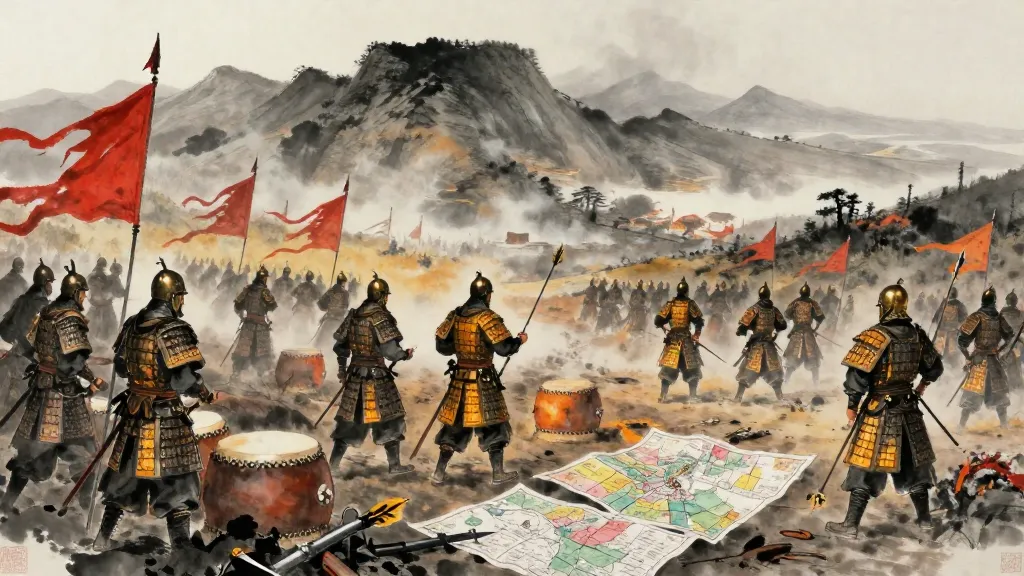
晉世家(下) (Hereditary House of Jin — Part 2) — Chinese ink painting

Chapter 39 of 130

晉世家(下)

Hereditary House of Jin — Part 2

View:

景公與邲之戰

Duke Jing and the Battle of Bi

景公元年春,陳大夫夏徵舒弒其君靈公。二年,楚莊王伐陳,誅徵舒。

三年,楚莊王圍鄭,鄭告急晉。晉使荀林父將中軍,隨會將上軍,趙朔將下軍,郤克、欒書、先縠、韓厥、鞏朔佐之。六月,至河。聞楚已服鄭,鄭伯肉袒與盟而去,荀林父欲還。先縠曰:「凡來救鄭,不至不可,將率離心。」卒度河。楚已服鄭,欲飲馬於河為名而去。楚與晉軍大戰。鄭新附楚,畏之,反助楚攻晉。晉軍敗,走河,爭度,船中人指甚眾。楚虜我將智。歸而林父曰:「臣為督將,軍敗當誅,請死。」景公欲許之。隨會曰:「昔文公之與楚戰城濮,成王歸殺子玉,而文公乃喜。今楚已敗我師,又誅其將,是助楚殺仇也。」乃止。

十七年,誅趙同、趙括,族滅之。韓厥曰:「趙衰、趙盾之功豈可忘乎?柰何絕祀!」乃復令趙庶子武為趙後,復與之邑。

十九年夏,景公病,立其太子壽曼為君,是為厲公。後月餘,景公卒。

In the first year of Duke Jing, spring, the Chen minister Xia Zhengshu assassinated his lord Duke Ling of Chen. In the second year, King Zhuang of Chu attacked Chen and executed Zhengshu.

In the third year, King Zhuang of Chu besieged Zheng. Zheng appealed urgently to Jin. Jin sent Xun Linfu commanding the center army, Sui Hui the upper army, and Zhao Shuo the lower army, with Xi Ke, Luan Shu, Xian Hu, Han Jue, and Gong Shuo as their seconds. In the sixth month they reached the Yellow River and learned that Chu had already subdued Zheng — Duke Mu of Zheng had stripped to the waist and sworn an oath, and Chu had departed. Xun Linfu wished to turn back. Xian Hu said: "We came to rescue Zheng. Not to arrive is unacceptable — the commanders will lose heart." They crossed the river.

Chu, having subdued Zheng, intended merely to water its horses at the Yellow River as a gesture before withdrawing. But Chu and Jin engaged in a great battle. Zheng, having just submitted to Chu and fearing it, turned against Jin and aided the Chu attack. Jin's army was routed and fled to the river, fighting to cross. So many men had their fingers severed by those clutching at boats. Chu captured the Jin commander Zhi. Upon returning, Linfu said: "I was supreme commander. The army was defeated. I deserve execution. I request death." Duke Jing was inclined to grant it. Sui Hui said: "When Duke Wen fought Chu at Chengpu, King Cheng returned and executed Ziyu — and Duke Wen was delighted. Now Chu has already defeated our army. If we also execute our own commander, we help Chu destroy its enemy." The execution was halted.

In the seventeenth year, Zhao Tong and Zhao Kuo were convicted and their clan was annihilated. Han Jue said: "Can the merit of Zhao Cui and Zhao Dun be forgotten? How can we extinguish their sacrifices?" A junior Zhao son, Wu, was therefore established as the Zhao heir and his fief was restored.

In the nineteenth year, summer, Duke Jing fell ill and installed his crown prince Shouman — this was Duke Li. A month later, Duke Jing died.

Notes

1context

The Battle of Bi (邲之戰, 597 BC) was Jin's worst defeat of the Spring and Autumn period. It established King Zhuang of Chu as hegemon and shifted the balance of power southward. The image of soldiers' fingers being cut off as they clung to boat-rails became a byword for panicked retreat.

2context

The near-extinction of the Zhao clan (the 趙氏孤兒 or 'Orphan of Zhao' story, though Sima Qian tells it differently in the Zhao chapter) and Han Jue's intervention to preserve the Zhao line is historically crucial. The restored Zhao family would eventually become one of the Three Jin states.

厲公與鄢陵之戰

Duke Li and the Battle of Yanling

厲公元年,初立,欲和諸侯,與秦桓公夾河而盟。歸而秦倍盟,與翟謀伐晉。三年,使呂相讓秦,因與諸侯伐秦。至涇,敗秦於麻隧,虜其將成差。

六年春,鄭倍晉與楚盟,晉怒。欒書曰:「不可以當吾世而失諸侯。」乃發兵。厲公自將,五月度河。聞楚兵來救,範文子請公欲還。郤至曰:「發兵誅逆,見彊辟之,無以令諸侯。」遂與戰。癸巳,射中楚共王目,楚兵敗於鄢陵。子反收餘兵,拊循欲復戰,晉患之。共王召子反,其侍者豎陽穀進酒,子反醉,不能見。王怒,讓子反,子反死。王遂引兵歸。晉由此威諸侯,欲以令天下求霸。

厲公多外嬖姬,歸,欲盡去群大夫而立諸姬兄弟。八年,厲公獵,與姬飲,郤至殺豕奉進,宦者奪之。郤至射殺宦者。公怒,曰:「季子欺予!」十二月壬午,公令胥童以兵八百人襲攻殺三郤。閏月乙卯,厲公游匠驪氏,欒書、中行偃以其黨襲捕厲公,囚之,殺胥童,而使人迎公子周於周而立之,是為悼公。

In the first year of Duke Li, newly enthroned, he wished to make peace among the feudal lords and swore an oath with Duke Huan of Qin, facing each other across the Yellow River. But upon returning, Qin broke the oath and conspired with the Di to attack Jin. In the third year, Jin sent Lü Xiang to reproach Qin, then led the feudal lords in an attack, reaching the Jing River and defeating Qin at Masui, capturing their general Cheng Cha.

In the sixth year, spring, Zheng broke with Jin and allied with Chu. Jin was furious. Luan Shu said: "We cannot lose the feudal lords during our generation." They mobilized. Duke Li personally led the army and crossed the Yellow River in the fifth month. When word came that Chu was sending a rescue force, Fan Wenzi urged the duke to return. Xi Zhi said: "We raised our army to punish treachery. To see a strong enemy and retreat gives us no authority to command the lords." They gave battle.

On the guisi day, an arrow struck King Gong of Chu in the eye. Chu's army was defeated at Yanling. Ziyu collected the remnants and wished to resume fighting. Jin was alarmed. King Gong summoned Ziyu, but his attendant, the boy Yanggu, had given him wine, and Ziyu was too drunk to appear. The king was furious, rebuked Ziyu, and Ziyu killed himself. The king then withdrew his forces. Jin thereby overawed the feudal lords and sought hegemony as commander of All-Under-Heaven.

Duke Li had many outside favorites among his consorts. Upon his return, he wished to eliminate all the great ministers and install his favorites' brothers. In the eighth year, Duke Li was out hunting and drinking with his consort. Xi Zhi killed a boar and presented it, but a eunuch seized it. Xi Zhi shot and killed the eunuch. The duke was furious: "Ji Zi defies me!" In the twelfth month, the duke ordered Xu Tong with eight hundred men to ambush and kill the three Xi ministers. In the intercalary month, while Duke Li was visiting the estate of Jiang Li, Luan Shu and Zhonghang Yan led their partisans to seize Duke Li, imprison him, and kill Xu Tong. They sent for Prince Zhou from the Zhou court and installed him — this was Duke Dao.

Notes

1context

The Battle of Yanling (鄢陵之戰, 575 BC) was the last major Jin-Chu confrontation of the Spring and Autumn period. The wounding of King Gong's eye and the drunkenness of his general Ziyu are treated as the moment Chu's challenge to Jin's hegemony collapsed for good.

2context

Duke Li's overthrow by Luan Shu and Zhonghang Yan marks a turning point in Jin politics: from this point onward, the great ministerial families increasingly dominated the state, and the ducal house was progressively weakened.

悼公中興與平公之衰

Duke Dao's Revival and Duke Ping's Decline

悼公周者,其大父捷,晉襄公少子也,不得立,號為桓叔,桓叔最愛。桓叔生惠伯談,談生悼公周。周之立,年十四矣。悼公曰:「大父、父皆不得立而辟難於周,客死焉。寡人自以疏遠,毋幾為君。今大夫不忘文、襄之意而惠立桓叔之後,賴宗廟大夫之靈,得奉晉祀,豈敢不戰戰乎?大夫其亦佐寡人!」於是逐不臣者七人,修舊功,施德惠,收文公入時功臣後。秋,伐鄭。鄭師敗,遂至陳。

三年,晉會諸侯。悼公問群臣可用者,祁傒舉解狐。解狐,傒之仇。復問,舉其子祁午。君子曰:「祁傒可謂不黨矣!外舉不隱仇,內舉不隱子。」方會諸侯,悼公弟楊乾亂行,魏絳戮其仆。悼公怒,或諫公,公卒賢絳,任之政,使和戎,戎大親附。十一年,悼公曰:「自吾用魏絳,九合諸侯,和戎、翟,魏子之力也。」

十五年,悼公卒,子平公彪立。

十四年,吳延陵季子來使,與趙文子、韓宣子、魏獻子語,曰:「晉國之政,卒歸此三家矣。」

十九年,齊使晏嬰如晉,與叔鄉語。叔鄉曰:「晉,季世也。公厚賦為台池而不恤政,政在私門,其可久乎!」晏子然之。

二十六年,平公卒,子昭公夷立。昭公六年卒。六卿彊,公室卑。子頃公去疾立。

Duke Dao, Zhou, was the grandson of Jie — a younger son of Duke Xiang of Jin who never reached the throne. Jie was titled Earl Huan and was the most beloved of his sons. Earl Huan sired Huibo Tan. Tan sired Duke Dao, Zhou. Zhou was fourteen when he was enthroned. He said: "My grandfather and father both failed to take the throne and fled to Zhou, where they died in exile. I considered myself too distant a relation and never expected to become lord. Now the great ministers, not forgetting the legacy of Dukes Wen and Xiang, have graciously installed Earl Huan's descendant. Through the blessings of the ancestral temples and the ministers, I am permitted to carry on Jin's sacrifices — dare I not tremble with reverence? Ministers, I ask you to assist me!" He expelled seven disloyal men, restored old meritorious families, distributed kindness, and gathered the descendants of Duke Wen's companions. In autumn he attacked Zheng, defeated its army, and advanced to Chen.

In the third year, Jin convened the feudal lords. Duke Dao asked which ministers could be employed. Qi Xi recommended Xie Hu — who was Qi Xi's personal enemy. Asked for a second recommendation, he named his own son Qi Wu. The gentlemen said: "Qi Xi may truly be called impartial! In recommending outsiders he does not conceal his enemies; in recommending from within he does not conceal his son." While the lords were assembled, the duke's brother Yang Gan disrupted the ranks. Wei Jiang punished his driver. Duke Dao was angry, but was counseled otherwise and ultimately valued Jiang, entrusting him with governance and the pacification of the Rong barbarians. The Rong became close allies. In the eleventh year, Duke Dao said: "Since I employed Wei Jiang, I have convened the lords nine times and pacified the Rong and Di — all through his efforts."

In the fifteenth year, Duke Dao died and his son Duke Ping, Biao, succeeded.

In Duke Ping's fourteenth year, Ji Zha of Yanling came as Wu's envoy and spoke with Zhao Wenzi, Han Xuanzi, and Wei Xianzi: "The governance of Jin will ultimately pass to these three families."

In the nineteenth year, Qi sent Yan Ying to Jin. He spoke privately with Shu Xiang: "Jin is in its final generation. The duke levies heavy taxes to build terraces and pools but does not attend to governance. Political power resides in private houses. How long can this last?" Yan Ying agreed.

In the twenty-sixth year, Duke Ping died and his son Duke Zhao, Yi, succeeded. Duke Zhao died after six years. The six great ministerial families were powerful; the ducal house was weak. His son Duke Qing, Quji, succeeded.

Notes

1person晉悼公Jìn Dào Gōng

Duke Dao of Jin (晉悼公, r. 572–558 BC) was the last great duke of Jin. His fourteen-year reign saw nine conferences of feudal lords and the successful pacification of the Rong tribes. After his death, the ducal house never recovered its authority.

2context

Ji Zha's prophecy that Jin's governance would pass to the Zhao, Han, and Wei families — three of the six great ministerial clans — proved exactly correct. The Three Jin partition of 403 BC is traditionally taken as the start of the Warring States period.

3person祁傒Qí Xī

Qi Xi (祁傒) of Jin became the paradigm of impartial recommendation (大公無私) in Chinese political culture. His willingness to recommend his personal enemy for office and then his own son was celebrated by Confucius and later thinkers.

六卿專權與晉之滅亡

The Six Ministers Seize Power and the Fall of Jin

頃公六年,周景王崩,王子爭立。晉六卿平王室亂,立敬王。

十二年,晉之宗家祁傒孫,叔鄉子,相惡於君。六卿欲弱公室,乃遂以法盡滅其族。而分其邑為十縣,各令其子為大夫。晉益弱,六卿皆大。

十四年,頃公卒,子定公午立。

定公十五年,趙鞅使邯鄲大夫午,不信,欲殺午,午與中行寅、范吉射親攻趙鞅,鞅走保晉陽。定公圍晉陽。荀櫟、韓不信、魏侈與范、中行為仇,乃移兵伐范、中行。范、中行反,晉君擊之,敗范、中行。范、中行走朝歌,保之。韓、魏為趙鞅謝晉君,乃赦趙鞅,復位。二十二年,晉敗范、中行氏,二子奔齊。

三十年,定公與吳王夫差會黃池,爭長,趙鞅時從,卒長吳。

三十七年,定公卒,子出公鑿立。

出公十七年,知伯與趙、韓、魏共分范、中行地以為邑。出公怒,告齊、魯,欲以伐四卿。四卿恐,遂反攻出公。出公奔齊,道死。故知伯乃立昭公曾孫驕為晉君,是為哀公。

哀公四年,趙襄子、韓康子、魏桓子共殺知伯,盡並其地。

十八年,哀公卒,子幽公柳立。

幽公之時,晉畏,反朝韓、趙、魏之君。獨有絳、曲沃,餘皆入三晉。

烈公十九年,周威烈王賜趙、韓、魏皆命為諸侯。

二十七年,烈公卒,子孝公頎立。孝公九年,魏武侯初立,襲邯鄲,不勝而去。十七年,孝公卒,子靜公俱酒立。是歲,齊威王元年也。

靜公二年,魏武侯、韓哀侯、趙敬侯滅晉後而三分其地。靜公遷為家人,晉絕不祀。

In Duke Qing's sixth year, King Jing of Zhou died and the royal princes fought over the succession. Jin's six great ministers pacified the Zhou court's disorder and installed King Jing.

In the twelfth year, the descendants of the Jin ducal house — the grandchildren of Qi Xi and the sons of Shu Xiang — fell into the duke's disfavor. The six ministerial families, wishing to weaken the ducal house, used the law to exterminate these clans entirely, dividing their fiefs into ten counties and appointing their own sons as magistrates. Jin grew weaker still, and the six families grew ever more powerful.

In the fourteenth year, Duke Qing died and his son Duke Ding, Wu, succeeded.

In Duke Ding's fifteenth year, Zhao Yang sent the Handan magistrate Wu on a mission. Wu proved disloyal, and Yang intended to kill him. Wu allied with Zhonghang Yin and Fan Jishe to attack Zhao Yang, who fled to defend Jinyang. Duke Ding besieged Jinyang. Xun Li, Han Buxin, and Wei Chi were enemies of the Fan and Zhonghang clans and redirected their troops against them. The Fan and Zhonghang forces revolted. The duke's forces struck them and prevailed. The Fan and Zhonghang forces fled to Zhaoye and held it. Han and Wei interceded for Zhao Yang with the duke, who pardoned Yang and restored his position. In the twenty-second year, Jin defeated the Fan and Zhonghang clans. Both fled to Qi.

In the thirtieth year, Duke Ding met King Fuchai of Wu at Huangchi. They contested precedence, with Zhao Yang in attendance. Wu was ultimately given precedence.

In the thirty-seventh year, Duke Ding died and his son Duke Chu, Zao, succeeded.

In Duke Chu's seventeenth year, Zhi Bo together with Zhao, Han, and Wei divided the Fan and Zhonghang territories as their own fiefs. Duke Chu was furious and appealed to Qi and Lu, intending to attack the four ministerial families. The four families, alarmed, turned and attacked Duke Chu. Duke Chu fled toward Qi and died on the road. Zhi Bo then installed Duke Zhao's great-grandson Jiao as lord of Jin — this was Duke Ai.

In Duke Ai's fourth year, Zhao Xiangzi, Han Kangzi, and Wei Huanzi jointly killed Zhi Bo and divided all his territory.

In the eighteenth year, Duke Ai died and his son Duke You, Liu, succeeded.

During Duke You's time, Jin was so diminished that it was the Jin lord who attended court upon the lords of Han, Zhao, and Wei — not the reverse. Jin held only Jiang and Quwo; all else had passed to the Three Jin.

In the nineteenth year of Duke Lie, King Weilie of Zhou formally invested Zhao, Han, and Wei as feudal lords.

In the twenty-seventh year, Duke Lie died and his son Duke Xiao, Qi, succeeded. In Duke Xiao's ninth year, Marquis Wu of Wei first took the throne and attacked Handan but failed. In the seventeenth year, Duke Xiao died and his son Duke Jing, Jujiu, succeeded. That year was the first year of King Wei of Qi.

In Duke Jing's second year, Marquis Wu of Wei, Marquis Ai of Han, and Marquis Jing of Zhao destroyed the remaining Jin state and divided its territory into three. Duke Jing was reduced to the status of a commoner. Jin's sacrifices were extinguished forever.

Notes

1context

The destruction of Zhi Bo by the combined forces of Zhao, Han, and Wei in 453 BC is traditionally taken as the true beginning of the Warring States period, though the formal recognition of the Three Jin as independent states by Zhou came in 403 BC. Zhi Bo had been the most powerful minister in Jin and had nearly destroyed the Zhao family by flooding Jinyang.

2context

The final partition of Jin in 376 BC ended a state that had been the dominant power of the Spring and Autumn world for three centuries. The irony is precise: Jin was founded when the Quwo branch usurped the main line through superior power; it perished when its own ministerial families applied the same logic to the ducal house itself.

3place

Jinyang (晉陽) was the Zhao family's fortress, located near modern Taiyuan, Shanxi. The siege of Jinyang by Zhi Bo — who diverted river water to flood the city — and Zhao's desperate survival became one of the pivotal military events of Chinese history.

Edition & Source

Text
《史記》 Shiji
Edition
中華古詩文古書籍網 transcription
Commentary
裴駰《史記集解》、司馬貞《史記索隱》、張守節《史記正義》(Three Commentaries)