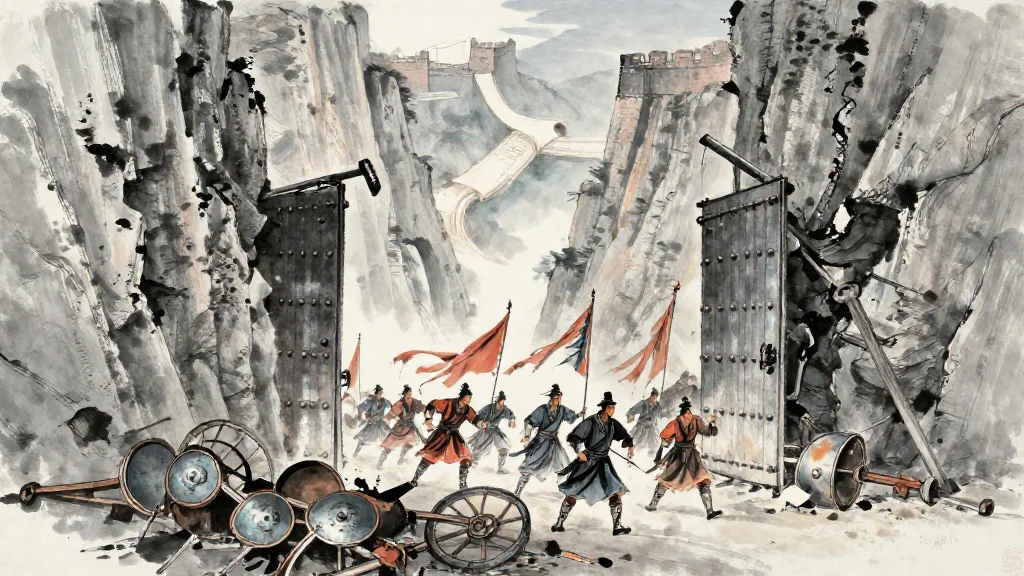
In the twentieth year of King Qingxiang of Chu, Qin's general Bai Qi took Chu's Xiling, then captured Yan, Ying, and Yiling, and burned the tombs of Chu's former kings. The king fled northeast and took refuge at the city of Chen. Chu was drastically weakened and held in contempt by Qin. Then Bai Qi again led an army to attack.
There was a Chu man named Huang Xie, widely traveled and learned. King Xiang considered him eloquent and sent him as envoy to Qin. He addressed King Zhao:
"The two strongest states under Heaven are Qin and Chu. Now I hear Your Majesty intends to attack Chu. This is like two tigers fighting while a mongrel dog profits from their wounds — it would be better to befriend Chu. Allow me to explain.
"I have heard it said: 'Things reach their extreme and reverse — winter and summer are proof. Push to the limit and danger follows — a tower of chess pieces shows this.' Now Your Majesty's territory covers half of All-Under-Heaven, with two frontiers extending outward — since the beginning of human habitation, no state of ten thousand chariots has ever held such territory. Through three generations — Kings Wen and Zhuang and now Your Majesty — Qin has kept its borders from touching Qi, thereby severing the vital link of the north-south coalition. Your Majesty sent Sheng Qiao three times to manage affairs in Han, and Cheng Qiao entered Yan from the north. Without deploying armor or projecting force, you gained a hundred li of territory — this may be called skillful. Then Your Majesty raised an army and attacked Wei, sealed the gates of Daliang, took Henei, and captured Yan, Suanzao, Xu, and Taoren. The forces of Chu and Yan circled like clouds but dared not engage. Your Majesty's achievements are considerable. After resting the troops for two years, you resumed, taking Pu, Yan, and Shouguan, advancing on Ren, Pingqiu, Xiaohuang, and Jiyang, forcing them behind their walls — and Wei submitted. Then Your Majesty ceded the territory north of Pu and Mo to Yan, severing the link between Qi and Qin and cutting the spine of Chu and Wei. All-Under-Heaven formed coalitions five and six times but dared not come to the rescue. Your Majesty's authority inspires dread. If you can hold these achievements and guard this authority, restrain the impulse to conquer and nourish the restraint of benevolence and righteousness, ensuring no future calamity, then the Three Kings would need a fourth and the Five Hegemons a sixth.
"But if Your Majesty relies on sheer numbers and military strength, destroys Wei's power, and tries to force All-Under-Heaven's rulers into submission by might alone, I fear there will be consequences. The Odes say: 'All have a beginning; few see it through to the end.' The Changes say: 'The fox wets its tail.' These speak of how easy it is to start and how hard to finish. How do we know? The Zhi clan saw the profit in attacking Zhao but did not foresee the disaster at Yuci. Wu saw the advantage in attacking Qi but did not foresee the defeat at Gansui. These two states did not lack great achievements — they set gain before their eyes and overlooked the peril behind them. Wu trusted Yue and went to attack Qi; having defeated Qi at Ailing, it returned only to be captured by the King of Yue at the Three Rivers. The Zhi clan trusted Han and Wei and went to attack Zhao, besieging Jinyang — victory was a matter of days — but Han and Wei turned against them and killed Zhibo Yao at Zuotai. Now Your Majesty resents that Chu has not been destroyed, but forgets that destroying Chu would strengthen Wei. I have considered this for Your Majesty and find it inadvisable.
"The Odes say: 'A great army camped far off does not cross the river.' From this we see: Chu is an ally; the neighboring states are the enemy. The Odes also say: 'Others have designs in their hearts — I measure and fathom them. The leaping hare, when it meets the hound, is caught.' Now Your Majesty trusts that Han and Wei are loyal to you midway through your campaign — this is precisely Wu trusting Yue. I have heard: 'Do not underestimate an enemy; do not miss the right moment.' I fear that Han and Wei's humble words mask their real calculations and that they are in truth deceiving Your Majesty. Why? You have no accumulated goodwill toward Han and Wei — only accumulated grievances spanning generations. The fathers, sons, and brothers of Han and Wei who have died at Qin's hands are beyond counting. Their homelands have been ravaged, their altars destroyed, their ancestral temples toppled. Disemboweled, jaws broken, heads severed from bodies, bones bleaching in the marshes, skulls scattered along the roads. Fathers, sons, the old and the young, bound as captives, filing along the highways. Their spirits and gods have nothing to eat; their people cannot sustain themselves. Clans scattered, refugees made servants and concubines throughout the realm. That Han and Wei have not yet perished is itself a worry for Qin's altars. Is it not a mistake, then, to attack Chu?
"On the day Your Majesty attacks Chu, where will you send your troops? Will you borrow passage through Han and Wei — your mortal enemies? The day your army marches out, you will fear it may never return — you will have handed your army to your mortal enemies. If you do not borrow passage through Han and Wei, you must attack through Suiyang and You Rang — but these are regions of broad rivers and deep water, mountains and forests and gorges, barren land. Even if you take them, you gain nothing. You would have the name of destroying Chu but not the reality of gaining territory. Moreover, on the day you attack Chu, the four states will certainly all rise in response. While Qin and Chu are locked in conflict, Wei will send armies to attack Liu, Fangyu, Zhi, Huling, Dang, Xiao, and Xiang — all of old Song will be taken. Qi will advance southward, and everything north of the Si River will fall. These are open plains, rich and fertile lands — and Your Majesty lets others take them. By destroying Chu you fatten Han and Wei in the Central States and strengthen Qi. Han and Wei will be strong enough to challenge Qin. Qi, with the Si as its southern border, the sea at its back, and the Yellow River to the north, will face no threats — no state under Heaven will be stronger. Once Qi and Wei gain territory and consolidate their power, even if pretending to serve you through minor officials, within a year, though they may not be able to claim the imperial title themselves, they will certainly be able to block Your Majesty from claiming it.
"I advise Your Majesty: nothing is better than befriending Chu. If Qin and Chu unite as one and press Han, Han must surrender. With the mountain passes of the east as your collar and the bend of the Yellow River as your belt, Han will become a vassal within the passes. Then use ten cities to secure Zheng. The house of Liang will quake. Xu and Yanling will cower behind their walls. Shangcai and Shaoling will cease all traffic. Thus Wei too will become a vassal within the passes. By one act of befriending Chu, two lords of ten thousand chariots within the passes will turn their forces against Qi — Qi's western territories can be taken without lifting a hand. Your Majesty's domain will stretch between the two seas, commanding All-Under-Heaven. Then Yan and Zhao will have no Qi or Chu to rely on, and without Yan and Zhao, Qi and Chu are helpless. Threaten Yan and Zhao, hold Qi and Chu — these four states will submit without having to feel the blade."