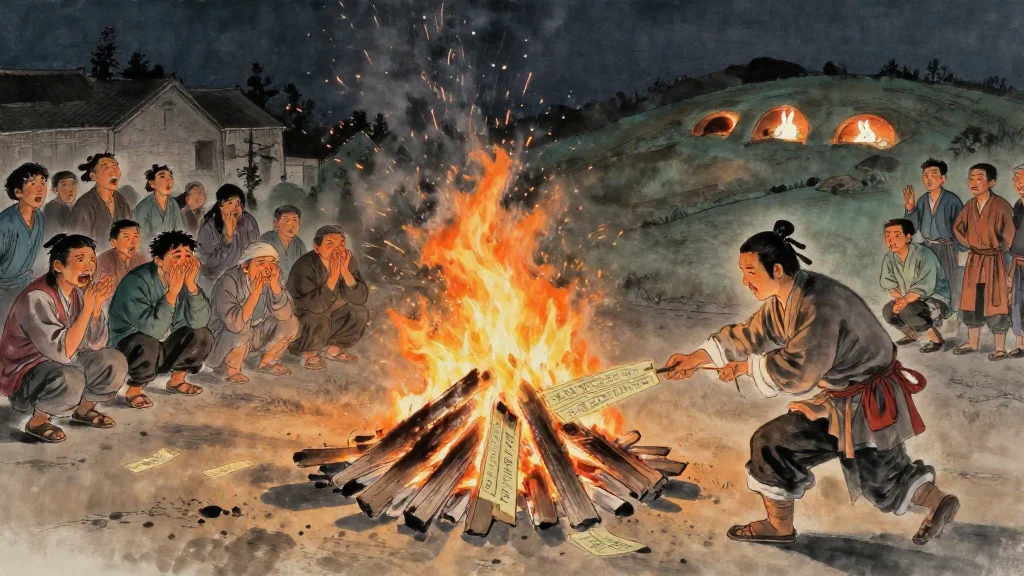
齊策四 (Stratagems of Qi IV) — Chinese ink painting

Chapter 11 of 33 · Qi state

齊策四

Stratagems of Qi IV

View:

齊人有馮諼者

There Was a Man of Qi Named Feng Xuan

齊人有馮諼者,貧乏不能自存,使人屬孟嘗君,願寄食門下。孟嘗君曰:「客何好?」曰:「客無好也。」曰:「客何能?」曰:「客無能也。」孟嘗君笑而受之曰:「諾。」左右以君賤之也,食以草具。

居有頃,倚柱彈其劍,歌曰:「長鋏歸來乎!食無魚。」左右以告。孟嘗君曰:「食之,比門下之客。」居有頃,復彈其鋏,歌曰:「長鋏歸來乎!出無車。」左右皆笑之,以告。孟嘗君曰:「為之駕,比門下之車客。」於是乘其車,揭其劍,過其友曰:「孟嘗君客我。」後有頃,復彈其劍鋏,歌曰:「長鋏歸來乎!無以為家。」左右皆惡之,以為貪而不知足。孟嘗君問:「馮公有親乎?」對曰:「有老母。」孟嘗君使人給其食用,無使乏。於是馮諼不復歌。

後孟嘗君出記,問門下諸客:「誰習計會,能為文收責於薛者乎?」馮諼署曰:「能。」孟嘗君怪之,曰:「此誰也?」左右曰:「乃歌夫長鋏歸來者也。」孟嘗笑曰:「客果有能也,吾負之,未嘗見也。」請而見之,謝曰:「文倦於事,憒於憂,而性寧愚,沉於國家之事,開罪於先生。先生不羞,乃有意欲為收責於薛乎?」馮諼曰:「願之。」於是約車治裝,載券契而行,辭曰:「責畢收,以何市而反?」孟嘗君曰:「視吾家所寡有者。」

驅而之薛,使吏召諸民當償者,悉來合券。券遍合,起矯命以責賜諸民,因燒其券,民稱萬歲。

長驅到齊,晨而求見。孟嘗君怪其疾也,衣冠而見之,曰:「責畢收乎?來何疾也!」曰:「收畢矣。」「以何市而反?」馮諼曰:「君雲『視吾家所寡有者』。臣竊計,君宮中積珍寶,狗馬實外廄,美人充下陳。君家所寡有者以義耳!竊以為君市義。」孟嘗君曰:「市義奈何?」曰:「今君有區區之薛,不拊愛子其民,因而賈利之。臣竊矯君命,以責賜諸民,因燒其券,民稱萬歲。乃臣所以為君市義也。」孟嘗君不說,曰:「諾,先生休矣!」

後期年,齊王謂孟嘗君曰:「寡人不敢以先王之臣為臣。」孟嘗君就國於薛,未至百里,民扶老攜幼,迎君道中。孟嘗君顧謂馮諼:「先生所為文市義者,乃今日見之。」馮諼曰:「狡兔有三窟,僅得免其死耳。今君有一窟,未得高枕而臥也。請為君復鑿二窟。」孟嘗君予車五十乘,金五百斤,西遊於梁,謂惠王曰:「齊於其大臣孟嘗君於諸侯,諸侯先迎之者,富而兵強。」於是梁王虛上位,以故相為上將軍,遣使者,黃金千斤,車百乘,往聘孟嘗君。馮諼先驅誡孟嘗君曰:「千金,重幣也;百乘,顯使也。齊其聞之矣。」梁使三反,孟嘗君固辭不往也。齊王聞之,君臣恐懼,遣太傅齎黃金千斤,文車二駟,服劍一,封書謝孟嘗君曰:「寡人不祥,被於宗廟之祟,沉於諂諛之臣,開罪於君,寡人不足為也。願君顧先王之宗廟,姑反國統萬人乎?」馮諼誡孟嘗君曰:「願請先王之祭器,立宗廟於薛。」廟成,還報孟嘗君曰:「三窟已就,君始高枕為樂矣。」

孟嘗君為相數十年,無纖介之禍者,馮諼之計也。

There is a man of Qi named Feng Xuan, so poor he cannot support himself. He has someone recommend him to Lord Mengchang, saying he wishes to eat at his lord's table. Lord Mengchang asks: "What does the guest enjoy?" The answer: "The guest has no particular tastes." "What can the guest do?" "The guest has no particular talents." Lord Mengchang laughs and accepts him: "Very well." His attendants, assuming the lord holds the man in contempt, serve him coarse fare.

After a while, Feng Xuan leans against a pillar, taps his sword, and sings: "Long sword, let us go home! There is no fish to eat." The attendants report this. Lord Mengchang says: "Feed him fish — treat him like a regular guest." After a while, he taps his sword again and sings: "Long sword, let us go home! There is no carriage to ride." The attendants all laugh and report it. Lord Mengchang says: "Give him a carriage — treat him like the carriage guests." So Feng Xuan rides his carriage, brandishes his sword, and visits his friends saying: "Lord Mengchang treats me as a guest." After a while more, he taps his sword again and sings: "Long sword, let us go home! There is nothing to support a family." The attendants all despise him, considering him greedy and insatiable. Lord Mengchang asks: "Does Master Feng have family?" The answer: "An elderly mother." Lord Mengchang sends provisions to support her, ensuring she lacks for nothing. Feng Xuan sings no more.

Later, Lord Mengchang puts out a notice asking his retainers: "Who is skilled in accounting and can collect the debts owed to me at Xue?" Feng Xuan signs up: "I can." Lord Mengchang is surprised: "Who is this?" His attendants say: "The one who sang 'Long sword, let us go home.'" Lord Mengchang laughs: "So the guest does have abilities after all. I have failed him — I never once received him." He invites Feng Xuan in and apologizes: "I have been worn down by affairs and muddled with worries. My nature is dim and I have been sunk in state business, giving offense to you, sir. You are not ashamed — and you wish to collect the debts at Xue for me?" Feng Xuan says: "I do."

He prepares the carriage, packs the debt tallies, and sets off. As he departs he asks: "When the debts are collected, what shall I buy to bring back?" Lord Mengchang says: "Look at what my household lacks."

Feng Xuan drives to Xue and has the officials summon all the people who owe debts. When every tally has been matched, he rises and, forging Lord Mengchang's command, forgives all the debts — and burns the tallies. The people shout: "Ten thousand years!"

He drives straight back to Qi, arriving at dawn and requesting an audience. Lord Mengchang is startled by his speed, dresses formally, and receives him: "Are all the debts collected? How did you return so fast?" Feng Xuan says: "All collected." "And what did you buy?" Feng Xuan replies: "You told me to look at what your household lacks. I privately calculated: your palace is heaped with treasures, your stables are full of dogs and horses, your chambers are filled with beauties. What your household lacks is righteousness. So I took the liberty of buying righteousness for you."

"How does one buy righteousness?"

"You hold the tiny domain of Xue, yet instead of cherishing its people and treating them as your children, you have been squeezing profit from them. I took the liberty of forging your command, forgiving the debts, and burning the tallies. The people shouted 'ten thousand years.' This is how I bought righteousness for you."

Lord Mengchang is displeased: "Very well. You may rest, sir."

A year later, the King of Qi tells Lord Mengchang: "I do not presume to keep a minister of the former king as my own minister." Lord Mengchang retires to his domain of Xue. Before he has traveled a hundred li, the people — old supporting young, young leading old — line the road to welcome him. Lord Mengchang turns to Feng Xuan: "What you bought for me as righteousness — today I see it."

Feng Xuan says: "The cunning rabbit has three burrows and barely manages to avoid death. You, my lord, have only one burrow — you cannot yet rest easy. Allow me to dig two more for you."

Lord Mengchang gives him fifty chariots and five hundred catties of gold. He travels west to Liang and tells King Hui: "Qi has dismissed its great minister Lord Mengchang and made him available to the feudal lords. Whichever lord welcomes him first will grow rich and his armies strong." At this, the King of Liang empties the position of highest honor, demotes his current prime minister to supreme general, and dispatches envoys with a thousand catties of gold and a hundred chariots to recruit Lord Mengchang.

Feng Xuan races ahead and warns Lord Mengchang: "A thousand catties of gold is a heavy gift; a hundred chariots is a conspicuous embassy. Qi will certainly hear of it." The Liang envoys come three times; Lord Mengchang firmly declines each time.

The King of Qi hears of this. Ruler and ministers grow alarmed. He dispatches the Grand Tutor bearing a thousand catties of gold, two decorated four-horse chariots, a ceremonial sword, and a sealed letter of apology to Lord Mengchang: "I am an unlucky man, afflicted by ancestral spirits and led astray by flattering ministers. I have given offense to you, and I am not worthy. I beg you to remember the ancestral temple of the former kings and return to govern the people."

Feng Xuan advises Lord Mengchang: "Request the former king's ritual vessels and establish an ancestral temple at Xue." When the temple is complete, he returns and reports: "The three burrows are finished. Now you may rest easy and be content."

Lord Mengchang serves as prime minister for decades, without the slightest misfortune. This is all due to Feng Xuan's strategy.

Notes

1person馮諼Féng Xuān

Feng Xuan (馮諼, also written 馮驩) is one of the most famous retainers in Chinese literature. His story is the definitive illustration of the principle that the most valuable talent often comes in the least impressive packaging. His three escalating demands — fish, carriage, family support — are a deliberate test of Lord Mengchang's generosity.

2context

The phrase 'buying righteousness' (市義) has become proverbial in Chinese. Feng Xuan's insight is that Lord Mengchang has plenty of material wealth but no popular loyalty — the one asset that cannot be seized or bought after a crisis hits. Burning the debt tallies was unauthorized and looks reckless, but it is precisely the kind of investment that pays off only in catastrophe. Lord Mengchang's initial displeasure is understandable: he wanted cash, and Feng Xuan brought him an intangible. A year later, when he is fired and the people of Xue line the road to welcome him, the intangible turns out to be the only thing that matters.

3context

The 'three burrows of the cunning rabbit' (狡兔三窟) became one of the most enduring Chinese idioms. The three burrows are: (1) the people's loyalty at Xue, bought by forgiving their debts; (2) a competing offer from Liang, which makes Qi afraid to lose Lord Mengchang; (3) an ancestral temple at Xue, which means Qi's kings cannot destroy the fief without committing sacrilege against their own ancestors. Each burrow is a different kind of insurance — popular, diplomatic, and religious.

4place梁惠王

Liang (梁) is Wei, called by the name of its capital Daliang (modern Kaifeng, Henan). King Hui (惠王) here is probably an error or anachronism — the Wei king contemporary with Lord Mengchang's later career would be King Zhao of Wei.

孟嘗君為從

Lord Mengchang Organizes a North-South Coalition

孟嘗君為從。公孫弘謂孟嘗君曰:「君不以使人先觀秦王?意者秦王帝王之主也,君恐不得為臣,奚暇從以難之?意者秦王不肖之主也,君從以難之,未晚。」孟嘗君曰:「善,願因請公往矣。」

公孫弘敬諾,以車十乘之秦。昭王聞之,而欲醜之以辭。公孫弘見,昭王曰:「薛公之地,大小几何?」公孫弘對曰:「百里。」昭王笑而曰:「寡人地數千里,猶未敢以有難也。今孟嘗君之地方百里,而因欲難寡人,猶可乎?」公孫弘對曰:「孟嘗君好人,大王不好人。」昭王曰:「孟嘗之好人也,奚如?」公孫弘曰:「義不臣乎天子,不友乎諸侯,得志不慚為人主,不得志不肯為人臣,如此者三人;而治可為管、商之師,說義聽行,能致其如此者五人;萬乘之嚴主也,辱其使者,退而自刎,必以其血洿其衣,如臣者十人。」昭王笑而謝之,曰:「客胡為若此,寡人直與客論耳!寡人善孟嘗君,欲客之必諭寡人之志也!」公孫弘曰:「敬諾。」

公孫弘可謂不侵矣。昭王,大國也。孟嘗,千乘也。立千乘之義而不可陵,可謂足使矣。

Lord Mengchang is organizing a north-south coalition. Gongsun Hong says to him: "Why not first send someone to assess the King of Qin? If the King of Qin turns out to be a ruler of imperial caliber, you, my lord, should worry about not being able to serve him — let alone challenging him with a coalition. If the King of Qin turns out to be an incompetent ruler, it will not be too late to organize a coalition against him then."

Lord Mengchang says: "Good. I would like to ask you to go."

Gongsun Hong respectfully agrees and sets out for Qin with ten chariots. King Zhao of Qin hears of his coming and intends to humiliate him in debate. When Gongsun Hong is received, King Zhao says: "The Lord of Xue's domain — how large is it exactly?"

Gongsun Hong replies: "A hundred li."

King Zhao laughs: "My domain spans thousands of li, and I still do not presume to challenge anyone. Lord Mengchang's domain is a mere hundred li, and he presumes to challenge me? Is that reasonable?"

Gongsun Hong replies: "Lord Mengchang values men. Your Majesty does not."

King Zhao asks: "How does Lord Mengchang value men?"

Gongsun Hong says: "He has three men who on principle will not serve as subjects to any Son of Heaven, will not befriend any feudal lord, and if they attain their ambitions feel no shame in becoming rulers themselves — yet if they do not, refuse to serve as anyone's minister. He has five men whose governance could rival Guan Zhong and Shang Yang as teachers, whose counsel is heeded and whose plans are followed, men capable of achieving such things. And he has ten men like myself — men who, if the ruler of a ten-thousand-chariot state insults their envoy, will withdraw and cut their own throats, making certain their blood stains the king's garments."

King Zhao laughs and backs down: "Why does the guest speak so? I was merely debating with you! I admire Lord Mengchang, and I wanted you to convey my goodwill to him."

Gongsun Hong says: "Respectfully understood."

The narrator comments: Gongsun Hong can be called unyielding. King Zhao commands a great state; Lord Mengchang, a state of a thousand chariots. To uphold the dignity of a thousand-chariot lord and refuse to be overawed — that is what it means to be a worthy envoy.

Notes

1person秦昭王Qín Zhāo Wáng

King Zhao of Qin (秦昭王, r. 306–251 BC) was the longest-reigning Qin king and the one who set the stage for unification, presiding over victories at Changping and Yan-Ying.

2context

Gongsun Hong's escalating catalog of Lord Mengchang's retainers is a masterpiece of diplomatic bluff. The first tier — men too proud to serve anyone — is impressive but abstract. The second tier — administrators of Guan Zhong's caliber — is more threatening. The third tier is the punchline: ten men willing to die specifically to humiliate the king who insulted their envoy. The message to King Zhao is: 'I am one of the expendable ones, and there are nine more behind me.' King Zhao gets the point.

3person公孫弘Gōngsūn Hóng

Gongsun Hong (公孫弘) is not the famous Han dynasty chancellor of the same name but an otherwise unknown retainer of Lord Mengchang.

魯仲連謂孟嘗

Lu Zhonglian Addresses Lord Mengchang

魯仲連謂孟嘗:「君好士也,雍門養椒亦,陽得子養,飲食、衣裘與之同之,皆得其死。今君之家富於二公,而士未有為君盡遊者也。」君曰:「文不得是二人故也。使文得二人者,豈獨不得盡?」對曰:「君之廄馬百乘,無不被繡衣而食菽粟者,豈有騏麟騄耳哉?後宮十妃,皆衣縞紵,食梁肉,豈有毛嬙、西施哉?色與馬取於今之世,士何必待古哉?故曰君之好士未也。」

Lu Zhonglian says to Lord Mengchang: "You are known as a lover of men of talent. Yongmen Yang Jiao shared his own food, clothing, and furs equally with his men, and every one of them died for him. Yang Dezi did the same, and every one of his men died for him. Your household is wealthier than either of those two men, yet no retainer has ever given his life for you."

Lord Mengchang says: "That is because I have not found men of their caliber. If I could find such men, would I alone fail to earn their devotion?"

Lu Zhonglian replies: "You have a hundred chariots' worth of horses in your stables, every one of them draped in embroidered blankets and fed fine grain — but is there a single thoroughbred among them? You have ten consorts in your inner chambers, all dressed in fine silk and fed choice meat — but is there a Mao Qiang or Xi Shi among them? Beauties and horses are found in the present age. Why should worthy men be sought only among the ancients? I say you have not yet truly committed to valuing talent."

Notes

1context

Lu Zhonglian's critique cuts deep: Lord Mengchang has quantity without quality. He has three thousand retainers, none of them willing to die for him, because his generosity is indiscriminate. The horse-and-consort analogy is devastating — you don't get thoroughbreds by feeding every horse equally well, and you don't inspire mortal loyalty by treating every hanger-on like a guest of honor.

2person毛嬙 / 西施Máo Qiáng / Xī Shī

Mao Qiang (毛嬙) and Xi Shi (西施) were legendary beauties of ancient China. Xi Shi, from the state of Yue, was supposedly used as a 'honey trap' to distract King Fuchai of Wu.

孟嘗君逐於齊而復反

Lord Mengchang Is Expelled from Qi and Returns

孟嘗君逐於齊而復反。譚拾子迎之於境,謂孟嘗君曰:「君得無有所怨齊士大夫?」孟嘗君曰:「有。」「君滿意殺之乎?」孟嘗君曰:「然。」譚拾子曰:「事有必至,理有固然,君知之乎?」孟嘗君曰:「不知。」譚拾子曰:「事之必至者,死也;理之固然者,富貴則就之,貧賤則去之。此事之必至,理之固然者。請以市諭。市,朝則滿,夕則虛,非朝愛市而夕憎之也,求存故往,亡故去。願君勿怨!」孟嘗君乃取所怨五百牒削去之,不敢以為言。

Lord Mengchang is expelled from Qi, then returns. Tan Shizi meets him at the border and says: "Does my lord bear resentment toward any Qi officials?"

Lord Mengchang says: "I do."

"Does my lord intend to kill them all?"

"I do."

Tan Shizi says: "There are things that inevitably happen and principles that are inherently so. Does my lord understand?"

"I do not."

"The thing that inevitably happens is death. The principle that is inherently so is: people flock to wealth and status and desert poverty and disgrace. This is inevitable; this is inherent. Let me illustrate with the marketplace. In the morning it is full; by evening it is empty. This is not because people love the market in the morning and hate it in the evening — what they want is there, so they come; when it is gone, they leave. I beg my lord not to bear a grudge."

Lord Mengchang takes the list of five hundred names he had written for revenge, crosses them all out, and never speaks of the matter again.

Notes

1context

Tan Shizi's marketplace analogy is one of the most psychologically acute passages in the Zhanguoce. It reframes betrayal as physics: people orient toward power the way shoppers orient toward goods. There is nothing personal about it. Lord Mengchang's willingness to destroy a five-hundred-name revenge list on the strength of one good metaphor suggests he understands — or at least that he is rational enough to recognize that mass purges upon return to power tend to create more enemies than they eliminate.

2person譚拾子Tán Shízǐ

Tan Shizi (譚拾子) is otherwise unknown. His name may be a title rather than a personal name.

齊宣王見顏斶

King Xuan of Qi Receives Yan Chu

齊宣王見顏斶,曰:「斶前!」斶亦曰:「王前!」宣王不悅。左右曰:「王,人君也。斶,人臣也。王曰『斶前』,亦曰『王前』,可乎?」斶對曰:「夫斶前為慕勢,王前為趨士。與使斶為趨勢,不如使王為趨士。」王忿然作色曰:「王者貴乎?士貴乎?」對曰:「士貴耳,王者不貴。」王曰:「有說乎?」斶曰:「有。昔者秦攻齊,令曰:『有敢去柳下季壟五十步而樵採者,死不赦。』令曰:『有能得齊王頭者,封萬戶侯,賜金千鎰。』由是觀之,生王之頭,曾不若死士之壟也。」宣王默默不悅。

左右皆曰:「斶來,斶來!大王據千乘之地,而建千石鐘,萬石虡。天下之士,仁義皆來役處;辯知並進,莫不來語;東西南北,莫敢不服。求萬物不備具,而百無不親附。今夫士之高者,乃稱匹夫,徒步而處農畝,下則鄙野、監門、閭里,士之賤也,亦甚矣!」

斶對曰:「不然。斶聞古大禹之時,諸侯萬國。何則?德厚之道,得貴士之力也。故舜起農畝,出於野鄙,而為天子。及湯之時,諸侯三千。當今之世,南面稱寡者,乃二十四。由此觀之,非得失之策與?稍稍誅滅,滅亡無族之時,欲為監門、閭里,安可得而有乎哉?是故《易傳》不云乎:『居上位,未得其實,以喜其為名者,必以驕奢為行。據慢驕奢,則凶從之。是故無其實而喜其名者削,無德而望其福者約,無功而受其祿者辱,禍必握。』故曰:『矜功不立,虛願不至。』此皆幸樂其名,華而無其實德者也。是以堯有九佐,舜有七友,禹有五丞,湯有三輔,自古及今而能虛成名於天下者,無有。是以君王無羞亟問,不市下學;是故成其道德而揚功名於後世者,堯、舜、禹、湯、周文王是也。故曰:『無形者,形之君也。無端者,事之本也。』夫上見其原,下通其流,至聖人明學,何不吉之有哉!老子曰:『雖貴,必以賤為本;雖高,必以下為基。』是以侯王稱孤寡不穀。是其賤之本與!非夫孤寡者,人之困賤下位也,而侯王以自謂,豈非下人而尊貴士與?夫堯傳舜,舜傳禹,周成王任周公旦,而世世稱曰明主,是以明乎士之貴也。」

宣王曰:「磋乎!君子焉可侮哉,寡人自取病耳!及今聞君子之言,乃今聞細人之行,願請受為弟子。且顏先生與寡人游,食必太牢,出必乘車,妻子衣服麗都。」

顏斶辭去曰:「夫玉生於山,制則破焉,非弗寶貴矣,然夫璞不完。士生乎鄙野,推選則祿焉,非不得尊遂也,然而形神不全。斶願得歸,晚食以當肉,安步以當車,無罪以當貴,清靜貞正以自虞。制言者王也,盡忠直言者斶也。言要道已備矣,願得賜歸,安行而反臣之邑屋。」則再拜而辭去也。

斶知足矣,歸反撲,則終身不辱也。

King Xuan of Qi receives Yan Chu. The king says: "Chu, come forward!" Yan Chu also says: "King, come forward!"

The king is displeased. His attendants say: "The king is a ruler; Chu is a subject. The king says 'Chu, come forward' and Chu also says 'King, come forward' — is this acceptable?"

Yan Chu replies: "If Chu goes forward, that is courting power. If the king goes forward, that is honoring talent. Rather than make Chu court power, it would be better to have the king honor talent."

The king flushes with anger: "Is kingship more precious, or is scholarship?"

"Scholarship is precious. Kingship is not."

"Can you justify that?"

Yan Chu says: "I can. In the past, when Qin attacked Qi, it issued this order: 'Anyone who dares gather firewood within fifty paces of the tomb of Liu Xia Ji shall be executed without pardon.' It also issued this order: 'Anyone who can bring me the head of the King of Qi shall be enfeoffed as a lord of ten thousand households and given a thousand yi of gold.' Judging from this, the head of a living king is worth less than the tomb mound of a dead scholar."

King Xuan falls silent, displeased.

His attendants all say: "Chu, come! Come! The great king holds a domain of a thousand chariots, with bells weighing a thousand shi and bell-stands weighing ten thousand shi. All the world's men of talent — the humane and righteous all come to serve; the eloquent and wise all come to speak; from every direction, none dare refuse obedience. Every object is available, and all the hundred clans gladly submit. Yet the highest of scholars merely calls himself a commoner, walks on foot, and lives among farmers. At worst, they are rustics, gatekeepers, village dwellers. Is scholarship not utterly base?"

Yan Chu replies: "Not so. I have heard that in the time of Great Yu, there were ten thousand feudal states. Why? Because the way of thick virtue worked through the power of honoring scholars. So Shun rose from the fields, came from the wilderness, and became Son of Heaven. By the time of Tang, the feudal states numbered three thousand. In the present age, those who face south and call themselves 'We' number only twenty-four. Observe this trajectory — is it not a record of gain and loss? As states are gradually destroyed and annihilated, their clans exterminated, those rulers would be glad to become gatekeepers and village dwellers, but can they? The Commentary on the Changes says: 'To occupy high position without possessing its substance, delighting in the title alone, is to ensure arrogant and extravagant conduct. Arrogance and extravagance bring misfortune. Those who lack substance but delight in the name are diminished. Those without virtue who hope for blessings are impoverished. Those without merit who receive salary are disgraced — disaster will surely follow.' Therefore it is said: 'Pride in accomplishments achieves nothing; empty wishes go unfulfilled.' These are all those who rejoice in empty glory and adornment without the substance of real virtue.

"Thus Yao had nine assistants, Shun had seven friends, Yu had five ministers, and Tang had three counselors. From ancient times to the present, no one has achieved empty fame in All-Under-Heaven without such men. This is why a true king is never ashamed to ask frequently and never disdains to learn from those below. Those who perfected their virtue and spread their fame to later generations — Yao, Shun, Yu, Tang, and King Wen of Zhou are such men. Therefore it is said: 'The formless is the lord of form; the originless is the root of all affairs.' One who sees the source above and understands the flow below — a sage illuminated by learning — how could ill fortune touch him? Laozi said: 'Though noble, one must take humility as the root; though lofty, one must take lowliness as the foundation.' This is why kings and lords call themselves 'the orphaned,' 'the solitary,' 'the unworthy.' Is this not taking the base as one's root? The orphaned and solitary are terms for the most wretched and humble of people, yet kings and lords apply them to themselves — is this not humbling themselves to exalt the worthy? Yao passed the throne to Shun, Shun passed it to Yu, King Cheng of Zhou entrusted power to the Duke of Zhou — and every generation calls them enlightened rulers. This is how clear it is that scholars are the more precious."

King Xuan says: "Alas! How can a gentleman be demeaned? I have only brought illness upon myself! Now that I hear the words of a gentleman, I understand the conduct of petty men. I wish to be accepted as your student. Let Yan Chu remain with me — he shall eat from the great sacrificial offerings, ride in a carriage whenever he goes out, and his wife and children shall be dressed in splendid clothes."

Yan Chu declines and takes his leave: "Jade grows in the mountain; when it is carved, it is broken — not that it is not still precious, but the uncut stone is no longer whole. A scholar is born in the wilderness; when he is selected and given a salary, not that he does not gain honor and success, but his body and spirit are no longer intact. I, Chu, wish to return home. I will eat late so that food tastes like meat. I will walk peacefully so that walking serves as a carriage. I will live without offense so that innocence serves as rank. I will keep myself clear, still, upright, and correct.

"The one who dictates words is the king. The one who speaks with full honesty is Chu. The essential Way has been fully stated. I beg leave to return and walk at ease back to my village home." He bows twice and departs.

The narrator comments: Yan Chu understood contentment. By returning to simplicity, he avoided disgrace for the rest of his life.

Notes

1person顏斶Yán Chù

Yan Chu (顏斶, pinyin Yán Chù) is an otherwise obscure figure. His name 斶 means 'to cut' or 'to chop' — appropriate for a man whose rhetoric is a blunt instrument.

2person柳下惠Liǔxià Huì

Liu Xia Ji (柳下季) is Liu Xia Hui (柳下惠), the famously virtuous official of Lu during the Spring and Autumn period. His tomb was apparently so revered that even an invading Qin army placed it off-limits.

3context

Yan Chu's argument about the declining number of feudal states — from ten thousand to three thousand to twenty-four — is a brilliantly simple demographic proof. The kings who failed to honor scholars ended up extinct. The trajectory is unidirectional. The implicit threat: keep treating scholars like inferiors and your dynasty will be next.

4context

Yan Chu's parting speech is one of the most beautiful refusals in Chinese literature. He declines not from pique but from a principled preference for integrity over luxury. The parallel structures — 'eating late to replace meat, walking to replace carriages, innocence to replace rank' — have been quoted for two millennia as the manifesto of the contented scholar.

先生王斗造門而欲見齊宣王

Master Wang Dou Arrives at the Gate Seeking to See King Xuan

先生王斗造門而欲見齊宣主,宣王使謁者延入。王斗曰:「斗趨見王為好勢,王趨見斗為好士,於王何如?」使者復還報。王曰:「先生徐之,寡人請從。」宣王因趨而迎之於門,與入,曰:「寡人奉先君之宗廟,守社稷,聞先生直言正諫不諱。」王斗對曰:「王聞之過。斗生於亂世,事亂君,焉敢直言正諫。」宣王忿然作色,不說。

有間,王斗曰:「昔先君桓公所好者,九合諸侯,一匡天下,天子受籍,立為大伯。今王有四焉。」宣王說,曰:「寡人愚陋,守齊國,唯恐失抎之,焉能有四焉?」王斗曰:「否。先君好馬,王亦好馬。先君好狗,王亦好狗。先君好酒,王亦好酒。先君好色,王亦好色。先君好士,是王不好士。」宣王曰:「當今之世無士,寡人何好?」王斗曰:「世無騏驎騄耳,王駟已備矣。世無東郭俊、盧氏之狗,王之走狗已具矣。世無毛嬙、西施,王宮已充矣。王亦不好士也,何患無士?」王曰:「寡人憂國愛民,固願得士以治之。」王斗曰:「王之憂國愛民,不若王愛尺縠也。」王曰:「何謂也?」王斗曰:「王使人為冠,不使左右便辟而使工者何也?為能之也。今王治齊,非左右便辟無使也,臣故曰不如愛尺縠也。」

宣王謝曰:「寡人有罪國家。」於是舉士五人任官,齊國大治。

Master Wang Dou arrives at the palace gate seeking an audience with King Xuan of Qi. The king sends a chamberlain to usher him in. Wang Dou says: "If I hurry to see the king, I am courting power. If the king hurries to see me, he is honoring talent. Which would the king prefer?"

The messenger returns with this. The king says: "Ask the gentleman to wait — I will come."

King Xuan hurries out to welcome him at the gate, and they enter together. The king says: "I, who maintain the ancestral temple and guard the state, have heard that you, sir, speak frankly and remonstrate without holding back."

Wang Dou replies: "Your Majesty has heard wrongly. I, Dou, was born in a disordered age and serve a disordered ruler — how would I dare speak frankly and remonstrate?"

King Xuan flushes with anger, displeased.

After a pause, Wang Dou says: "In the past, your ancestor Duke Huan had certain preferences — and he united the feudal lords nine times, straightened All-Under-Heaven, received tribute from the Son of Heaven, and was established as the great hegemon. Your Majesty shares four of his preferences."

The king is pleased: "I am an ignorant and rustic man, merely guarding the state of Qi and constantly fearing I will lose it. How could I share four of his qualities?"

Wang Dou says: "No. Your ancestor loved horses — and so does Your Majesty. Your ancestor loved hounds — and so does Your Majesty. Your ancestor loved wine — and so does Your Majesty. Your ancestor loved women — and so does Your Majesty. Your ancestor loved talent. Your Majesty does not."

The king says: "There are no men of talent in the present age. What is there for me to love?"

Wang Dou says: "The world has no legendary thoroughbreds, yet Your Majesty's stables are full. The world has no famed hounds like Dongguo Jun or the Lu clan's dog, yet Your Majesty's kennels are fully stocked. The world has no Mao Qiang or Xi Shi, yet your harem is overflowing. Your Majesty simply does not value talent — why complain of its absence?"

The king says: "I worry about the state and love the people. I sincerely wish to obtain worthy men to govern."

Wang Dou says: "Your Majesty's concern for the state and love for the people does not match your love for a foot of silk gauze."

"What do you mean?"

"When Your Majesty commissions a cap, you do not hand it to your favorites and flatterers — you give it to a skilled craftsman. Why? Because he is capable. Yet when Your Majesty governs Qi, you use no one except your favorites and flatterers. This is why I say your concern falls short of your love for a foot of silk."

King Xuan apologizes: "I stand guilty before the state." He then promotes five worthy men to office, and Qi is well governed.

Notes

1context

Wang Dou's setup is exquisite. He starts by implying the king is a bad ruler — which enrages the king — then pivots to flattery by comparing him to the great Duke Huan, which delights the king — then reveals the comparison is four-fifths unfavorable. The king shares all of Duke Huan's vices (horses, dogs, wine, women) but none of his virtue (talent recruitment). The silk-gauze analogy drives the point home: you would never let an amateur make your hat, so why let amateurs run your state?

2person齊桓公Qí Huán Gōng

Duke Huan of Qi (齊桓公, r. 685–643 BC) was the first of the Five Hegemons of the Spring and Autumn period. With Guan Zhong as his chief minister, he unified the feudal lords nine times under his leadership.

齊王使使者問趙威后

The King of Qi Sends an Envoy to the Dowager Queen of Zhao

齊王使使者問趙威后。書未發,威後問使者曰:「歲亦無恙耶?民亦無恙耶?王亦無恙耶?」使者不說,曰:「臣奉使使威後,今不問王,而先問歲與民,豈先賤而後尊貴者乎?」威後曰:「不然。苟無歲,何以有民?苟無民,何以有君?故有問舍本而問末者耶?」乃進而問之曰:「齊有處士曰鍾離子,無恙耶?是其為人也,有糧者亦食,無糧者亦食;有衣者亦衣,無衣者亦衣。是助王養其民也,何以至今不業也?葉陽子無恙乎?是其為人,哀鰥寡,恤孤獨,振困窮,補不足。是助王息其民者也,何以至今不業也?北宮之女嬰兒子無恙耶?撤其環殽,至老不嫁,以養父母。是皆率民而出於孝情者也,胡為至今不朝也?此二士弗業,一女不朝,何以王齊國,子萬民乎?於陵子仲尚存乎?是其為人也,上不臣於王,下不治其家,中不索交諸侯。此率民而出於無用者,何為至今不殺乎?」

The King of Qi sends an envoy to call upon Queen Dowager Wei of Zhao. Before the letter is even opened, the Queen Dowager asks the envoy: "Is the harvest well? Are the people well? Is the king well?"

The envoy is displeased: "I have been sent to call upon Your Majesty. Yet you do not first ask after the king, but ask about the harvest and the people first. Is this not placing the base before the noble?"

The Queen Dowager says: "Not so. Without a harvest, how can there be a people? Without a people, how can there be a ruler? Who would abandon the root to ask about the branch?"

She then presses further: "There is a recluse in Qi named Zhongli Zi — is he well? He is the sort of man who feeds both those who have grain and those who do not, clothes both those who have clothes and those who do not. He helps the king nourish his people. Why has he not been given office? Is Ye Yangzi well? He is the sort of man who pities widowers and widows, cares for orphans and the solitary, relieves the impoverished, and supplements the lacking. He helps the king sustain his people. Why has he not been given office? Is Yinger Zi, the woman of the Northern Palace, well? She removed her earrings and finery and refused to marry to the end of her life, in order to support her parents. She leads the people toward filial devotion. Why has she not been honored at court?

"Two worthy men are not given office, one filial woman is not honored — how can you rule the state of Qi and be father to ten thousand people?

"Is Yuling Zizhong still alive? He is a man who above refuses to serve the king, below neglects his own household, and in between declines relations with the feudal lords. He leads the people toward uselessness. Why has he not been executed?"

Notes

1person趙威后Zhào Wēi Hòu

Queen Dowager Wei of Zhao (趙威后) was the mother of King Huiwen of Zhao. She is famous for two episodes in the Zhanguoce: this one, and the more famous 'Touching Persuasion' (觸龍說趙太后) in the Zhao chapters.

2context

The Queen Dowager's prioritization — harvest, people, king, in that order — is not merely rhetorical; it is a compressed political philosophy. Mencius would approve. Her follow-up questions are even sharper: she knows the names of specific virtuous individuals in Qi and uses them to demonstrate that the Qi court is failing at basic governance. The punchline about Yuling Zizhong is ice-cold: a man who contributes nothing to the state at any level is, in her view, actively harmful and should be killed.

3person於陵子仲 / 陳仲Yúlíng Zǐzhòng / Chén Zhòng

Yuling Zizhong (於陵子仲) is Chen Zhong (陳仲), a famous ascetic of Qi who refused all political engagement. He is discussed critically by Mencius (3B.10) as a man whose purity is in fact parasitic — he can only maintain his principles because others do the messy work of governing.

齊人見田駢

A Man of Qi Visits Tian Pian

齊人見田駢,曰:「聞先生高議,設為不宦,而願為役。」田駢曰:「子何聞之?」對曰:「臣聞之鄰人之女。」田駢曰:「何謂也?」對曰:「臣鄰人之女,設為不嫁,行年三十而有七子,不嫁則不嫁,然嫁過畢矣。今先生設為不宦,訾養千鍾,徒百人,不宦則然矣,而富過畢也。」田子辭。

A man of Qi visits Tian Pian and says: "I have heard of your lofty views, sir, and that you have resolved not to take office. I wish to serve you."

Tian Pian asks: "Where did you hear this?"

"I heard it from my neighbor's daughter."

"What do you mean?"

"My neighbor's daughter resolved never to marry. She is now thirty years old and has seven children. She may not have married, but she has exceeded all the married women in output. Now you, sir, have resolved not to take office, yet you receive a stipend of a thousand zhong of grain and maintain a hundred followers. You may not hold office, but you have exceeded all the officeholders in wealth."

Master Tian is left without a reply.

Notes

1person田駢Tián Pián

Tian Pian (田駢, fl. 4th century BC) was a philosopher associated with the Jixia Academy in Qi, known for his Daoist leanings and his professed disdain for political office.

2context

The neighbor's-daughter analogy is devastating in its simplicity. The unnamed visitor's point is that Tian Pian's 'refusal' to hold office is a sham — he enjoys all the material benefits of officialdom (stipend, followers, status) while maintaining the moral prestige of a recluse. He is, in effect, an unmarried woman with seven children: the label does not match the reality. Tian Pian's silence is the only honest response available to him.

管燕得罪齊王

Guan Yan Offends the King of Qi

管燕得罪齊王,謂其左右曰:「子孰而與我赴諸侯乎?」左右嘿然莫對。管燕連然流涕曰:「悲夫!士何其易得而難用也!」田需對曰:「士三食不得饜,而君鵝鶩有餘食;下宮糅羅紈,曳綺縠,而士不得以為緣。且財者君之所輕,死者士之所重,君不肯以所輕與士,而責士以所重事君,非士易得而難用也。」

Guan Yan has given offense to the King of Qi. He says to his attendants: "Which of you will go into exile with me to another state?"

His attendants are silent. No one answers.

Guan Yan weeps freely: "How sad! Scholars are easy to acquire but impossible to use!"

Tian Xu responds: "Your scholars cannot get enough to eat at three meals a day, while your geese and ducks have food left over. Your women in the inner chambers trail silks and gauzes, while your scholars cannot even afford hem-lining. Wealth is what you treat lightly; death is what scholars treat heavily. You refuse to give scholars what costs you little, yet you demand from scholars what costs them everything. It is not that scholars are easy to acquire and hard to use — it is that you have never actually tried using them."

Notes

1context

Tian Xu's retort is a clean inversion of Guan Yan's self-pitying complaint. Guan Yan's geese eat better than his scholars, his concubines dress better than his advisors, yet he expects these same underfed, under-clothed men to risk their lives following him into exile. The asymmetry is structural, not personal: you gave them nothing, and now you are confused that they give you nothing back.

蘇秦自燕之齊

Su Qin Travels from Yan to Qi

蘇秦自燕之齊,見於華章南門。齊王曰:「嘻!子之來也。秦使魏冉致帝,子以為何如?」對曰:「王之問臣也卒,而患之所從生者微。今不聽,是恨秦也;聽之,是恨天下也。不如聽之以卒秦,勿庸稱也以為天下。秦稱之,天下聽之,王亦稱之,先後之事,帝名為無傷也。秦稱之,而天下不聽,王因勿稱,其於以收天下,此大資也。」

Su Qin travels from Yan to Qi and is received at the Huazhang South Gate. The King of Qi says: "Ah! You have come. Qin has sent Wei Ran to confer the imperial title on us. What do you think?"

Su Qin replies: "Your Majesty's question comes abruptly, but the source of the danger is subtle. If you refuse, you offend Qin. If you accept, you offend All-Under-Heaven. Better to accept it to satisfy Qin, but refrain from actually using the title — for the sake of All-Under-Heaven. If Qin uses the title and the world accepts it, Your Majesty can use it too — the sequence does no harm, and the imperial title costs you nothing. But if Qin uses the title and the world rejects it, Your Majesty simply does not use it. The opportunity to rally All-Under-Heaven against Qin — this is a great asset."

Notes

1person魏冉Wèi Rǎn

Wei Ran (魏冉, d. 266 BC) was the maternal uncle and chief minister of King Zhao of Qin. He was one of the most powerful figures in Qin politics for decades.

2context

This episode refers to the 'Mutual Emperor' incident of 288 BC, when Qin proposed that it and Qi both take the imperial title 'Di' (帝) — Qin as Western Emperor, Qi as Eastern Emperor. Su Qin's advice is to accept the title formally but not use it, keeping all options open. Accept it and wait: if the title sticks for Qin, use it too at no cost; if the title provokes backlash against Qin, discard it and lead the anti-Qin coalition. This is hedging elevated to an art form.

蘇秦謂齊王

Su Qin Addresses the King of Qi

蘇秦謂齊王曰:「齊、秦立為兩帝,王以天下為尊秦乎?且尊齊乎?」王曰:「尊秦。」「釋帝則天下愛齊乎?且愛秦乎?」王曰:「愛齊而憎秦。」「兩帝立,約伐趙,孰與伐宋之利也?」對曰:「夫約然與秦為帝,而天下獨尊秦而輕齊;齊釋帝,則天下愛齊而憎秦;伐趙不如伐宋之利。故臣願王明釋帝,以就天下;倍約儐秦,勿使爭重;而王以其間舉宋。夫有宋則衛之陽城危;有淮北則楚之東國危;有濟西則趙之河東危;有陰、平陸則梁門不啟。故釋帝而貳之以伐宋之事,則國重而名尊,燕、楚以形服,天下不敢不聽,此湯、武之舉也。敬秦以為名,而後使天下憎之,此所謂以卑易尊者也!願王之熟慮之也!」

Su Qin says to the King of Qi: "Qi and Qin have both assumed the imperial title. Does Your Majesty believe All-Under-Heaven respects Qin more, or Qi more?"

The king says: "Qin."

"If you renounce the title, will All-Under-Heaven love Qi or Qin?"

"Love Qi and despise Qin."

"If both emperors stand together and agree to attack Zhao, is that more profitable than attacking Song?"

Su Qin answers his own question: "If you accept the joint imperial title with Qin, All-Under-Heaven will respect only Qin and dismiss Qi. If Qi renounces the title, All-Under-Heaven will love Qi and despise Qin. Attacking Zhao is less profitable than attacking Song.

"Therefore I advise Your Majesty to publicly renounce the imperial title, thereby winning All-Under-Heaven's support. Abandon the pact with Qin, deny it any leverage, and in the interval — take Song. If you hold Song, Wei's Yangcheng is threatened. If you hold the Huai River's north bank, Chu's eastern territories are threatened. If you hold the area west of the Ji River, Zhao's lands east of the Yellow River are threatened. If you hold Yin and Pinglu, the gates of Liang cannot open.

"Renounce the title and replace it with the conquest of Song — your state grows powerful and your reputation rises. Yan and Chu will submit to the strategic reality. All-Under-Heaven will not dare refuse obedience. This is a campaign worthy of Tang and Wu.

"Show deference to Qin in name, then maneuver All-Under-Heaven into despising it. This is what is called exchanging the low position for the high. I beg Your Majesty to consider carefully!"

Notes

1context

This is the continuation of the 'Mutual Emperor' discussion. Su Qin's logic is seductive: the imperial title is a trap. Keeping it gains you nothing because everyone respects Qin anyway; renouncing it gains you moral authority at no cost. Meanwhile, use the time to conquer Song, which is the real prize. King Min of Qi followed this advice in 286 BC and conquered Song — but the resulting alarm among the other states led directly to the devastating Yan-led invasion of Qi in 284 BC. Su Qin's counsel was strategically brilliant in the short term and catastrophic in the long term.

2place

Song (宋) was a mid-sized state in modern eastern Henan and western Shandong. Its conquest by Qi in 286 BC was one of the most consequential events of the late Warring States, triggering the five-state coalition that nearly destroyed Qi.

Edition & Source

Text
《戰國策》 Zhanguoce
Edition
中華古詩文古書籍網 transcription
Commentary
鮑彪 (Bao Biao) Song dynasty commentary