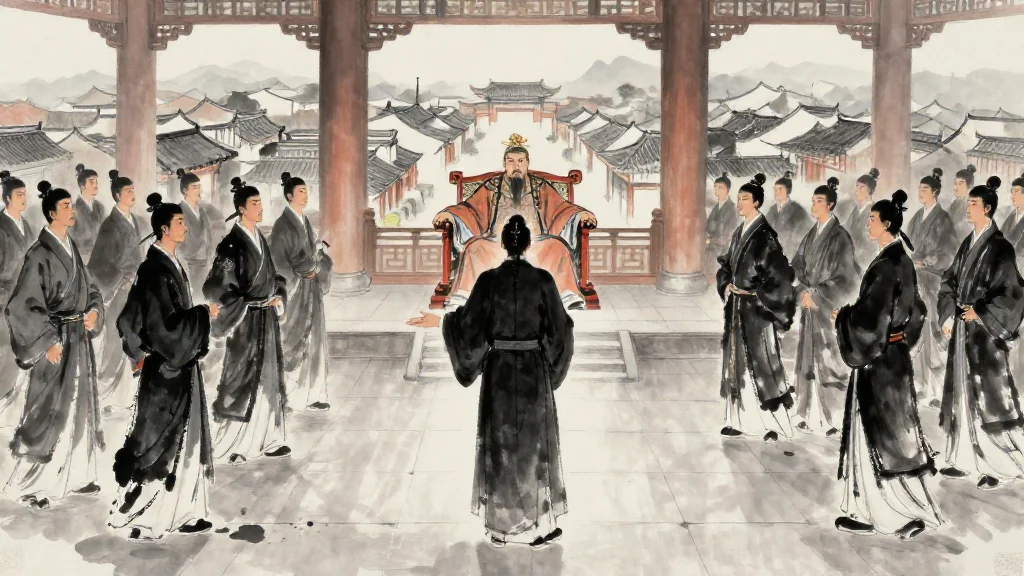
蘇秦說齊閔王
Su Qin Persuades King Min of Qi
蘇秦說齊閔王曰:「臣聞用兵而喜先天下者憂,約結而喜主怨者孤。夫後起者藉也,而遠怨者時也。是以聖人從事,必藉於權而務興於時。夫權藉者,萬物之率也;而時勢者,百事之長也。故無權藉,倍時勢,而能事成者寡矣。
「今雖干將、莫邪,非得人力,則不能割劌矣。堅箭利金,不得弦機之利,則不能遠殺矣。矢非不銛,而劍非不利也,何則?權藉不在焉。何以知其然也?昔者趙氏襲衛,車舍人不休傳,衛國城割平,衛八門土而二門墮矣,此亡國之形也。衛君跣行,告迎於魏。魏王身被甲底劍,挑趙索戰。邯鄲之中鶩,河、山之間亂。衛得是藉也,亦收余甲而北面,殘剛平,墮中牟之郭。衛非強於趙也,譬之衛矢而魏弦機也,藉力魏而有河東之地。趙氏懼,楚人救趙而伐魏,戰於州西,出梁門,軍舍林中,馬飲於大河。趙得是藉也,亦襲魏之河北,燒棘溝,墜黃城。故剛平之殘也,中牟之墮也,黃城之墜也,棘溝之燒也,此皆非趙、魏之欲也。然二國勸行之者,何也?衛明於時權之藉也。今世之為國者不然矣。兵弱而好敵強,國罷而好眾怨,事敗而好鞠之,兵弱而憎下人也,地狹而好敵大,事敗而好長詐。行此六者而求伯,則遠矣。
「臣聞善為國者,順民之意,而料兵之能,然後從於天下。故約不為人主怨,伐不為人挫強。如此,則兵不費,權不輕,地可廣,欲可成也。昔者,齊之與韓、魏伐秦、楚也,戰非甚疾也,分地又非多韓、魏也,然而天下獨歸咎於齊者,何也?以其為韓、魏主怨也。且天下遍用兵矣,齊、燕戰,而趙氏兼中山,秦、楚戰韓、魏不休,而宋、越專用其兵。此十國者,皆以相敵為意,而獨舉心於齊者,何也?約而好主怨,伐而好挫強也。
「且夫強大之禍,常以王人為意也;夫弱小之殃,常以謀人為利也。是以大國危,小國滅也。大國之計,莫若後起而重伐不義。夫後起之籍與多而兵勁,則事以眾強適罷寡也,兵必立也。事不塞天下之心,則利必附矣。大國行此,則名號不攘而至,伯王不為而立矣。小國之情,莫如僅靜而寡信諸侯。僅靜,則四鄰不反;寡信諸侯,則天下不賣,外不賣,內不反,則檳禍朽腐而不用,幣帛矯蠹而不服矣。小國道此,則不祠而福矣,不貸而見足矣。故曰:祖仁者王,立義者伯,用兵窮者亡。何以知其然也?昔吳王夫差以強大為天下先,強襲郢而棲越,身從諸侯之君,而卒身死國亡,為天下戮者,何也?此夫差平居而謀王,強大而喜先天下之禍也。昔者萊、莒好謀,陳、蔡好詐,莒恃越而滅,蔡恃晉而亡,此皆內長詐,外信諸侯之殃也。由此觀之,則強弱大小之禍,可見於前事矣。
「語曰:『麒驥之衰也,駑馬先之;孟賁之倦也,女子勝之。』夫駑馬、女子,筋骨力勁,非賢於麒驥、孟賁也。何則?後起之藉也。今天下之相與也不並滅,有而案兵而後起,寄怨而誅不直,微用兵而寄於義,則亡天下可跼足而須也。明於諸侯之故,察於地形之理者,不約親,不相質而固,不趨而疾,眾事而不反,交割而不相憎,懼強而加以親。何則?形同憂而兵趨利也。何以知其然也?昔者齊、燕戰於桓之曲,燕不勝,十萬之眾盡。胡人襲燕樓煩數縣,取其牛馬。夫胡之與齊非素親也,而用兵又非約質而謀燕也,然而甚於相趨者,何也?何則形同憂而兵趨利也。由此觀之,約於同形則利長,後起則諸侯可趨役也。
「故明主察相,誠欲以伯王也為志,則戰攻非所先。戰者,國之殘也,而都縣之費也。殘費已先,而能從諸侯者寡矣。彼戰者之為殘也,士聞戰則輸私財而富軍市,輸飲食而待死士,令折轅而炊之,殺牛而觴士,則是路君之道也。中人禱視,君翳釀,通都小縣置社,有市之邑莫不止事而奉王,則此虛中之計也。夫戰之明日,屍死扶傷,雖若有功也,軍出費,中哭泣,則傷主心矣。死者破家而葬,夷傷者空財而共藥,完者內酺而華樂,故其費與死傷者鈞。故民之所費也,十年之田而不償也。軍之所出,矛戟折,鐶弦絕,傷弩,破車,罷馬,亡矢之大半。甲兵之具,官之所私出也,士大夫之所匿,廝養士之所竊,十年之田而不償也。天下有此再費者,而能從諸侯寡矣。攻城之費,百姓理襜蔽,舉沖櫓,家雜總,身窟穴,中罷於刀金。而士困於土功,將不釋甲,期數而能拔城者為亟耳。上倦於教,士斷於兵,故三下城而能勝敵者寡矣。故曰:彼戰攻者,非所先也。何以知其然也?昔智伯瑤攻范、中行氏,殺其君,滅其國,又西圍晉陽,吞兼二國,而憂一主,此用兵之盛也。然而智伯卒身死國亡,為天下笑者,何謂也?兵先戰攻,而滅二子患也。日者,中山悉起而迎燕、趙,南戰於長子,敗趙氏;北戰於中山,克燕軍,殺其將。夫中山千乘之國也,而敵萬乘之國二,再戰北勝,此用兵之上節也。然而國遂亡,君臣於齊者,何也?不嗇於戰攻之患也。由此觀之,戰攻之敗,可見於前事。
「今世之所謂善用兵者,終戰比勝,而守不可拔,天下稱為善,一國得而保之,則非國之利也。臣聞戰大勝者,其士多死而兵益弱;守而不可拔者,其百姓罷而城郭露。夫士死於外,民殘於內,而城郭露於境,則非王之樂也。今夫鵠的非咎罪於人也,便弓引弩而射之,中者則善,不中則愧,少長貴賤,則同心於貫之者,何也?惡其示人以難也。今窮戰比勝,而守必不拔,則是非徒示人以難也,又且害人者也,然則天下仇之必矣。夫罷士露國,而多與天下為仇,則明君不居也;素用強兵而弱之,則察相不事。彼明君察相者,則五兵不動而諸侯從,辭讓而重賂至矣。故明君之攻戰也,甲兵不出於軍而敵國勝,沖櫓不施而邊城降,士民不知而王業至矣。彼明君之從事也,用財少,曠日遠而為利長者。故曰:兵後起則諸侯可趨役也。
「臣之所聞,攻戰之道非師者,雖有百萬之軍,比之堂上;雖有闔閭、吳起之將,禽之戶內;千丈之城,拔之尊俎之間;百尺之衝,折之衽席之上。故鐘鼓竽瑟之音不絕,地可廣而欲可成;和樂倡優侏儒之笑不之,諸侯可同日而致也。故名配天地不為尊,利制海內不為厚。故夫善為王業者,在勞天下而自佚,亂天下而自安,諸侯無成謀,則其國無宿憂也。何以知其然?佚治在我,勞亂在天下,則王之道也。銳兵來則拒之,患至則趨之,使諸侯無成謀,則其國無宿憂矣。何以知其然矣?昔者魏王擁士千里,帶甲三十六萬,其強而拔邯鄲,西圍定陽,又從十二諸侯朝天子,以西謀秦。秦王恐之,寢不安席,食不甘昧,令於境內,盡堞中為戰具,竟為守備,為死士置將,以待魏氏。衛鞅謀於秦王曰:『夫魏氏其功大,而令行於天下,有十二諸侯而朝天子,其與必眾。故以一秦而敵大魏,恐不如。王何不使臣見魏王,則臣請必北魏矣。』秦王許諾。衛鞅見魏王曰:『大王之功大矣,令行於天下矣。今大王之所從十二諸侯,非宋、衛也,則鄒、魯、陳、蔡,此固大王之所以鞭箠使也,不足以王天下。大王不若北取燕,東伐齊,則趙必從矣;西取秦,南伐楚,則韓必從矣。大王有伐齊、楚心,而從天下之志,則王業見矣。大王不如先行王服,然後圖齊、楚。』魏王說於衛鞅之言也,故身廣公宮,制丹衣柱,建九斿,從七星之旟。此天子之位也,而魏王處之。於是齊、楚怒,諸侯奔齊,齊人伐魏,殺其太子,覆其十萬之軍。魏王大恐,跣行按兵於國,而東次於齊,然後天下乃舍之。當是時,秦王垂拱受河西之外,而不以德魏王。故曰衛鞅之始與秦王計也,謀約不下席,言於尊俎之間,謀成於堂上,而魏將以禽於齊矣;沖櫓未施,而西河之外入於秦矣。此臣之所謂比之堂上,禽將戶內,拔城於尊俎之間,折衝席上者也。」
Su Qin persuades King Min of Qi:
"I have heard that those who use force and delight in acting before All-Under-Heaven end in worry; those who form alliances and delight in taking the lead in enmities end in isolation. Those who rise later gain leverage; those who distance themselves from enmity gain time. Therefore the sage, in conducting affairs, must rely on strategic advantage and attend to the moment. Strategic advantage governs all things; timing governs all undertakings. Without strategic advantage, and against the momentum of the times, few succeed.
"Even the swords Ganjiang and Moye cannot cut without human strength behind them. The hardest arrows with the sharpest points cannot kill at distance without the power of the bowstring. The arrows are not unsharp, the swords not dull — what is missing? The leverage is not in place.
"How do we know this is so? In the past, Zhao attacked Wei, driving without rest through relay stations. Wei's walls were leveled, and of Wei's eight gates, two had already collapsed — this was the shape of a doomed state. The lord of Wei walked barefoot to beg help from Wei. The King of Wei personally donned armor and drew his sword, challenging Zhao to battle. Handan fell into turmoil; the region between the Yellow River and the mountains was thrown into disorder. Wei, gaining this leverage, rallied its remaining troops, turned northward, ravaged Gangping, and destroyed the outer walls of Zhongmou. Wei was not stronger than Zhao — Wei was the arrow, and the great state of Wei was the bowstring. Borrowing Wei's strength, small Wei gained territory east of the Yellow River.
"When Zhao grew frightened, Chu rescued Zhao by attacking Wei, fighting west of Zhou, advancing through Liangmen, encamping in the forest, and watering horses at the Great River. Zhao, gaining this leverage, also struck Wei's territory north of the Yellow River, burning Jigou and toppling Huangcheng.
"The destruction of Gangping, the fall of Zhongmou, the toppling of Huangcheng, the burning of Jigou — none of these were what Zhao and Wei desired. Yet both states were driven to action. Why? Because Wei understood how to exploit timing and leverage.
"But states in the present age do otherwise. Their armies are weak yet they love to challenge the strong. Their states are exhausted yet they love to accumulate enmities. Their enterprises fail yet they love to pursue them to the end. Their armies are weak yet they disdain to yield to others. Their territory is small yet they love to challenge the great. Their enterprises fail yet they love prolonged deception. Anyone who practices these six things and seeks hegemony is far from it.
"I have heard that those who govern well follow the people's wishes and assess their army's capabilities before engaging with All-Under-Heaven. Their alliances do not make them the primary target of resentment; their campaigns do not make them the primary crusher of the strong. In this way, armies are not wasted, leverage is not diminished, territory can expand, and ambitions can be achieved.
"In the past, when Qi joined Han and Wei in attacking Qin and Chu, Qi's fighting was not the fiercest, and its share of conquered territory was not greater than Han's and Wei's. Yet All-Under-Heaven blamed Qi alone. Why? Because Qi had taken the lead in provoking enmity for Han and Wei. Moreover, the whole world was at war — Qi and Yan fought while Zhao annexed Zhongshan; Qin and Chu warred endlessly with Han and Wei; Song and Yue deployed their own armies. All ten states were preoccupied with mutual antagonism, yet they all singled out Qi. Why? Because in alliances Qi loved to take the lead in enmity, and in campaigns Qi loved to take the lead in crushing the strong.
"The danger of being large and powerful is the temptation to dominate others. The danger of being small and weak is the temptation to scheme against others. This is why great states become imperiled and small states perish.
"For a great state, the best strategy is to rise last and to strike only the unjust with overwhelming force. Rising last means having many allies and strong armies — you pit the many and strong against the few and exhausted, and your forces will certainly prevail. If your cause does not obstruct the world's desires, advantage will naturally flow to you. A great state that follows this course will find that titles and honors come unsought, and hegemony establishes itself without effort.
"For a small state, the best strategy is to keep perfectly still and place little trust in the feudal lords. Keep still, and your four neighbors will not turn against you. Trust the feudal lords sparingly, and the world will not sell you out. If none betray you abroad and none rebel at home, then disasters wither unused and tribute silks rot undisturbed. A small state following this path will find blessings without sacrifice and sufficiency without borrowing.
"Therefore it is said: those rooted in benevolence become kings; those who establish righteousness become hegemons; those who exhaust themselves in war perish.
"How do we know? King Fuchai of Wu, relying on his strength, rushed to act before All-Under-Heaven — he stormed Ying, cornered Yue, and led the feudal lords in person. Yet in the end he died and his state was destroyed, becoming a laughingstock. Why? Fuchai plotted kingship in peacetime and delighted in bringing All-Under-Heaven's troubles upon himself first.
"In the past, Lai and Ju loved to scheme; Chen and Cai loved to deceive. Ju relied on Yue and was destroyed; Cai relied on Jin and perished. These were all cases of cultivating deception internally while trusting the feudal lords externally.
"A proverb says: 'When the thoroughbred flags, the nag pulls ahead. When Meng Ben tires, a woman can defeat him.' It is not that nags and women have stronger sinews and bones than thoroughbreds and Meng Ben. The advantage lies in rising after.
"In the present world, where states do not annihilate one another simultaneously, if one holds back its forces and rises later — directing enmity against the unjust, deploying force sparingly in the name of righteousness — then mastery of All-Under-Heaven can be achieved by sitting on one's heels and waiting.
"Those who understand the relations among the feudal lords and perceive the logic of terrain do not need formal alliances to be united, do not need hostage exchanges to be secure. They do not need to rush yet are swift; they handle many affairs without reversal; they exchange territory without breeding resentment; they fear the strong yet draw closer to them. Why? Because shared strategic circumstances unite them, and armies naturally flow toward advantage.
"How do we know? In the past, Qi and Yan fought at the bend of Huan. Yan lost, its hundred-thousand-man army annihilated. The Hu tribes then raided several counties of Yan's Loufan region and seized its cattle and horses. The Hu had no prior alliance with Qi, and their attack on Yan was not arranged by treaty — yet they struck more eagerly than any ally would. Why? Shared strategic circumstances, and armies flowing toward advantage.
"Therefore an enlightened ruler and a perceptive minister who truly aspire to royal hegemony do not place battle and siege first. War is the ruin of states, the drain of cities and counties. When ruin and drain have already come first, few can lead the feudal lords afterward.
"The ruin that war brings: when soldiers hear that battle is coming, they spend their private wealth to stock the army market and prepare food for the doomed. Officers break up their carriage shafts for firewood and slaughter oxen to toast the troops — this is the road of exhausting the ruler. Throughout the heartland, people pray at shrines; the ruler hides and brews; in every city and small county, altars are set up and in every town with a market all business stops to serve the campaign — this is the strategy of emptying the interior.
"On the day after battle, the dead are laid out and the wounded are carried home. Though there may be a claim of victory, the army's expenses and the weeping at home wound the ruler's heart. The dead must have their families bankrupted for burial. The wounded drain their savings for medicine. The uninjured hold feasts and entertainments. The cost to the survivors equals that of the casualties. What the people expend cannot be recouped by ten years of farming.
"What the army expends: spears and halberds broken, bowstrings and rings snapped, crossbows damaged, chariots destroyed, horses exhausted, more than half the arrows lost. The armor and weapons — what the government grudgingly issued, what the officers concealed, what the camp servants pilfered — ten years of farming cannot replace them. A state that bears this double drain and still leads the feudal lords: such cases are rare.
"The cost of siege warfare: the people prepare mantlets and shields, raise battering rams and siege towers, bring their household ropes, dig themselves into tunnels, and are exhausted by blades and metal inside. Soldiers are ground down by earthworks, generals never remove their armor — and to take a city even after several deadlines is considered fast. The commanders are wearied by drilling, the soldiers worn out by combat. After taking three cities, few can still defeat the enemy. This is why battle and siege are not what should come first.
"How do we know? In the past, Zhi Bo Yao attacked the Fan and Zhonghang clans, killed their lords, and destroyed their states. He then besieged Jinyang to the west, swallowing two states and threatening one lord — this was the peak of military achievement. Yet Zhi Bo ended up dead and his house destroyed, a laughingstock. Why? He put battle first and the destruction of two houses brought disaster upon him.
"Recently, Zhongshan mobilized its entire force to meet Yan and Zhao. Fighting south at Changzi, it defeated Zhao. Fighting north at Zhongshan, it crushed Yan's army and killed its general. Zhongshan was a thousand-chariot state that took on two ten-thousand-chariot states and won both battles — this was the highest distinction in the use of arms. Yet the state was subsequently destroyed and its ruler and ministers ended up in Qi. Why? It was not frugal with the costs of battle.
"What the present age calls 'good generalship' — winning every battle and holding every defense — is praised by All-Under-Heaven. But if a single state achieves this and holds the territory, it is not actually in the state's interest. I have heard that the side that wins great battles suffers many dead and its army grows weaker; the side whose defenses cannot be breached exhausts its people and exposes its walls. When soldiers die abroad, the people are wasted at home, and walls are laid bare at the borders — this is no cause for a king's pleasure.
"A target hung on a post has committed no offense against anyone, yet everyone draws a bow and shoots at it — those who hit it feel pleased, those who miss feel ashamed. Young and old, noble and base all want to pierce it. Why? Because it presents itself as a challenge. Now to win every battle and hold every position presents not merely a challenge but an actual threat. All-Under-Heaven will certainly treat such a state as an enemy.
"To exhaust your soldiers, expose your state, and make enemies of the whole world — an enlightened ruler does not permit this. To deplete strong armies through constant use — a perceptive minister does not do this. Under an enlightened ruler and perceptive minister, the five weapons need not stir and the feudal lords submit; courteous yielding brings in heavy tribute. The enlightened ruler's campaigns: armored troops do not leave camp yet enemy states are defeated; battering rams are not deployed yet border cities surrender; the people do not even know it, yet the king's enterprise arrives. The enlightened ruler's affairs: spending little, taking a long view, and reaping lasting benefit. This is why I say: if arms rise later, the feudal lords can be marshaled at will.
"What I have heard of the Way of conquest without armies: though you have a million troops, arrange them from the audience hall; though you face generals like He Lu and Wu Qi, capture them from the doorway of your chamber; a wall of a thousand zhang — take it from between the wine vessels; a hundred-foot battering ram — break it at the banquet mat.
"When the bells, drums, pipes, and zithers never fall silent, territory can expand and ambitions can be fulfilled. When the laughter of jesters, singers, and dwarfs never ceases, the feudal lords can be summoned on the same day.
"A reputation to match heaven and earth is not considered too grand; profit that commands the realm is not considered too great. The one who truly builds the king's enterprise toils All-Under-Heaven while keeping himself at ease, disorders All-Under-Heaven while keeping himself secure. When the feudal lords have no mature plans, the state has no lingering worries.
"How do we know? Ease and order belong to me; toil and disorder belong to All-Under-Heaven — this is the royal Way. Repel sharp forces when they come, address threats as they arise, and ensure no feudal lord achieves a settled strategy — then the state has no lingering worries.
"In the past, the King of Wei commanded a territory of a thousand li, armored troops numbering three hundred and sixty thousand. At the height of his power he took Handan, besieged Dingyang to the west, and led twelve feudal lords to pay court to the Son of Heaven, plotting westward against Qin. The King of Qin was terrified — he could not sleep, could not eat, issued orders throughout the realm to turn every battlement into a weapons depot, erected defenses everywhere, assigned commanders to suicide battalions, and prepared to meet Wei.
"Shang Yang proposed to the King of Qin: 'Wei's achievements are great and its authority extends over All-Under-Heaven. With twelve feudal lords, it paid court to the Son of Heaven. Its allies must be numerous. For one Qin to face the great Wei — I fear we cannot prevail. Why not let me visit the King of Wei? I guarantee I will defeat Wei.'
"The King of Qin agreed. Shang Yang visited the King of Wei and said: 'Your Majesty's achievements are great indeed. Your authority extends over All-Under-Heaven. Yet the twelve feudal lords you lead are merely Song, Wei, Zou, Lu, Chen, and Cai — states you can drive with a whip. They are not enough to make you king of All-Under-Heaven. Your Majesty would do better to take Yan in the north and attack Qi in the east — then Zhao will follow. Take Qin in the west and attack Chu in the south — then Han will follow. If Your Majesty holds the ambition to attack Qi and Chu and pursues All-Under-Heaven's allegiance, then the king's enterprise is in sight. Your Majesty should first adopt the royal vestments, and afterward plan against Qi and Chu.'
"The King of Wei was delighted by Shang Yang's words. He enlarged the royal palace, erected vermilion-painted pillars, raised the nine-streamer standard, and adopted the seven-star banner. These are the trappings of the Son of Heaven, and the King of Wei assumed them.
"At this, Qi and Chu were enraged. The feudal lords flocked to Qi. Qi attacked Wei, killed its crown prince, and annihilated its hundred-thousand-man army. The King of Wei was terrified, walked barefoot, pulled back his troops within his borders, and submitted to Qi. Only then did All-Under-Heaven relent.
"At that very moment, the King of Qin sat with folded hands and received the lands west of the Yellow River — without even having to feel grateful to the King of Wei.
"Thus when Shang Yang first plotted with the King of Qin, the strategy was laid without leaving the banquet mat, the words were spoken between the wine vessels, the plan was completed in the audience hall — and Wei's generals were already as good as captured by Qi. Before a single battering ram was deployed, the lands west of the Yellow River had entered Qin.
"This is what I mean by arranging armies from the audience hall, capturing generals from the doorway, taking cities from between the wine vessels, and breaking siege engines at the banquet mat."
Notes
King Min of Qi (齊閔王, also written 齊湣王, r. 301–284 BC) was the king whose overreach — particularly the conquest of Song in 286 BC — provoked the five-state coalition led by Yan that devastated Qi in 284 BC. Su Qin's advice here is ironic in hindsight: he counsels restraint and late action, but King Min was anything but restrained.
This is the longest single speech in the Qi chapters of the Zhanguoce and one of the most important strategic essays in the text. Su Qin's thesis can be stated simply: the state that moves first loses. Every historical example he cites — Wu under Fuchai, Zhi Bo, Zhongshan, Wei under King Hui — shows a state that won militarily and then was destroyed by the strategic consequences of its own victories. The argument that even winning every battle weakens the winner is essentially an ancient Chinese version of imperial overstretch theory.
Shang Yang (商鞅 / 衛鞅, d. 338 BC) was the Legalist reformer who transformed Qin into a military superpower. The episode here shows him in his other role — as a diplomatic saboteur. His advice to the King of Wei is a deliberate trap: by encouraging Wei to adopt imperial pretensions, he makes Wei a target for every other state.
Zhi Bo Yao (智伯瑤, d. 453 BC) was the most powerful of the four great families of Jin. He destroyed the Fan and Zhonghang clans and nearly conquered the Zhao stronghold at Jinyang before being defeated by an alliance of Zhao, Han, and Wei — the event that triggered the Partition of Jin.
King Fuchai of Wu (吳王夫差, r. 495–473 BC) was the last king of Wu, who defeated Chu and humiliated Yue before being destroyed by King Goujian of Yue. He is the classic cautionary example of military success breeding strategic overconfidence.
Su Qin's extended accounting of the costs of war — from broken spears to bankrupt families to pilfered equipment — is remarkably detailed and realistic. His point is not that war is morally wrong but that it is economically ruinous even when you win. Ten years of farming cannot replace the losses from a single campaign. The passage reads less like ancient political philosophy and more like a modern cost-benefit analysis, right down to the observation that soldiers' camp servants steal equipment — a detail suggesting firsthand military knowledge or very good sources.
Meng Ben (孟賁) was a legendary strongman of the Warring States period, proverbially invincible — until he gets tired, which is Su Qin's point.