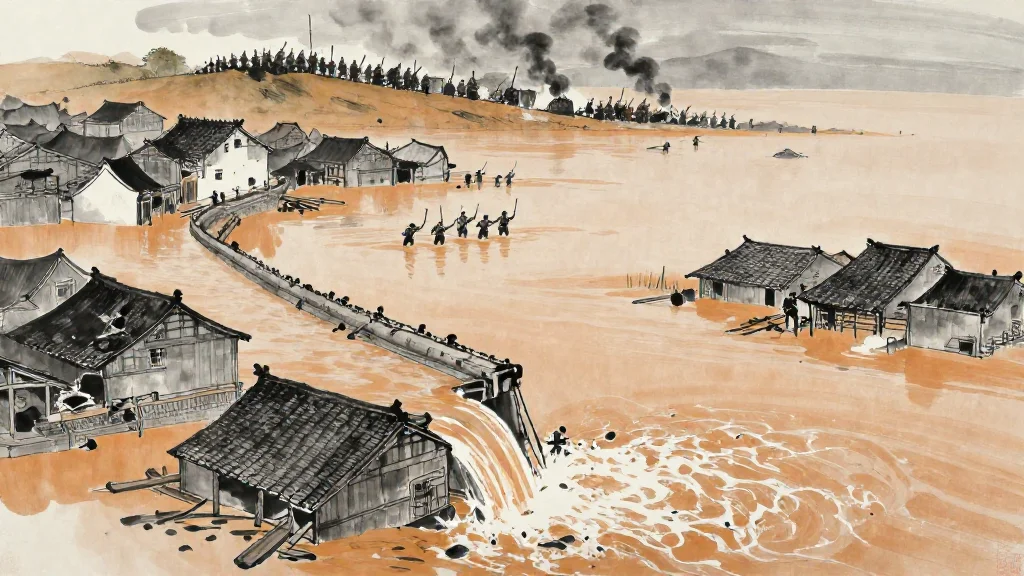
趙策一 (Stratagems of Zhao I) — Chinese ink painting

Chapter 18 of 33 · Zhao state

趙策一

Stratagems of Zhao I

View:

知伯從韓魏兵以攻趙

Zhi Bo Leads Han and Wei Forces to Attack Zhao

知伯從韓、魏兵以攻趙,圍晉陽而水之,城下不沉者三板。郗疵謂知伯曰:「韓、魏之君必反矣。」知伯曰:「何以知之?」郗疵曰:「以其人事知之。夫從韓、魏之兵而攻趙,趙亡,難必及韓、魏矣。今約勝趙而三分其地。今城不沒者三板,臼灶生蛙,人馬相食,城降有日,而韓魏之君無熹志而有憂色,是非反如何也?」

明日,知伯以告韓、魏之君曰:「郗疵言君之且反也。」韓、魏之君曰:「夫勝趙而三分其地,城今且將拔矣。夫三家雖愚,不棄美利於前,背信盟之約,而為危難不可成之事,其勢可見也。是疵為趙計矣,使君疑二主之心,而解於攻趙也。今君聽讒臣之言,而離二主之交,為君惜之。」趨而出。郗疵謂知伯曰:「君又何以疵言告韓、魏之君為?」知伯曰:「子安知之?」對曰:「韓、魏之君視疵端而趨疾。」

郗疵知其言之不聽,請使於齊,知伯遣之。韓、魏之君果反矣。

Zhi Bo commandeers forces from Han and Wei to attack Zhao, besieging Jinyang and flooding it. The water rises to within three boards of the top of the walls. Xi Ci tells Zhi Bo: "The rulers of Han and Wei are certain to defect."

Zhi Bo asks: "How do you know?"

Xi Ci says: "From observing their conduct. They have committed Han and Wei troops to attack Zhao, but once Zhao falls, calamity will inevitably reach Han and Wei next. The current agreement is to divide Zhao's lands three ways. Now the city walls are nearly submerged, mortars and stoves are breeding frogs, men and horses are eating one another, and the city's surrender is days away — yet the lords of Han and Wei show no joy and wear worried expressions. If that is not the look of men about to turn, what is?"

The next day, Zhi Bo tells the lords of Han and Wei: "Xi Ci says you two are about to defect."

The lords of Han and Wei reply: "With Zhao defeated and its lands divided three ways, the city is about to fall. Stupid as we three houses may be, we would not throw away these fine profits, betray a sworn pact, and attempt something dangerous and impossible — the logic is obvious. Xi Ci is scheming on Zhao's behalf, trying to make you doubt us and slacken your siege. If you listen to a slanderous minister's words and sever your alliance with us two, we pity you for it." They stride out.

Xi Ci says to Zhi Bo: "Why did you go and tell the lords of Han and Wei what I said?"

Zhi Bo asks: "How did you know I told them?"

"The lords of Han and Wei stared straight at me and walked out fast."

Xi Ci, knowing his counsel will not be heeded, requests to be sent as envoy to Qi, and Zhi Bo dispatches him. The lords of Han and Wei do indeed defect.

Notes

1person知伯瑤Zhì Bó Yáo

Zhi Bo (知伯), also known as Zhibo Yao (智伯瑤), was the head of the Zhi clan, one of the four great families that dominated the state of Jin in the late Spring and Autumn period. His destruction in 453 BC by the coalition of Zhao, Han, and Wei led directly to the Partition of Jin.

2place

Jinyang (晉陽) was the Zhao clan's stronghold, located near modern Taiyuan, Shanxi. The flooding of Jinyang is one of the most famous sieges in pre-imperial Chinese history.

3context

Xi Ci reads the situation perfectly: the lords of Han and Wei have every reason to betray Zhi Bo, since they are next on the menu. But Zhi Bo, in a magnificently self-destructive move, tells them that Xi Ci suspects them — essentially warning them to be more careful about their conspiracy. Xi Ci's detection method (they stared at me and walked out fast) is the Warring States equivalent of reading body language at a poker table.

4person郗疵Xī Cī

Xi Ci (郗疵) was an advisor to Zhi Bo. His name appears only in this episode; he was evidently better at reading people than at choosing employers.

知伯帥趙韓魏而伐范中行氏

Zhi Bo Leads Zhao, Han, and Wei to Destroy the Fan and Zhonghang Clans

知伯帥趙、韓、魏而伐范中行氏,滅之。休數年,使人請地於韓。韓康子欲勿與,段規諫曰:「不可。夫知伯之為人也,好利而鷙復,來請地不與,必加兵於韓矣。君其與之。與之彼狃,又將請地於他國,他國不聽,必鄉之以兵;然則韓可以免於患難,而待事之變。」康子曰:「善。」使使者致萬家之邑一於知伯。知伯說,又使人請地於魏,魏宣子欲勿與。趙葭諫曰:「彼請地於韓,韓與之。請地於魏,魏弗與,則是魏內自強,而外怒知伯也。然則其錯兵於魏必矣!不如與之。」宣子曰:「諾。」因使人致萬家之邑一於知伯。知伯說,又使人之趙,請蔡、皋狼之地,趙襄子弗與。知伯因陰結韓、魏,將以伐趙。

趙襄子召張孟談而告之曰:「夫知伯之為人,陽親而陰疏,三使韓、魏,而寡人弗與焉,其移兵寡人必矣。今吾安居而可?」張孟談曰:「夫董閼安於,簡主之才臣也,世治晉陽,而尹澤循之,其餘政教猶存,君其定居晉陽。」君曰:「諾。」乃使延陵王將車騎先之晉陽,君因從之。至,行城郭,案府庫,視倉廩,召張孟談曰:「吾城郭之完,府庫足用,倉廩實矣,無矢奈何?」張孟談曰:「臣聞董子之治晉陽也,公宮之垣,皆以狄蒿苫楚廧之,其高至丈余,君發而用之。」於是發而試之,其堅則箘簬之勁不能過也。君曰:「足矣,吾銅少若何?」張孟談曰:「臣聞董子之治晉陽也,公宮之室,皆以煉銅為柱質,請發而用之,則有餘銅矣。」君曰:「善。」號令以定,備守以具。

三國之兵乘晉陽城,遂戰。三月不能拔,因舒軍而圍之,決晉水而灌之。圍晉陽三年,城中巢居而處,懸釜而炊,財食將盡,士卒病羸。襄子謂張孟談曰:「糧食匱,城力盡,士大夫病,吾不能守矣。欲以城下,何如?」張孟談曰:「臣聞之,亡不能存,危不能安,則無為貴知士也。君釋此計,勿復言也。臣請見韓、魏之君。」襄子曰:「諾。」

張孟談於是陰見韓、魏之君曰:「臣聞唇亡則齒寒,今知伯帥二國之君伐趙,趙將亡矣,亡則二君為之次矣。」二君曰:「我知其然。夫知伯為人也,麁中而少親,我謀未遂而知,則其禍必至,為之奈何?」張孟談曰:「謀出二君之口,入臣之耳,人莫之知也。」二君即與張孟談陰約三軍,與之期日,夜,遣入晉陽。張孟談以報襄子,襄子再拜之。

張孟談因朝知伯而出,遇知過轅門之外。知過入見知伯曰:「二主殆將有變。」君曰:「何如?」對曰:「臣遇張孟談於轅門之外,其志矜,其行高。」知伯曰:「不然。吾與二主約謹矣,破趙三分其地,寡人所親之,必不欺也。子釋之,勿出於口。」知過出見二主,入說知伯曰:「二主色動而意變,必背君,不如令殺之。」知伯曰:「兵箸晉陽三年矣,旦暮當拔之而饗其利,乃有他心?不可,子慎勿復言。」知過曰:「不殺則遂親之。」知伯曰:「親之奈何?」知過曰:「魏宣子之謀臣曰趙葭,康子之謀臣曰段規,是皆能移其君之計。君其與二君約,破趙則封二子者各萬家之縣一,如是則二主之心可不變,而君得其所欲矣。」知伯曰:「破趙而三分其地,又封二子者各萬之縣一,則吾所得者少,不可。」知過見君之不用也,言之不聽,出,更其姓為輔氏,遂去不見。

張孟談聞之,入見襄子曰:「臣遇知過於轅門之外,其視有疑臣之心,入見知伯,出更其姓。今暮不擊,必後之矣。」襄子曰:「諾。」使張孟談見韓、魏之君曰:「夜期殺守堤之吏,而決水灌知伯軍。」知伯軍救水而亂,韓、魏翼而擊之,襄子將卒犯其前,大敗知伯軍而禽知伯。

知伯身死,國亡地分,為天下笑,此貪慾無厭也。夫不聽知過,亦所以亡也。知氏盡滅,唯輔氏存焉。

Zhi Bo leads Zhao, Han, and Wei to attack the Fan and Zhonghang clans and destroys them. After resting several years, he sends men to demand territory from Han. Duke Kang of Han is inclined to refuse, but Duan Gui remonstrates: "You must not. Zhi Bo is by nature greedy and fiercely vindictive. If he requests land and you refuse, he will certainly bring troops against Han. Give it to him. Once he gets comfortable making demands, he will request land from other states too; when they refuse, he will march on them. Then Han can escape trouble and wait for circumstances to change." Duke Kang says: "Good." He sends an envoy to present Zhi Bo with a city of ten thousand households.

Zhi Bo is pleased. He then sends men to demand land from Wei. The Marquis Xuan of Wei is inclined to refuse. Zhao Jia remonstrates: "Zhi Bo demanded land from Han, and Han gave it. If he demands land from Wei and Wei refuses, then Wei will be seen as internally defiant and will externally anger Zhi Bo. His troops will certainly turn on Wei. Better to give." The Marquis says: "Agreed." He too presents a city of ten thousand households.

Zhi Bo is pleased. He then sends to Zhao demanding the territories of Cai and Gaolang. Zhao Xiangzi refuses. Zhi Bo secretly binds Han and Wei into an alliance to attack Zhao.

Zhao Xiangzi summons Zhang Mengtan and tells him: "Zhi Bo is outwardly friendly but inwardly hostile. He has sent to Han and Wei three times, and I alone refused him. He will surely move his troops against me. Where can I make my stand?" Zhang Mengtan says: "Dong E An Yu was a capable minister of Lord Jian, who governed Jinyang for generations. Yin Ze continued his policies, and the residual good governance still persists. You should make your stand at Jinyang."

The lord agrees and sends Yanling Wang ahead with chariots and cavalry to Jinyang, then follows himself. Upon arriving, he inspects the city walls, examines the treasury, reviews the granaries, then summons Zhang Mengtan: "The walls are sound, the treasury sufficient, the granaries full — but I have no arrows. What can I do?" Zhang Mengtan says: "When Dong Zi governed Jinyang, the walls of the ducal palace were all plastered with Di reeds and brambles, built up over a zhang in height. Tear them open and use the reeds." They tear them open and test them: the stalks prove as strong and resilient as fine bamboo. "Enough! But I am short on bronze — what about that?" Zhang Mengtan says: "When Dong Zi governed Jinyang, the pillars of the ducal chambers were all cast from refined bronze. Extract and use them, and you will have bronze to spare." "Excellent." Orders are issued and defenses prepared.

The armies of the three states assault Jinyang's walls and battle ensues. After three months without taking the city, they relax the siege into an encirclement, breach the Jin River, and flood the city. After three years of siege, the people inside live in nests above the water and cook with pots suspended from above. Supplies are nearly exhausted and the soldiers are sick and emaciated.

Xiangzi tells Zhang Mengtan: "Grain is gone, the city's strength is spent, the officers are ill. I cannot hold any longer. What if I surrender the city?"

Zhang Mengtan says: "If a man cannot preserve a state from ruin or secure it in danger, then what is the point of valuing wise counselors? Abandon that plan and never speak of it again. Allow me to go see the lords of Han and Wei."

Zhang Mengtan secretly meets the lords of Han and Wei: "As the saying goes, 'When the lips are gone, the teeth grow cold.' Now Zhi Bo leads your two states to attack Zhao. Once Zhao falls, you two are next." The two lords say: "We know it. But Zhi Bo is coarse by nature and shows little affection. If our plot is discovered before it succeeds, disaster will surely follow. What can we do?" Zhang Mengtan says: "The plan leaves your lips and enters my ears alone. No one else will know." The two lords then secretly agree with Zhang Mengtan on a joint military plan, set a date, and by night send him back into Jinyang. Zhang Mengtan reports to Xiangzi, who bows twice in gratitude.

Zhang Mengtan then goes to pay his morning call on Zhi Bo, and as he leaves, encounters Zhi Guo outside the camp gate. Zhi Guo enters and tells Zhi Bo: "The two lords are likely about to turn." Zhi Bo asks: "How so?" "I encountered Zhang Mengtan outside the gate — his bearing was proud, his step was high." Zhi Bo says: "Not so. My agreement with the two lords is firm. Once we break Zhao and divide the land three ways, they — whom I have personally befriended — would never deceive me. Put it out of your mind and say nothing more."

Zhi Guo goes out, observes the two lords, returns, and urges Zhi Bo: "Their expressions have shifted and their intentions have changed. They will certainly betray you. Better to have them killed." Zhi Bo says: "We have been camped at Jinyang three years. Any day now we will take it and enjoy the spoils. How could they have second thoughts? Impossible. Do not bring this up again."

Zhi Guo says: "If you will not kill them, then at least bind them closer." Zhi Bo asks: "How?" Zhi Guo says: "The chief counselor of the Wei lord is Zhao Jia; the chief counselor of the Han lord is Duan Gui. Both of these men can shift their masters' calculations. Promise the two lords that after Zhao is destroyed, each of these advisors will receive a county of ten thousand households. Then the two lords' hearts will not waver, and you will still get what you want."

Zhi Bo says: "After destroying Zhao and dividing its land three ways, to then give away a ten-thousand-household county to each of their two counselors — that leaves me too little. I refuse."

Zhi Guo, seeing his lord will not listen, goes out, changes his surname to Fu, and departs without looking back.

Zhang Mengtan hears of this and goes to Xiangzi: "I encountered Zhi Guo outside the gate and his eyes showed suspicion of me. He went in to see Zhi Bo and came out having changed his surname. If we do not strike tonight, it will be too late."

Xiangzi agrees: "Do it." He sends Zhang Mengtan to the lords of Han and Wei: "Tonight, at the appointed hour, kill the officers guarding the dikes and breach the flood against Zhi Bo's army." Zhi Bo's forces scramble to deal with the water and fall into chaos. Han and Wei strike from the flanks; Xiangzi leads his troops in a frontal assault. They rout Zhi Bo's army completely and capture Zhi Bo.

Zhi Bo dies, his state is destroyed, his lands are divided, and All-Under-Heaven laughs at him — the result of greed without limit. His failure to heed Zhi Guo was also a cause of his ruin. The entire Zhi clan is annihilated. Only the Fu clan survives.
Notes

1context

This section recounts the prelude to the Partition of Jin (453 BC), one of the pivotal events in Chinese history. The four great clans of Jin — Zhi, Zhao, Han, and Wei — had already devoured two others (Fan and Zhonghang). Zhi Bo's attempt to dominate the remaining three by salami-slicing their territory backfired spectacularly: the two states that gave in (Han and Wei) helped destroy him, while the one that refused (Zhao) survived. The moral — greed invites coalition — is a recurring theme of the Zhanguoce.

2person段規Duàn Guī

Duan Gui (段規) was chief counselor to Duke Kang of Han. His advice — give Zhi Bo what he wants and wait for him to overreach — is textbook appeasement-as-strategy, and it actually works here because Zhao's refusal provides the tripwire.

3person張孟談Zhāng Mèngtán

Zhang Mengtan (張孟談) was Zhao Xiangzi's most trusted advisor. He single-handedly negotiated the coalition that destroyed Zhi Bo — sneaking out of a besieged, flooded city to do so, which shows either extreme courage or the understanding that staying in the city was the worse option.

4person知過Zhì Guò

Zhi Guo (知過) was a kinsman and advisor to Zhi Bo who correctly read every sign of the impending betrayal. Zhi Bo ignored him three times — first the warning, then the suggestion to kill the two lords, then the compromise of buying their loyalty. Zhi Guo's response (changing his surname and leaving) is the Warring States equivalent of updating your LinkedIn before the layoffs hit.

5person趙襄子Zhào Xiāngzǐ

Zhao Xiangzi (趙襄子), personal name Wuxu (無恤), was the head of the Zhao clan. After the Partition of Jin, the Zhao, Han, and Wei clans became independent states recognized by the Zhou court in 403 BC.

6textual

The 'three boards' (三板) measurement: a 'board' (板) was about two feet, so 'three boards from submerging' means roughly six feet of wall remained above water — barely enough to defend.

張孟談既固趙宗

Zhang Mengtan Secures the Zhao Ancestral Line, Then Retires

張孟談既固趙宗,廣封疆,發五百,乃稱簡之塗以告襄子曰:「昔者,前國地君之御有之曰:『五百之所以致天下者,約兩主勢能制臣,無令臣能制主。故貴為列侯者,不令在相位,自將軍以上,不為近大夫。』今臣之名顯而身尊,權重而眾服,臣願捐功名、去權勢以離眾。」襄子恨然曰:「何哉?吾聞輔主者名顯,功大者身尊,任國者權重,信忠在己而眾服焉。此先聖之所以集國家、安社稷乎!子何為然?」張孟談對曰:「君主所言,成功之美也。臣之所謂,持國之道也。臣觀成事,聞往古,天下之美同,臣主之權均之能美,未之有也。前事之不忘,後事之師。君若弗圖,則臣力不足。」愴然有決色。襄子去之。臥三日,使人謂之曰:「晉陽之政,臣下不使者何如?」對曰:「死僇。」張孟談曰:「左司馬見使於國家,安社稷,不避其死,以成其忠,君其行之。」君曰:「子從事。」乃許之。張孟談便厚以便名,納地釋事以去權尊,而耕於負親之丘。故曰,賢人之行,明主之政也。

耕三年,韓、魏、齊、燕負親以謀趙。襄子往見張孟談而告之曰:「昔者知氏之地,趙氏分則多十城,復來,而今諸侯孰謀我,為之奈何?」張孟談曰:「君其負劍而御臣以之國,舍臣於廟,授吏大夫,臣試計之。」君曰:「諾。」張孟談乃行,其妻之楚,長子之韓,次子之魏,少子之齊。四國疑而謀敗。

Having secured the Zhao ancestral line, expanded the borders, and raised a force of five hundred, Zhang Mengtan invokes the principles of Lord Jian to address Xiangzi: "In ancient times, the former lord's teachings held: 'The way to command All-Under-Heaven by keeping five hundred men is to constrain affairs so that the ruler controls his ministers, never allowing ministers to control the ruler. Those ennobled as marquises should not hold the prime ministership; those ranked general or above should not serve as inner counselors.'

Now my name is renowned and my person exalted. My power is great and the multitude follows me. I wish to relinquish my achievements and fame, shed my power and influence, and withdraw from the crowd."

Xiangzi says resentfully: "What is this? I have heard that those who assist their lord gain renown, those with great achievements gain honor, those entrusted with the state gain power, and those of proven loyalty win the people's allegiance. Are these not the principles by which the ancient sages built states and secured their altars? Why would you do this?"

Zhang Mengtan replies: "What Your Lordship describes is the beauty of completed achievement. What I speak of is the way to sustain a state. I have observed what has transpired and studied antiquity: wherever lord and minister held equal power, beauty has never lasted. 'What is not forgotten from past events becomes the teacher of future ones.' If you will not consider this, then my abilities are insufficient." His expression is sorrowful but resolved.

Xiangzi leaves him. After lying awake for three days, he sends someone to ask: "Under the government of Jinyang, what is the penalty for a subordinate who disobeys orders?" The answer: "Death." Zhang Mengtan says: "The Left Marshal has served the state and secured the altars of the soil and grain without fearing death, fulfilling his loyalty. Let Your Lordship carry it out." The lord says: "Attend to it yourself."

And so he permits it. Zhang Mengtan converts his generous emoluments into a comfortable retirement, surrenders his lands and offices to shed his power, and farms at the hills of Fuqin. Hence the saying: the conduct of a worthy man is the mark of an enlightened ruler's government.

After three years of farming, Han, Wei, Qi, and Yan conspire together to attack Zhao. Xiangzi goes to see Zhang Mengtan and tells him: "When Zhi Bo's lands were divided, Zhao received the largest share — ten cities more than the others. Now the feudal lords are plotting against me. What should I do?"

Zhang Mengtan says: "Strap on your sword, drive me personally to the capital, lodge me in the ancestral temple, and assemble your officials. I will try to devise a plan."

The lord agrees. Zhang Mengtan then acts: he sends his wife to Chu, his eldest son to Han, his second son to Wei, and his youngest son to Qi. The four states grow suspicious of one another and the conspiracy collapses.

Notes

1context

Zhang Mengtan is doing something extremely unusual for a Warring States advisor: voluntarily giving up power at the height of his influence. His reasoning — that equal power between lord and minister has never ended well — is essentially a warning about what will happen to him if he stays. The phrasing is diplomatic, but the subtext is clear: 'Either I retire, or eventually you will have to kill me.' Xiangzi initially resists, but after three days of insomnia, he gets the message.

2context

The final stratagem — sending family members to the four conspiring states — is a masterclass in creating mutual suspicion. Each state now has a hostage-slash-potential-mole from Zhang Mengtan's household, and none can be sure the others aren't cutting a separate deal. The conspiracy dissolves not because anyone was threatened, but because trust among the conspirators evaporated.

晉畢陽之孫豫讓

Yu Rang, Grandson of Bi Yang of Jin

晉畢陽之孫豫讓,始事范中行氏而不說,去而就知伯,知伯寵之。及三晉分知氏,趙襄子最怨知伯,而將其頭以為飲器。豫讓遁逃山中,曰:「嗟乎!士為知己者死,女為悅己者容。吾其報知氏之仇矣。」乃變姓名,為刑人,入宮塗廁,欲以刺襄子。襄子如廁,心動,執問塗者,則豫讓也。刃其扞曰:「欲為知伯報仇!」左右欲殺之。趙襄子曰:「彼義士也,吾謹避之耳。且知伯已死,無後,而其臣至為報仇,此天下之賢人也。」卒釋之。豫讓又漆身為厲,滅須去眉,自刑以變其容,為乞人而往乞,其妻不識,曰:「狀貌不似吾夫,其音何類吾夫之甚也。」又吞炭為啞,變其音。其友謂之曰:「子之道甚難而無功,謂子有志,則然矣,謂子知,則否。以子之才,而善事襄子,襄子必近幸子;子之得近而行所欲,此甚易而功必成。」豫讓乃笑而應之曰:「是為先知報後知,為故君賊新君,大亂君臣之義者無此矣。凡吾所謂為此者,以明君臣之義,非從易也。且夫委質而事人,而求弒之,是懷二心以事君也。吾所為難,亦將以愧天下後世人臣懷二心者。」

居頃之,襄子當出,豫讓伏所當過橋下。襄子至橋而馬驚。襄子曰:「此必豫讓也。」使人問之,果豫讓。於是趙襄子面數豫讓曰:「子不嘗事范中行氏乎?知伯滅范中行氏,而子不為報仇,反委質事知伯。知伯已死,子獨何為報仇之深也?」豫讓曰:「臣事范中行氏,范中行氏以眾人遇臣,臣故眾人報之;知伯以國士遇臣,臣故國士報之。」襄子乃喟然嘆泣曰:「嗟乎,豫子!豫子之為知伯,名既成矣,寡人舍子,亦以足矣。子自為計,寡人不捨子。」使兵環之。豫讓曰:「臣聞明主不掩人之義,忠臣不愛死以成名。君前已寬舍臣,天下莫不稱君之賢。今日之事,臣故伏誅,然願請君之衣而擊之,雖死不恨。非所望也,敢布腹心。」於是襄子義之,乃使使者持衣與豫讓。豫讓拔劍三躍,呼天擊之曰:「而可以報知伯矣。」遂伏劍而死。死之日,趙國之士聞之,皆為涕泣。

Yu Rang, grandson of Bi Yang of Jin, first serves the Fan and Zhonghang clans but is not valued. He leaves and enters the service of Zhi Bo, who favors him greatly. When the Three Jin partition the Zhi clan's territory, Zhao Xiangzi — harboring the deepest grudge against Zhi Bo — has his skull lacquered and made into a drinking vessel.

Yu Rang flees into the mountains and declares: "Alas! A man dies for the one who truly knows him, as a woman adorns herself for the one who delights in her. I shall avenge the Zhi clan."

He changes his name and identity, poses as a convict laborer, enters the palace, and plasters the privy, intending to assassinate Xiangzi. Xiangzi goes to the privy and feels a sudden unease. He seizes and interrogates the plasterer — it is Yu Rang. Yu Rang grips his blade and says: "I mean to avenge Zhi Bo!"

The attendants move to kill him. Xiangzi says: "He is a man of honor. I shall simply be careful to avoid him. Zhi Bo is dead with no heir, yet this man, a mere retainer, goes so far as to seek vengeance — he is one of the most admirable men in All-Under-Heaven." He releases him.

Yu Rang then lacquers his body to produce sores, shaves off his beard and eyebrows, and mutilates himself to change his appearance. He begs as a street beggar. His wife does not recognize him but says: "His appearance does not resemble my husband, yet his voice — how closely it resembles my husband's!" So he swallows charcoal to destroy his voice.

A friend says to him: "Your path is extremely difficult and will come to nothing. That you have resolve — certainly. That you have wisdom — no. With your talents, if you served Xiangzi well, he would certainly take you into his inner circle. Once close, you could carry out your wish easily, and success would be assured."

Yu Rang laughs and replies: "That would mean betraying a later lord on behalf of a former lord — assassinating a new master while in his service — the greatest possible perversion of the duty between lord and minister. What I am doing, I do precisely to illuminate the meaning of that duty, not to take the easy path. To pledge oneself in service to a man while plotting to murder him is to serve one's lord with a divided heart. I choose the hard way so that, for all time, every minister who serves with a divided heart will feel shame."

Some time later, Xiangzi is due to go out, and Yu Rang hides beneath a bridge on his route. Xiangzi reaches the bridge and his horse shies. Xiangzi says: "This must be Yu Rang." He sends men to check, and indeed it is.

Xiangzi confronts Yu Rang face to face: "Did you not once serve the Fan and Zhonghang clans? Zhi Bo destroyed them, yet you did not avenge them — instead you pledged yourself to Zhi Bo. Now that Zhi Bo is dead, why do you pursue vengeance so deeply for him alone?"

Yu Rang says: "When I served the Fan and Zhonghang clans, they treated me as an ordinary man, so I repaid them as an ordinary man. Zhi Bo treated me as the foremost man in the state, so I repay him as the foremost man in the state."

Xiangzi heaves a great sigh and weeps: "Ah, Yu Rang! Your devotion to Zhi Bo has already made your name. And I have already shown clemency enough. Make your own plans — I will not spare you again." He orders soldiers to surround him.

Yu Rang says: "I have heard that an enlightened lord does not suppress another man's honor, and a loyal minister does not begrudge death to fulfill his name. You once generously released me, and All-Under-Heaven has praised your virtue for it. In today's affair, I willingly accept execution. But I beg to strike your robe with my sword before I die. Even in death I will have no regret. This is more than I could have hoped — I dare to lay bare my heart."

Xiangzi, honoring his sense of duty, has an attendant bring his robe to Yu Rang. Yu Rang draws his sword, leaps three times, strikes the robe crying out to Heaven: "Now I may face Zhi Bo!" Then he falls upon his sword and dies.

On the day of his death, every gentleman in the state of Zhao who hears the news weeps for him.

Notes

1person豫讓Yù Ràng

Yu Rang (豫讓) is one of the most celebrated assassins in Chinese history, though he never actually kills anyone. His story is also recorded in Sima Qian's 'Biographies of Assassins' (刺客列傳) in the Shiji. The phrase he coins — 'a man dies for the one who truly knows him' (士為知己者死) — becomes one of the most quoted lines in Chinese literature.

2context

The skull-lacquered-as-drinking-vessel detail is not casual barbarism — it is a deliberate humiliation of the dead, indicating the depth of Xiangzi's hatred. This makes Xiangzi's subsequent respect for Yu Rang all the more striking: he can hate the master and admire the servant simultaneously.

3context

Yu Rang's friend offers perfectly rational advice: infiltrate Xiangzi's inner circle and kill him from within. Yu Rang's refusal — on the grounds that this would corrupt the very principle of loyalty he is trying to uphold — elevates the story from thriller to ethical treatise. He is not trying to succeed; he is trying to establish a precedent. The assassination attempt is a performance of principle, not a practical operation.

4translation

The famous line 士為知己者死,女為悅己者容 is rendered here as 'A man dies for the one who truly knows him, as a woman adorns herself for the one who delights in her.' The parallel structure in the original is exact — 知己 (one who knows me) maps onto 悅己 (one who delights in me) — and the sentence has become proverbial in Chinese.

魏文侯借道於趙攻中山

Marquis Wen of Wei Borrows a Road Through Zhao to Attack Zhongshan

魏文侯借道於趙攻中山。趙侯將不許。趙利曰:「過矣。魏攻中山而不能取,則魏必罷,罷則趙重。魏拔中山,必不能越趙而有中山矣。是用兵者,魏也;而得地者,趙也。君不如許之,許之大勸,彼將知矣利之也,必輟。君不如借之道,而示之不得已。」

Marquis Wen of Wei seeks to borrow a passage through Zhao to attack Zhongshan. The Lord of Zhao is inclined to refuse.

Zhao Li says: "That would be a mistake. If Wei attacks Zhongshan and fails, then Wei will be exhausted, and Zhao's weight increases. If Wei takes Zhongshan, it certainly cannot hold territory on the far side of Zhao — so the one who fights is Wei, but the one who gains the land is Zhao. You should permit it. But if you permit it too eagerly, Wei will realize we stand to benefit and will call it off. Better to lend the road while making it look reluctant."

Notes

1person魏文侯Wèi Wén Hóu

Marquis Wen of Wei (魏文侯, r. 445–396 BC) was one of the most capable early rulers of the Three Jin states, known for patronizing talent like Li Kui and Wu Qi.

2place

Zhongshan (中山) was a non-Chinese (Xianyu 鮮虞) state in the mountains of modern central Hebei, geographically wedged between Zhao and Yan. It was conquered by Wei and later reconstituted before its final destruction by Zhao.

3context

Zhao Li's advice is a beautiful little piece of strategic theater: say yes while looking like you hate it. If you say yes enthusiastically, Wei will realize you expect to profit and may reconsider. The optimal move is to appear coerced into something that actually benefits you — a principle that has aged well.

秦韓圍梁燕趙救之

Qin and Han Besiege Wei; Yan and Zhao Come to the Rescue

秦、韓圍梁,燕、趙救之。謂山陽君曰:「秦戰而勝三國,秦必過周、韓而有梁。三國而勝秦,三國之力,雖不足以攻秦,足以拔鄭。計者不如構三國攻秦。」

Qin and Han besiege Wei. Yan and Zhao come to rescue it. Someone says to the Lord of Shanyang: "If Qin defeats the three states, Qin will certainly overrun Zhou and Han and absorb Wei. But if the three states defeat Qin, their combined strength — though insufficient to conquer Qin — will be enough to take Zheng. The better plan is to organize the three states into an attack on Qin."

Notes

1place

Liang (梁) is Wei's capital Daliang, near modern Kaifeng, Henan. The text uses 'Liang' and 'Wei' interchangeably.

2context

A terse fragment — barely a paragraph — but the logic is clean: whether you win or lose against Qin, you need to think about what you do next. Victory over Qin is not an end in itself; it creates a window to take Zheng.

腹擊為室而鉅

Fu Ji Builds Himself a Grand Mansion

腹擊為室而鉅,荊敢言之主。謂腹子曰:「何故為室之鉅也?」腹擊曰:「臣,羈旅也,爵高而祿輕,宮室小而帑不眾。主雖信臣,百姓皆曰:『國有大事,擊必不為用。』今擊之鉅宮,將以取信於百姓也。」主君曰:「善。」

Fu Ji builds himself a grand mansion. Jing Gan reports this to their lord. The lord asks Fu Ji: "Why did you build such a grand house?"

Fu Ji says: "I am a sojourner here — my rank is high but my salary is modest, my dwelling is small and my household is not large. Although Your Lordship trusts me, the common people all say: 'If there is a crisis, Fu Ji will certainly not commit to this state.' My grand mansion is meant to win the people's confidence."

The lord says: "Well done."

Notes

1context

Fu Ji's logic is an interesting inversion of the usual 'why are you spending so much' complaint. He argues that conspicuous consumption can serve as a credibility signal: if he looks ready to leave at any moment, nobody will trust his commitment. A grand house is a sunk cost that communicates permanence. It is the Warring States version of burning your ships.

2person腹擊Fù Jī

Fu Ji (腹擊) was a foreign minister serving in Zhao. Little is known about him beyond this anecdote.

蘇秦說李兌

Su Qin Persuades Li Dui

蘇秦說李兌曰:「洛陽乘軒里蘇秦,家貧親老,無罷車駑馬,桑輪蓬篋羸幐,負書擔櫜,觸塵埃,蒙霜露,越漳、河,足重繭,日百而舍,造外闕願見於前。口道天下之事。」李兌曰:「先生以鬼之言見我則可,若以人之事,兌盡知之矣。」蘇秦對曰:「臣固以鬼之言見君,非以人之言也。」李兌見之。蘇秦曰:「今日臣之來也暮,後郭門,藉席無所得,宿寄人田中,傍有大叢。夜半,土梗與木梗斗曰:『汝不如我,我者乃土也。使我逢疾風淋雨,壞沮,乃復歸土。今汝非木之根,則木之枝耳。汝逢疾風淋雨,漂入漳、河,東流至海,氾濫無所止。』臣竊以為土梗勝也。今君殺主父而族之,君之立於天下,危於累卵。君聽臣計則生,不聽臣計則死。」李兌曰:「先生就舍,明日復來見兌也。」

蘇秦出,李兌舍人謂李兌曰:「臣竊觀君與蘇公談也,其辯過君,其博過君,君能聽蘇公之計乎?」李兌曰:「不能。」舍人曰:「君即不能,願君堅塞兩耳,無聽其談也。」

明日復見,終日談而去。舍人出送蘇君,蘇秦謂舍人曰:「昨日我談粗而君動,今日精而君不動,何也?」舍人曰:「先生之計大而規高,吾君不能用也。乃我請君塞兩耳,無聽談者。雖然,先生明日復來,吾請資先生厚用。」

明日來,抵掌而談。李兌送蘇秦明月之珠,和氏之璧,黑貂之襲,黃金百鎰。蘇秦得以為用,西入於秦。

Su Qin presents himself to Li Dui: "Su Qin of Chengxuan Ward, Luoyang — poor family, aging parents, no decent carriage or horse. With mulberry-wood wheels, a wicker case, and threadbare sacks, carrying books on my back and documents on my shoulders, through dust and frost, crossing the Zhang and the Yellow Rivers, calluses layered on my feet, walking a hundred li a day before resting — I have come to your outer gate, seeking an audience. I come to speak of the affairs of All-Under-Heaven."

Li Dui says: "If you have come to tell me the words of ghosts, fine. But if this is about human affairs, I already know everything there is to know."

Su Qin replies: "Indeed, I have come with the words of ghosts, not the words of men." Li Dui grants him an audience.

Su Qin says: "I arrived late today and missed the city gates. I could find no lodging and spent the night in someone's field, beside a large thicket. At midnight, a clay figurine quarreled with a wooden figurine. The clay one said: 'You are not my equal. I am made of earth. If a storm comes with driving rain and I am smashed and dissolved, I simply return to the soil. But you — you are nothing but a root or a branch. If a storm comes, you will be swept into the Zhang and the Yellow Rivers, east to the sea, drifting forever with nowhere to stop.' I privately concluded that the clay figurine wins the argument.

"Now, you killed the Lord Father and exterminated his clan. Your position in All-Under-Heaven is more precarious than stacked eggs. Heed my plan and you live. Ignore it and you die."

Li Dui says: "Go to your lodging, sir. Come back and see me tomorrow."

Su Qin leaves. Li Dui's steward says to Li Dui: "I was observing your conversation with Master Su. His eloquence exceeds yours; his breadth of knowledge exceeds yours. Can you follow his plan?" Li Dui says: "I cannot." The steward says: "Then I beg you to plug both ears and refuse to listen to his arguments."

The next day Su Qin returns and talks all day before leaving. The steward goes out to see Su Qin off. Su Qin says to him: "Yesterday my pitch was rough and your lord was moved. Today it was refined and he was unmoved. Why?"

The steward says: "Your plans are too grand and your ambitions too lofty for my lord to use. It was I who asked him to plug his ears against your arguments. Even so, come back again tomorrow — I will see that you are generously supplied with funds."

The next day Su Qin returns. They talk, slapping their palms together in animated debate. Li Dui presents Su Qin with pearls bright as the moon, jade disks of the He clan, a set of black sable furs, and a hundred yi of gold. With these resources in hand, Su Qin travels west into Qin.

Notes

1person蘇秦Sū Qín

Su Qin (蘇秦, d. 284 BC) was the most famous persuader-diplomat of the Warring States period, traditionally credited with organizing the north-south coalition (合縱) against Qin. His actual biography is muddled by competing traditions; silk manuscripts from Mawangdui present a rather different Su Qin than the received texts.

2person李兌Lǐ Duì

Li Dui (李兌) was a powerful minister in Zhao who engineered the Sandbox Palace Incident (沙丘之變), in which King Wuling of Zhao (武靈王, 'Lord Father' / 主父) was trapped and starved to death in 295 BC. Su Qin's reference to this is not subtle.

3context

The ghost-story gambit is classic Su Qin: Li Dui says he already knows everything about human affairs, so Su Qin immediately agrees to talk about ghosts — then delivers a political allegory dressed as a supernatural anecdote. The clay-vs-wood figurine fable is pointed: Li Dui, like the wooden figurine, can be swept away and have nowhere to land. The steward's role is fascinating — he knows Li Dui cannot follow through on Su Qin's grand strategy but arranges for Su Qin to be paid off anyway, essentially buying him to go bother someone else.

趙收天下且以伐齊

Zhao Rallies All-Under-Heaven to Attack Qi

趙收天下,且以伐齊。蘇秦為齊上書說趙王曰:「臣聞古之賢君,德行非施於海內也,教順慈愛,非布於萬民也,祭祀時享,非當於鬼神也,甘露降,風雨時至,農夫登,年穀豐盈,眾人喜之,而賢主惡之。今足下功力,非數痛加於秦國,而怨毒積惡,非曾深凌於韓也。臣竊外聞大臣及下吏之議。皆言主前專據,以秦為愛趙而憎韓。臣竊以事觀之,秦豈得愛趙而憎韓哉?欲亡韓吞兩周之地,故以韓為餌,先出聲於天下,欲鄰國聞而觀之也。恐其事不成,故出兵以佯示趙、魏。恐天下之警覺,故微韓以貳之。恐天下疑己,故出質以為信。聲德於與國,而實伐空韓。臣竊觀其圖之也。議秦以謀計,必出於是。且夫說士之計,皆曰韓亡三川,魏滅晉國,恃韓未窮,而禍及於趙。且物固有勢異而患同者,又有勢同而患異者。昔者楚人久伐而中山亡。今燕盡韓之河南,距沙丘,而至鉅鹿之界三百里;距於捍關,至於榆中千五百里。秦盡韓、魏之上黨,則地與國都邦屬而壤挈者七百里。秦以三軍強弩坐羊唐之上,即地去邯鄲二十里。且秦以三軍攻王之上黨而危其北,則句注之西,非王之有也。今魯句注禁常山而守,三百里通於燕之唐、曲吾,此代馬胡駒不東,而崑山之玉不出也。此三寶者,又非王之有也。今從於強秦國之伐齊,臣恐其禍出於是矣。昔者五國之王嘗合橫而謀伐趙,叄分趙國壤地,著之盤盂,屬之仇柞。五國之兵有日矣,韓乃西師以禁秦國,使秦發令素服而聽,反溫、枳、高平於魏,反三公、什清於趙,此王之明知也。夫韓事趙宜正為上交;今乃以抵罪取伐,臣恐其後事王者之不敢自必也。今王收天下,必以王為得。韓危社稷以事王,天下必重王。然則韓義王以天下就之,下至韓慕王以天下收之,是一世之命,制於王已。臣願大王深與左右群臣卒計而重謀,先事成慮而熟圖之也。」

Zhao rallies All-Under-Heaven to attack Qi. Su Qin, writing on behalf of Qi, sends a memorial to the King of Zhao:

"I have heard that the wise rulers of antiquity did not extend their virtuous conduct throughout the realm, did not spread their benevolent instruction to all people, and did not make their sacrifices precisely match what the spirits desired. Yet sweet dew fell, wind and rain came in season, harvests flourished, and grain was abundant. The multitude rejoiced at this, while the wise ruler grew wary of it.

Now Your Majesty's military efforts have not repeatedly struck at Qin, and your accumulated resentment has not been deeply directed at Han. Yet I hear the private discussions of your ministers and officials — they all say that Your Majesty has been acting on the assumption that Qin loves Zhao and hates Han.

Looking at the matter from the outside, how could Qin possibly love Zhao and hate Han? Qin wants to destroy Han and swallow the territory of the Two Zhous. It uses Han as bait, making noise throughout the realm so that neighboring states will watch. Fearing its plan might not succeed, it deploys troops as a feint toward Zhao and Wei. Fearing that All-Under-Heaven might become alert, it undermines Han to keep it divided. Fearing that All-Under-Heaven might suspect its motives, it sends hostages as tokens of good faith. It proclaims virtue toward its allies while in practice attacking a weakened Han.

Moreover, all the persuaders' plans say the same thing: once Han loses Sanchuan and Wei loses Jin, and while Han has not yet been fully consumed, the calamity will reach Zhao next. Things that are differently situated may share the same peril; things that are similarly situated may face different perils.

If Qin takes all of Shangdang from Han and Wei, then the territory connecting to your capital and its dependent cities extends seven hundred li. With Qin's three armies and powerful crossbows stationed at Yangtang, the distance to Handan is a mere twenty li. And if Qin attacks Your Majesty's Shangdang and threatens the north, then everything west of Juzhu Pass will no longer be yours. If Juzhu Pass is blocked and Changshan defended, the three hundred li that connect to Yan's Tang and Quwu will be severed — meaning that the horses of Dai, the Hu steeds, cannot travel east, and the jade of Kunshan cannot come out. These three treasures will no longer be yours either.

Now, by following powerful Qin to attack Qi, I fear the disaster will come from precisely this.

In former times, the kings of five states formed a horizontal alliance to attack Zhao, planning to divide Zhao's territory three ways, inscribing the terms on vessels and sealing them with oaths. The five states' armies had a set date — but then Han led troops west to check Qin, forcing Qin to issue a peace order, return Wen, Zhi, and Gaoping to Wei, and return the Three Dukes and Shiqing to Zhao. This Your Majesty knows well.

Han's service to Zhao ought rightly to be regarded as the highest form of alliance. Yet now you treat Han as a criminal and make it a target. I fear that those who might serve Your Majesty in the future will not dare count on your constancy.

If Your Majesty rallies All-Under-Heaven, it must be because they consider Your Majesty right. If Han risks its very state to serve Your Majesty, All-Under-Heaven will certainly respect Your Majesty. From above, Han will rally to Your Majesty's righteous cause with All-Under-Heaven; from below, Han will follow Your Majesty's leadership with All-Under-Heaven. The fate of a generation is in Your Majesty's hands. I beg Your Majesty to deliberate deeply with your ministers, consider the matter thoroughly, and plan it carefully before acting."

Notes

1context

Su Qin is now working for Qi against Zhao, which is ironic given that in other chapters he champions Zhao. The Zhanguoce is not troubled by such inconsistencies — the text collects persuasions topically rather than biographically, and Su Qin is practically a generic brand name for 'itinerant persuader.'

2place

Shangdang (上黨) is the high plateau region in southeastern Shanxi, critically important for Zhao's defense. Its later transfer to Zhao (described in section 10) triggers the catastrophic Battle of Changping.

3translation

The Two Zhous (兩周) refers to the two small rump states into which the Zhou royal domain had split by this period: East Zhou and West Zhou. Both were tiny but symbolically important as the seat of Zhou's ritual authority.

齊攻宋奉陽君不欲

Qi Attacks Song; Lord Fengyang Is Reluctant

齊攻宋,奉陽君不欲。客請奉陽君曰:「君之春秋高矣,而封地不定,不可不熟圖也。秦之貪,韓、魏危,衛、楚正,中山之地薄,宋罪重,齊怒深。殘伐亂宋,定身封,德強齊,比百代之一時也。」

Qi attacks Song. Lord Fengyang is opposed. A retainer addresses Lord Fengyang: "Your Lordship's years are advancing, and your fief remains unsettled — you must consider this carefully. Qin is greedy, Han and Wei are endangered, Wey and Chu stand aside, Zhongshan's territory is poor. Song's offenses are grave and Qi's anger is deep. Smash chaotic Song, secure your own fief, earn the gratitude of mighty Qi — this is a once-in-a-hundred-generations opportunity."

Notes

1person奉陽君Fèngyáng Jūn

Lord Fengyang (奉陽君) was Li Dui, the powerful Zhao minister who features in section 8. Here a retainer urges him to support Qi's attack on Song so he can secure a personal fief from the spoils — a nice illustration of how personal ambition drove interstate policy.

秦王謂公子他

The King of Qin Speaks to Prince Ta About Attacking Han

秦王謂公子他曰:「昔歲殽下之事,韓為中軍,以與諸侯攻秦。韓與秦接境壤界,其地不能千里,展轉不可約。日者秦、楚戰於藍田,韓出銳師以佐秦,秦戰不利,因轉與楚,不固信盟,唯便是從。韓之在我,心腹之疾。吾將伐之,何如?」公子他曰:「王出兵韓,韓必懼,懼則可以不戰而深取割。」王曰:「善。」乃起兵,一軍臨熒陽,一軍臨太行。

韓恐,使陽成君入謝於秦,請效上黨之地以為和。命韓陽告上黨之守靳黃重曰:「秦起二軍以臨韓,韓不能有。今王令韓興兵以上黨入和與秦,使陽言之太守,太守其效之。」靳黃重曰:「人有言:挈瓶之知,不失守器。王則有令,而臣太守,雖王與子,亦其猜焉。臣請悉發守以應秦,若不能卒,則死之。」

韓陽趨以報王,王曰:「吾始已諾於應侯矣,今不與,是欺之也。」乃使馮亭代靳黃重。

馮亭守三十日,陰使人請趙王曰:「韓不能守上黨,且以與秦,其民皆不欲為秦,而願為趙。今有城市之邑七十,願拜內之與王,唯王才之。」趙王喜,召平原君而告之曰:「韓不能守上黨,且以與秦,其吏民不欲為秦,而皆願為趙。今馮亭令使者以與寡人,何如?」趙豹對曰:「臣聞聖人甚禍無故之利。」王曰:「人懷吾義,何謂無故乎?」對曰:「秦蠶食韓氏之地,中絕不令相通,故自以為坐受上黨也。且夫韓之所以內趙者,欲嫁其禍也。秦被其勞,而趙受其利,雖強大不能得之於小弱,而小弱顧能得之強大乎?今王取之,可謂有故乎?且秦以牛田,水通糧,其死士皆列之於上地,令嚴政行,不可與戰。王自圖之。」王大怒曰:「夫用百萬之眾,攻戰逾年曆歲,未見一城也。今不用兵而得城七十,何故不為?」趙豹出。

王召趙勝、趙禹而告之曰:「韓不能守上黨,今其守以與寡人,有城市之邑七十。」二人對曰:「用兵逾年,未見一城,今坐而得城,此大利也。」乃使趙勝往受地。

趙勝至曰:「敝邑之王,使使者臣勝,太守有詔,使臣勝謂曰:『請以三萬戶之都封太守,千戶封縣令,諸吏皆益爵三級,民能相集者,賜家六金。』」馮亭垂涕而勉曰:「是吾處三不義也:為主守地而不能死,而以與人,不義一也;主內之秦,不順主命,不義二也;賣主之地而食之,不義三也。」辭封而入韓,謂韓王曰:「趙聞韓不能守上黨,今發兵已取之矣。」

韓告秦曰:「趙起兵取上黨。」秦王怒,令公孫起、王齮以兵遇趙於長平。

The King of Qin says to Prince Ta: "In the affair at Xiao some years ago, Han served as the center army in the allied attack on Qin. Han shares a border with Qin for less than a thousand li, yet it shifts and twists and cannot be pinned to an agreement. When Qin and Chu fought at Lantian, Han sent its best troops to aid Qin — but when Qin fared poorly, Han immediately switched sides to Chu. It has no regard for alliances; it simply follows convenience. Han is a disease in my belly. I intend to attack it — what say you?"

Prince Ta says: "If Your Majesty sends troops against Han, Han will be terrified. Terrified, it can be made to yield territory without a battle." The king says: "Good." He raises troops: one army advancing on Xingyang, another on the Taihang Mountains.

Han is frightened and sends Lord Yangcheng to Qin to apologize, offering the territory of Shangdang as a peace settlement. He instructs Han Yang to tell the governor of Shangdang, Jin Huangzhong: "Qin has raised two armies against Han. Han cannot hold. The king now orders that Shangdang be surrendered to Qin as a peace offering. I am telling the governor — please comply."

Jin Huangzhong says: "There is a saying: 'Even the wisdom of a man carrying a small jug is enough not to lose what he has been set to guard.' The king has issued his order, but I am governor. Even if the king and you support this, I remain suspicious. Allow me to mobilize the full garrison to resist Qin. If we cannot hold, I will die here."

Han Yang hurries back to report. The king says: "I have already given my word to the Marquis of Ying. To renege now is to deceive him." He sends Feng Ting to replace Jin Huangzhong.

Feng Ting holds for thirty days, then secretly sends an envoy to the King of Zhao: "Han cannot hold Shangdang and is about to cede it to Qin. But the people all refuse to become subjects of Qin — they wish to be subjects of Zhao. There are seventy walled towns and cities. I respectfully offer to submit them to Your Majesty. I leave it to Your Majesty's judgment."

The King of Zhao is delighted. He summons the Lord of Pingyuan and tells him. Zhao Bao responds: "I have heard that sages are most wary of profit that comes without cause."

The king says: "These people embrace our righteousness — how is this without cause?"

Zhao Bao replies: "Qin has been gnawing at Han's territory, cutting it in two and preventing communication, precisely so that it could sit and receive Shangdang. The reason Han is handing this to Zhao is to transfer its disaster. Qin has done the work, and Zhao would receive the benefit. Not even a great power can take something from a weaker state this easily — so how can a weaker state take it from a stronger one? Can Your Majesty truly call this 'with cause'? Moreover, Qin farms with oxen, transports grain by water, stations its dead-ready soldiers in the uplands, enforces strict laws — you cannot fight them. Consider this carefully."

The king is furious: "We have deployed a million troops for campaigns lasting year after year without gaining a single city. Now seventy cities come without using any troops — why would we refuse?" Zhao Bao withdraws.

The king summons Zhao Sheng and Zhao Yu and tells them. Both reply: "Fighting for years without taking a single city, and now cities come to us sitting down — this is a great windfall!" Zhao Sheng is sent to accept the territory.

Zhao Sheng arrives and says: "The King of our humble state has sent his envoy, your servant Sheng. By decree from the governor, I am to say: 'We request to enfeoff the governor with a capital of thirty thousand households, the county magistrate with a thousand households, all officials with a raise of three ranks, and every family among the people who can gather together will receive six jin of gold.'"

Feng Ting weeps and says with effort: "In this I find myself guilty of three injustices: serving my lord as guardian of his territory and being unable to die for it, but instead giving it to another — that is the first injustice. My lord ordered it surrendered to Qin, and I disobeyed — that is the second. Selling my lord's territory and profiting from it — that is the third." He declines the enfeoffment, returns to Han, and tells the King of Han: "Zhao heard that Han could not hold Shangdang and has already dispatched troops to take it."

Han informs Qin: "Zhao has raised troops and seized Shangdang."

The King of Qin is furious and orders Gongsun Qi and Wang Yi to meet Zhao's forces at Changping.

Notes

1context

This is the origin story of the Battle of Changping (長平之戰, 260 BC), the largest and most catastrophic battle of the Warring States period. Zhao's acceptance of Shangdang — against Zhao Bao's prescient warnings — set in motion the chain of events that led to the burial alive of some 400,000 Zhao soldiers. Zhao Bao's counsel ('sages are most wary of profit that comes without cause') deserves to be carved above every free-money offer in history.

2person馮亭Féng Tíng

Feng Ting (馮亭) is a genuinely tragic figure. He disobeys his king's order to surrender to Qin, offers the territory to Zhao instead, then refuses Zhao's rewards on the grounds that what he has done is disloyal. He manages to weep about three separate injustices while executing a geopolitical maneuver that will kill hundreds of thousands of people. His sincerity is not in question; his judgment is another matter.

3person白起Bái Qǐ

Gongsun Qi (公孫起) is better known as Bai Qi (白起), one of the four great generals of the Warring States. He commanded the Qin forces at Changping and ordered the mass execution of Zhao prisoners — an act that made him one of the most feared figures in Chinese military history.

4person平原君趙勝Píngyuán Jūn Zhào Shèng

Zhao Sheng (趙勝) is the Lord of Pingyuan (平原君), one of the 'Four Lords' (四公子) of the late Warring States. His eager acceptance of Shangdang ('seventy cities for free!') against cooler counsel is not his finest hour.

5person范雎Fàn Jū

The Marquis of Ying (應侯) is Fan Ju (范雎), chief minister of Qin. The King of Han's mention of having 'given his word' to Fan Ju suggests the surrender was partly arranged through Fan Ju's diplomacy.

6place

Changping (長平) was located near modern Gaoping, Shanxi. Mass graves from the battle have been excavated at the site.

蘇秦為趙王使於秦

Su Qin Goes to Qin as Zhao's Envoy

蘇秦為趙王使於秦,反,三日不得見。謂趙王曰:「秦乃者過柱山,有兩木焉。一蓋呼侶,一蓋哭。問其故,對曰:『吾已大矣,年已長矣,吾苦夫匠人且以繩墨案規矩刻鏤我。』一蓋曰:『此非吾所苦也,是故吾事也。吾所苦夫鐵鑽然,自入而出夫人者。』今臣使於秦,而三日不見,無有謂臣為鐵鑽者乎?」

Su Qin goes to Qin as envoy for the King of Zhao. Upon his return, he cannot get an audience for three days. He says to the King of Zhao:

"Recently, when passing Pillar Mountain, I came upon two trees. One was calling to its companion; the other was weeping. When asked why, it said: 'I have grown large and my years are many. I dread that the carpenter will come with his ink line, square, and compass to carve and chisel me.' The other tree said: 'That is not what I dread — that is simply what trees are for. What I dread is the iron drill bit: it enters by itself and emerges through someone else.'

"Now I have served as Your Majesty's envoy to Qin and cannot get an audience for three days. Could it be that someone has been telling you I am a drill bit — boring my way in for someone else's benefit?"

Notes

1context

The allegory is pointed: the 'carpenter' represents an overt, comprehensible threat (like being interrogated after a diplomatic mission), but the 'drill bit' represents infiltration — the suspicion that Su Qin has been turned by Qin during his mission. Su Qin is confronting the accusation head-on by naming it through parable.

甘茂為秦約魏以攻韓宜陽

Gan Mao Negotiates with Wei on Qin's Behalf to Attack Yiyang

甘茂為秦約魏以攻韓宜陽,又北之趙。冷向請強國曰:「不如令趙拘甘茂,勿出,以與齊、韓、秦市。齊王欲求救宜陽,必效縣狐氏。韓欲有宜陽,必以路涉、端氏賂趙。秦王欲得宜陽,不愛名寶,且拘茂也,且以置公孫赫、樗里疾。」

Gan Mao has negotiated with Wei on Qin's behalf to attack Han's Yiyang, and then travels north to Zhao. Leng Xiang advises the ruler of his state: "It would be better to have Zhao detain Gan Mao and refuse to release him, then use him as a bargaining chip with Qi, Han, and Qin simultaneously. The King of Qi wants to rescue Yiyang and will certainly offer the county of Hushi. Han wants to keep Yiyang and will certainly bribe Zhao with Lushe and Duanshi. The King of Qin wants to take Yiyang and will spare no treasure — and with Gan Mao detained, he will have to rely on Gongsun He and Chuli Ji instead."

Notes

1person甘茂Gān Mào

Gan Mao (甘茂) was a Qin general and minister who led the campaign against Yiyang (宜陽) in 308 BC. The suggestion to detain him is pure opportunism — hold the asset and auction him to the highest bidder.

2context

Leng Xiang's plan is elegantly cynical: by holding one man hostage, Zhao can extract territorial concessions from three different states, each of which wants a different outcome. The plan treats Gan Mao not as a person but as a futures contract on Yiyang.

謂皮相國

Addressing Chancellor Pi

謂皮相國曰:「以趙之弱而據之建信君,涉孟之仇然者何也?以從為有功也。齊不從,建信君知從之無功。建信者安能以無功惡秦哉?不能以無功惡秦,則且出兵助秦攻魏,以楚、趙分齊,則是強畢矣。建信、春申從,則無功而惡秦。秦分齊,齊亡魏,則有功而善秦。故兩君者,奚擇有功之無功為知哉?」

Someone addresses Chancellor Pi: "Zhao is weak and relies on Lord Jianxin, who regards She Meng as an enemy — why? Because he believes the north-south coalition has achieved results. But if Qi refuses to join the coalition, Lord Jianxin will realize the coalition has accomplished nothing. And how can he afford to antagonize Qin on the basis of no results? If he cannot, then he will send troops to help Qin attack Wei, and use Chu and Zhao to carve up Qi — and that will be the end of it.

If Lord Jianxin and Lord Chunshen join the coalition, it will achieve nothing and will antagonize Qin. But if Qin carves up Qi and Qi destroys Wei, then there will be real results and good relations with Qin. So which of the two lords will choose 'results' and which will choose 'no results' — and which do you think is wiser?"

Notes

1person建信君Jiànxìn Jūn

Lord Jianxin (建信君) was a powerful Zhao minister. Lord Chunshen (春申君) was the chief minister of Chu, one of the famous 'Four Lords' of the late Warring States.

2context

This is a compressed argument about realpolitik incentives: if the anti-Qin coalition cannot deliver results, its leaders will rationally switch to pro-Qin alignment. The speaker is essentially warning that the coalition is held together by expectations of success, not by principle.

或謂皮相國

Someone Addresses Chancellor Pi

或謂皮相國曰:「魏殺呂遼而衛兵,亡其北陽而梁危,河間封不定而齊危,文信不得志,三晉倍之憂也。今魏恥未滅,趙患又起,文信侯之憂大矣。齊不從,三晉之心疑矣。憂大者不計而構,心疑者事秦急。秦、魏之構,不待割而成。秦從楚、魏攻齊,獨吞趙,齊、趙必俱亡矣。」

Someone addresses Chancellor Pi: "Wei killed Lu Liao and armed its garrison; it lost Beiyang and Daliang is endangered. The fief at Hejian is unsettled and Qi is endangered. Lord Wenxin has not achieved his aims — this is the Three Jin's shared worry.

Now Wei's humiliation is not yet avenged and Zhao faces a new crisis. Lord Wenxin's anxieties are great indeed. If Qi does not join the coalition, the Three Jin's resolve will waver. Those with great worries act rashly and make deals; those with wavering resolve rush to serve Qin. An accommodation between Qin and Wei will be reached without requiring any territorial cessions. Then Qin, leading Chu and Wei, will attack Qi while swallowing Zhao alone — and both Qi and Zhao will certainly perish."

Notes

1person呂不韋Lǚ Bùwéi

Lord Wenxin (文信侯) is Lu Buwei (呂不韋), the merchant-turned-chief-minister of Qin who served as regent for the young King Zheng (the future First Emperor). His involvement in Three Jin affairs reflects Qin's active manipulation of inter-state politics.

趙王封孟嘗君以武城

The King of Zhao Enfeoffs Lord Mengchang with Wucheng

趙王封孟嘗君以武城。孟嘗君擇舍人以為武城吏,而遣之曰:「鄙語豈不曰,借車者馳之,借衣者被之哉?」皆對曰:「有之。」孟嘗君曰:「文甚不取也。夫所借衣車者,非親友,則兄弟也。夫馳親友之車,被兄弟之衣,文以為不可。今趙王不知文不肖,而封之以武城,願大夫之往也,毋伐樹木,毋髮屋室,訾然使趙王悟而知文也。謹使可全而歸之。」

The King of Zhao enfeoffs Lord Mengchang with the city of Wucheng. Lord Mengchang selects retainers to serve as officials there, and before sending them off says: "Does the common saying not go, 'He who borrows a carriage drives it recklessly; he who borrows a robe wears it carelessly'?"

They all reply: "It does."

Lord Mengchang says: "I strongly disagree. The people you borrow carriages and robes from are either close friends or brothers. To race a friend's carriage or soil a brother's robe — I consider that wrong. Now the King of Zhao, not knowing my unworthiness, has enfeoffed me with Wucheng. When you gentlemen go there, do not cut down the trees, do not tear apart the buildings. Govern quietly so that the King of Zhao may awaken to what kind of man I am. Take care to keep Wucheng intact and returnable."

Notes

1person孟嘗君田文Mèngcháng Jūn Tián Wén

Lord Mengchang (孟嘗君), personal name Tian Wen (田文), was lord of Xue and one of the 'Four Lords' of the Warring States, famous for hosting thousands of retainers. His fiefs shifted between Qi and Zhao depending on political circumstances.

2context

Lord Mengchang is making a surprisingly principled point: a fief granted by another ruler is a loan, not a possession. Treating it like your own — stripping its resources — is the behavior of someone who does not expect to return it. He instructs his officials to govern lightly and keep everything intact, signaling to the King of Zhao that he is a trustworthy steward rather than a strip-miner. Whether this is genuine virtue or strategic reputation management is, as always with the Four Lords, an open question.

謂趙王曰三晉合而秦弱

Advising the King of Zhao That the Three Jin United Weakens Qin

謂趙王曰:「三晉合而秦弱,三晉離而秦強;此天下之所明也。秦之有燕而伐趙,有趙而伐燕;有梁而伐趙,有趙而伐梁;有楚而伐韓,有韓而伐楚;此天下之所明見也。然山東不能易其略,兵弱也。弱而不能相壹,是何楚之知,山東之愚也。是臣所為山東之憂也。虎將即禽,禽不知虎之即己也,而相鬥兩罷,而歸其死於虎。故使禽知虎之即己,決不相鬥矣。今山東之主不知秦之即己也,而尚相鬥兩敝,而歸其國於秦,知不如禽遠矣。願王熟慮之也。

「今事有可急者,秦之欲伐韓梁,東窺於周室甚,惟寐亡之。今南攻楚者,惡三晉之大合也。今攻楚休而復之,已五年矣,攘地千餘里。今謂楚王:『苟來舉玉趾而見寡人,必與楚為兄弟之國,必為楚攻韓、梁,反楚之故地。』楚王美秦之語,怒韓、梁之不救己,必入於秦。有謀故殺使之趙,以燕餌趙而離三晉。今王美秦之言,而欲攻燕,攻燕,食未飽而禍已及矣。楚王入秦,秦、楚為一,東面而攻韓。韓南無楚,北無趙,韓不待伐,割挈馬兔而西走。秦與韓為上交,秦禍安移於梁矣。以秦之強,有楚、韓之用,梁不待伐矣。割挈馬兔而西走,秦與梁為上交,秦禍案攘於趙矣。以強秦之有韓、梁、楚,與燕之怒,割必深矣。國之舉此,臣之所為來。臣故曰:事有可急為者。

「及楚王之未入也,三晉相親相堅,出銳師以戍韓、梁西邊,楚王聞之,必不入秦,秦必怒而循攻楚,是秦禍不離楚也,便於三晉。若楚王入,秦見三晉之大合而堅也,必不出楚王,即多割,是秦禍不離楚也,有利於三晉。願王之熟計之也急。」

趙王因起兵南戍韓、梁之西邊。秦見三晉之堅也,果不出楚王卬,而多求地。

Someone advises the King of Zhao: "When the Three Jin are united, Qin is weak; when the Three Jin are divided, Qin is strong — this is obvious to All-Under-Heaven. Qin uses Yan to attack Zhao, uses Zhao to attack Yan; uses Wei to attack Zhao, uses Zhao to attack Wei; uses Chu to attack Han, uses Han to attack Chu — this too is plain for all to see. Yet the states east of the mountains cannot change their course, because their armies are weak. Weak and unable to unite — how is this Chu's wisdom and the eastern states' folly? This is what I worry about for the eastern states.

"A tiger approaches its prey. The prey, not knowing the tiger is coming for them, fight each other until both are exhausted — and hand their deaths to the tiger. If the prey knew the tiger was approaching, they would certainly not fight each other. The rulers east of the mountains do not know Qin is coming for them, and still fight each other until both are ruined, handing their states to Qin. Their understanding is far inferior to that of animals. I beg Your Majesty to consider this carefully.

"Now there is an urgent matter. Qin's desire to conquer Han and Wei and to peer east at the Zhou royal domain is extreme — it dreams of nothing else. Its current southern campaign against Chu is because it fears the Three Jin might form a grand coalition. After five years of attacking and pacifying Chu, Qin has seized over a thousand li of territory. Now it tells the King of Chu: 'If you will grace us with your presence, we will certainly make Chu a brother state, certainly attack Han and Wei on Chu's behalf, and return Chu's former territories.' The King of Chu, charmed by Qin's words and angered that Han and Wei did not rescue him, will certainly go to Qin.

"Meanwhile, Qin has deliberately provoked Zhao, using Yan as bait to lure Zhao and split the Three Jin. Now Your Majesty, charmed by Qin's words, wishes to attack Yan. But if you attack Yan, before you have finished eating you will find disaster upon you. Once the King of Chu enters Qin, Qin and Chu become one, and they turn east to attack Han. Han, with no Chu to the south and no Zhao to the north, will not even wait to be attacked — it will grab what it can and run west to submit. Once Qin has Han, the disaster shifts to Wei. With Qin's power plus Chu and Han, Wei will not need attacking either — it too will submit. Once Qin has Han, Wei, and Chu, plus Yan's hostility toward Zhao, the territorial demands will be severe. That this state faces such a situation is why I have come. Therefore I say: there is urgent business to attend to.

"Before the King of Chu enters Qin, the Three Jin should draw close and stand firm, dispatching elite troops to garrison Han and Wei's western borders. If the King of Chu hears of this, he will certainly not go to Qin. Qin will then be angry and continue attacking Chu — keeping the disaster on Chu, which benefits the Three Jin. And even if the King of Chu does enter Qin, Qin — seeing that the Three Jin have formed a solid bloc — will certainly not release the King of Chu but will demand heavy territorial concessions from him, again keeping the disaster on Chu, which benefits the Three Jin. I beg Your Majesty to consider this with utmost urgency."

The King of Zhao thereupon raises troops and garrisons the western borders of Han and Wei to the south. Qin, seeing the Three Jin standing firm, does indeed refuse to release King Huai of Chu, and demands large territorial concessions.

Notes

1context

The tiger-and-prey metaphor is one of the most vivid in the Zhanguoce. The speaker's analysis is correct on every point — Qin's strategy was indeed to keep the eastern states fighting each other while picking them off. The irony is that this advice is given repeatedly throughout the text, and the eastern states repeatedly fail to follow it.

2person楚懷王Chǔ Huái Wáng

The King of Chu who 'enters Qin' is King Huai of Chu (楚懷王, r. 328–299 BC), who was lured to Qin under false pretenses and held prisoner until his death in 296 BC. It remains one of the most dramatic diplomatic betrayals of the era.

3context

The strategic logic here is elegant: the Three Jin's best move is the same whether the King of Chu goes to Qin or not. If he doesn't go (because the Three Jin look strong), Qin stays focused on Chu. If he does go, Qin — seeing the Three Jin united — will keep squeezing Chu rather than pivoting to the Three Jin. Either way, Chu absorbs the damage. The advisor is essentially arguing: unite now, and the worst case is still good for you.

Edition & Source

Text
《戰國策》 Zhanguoce
Edition
中華古詩文古書籍網 transcription
Commentary
鮑彪 (Bao Biao) Song dynasty commentary