蘇秦從燕之趙始合從
Su Qin Travels from Yan to Zhao and Initiates the North-South Coalition
蘇秦從燕之趙,始合從,說趙王曰:「天下之卿相人臣,乃至布衣之士,莫不高賢大王之行義,皆願奉教陳忠於前之日久矣。雖然,奉陽君妬,大王不得任事,是以外賓客游談之士,無敢盡忠於前者。今奉陽君捐館舍,大王乃今然後得與士民相親,臣故敢獻其愚,效愚忠。為大王計,莫若安民無事,請無庸有為也。安民之本,在於擇交,擇交而得則民安,擇交不得則民終身不得安。請言外患:齊、秦為兩敵,而民不得安;倚秦攻齊,而民不得安;倚齊攻秦,而民不得安。故夫謀人之主,伐人之國,常苦出辭斷絕人之交,願大王慎無出與口也。
「請屏左右,曰言所以異,陰陽而已矣。大王誠能聽臣,燕必致氈裘狗馬之地,齊必致海隅魚鹽之地,楚必致桔柚雲夢之地,韓、魏皆可使致封地湯沐之邑,貴戚父兄皆可以受封侯。夫割地效實,五伯之所以復軍禽將而求也;封侯貴戚,湯、武之所以放殺而爭也。今大王垂拱而兩有之,是臣之所以為大王願也。大王與秦,則秦必弱韓、魏;與齊,則齊必弱楚、魏。魏弱則割河外,韓弱則效宜陽。宜陽效則上郡絕,河外割則道不通。楚弱則無援。此三策者,不可不熟計也。夫秦下軹道則南陽動,劫韓包周則趙自銷鑠,據衛取淇則齊必入朝。秦欲已得行於山東,則必舉甲而向趙。秦甲涉河逾漳,據番吾,則兵必戰於邯鄲之下矣。此臣之所以為大王患也。
「當今之時,山東之建國,莫如趙強。趙地方二千里,帶甲數十萬,車千乘,騎萬匹,粟支十年;西有常山,南有河、漳,東有清河,北有燕國。燕固弱國,不足畏也。且秦之所畏害於天下者,莫如趙。然而秦不敢舉兵甲而伐趙者,何也?畏韓、魏之議其後也。然則韓、魏,趙之南蔽也。秦之攻韓、魏也,則不然。無有名山大川之限,稍稍蠶食之,傅之國都而止矣。韓、魏不能支秦,必入臣。韓、魏臣於秦,秦無韓、魏之隔,禍中於趙矣。此臣之所以為大王患也。
「臣聞,堯無三夫之分,舜無咫尺之地,以有天下。禹無百人之聚,以王諸侯。湯、武之卒不過三千人,車不過三百乘,立為天子。誠得其道也。是故明主外料其敵國之強弱,內度其士卒之眾寡、賢與不肖,不待兩軍相當,而勝敗存亡之機節,固已見於胸中矣,豈掩於眾人之言,而以冥冥決事哉!
「臣竊以天下地圖案之。諸侯之地五倍於秦,料諸侯之卒,十倍於秦。六國併力為一,西面而攻秦,秦必破矣。今見破於秦,西面而事之,見臣於秦。夫破人之與破於人也,臣人之與臣於人也,豈可同日而言之哉!夫橫人者,皆欲割諸侯之地以與秦成。與秦成,則高台,美宮室,聽竽瑟之音,察五味之和,前有軒轅,後有長庭,美人巧笑,卒有秦患,而不與其憂。是故橫人日夜務以秦權恐猲諸侯,以求割地,願大王之熟計之也。
「臣聞,明王絕疑去讒,屏流言之跡,塞朋黨之門,故尊主廣地強兵之計,臣得陳忠於前矣。故竊本大王計,莫如一韓、魏、齊、楚、燕、趙六國從親,以儐畔秦。令天下之將相,相與會於洹水之上,通質刑白馬以盟之。約曰:『秦攻楚,齊、魏各出銳師以佐之,韓絕食道,趙涉河、漳,燕守常山以北。秦攻韓、魏,則楚絕其後,齊出銳師以佐之,趙涉河、漳,燕守雲中。秦攻齊,則楚絕其後,韓守成皋,魏塞午道,趙涉河、漳、博關,燕出銳師以佐之。秦攻燕,則趙守常山,楚軍武關,齊涉渤海,韓、魏出銳師以佐之。秦攻趙,則韓軍宜陽,楚軍武關,魏軍河外,齊涉渤海,燕出銳師以佐之。諸侯有先背約者,五國共伐之。』六國從親以擯秦,秦必不敢出兵函谷關以害山東矣。如是則伯業成矣。」
趙王曰:「寡人年少,蒞國之日淺,未嘗得聞社稷之長計。今上客有意存天下,安諸侯,寡人敬以國從。」乃封蘇秦為武安君,飾車百乘,黃金千鎰,白璧百雙,錦繡千純,以約諸侯。
Su Qin travels from Yan to Zhao and initiates the north-south coalition. He addresses the King of Zhao:
"Every minister, counselor, and commoner in All-Under-Heaven admires Your Majesty's righteous conduct and has long wished to present loyal counsel before you. However, Lord Fengyang's jealousy prevented Your Majesty from taking charge of affairs, and as a result no visiting scholar or traveling persuader dared speak frankly in your presence. Now Lord Fengyang has passed away, and Your Majesty is at last free to engage directly with your people and scholars. I therefore dare to offer my humble thoughts.
The best plan for Your Majesty is to give the people peace and avoid unnecessary action. The foundation of peace lies in choosing the right alliances. Choose correctly, and the people are secure; choose wrongly, and they will never know security in their lifetimes.
Consider the external threats: with Qi and Qin as dual adversaries, the people cannot be at peace. Lean on Qin to attack Qi — the people cannot be at peace. Lean on Qi to attack Qin — the people cannot be at peace. Those who plot against other rulers and attack other states always suffer from having words twisted and alliances severed. I beg Your Majesty to guard your speech carefully.
I ask that you dismiss your attendants, for what I wish to speak of concerns the difference between the two alignments — that and nothing more.
If Your Majesty will truly listen to me: Yan will certainly present its lands of felts, furs, dogs, and horses; Qi will certainly present its coastal fish and salt territories; Chu will certainly present its lands of oranges, pomelos, and Yunmeng; Han and Wei can both be made to present fiefdoms and bathing estates. Your own noble relatives can all receive marquessates.
Territorial cessions and material gains are what the Five Hegemons had to shatter armies and capture generals to obtain; ennobling relatives is what Tang and Wu had to banish and kill rulers to achieve. Now Your Majesty can sit back and gain both — this is what I wish for Your Majesty.
If Your Majesty sides with Qin, Qin will weaken Han and Wei. If you side with Qi, Qi will weaken Chu and Wei. When Wei is weakened, it will cede Hewai. When Han is weakened, it will surrender Yiyang. Once Yiyang is surrendered, Shangdang is cut off; once Hewai is ceded, the road is blocked. When Chu is weakened, it will have no allies. These three scenarios must be weighed carefully.
If Qin descends through the Zhi Road, Nanyang will tremble. If Qin coerces Han and encircles Zhou, Zhao will wither of its own accord. If Qin occupies Wey and takes the Qi River, Qi will be forced to submit. Once Qin achieves its will east of the mountains, it will certainly turn its armor toward Zhao. Once Qin's troops cross the Yellow River, ford the Zhang, and seize Fanwu, the battle will be fought beneath the walls of Handan. This is what I worry about on Your Majesty's behalf.
At present, among the established states east of the mountains, none is stronger than Zhao. Zhao's territory extends two thousand li, its armored troops number in the hundreds of thousands, its chariots number a thousand, its cavalry ten thousand, and its grain stores can last ten years. To the west lies Changshan, to the south the Yellow River and Zhang, to the east the Qing River, to the north Yan. Yan is inherently weak and not to be feared.
Moreover, of all the states Qin fears, none compares to Zhao. Yet Qin does not dare to attack Zhao — why? Because it fears Han and Wei might threaten its rear. Han and Wei are thus Zhao's southern shield. But Qin's approach to Han and Wei is different: there are no great mountains or rivers to block its advance. It nibbles them away bit by bit until it reaches their capitals. When Han and Wei can no longer resist Qin, they will submit. Once they submit, Qin has no barrier — and the disaster falls directly on Zhao.
I have studied the map of All-Under-Heaven. The combined territory of the feudal lords is five times that of Qin; their combined troops are ten times Qin's. If six states join forces as one and march west against Qin, Qin will certainly be crushed. Yet now they are being defeated by Qin, facing west to serve it, becoming its subjects. To defeat others versus being defeated by others, to make others your subjects versus becoming a subject yourself — how can these be spoken of in the same breath?
The advocates of east-west alignment all wish to carve up the feudal lords' territory and hand it to Qin as a settlement. Once they settle with Qin, they get their high terraces and fine palaces, their music and gourmet food, their beautiful women and clever laughter — and then when Qin's calamity comes, they share none of the trouble. Thus the horizontal-alliance men labor day and night to frighten the feudal lords with Qin's power, demanding territorial cessions. I beg Your Majesty to consider this carefully.
I have heard that an enlightened king cuts off doubt, dismisses slander, stops the spread of rumors, and blocks the door to factionalism. Thus I may at last present my loyal plan for honoring Your Majesty, expanding your territory, and strengthening your army.
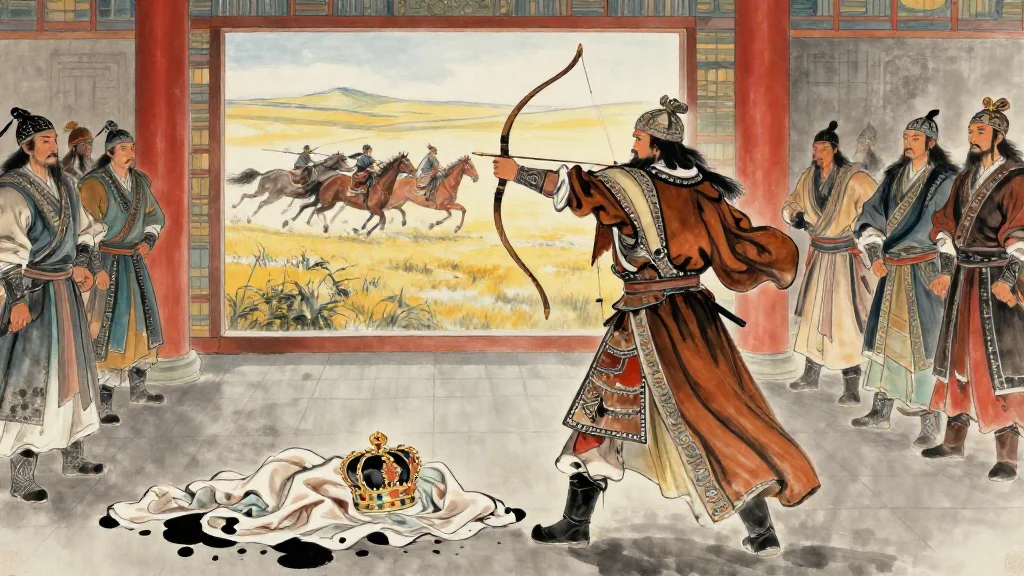
My fundamental plan for Your Majesty is this: unite Han, Wei, Qi, Chu, Yan, and Zhao in a six-state north-south alliance to repel Qin. Have the generals and ministers of All-Under-Heaven convene above the Huan River, exchange hostages, and slaughter a white horse to swear an oath:
'If Qin attacks Chu, Qi and Wei each dispatch elite forces to aid it, Han cuts Qin's supply lines, Zhao crosses the Yellow River and Zhang, and Yan guards north of Changshan. If Qin attacks Han or Wei, Chu cuts off Qin's rear, Qi dispatches elite forces, Zhao crosses the Yellow River and Zhang, and Yan guards Yunzhong. If Qin attacks Qi, Chu cuts off its rear, Han holds Chenggao, Wei blocks the Wu Road, Zhao crosses the Yellow River, Zhang, and Boguan, and Yan dispatches elite forces. If Qin attacks Yan, Zhao holds Changshan, Chu garrisons Wuguan, Qi crosses the Bohai, and Han and Wei dispatch elite forces. If Qin attacks Zhao, Han garrisons Yiyang, Chu garrisons Wuguan, Wei garrisons Hewai, Qi crosses the Bohai, and Yan dispatches elite forces. Any state that first breaks the pact will be attacked by the other five.'
With six states united in kinship to repel Qin, Qin will certainly not dare send troops out of Hangu Pass to harm the states east of the mountains. Then the hegemonic enterprise will be accomplished."
The King of Zhao says: "I am young and have governed for only a short time. I have never had the chance to hear the long-term strategy for the state. Now that an honored guest has come with the intention of preserving All-Under-Heaven and securing the feudal lords, I respectfully commit my state to the alliance."
He enfeoffs Su Qin as Lord of Wu'an, and equips him with a hundred decorated chariots, a thousand yi of gold, a hundred pairs of white jade disks, and a thousand bolts of brocade to negotiate with the other feudal lords.
Notes
This is the grand pitch — Su Qin's famous proposal for the north-south coalition (合縱) against Qin, arguably the most important diplomatic speech in the Zhanguoce. The mutual-defense pact he outlines is remarkably specific: each state has a designated role depending on which state Qin attacks. It reads like a NATO charter written by a traveling salesman.
Lord Fengyang (奉陽君) is Li Dui again. Su Qin diplomatically notes that Li Dui's monopoly on power prevented the king from hearing honest counsel — a polite way of saying 'your late minister was blocking everyone who might have helped you.'
The term 合從 (hezong, 'joining vertically') refers to the north-south alliance of the six eastern states against Qin. Its opposite, 連橫 (lianheng, 'linking horizontally'), refers to bilateral alignments with Qin. The metaphor derives from geography: the six states are arrayed roughly north-south, while Qin sits to the west, so 'vertical' unites the six and 'horizontal' connects each to Qin.
The Huan River (洹水) is in modern Anyang, Henan — a symbolically central location where the allied states could convene. The white-horse oath (刑白馬) was a standard covenant ritual.
Su Qin's description of the horizontal-alliance men is delicious: they scare the feudal lords with Qin's power, arrange for territorial cessions, and in return get 'high terraces, fine palaces, music, gourmet food, and beautiful women.' When Qin eventually shows up to collect, these men are conveniently uninvolved. It is a portrait of the wartime consultant who gets paid to manage the decline.