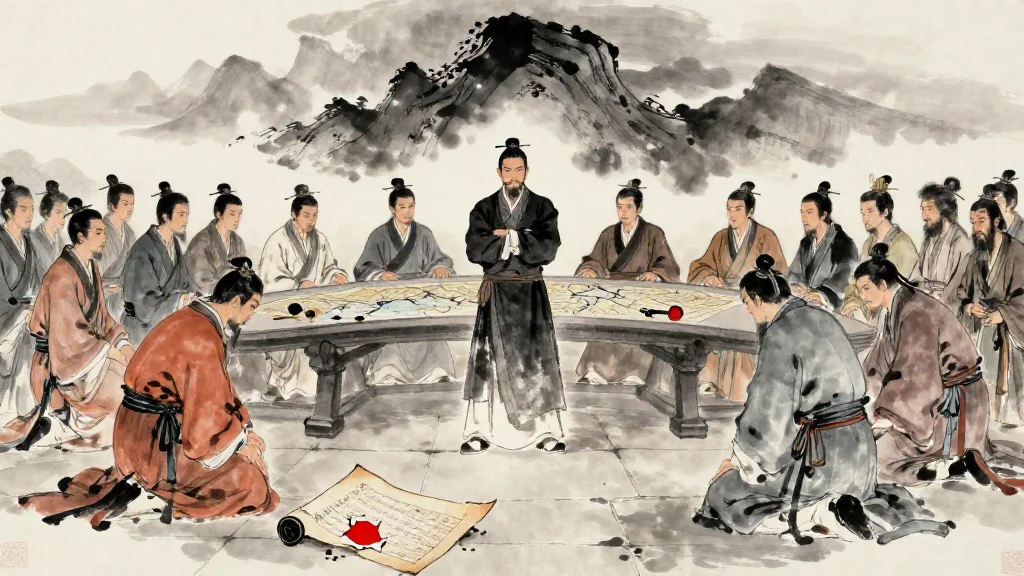
趙惠文王三十年
Tian Dan and Zhao She Debate the Proper Size of an Army
趙惠文王三十年,相都平君田單問趙奢曰:「吾非不說將軍之兵法也,所以不服者,獨將軍之用眾。用眾者,使民不得耕作,糧食輓賃不可給也。此坐而自破之道也,非單之所為也。單聞之,帝王之兵,所用者不過三萬,而天下服矣。今將軍必負十萬、二十萬之眾乃用之,此單之所不服也。」
馬服曰:「君非徒不達於兵也,又不明其時勢。夫吳乾之劍,肉試則斷牛馬,金試則截盤匜;薄之柱上而擊之,則折為三,質之石上而擊之,則碎為百。今以三萬之眾而應強國之兵,是薄柱擊石之類也。且夫吳乾之劍材,難夫毋脊之厚,而鋒不入;無脾之薄,而刃不斷。兼有是兩者,無釣鐔蒙須之便,操其刃而刺,則未入而手斷。君無十餘、二十萬之眾,而為此釣鐔蒙須之便,而徒以三萬行於天下,君焉能乎?且古者四海之內,分為萬國。城雖大,不過三百丈者。人雖眾,不過三千家者。而以集兵三萬,距此奚難哉!今取古之為萬國者,分以為戰國七,能具數十萬之兵,曠日持久,數歲,即君之齊已。齊以二十萬之眾攻荊,五年乃罷。趙以二十萬之眾攻中山,五年乃歸。今者齊韓相方,而國圍攻焉,豈有敢曰,我其以三萬救是者乎哉?今千丈之城,萬家之邑相望也,而索以三萬之眾,圍千丈之城,不存其一角,而野戰不足用也,君將以此何之?」都平君喟然太息曰:「單不至也!」
In the thirtieth year of King Huiwen of Zhao, the Chancellor, Lord Duping — Tian Dan — asks Zhao She: "It is not that I do not admire your generalship. What I cannot accept is your reliance on large numbers. Using masses of troops takes the people from their farming; the costs of transporting grain become unsustainable. This is a path to self-destruction through inaction. It is not how I operate.
"I have heard that the armies of the sage-kings used no more than thirty thousand men, yet All-Under-Heaven submitted. Now you insist on mobilizing a hundred or two hundred thousand before you will fight. This is what I cannot accept."
Zhao She — the Lord of Mafu — replies: "You are not merely ignorant of military affairs; you also fail to understand the circumstances of our time.
"Take the Wu-Gan sword: tested on flesh, it cuts through oxen and horses; tested on metal, it slices through basins and ewers. But strike it against a pillar and it shatters into three; smash it against a stone and it breaks into a hundred pieces. To send thirty thousand troops against a great power's army is like striking the sword against a pillar or a stone.
"Moreover, the Wu-Gan sword — without the thickness of its spine, the point cannot penetrate; without the thinness of its edge, the blade cannot cut. Even with both, without the convenience of a crossguard and hilt wrapping, if you grip the bare blade and thrust, your hand will be severed before the sword enters.
"Without a hundred or two hundred thousand troops providing the crossguard and hilt, and relying on only thirty thousand to campaign across All-Under-Heaven — how could you possibly succeed?
"In ancient times, the realm was divided among ten thousand states. Even the largest city measured no more than three hundred zhang; even the most populous contained no more than three thousand households. Against such opponents, assembling thirty thousand troops — what difficulty was there?
"But now those ten thousand states have been consolidated into seven great powers, each capable of fielding hundreds of thousands of soldiers in campaigns lasting years. Take your own Qi: it sent two hundred thousand troops against Chu and the campaign took five years. Zhao sent two hundred thousand against Zhongshan and took five years. Now, when Qi and Han face each other and a state is besieged, does anyone dare say 'I will rescue it with thirty thousand'?
"Today, cities of a thousand zhang and towns of ten thousand households are everywhere. Try to besiege a thousand-zhang city with thirty thousand men — you cannot even cover one corner, and in open battle you will be insufficient. Where exactly do you propose to go with this force?"
Lord Duping heaves a great sigh: "I had not thought it through!"
Notes
Tian Dan (田單) was the legendary Qi general who recovered Qi from Yan's invasion using the famous 'fire oxen' stratagem at the Battle of Jimo (279 BC). Here he serves as chancellor of Zhao — a remarkable career shift. His advocacy of small armies reflects his own experience: he achieved great results with minimal forces, but as Zhao She points out, that was a special case.
Zhao She (趙奢), Lord of Mafu (馬服君), was a distinguished Zhao general. His son Zhao Kuo (趙括) would later take command at Changping with catastrophic results — a contrast the text does not mention here but which hangs over the discussion like a shadow.
Zhao She's sword metaphor is brilliant: a blade needs both a cutting edge (the elite force) and a spine (the mass army) and a hilt (logistical support). Without all three, the sword is useless or dangerous to the wielder. The debate between small elite forces and mass armies is one that every military tradition eventually has; Zhao She's position — that the scale of war has changed and nostalgia for small armies is dangerous — proved correct in the Warring States context.