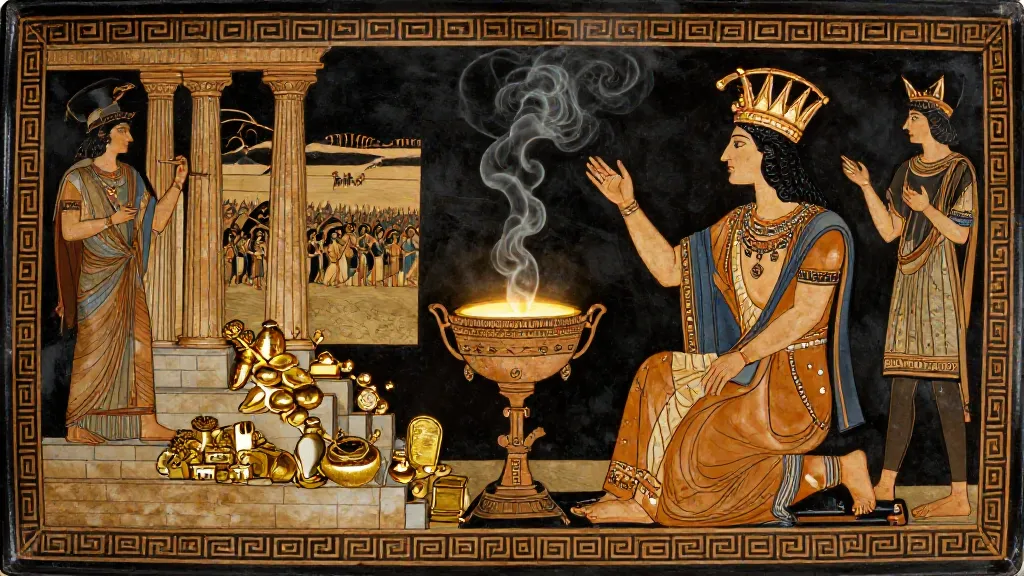
Croesus and the Oracle — Attic red-figure pottery painting

Herodotus · Book I, Chapters 26–91

Croesus and the Oracle

Κροῖσος

9,831 words · 1459 unique lemmas

View:

Hover over any Greek word for its dictionary form and definition

τελευτήσαντος δὲ Ἀλυάττεω ἐξεδέξατο τὴν βασιληίην Κροῖσος Ἀλυάττεω ἐτέων ἐὼν ἡλικίην πέντε καὶ τριήκοντα ὃς δὴ Ἑλλήνων πρώτοισι ἐπεθήκατο Ἐφεσίοισι [ ] ἔνθα δὴ οἱ Ἐφέσιοι πολιορκεόμενοι ὑπ᾽ αὐτοῦ ἀνέθεσαν τὴν πόλιν τῇ Ἀρτέμιδι ἐξάψαντες ἐκ τοῦ νηοῦ σχοινίον ἐς τὸ τεῖχος ἔστι δὲ μεταξὺ τῆς τε παλαιῆς πόλιος τότε ἐπολιορκέετο καὶ τοῦ νηοῦ ἑπτὰ στάδιοι [ ] πρώτοισι μὲν δὴ τούτοισι ἐπεχείρησε Κροῖσος μετὰ δὲ ἐν μέρεϊ ἑκάστοισι Ἰώνων τε καὶ Αἰολέων ἄλλοισι ἄλλας αἰτίας ἐπιφέρων τῶν μὲν ἐδύνατο μέζονας παρευρίσκειν μέζονα ἐπαιτιώμενος τοῖσι δὲ αὐτῶν καὶ φαῦλα ἐπιφέρων

ὡς δὲ ἄρα οἱ ἐν τῇ Ἀσίῃ Ἕλληνες κατεστράφατο ἐς φόρου ἀπαγωγήν τὸ ἐνθεῦτεν ἐπενόεε νέας ποιησάμενος ἐπιχειρέειν τοῖσι νησιώτῃσι [ ] ἐόντων δέ οἱ πάντων ἑτοίμων ἐς τὴν ναυπηγίην οἳ μὲν Βίαντα λέγουσι τὸν Πριηνέα ἀπικόμενον ἐς Σάρδις οἳ δὲ Πιττακὸν τὸν Μυτιληναῖον εἰρομένου Κροίσου εἴ τι εἴη νεώτερον περὶ τὴν Ἑλλάδα εἰπόντα τάδε καταπαῦσαι τὴν ναυπηγίην [ ] βασιλεῦ νησιῶται ἵππον συνωνέονται μυρίην ἐς Σάρδις τε καὶ ἐπὶ σὲ ἐν νόῳ ἔχοντες στρατεύεσθαι Κροῖσον δὲ ἐλπίσαντα λέγειν ἐκεῖνον ἀληθέα εἰπεῖν αἲ γὰρ τοῦτο θεοὶ ποιήσειαν ἐπὶ νόον νησιώτῃσι ἐλθεῖν ἐπὶ Λυδῶν παῖδας σὺν ἵπποισι [ ] τὸν δὲ ὑπολαβόντα φάναι βασιλεῦ προθύμως μοι φαίνεαι εὔξασθαι νησιώτας ἱππευομένους λαβεῖν ἐν ἠπείρῳ οἰκότα ἐλπίζων νησιώτας δὲ τί δοκέεις εὔχεσθαι ἄλλο ἐπείτε τάχιστα ἐπύθοντό σε μέλλοντα ἐπὶ σφίσι ναυπηγέεσθαι νέας λαβεῖν ἀρώμενοι Λυδούς ἐν θαλάσσῃ ἵνα ὓπερ τῶν ἐν τῇ ἠπείρῳ οἰκημένων Ἑλλήνων τίσωνταί σε τοὺς σὺ δουλώσας ἔχεις [ ] κάρτα τε ἡσθῆναι Κροῖσον τῷ ἐπιλόγῳ καί οἱ προσφυέως γὰρ δόξαι λέγειν πειθόμενον παύσασθαι τῆς ναυπηγίης καὶ οὕτω τοῖσι τὰς νήσους οἰκημένοισι Ἴωσι ξεινίην συνεθήκατο

χρόνου δὲ ἐπιγινομένου καὶ κατεστραμμένων σχεδὸν πάντων τῶν ἐντὸς Ἅλυος ποταμοῦ οἰκημένων πλὴν γὰρ Κιλίκων καὶ Λυκίων τοὺς ἄλλους πάντας ὑπ᾽ ἑωυτῷ εἶχε καταστρεψάμενος Κροῖσος εἰσὶ δὲ οἵδε Λυδοί Φρύγες Μυσοί Μαριανδυνοί Χάλυβες Παφλαγόνες Θρήικες οἱ Θυνοί τε καὶ Βιθυνοί Κᾶρες Ἴωνες Δωριέες Αἰολέες Πάμφυλοι κατεστραμμένων δὲ τούτων καὶ προσεπικτωμένου Κροίσου Λυδοῖσι

ἀπικνέονται ἐς Σάρδις ἀκμαζούσας πλούτῳ ἄλλοι τε οἱ πάντες ἐκ τῆς Ἑλλάδος σοφισταί οἳ τοῦτον τὸν χρόνον ἐτύγχανον ἐόντες ὡς ἕκαστος αὐτῶν ἀπικνέοιτο καὶ δὴ καὶ Σόλων ἀνὴρ Ἀθηναῖος ὃς Ἀθηναίοισι νόμους κελεύσασι ποιήσας ἀπεδήμησε ἔτεα δέκα κατά θεωρίης πρόφασιν ἐκπλώσας ἵνα δὴ μή τινα τῶν νόμων ἀναγκασθῇ λῦσαι τῶν ἔθετο [ ] αὐτοὶ γὰρ οὐκ οἷοί τε ἦσαν αὐτὸ ποιῆσαι Ἀθηναῖοι ὁρκίοισι γὰρ μεγάλοισι κατείχοντο δέκα ἔτεα χρήσεσθαι νόμοισι τοὺς ἄν σφι Σόλων θῆται

αὐτῶν δὴ ὦν τούτων καὶ τῆς θεωρίης ἐκδημήσας Σόλων εἵνεκεν ἐς Αἴγυπτον ἀπίκετο παρὰ Ἄμασιν καὶ δὴ καὶ ἐς Σάρδις παρὰ Κροῖσον ἀπικόμενος δὲ ἐξεινίζετο ἐν τοῖσι βασιληίοισι ὑπὸ τοῦ Κροίσου μετὰ δὲ ἡμέρῃ τρίτῃ τετάρτῃ κελεύσαντος Κροίσου τὸν Σόλωνα θεράποντες περιῆγον κατὰ τοὺς θησαυρούς καὶ ἐπεδείκνυσαν πάντα ἐόντα μεγάλα τε καὶ ὄλβια [ ] θεησάμενον δέ μιν τὰ πάντα καὶ σκεψάμενον ὥς οἱ κατὰ καιρὸν ἦν εἴρετο Κροῖσος τάδε ξεῖνε Ἀθηναῖε παρ᾽ ἡμέας γὰρ περὶ σέο λόγος ἀπῖκται πολλὸς καὶ σοφίης εἵνεκεν τῆς σῆς καὶ πλάνης ὡς φιλοσοφέων γῆν πολλὴν θεωρίης εἵνεκεν ἐπελήλυθας νῦν ὦν ἐπειρέσθαι με ἵμερος ἐπῆλθέ σε εἴ τινα ἤδη πάντων εἶδες ὀλβιώτατον [ ] μὲν ἐλπίζων εἶναι ἀνθρώπων ὀλβιώτατος ταῦτα ἐπειρώτα Σόλων δὲ οὐδὲν ὑποθωπεύσας ἀλλὰ τῷ ἐόντι χρησάμενος λέγει βασιλεῦ Τέλλον Ἀθηναῖον [ ] ἀποθωμάσας δὲ Κροῖσος τὸ λεχθὲν εἴρετο ἐπιστρεφέως κοίῃ δὴ κρίνεις Τέλλον εἶναι ὀλβιώτατον δὲ εἶπε Τέλλῳ τοῦτο μὲν τῆς πόλιος εὖ ἡκούσης παῖδες ἦσαν καλοί τε κἀγαθοί καί σφι εἶδε ἅπασι τέκνα ἐκγενόμενα καὶ πάντα παραμείναντα τοῦτο δὲ τοῦ βίου εὖ ἥκοντι ὡς τὰ παρ᾽ ἡμῖν τελευτὴ τοῦ βίου λαμπροτάτη ἐπεγένετο [ ] γενομένης γὰρ Ἀθηναίοισι μάχης πρὸς τοὺς ἀστυγείτονας ἐν Ἐλευσῖνι βοηθήσας καὶ τροπὴν ποιήσας τῶν πολεμίων ἀπέθανε κάλλιστα καί μιν Ἀθηναῖοι δημοσίῃ τε ἔθαψαν αὐτοῦ τῇ περ ἔπεσε καὶ ἐτίμησαν μεγάλως

ὣς δὲ τὰ κατὰ τὸν Τέλλον προετρέψατο Σόλων τὸν Κροῖσον εἴπας πολλά τε καὶ ὀλβία ἐπειρώτα τίνα δεύτερον μετ᾽ ἐκεῖνον ἴδοι δοκέων πάγχυ δευτερεῖα γῶν οἴσεσθαι δ᾽ εἶπε Κλέοβίν τε καὶ Βίτωνα [ ] τούτοισι γὰρ ἐοῦσι γένος Ἀργείοισι βίος τε ἀρκέων ὑπῆν καὶ πρὸς τούτῳ ῥώμη σώματος τοιήδε ἀεθλοφόροι τε ἀμφότεροι ὁμοίως ἦσαν καὶ δὴ καὶ λέγεται ὅδε λόγος ἐούσης ὁρτῆς τῇ Ἥρῃ τοῖσι Ἀργείοισι ἔδεε πάντως τὴν μητέρα αὐτῶν ζεύγεϊ κομισθῆναι ἐς τὸ ἱρόν οἱ δέ σφι βόες ἐκ τοῦ ἀγροῦ οὐ παρεγίνοντο ἐν ὥρῃ ἐκκληιόμενοι δὲ τῇ ὥρῃ οἱ νεηνίαι ὑποδύντες αὐτοὶ ὑπὸ τὴν ζεύγλην εἷλκον τὴν ἅμαξαν ἐπὶ τῆς ἁμάξης δέ σφι ὠχέετο μήτηρ σταδίους δὲ πέντε καὶ τεσσεράκοντα διακομίσαντες ἀπίκοντο ἐς τὸ ἱρόν [ ] ταῦτα δέ σφι ποιήσασι καὶ ὀφθεῖσι ὑπὸ τῆς πανηγύριος τελευτὴ τοῦ βίου ἀρίστη ἐπεγένετο διέδεξέ τε ἐν τούτοισι θεὸς ὡς ἄμεινον εἴη ἀνθρώπῳ τεθνάναι μᾶλλον ζώειν Ἀργεῖοι μὲν γὰρ περιστάντες ἐμακάριζον τῶν νεηνιέων τὴν ῥώμην αἱ δὲ Ἀργεῖαι τὴν μητέρα αὐτῶν οἵων τέκνων ἐκύρησε [ ] δὲ μήτηρ περιχαρής ἐοῦσα τῷ τε ἔργῳ καὶ τῇ φήμῃ στᾶσα ἀντίον τοῦ ἀγάλματος εὔχετο Κλεόβι τε καὶ Βίτωνι τοῖσι ἑωυτῆς τέκνοισι οἵ μιν ἐτίμησαν μεγάλως τὴν θεὸν δοῦναι τὸ ἀνθρώπῳ τυχεῖν ἄριστον ἐστί [ ] μετὰ ταύτην δὲ τὴν εὐχὴν ὡς ἔθυσάν τε καὶ εὐωχήθησαν κατακοιμηθέντες ἐν αὐτῷ τῷ ἱρῷ οἱ νεηνίαι οὐκέτι ἀνέστησαν ἀλλ᾽ ἐν τέλεϊ τούτῳ ἔσχοντο Ἀργεῖοι δὲ σφέων εἰκόνας ποιησάμενοι ἀνέθεσαν ἐς Δελφοὺς ὡς ἀριστῶν γενομένων

Σόλων μὲν δὴ εὐδαιμονίης δευτερεῖα ἔνεμε τούτοισι Κροῖσος δὲ σπερχθεὶς εἶπε ξεῖνε Ἀθηναῖε δ᾽ ἡμετέρη εὐδαιμονίη οὕτω τοι ἀπέρριπται ἐς τὸ μηδὲν ὥστε οὐδὲ ἰδιωτέων ἀνδρῶν ἀξίους ἡμέας ἐποίησας δὲ εἶπε Κροῖσε ἐπιστάμενόν με τὸ θεῖον πᾶν ἐὸν φθονερόν τε καὶ ταραχῶδες ἐπειρωτᾷς ἀνθρωπηίων πρηγμάτων πέρι [ ] ἐν γὰρ τῷ μακρῷ χρόνῳ πολλὰ μὲν ἐστὶ ἰδεῖν τὰ μή τις ἐθέλει πολλὰ δὲ καὶ παθεῖν ἐς γὰρ ἑβδομήκοντα ἔτεα οὖρον τῆς ζόης ἀνθρώπῳ προτίθημι [ ] οὗτοι ἐόντες ἐνιαυτοὶ ἑβδομήκοντα παρέχονται ἡμέρας διηκοσίας καὶ πεντακισχιλίας καὶ δισμυρίας ἐμβολίμου μηνὸς μὴ γινομένου εἰ δὲ δὴ ἐθελήσει τοὔτερον τῶν ἐτέων μηνὶ μακρότερον γίνεσθαι ἵνα δὴ αἱ ὧραι συμβαίνωσι παραγινόμεναι ἐς τὸ δέον μῆνες μὲν παρὰ τὰ ἑβδομήκοντα ἔτεα οἱ ἐμβόλιμοι γίνονται τριήκοντα πέντε ἡμέραι δὲ ἐκ τῶν μηνῶν τούτων χίλιαι πεντήκοντα [ ] τουτέων τῶν ἁπασέων ἡμερέων τῶν ἐς τὰ ἑβδομήκοντα ἔτεα ἐουσέων πεντήκοντα καὶ διηκοσιέων καὶ ἑξακισχιλιέων καὶ δισμυριέων ἑτέρη αὐτέων τῇ ἑτέρῃ ἡμέρῃ τὸ παράπαν οὐδὲν ὅμοιον προσάγει πρῆγμα οὕτω ὦν Κροῖσε πᾶν ἐστὶ ἄνθρωπος συμφορή [ ] ἐμοὶ δὲ σὺ καὶ πλουτέειν μέγα φαίνεαι καὶ βασιλεὺς πολλῶν εἶναι ἀνθρώπων ἐκεῖνο δὲ τὸ εἴρεό με οὔκω σε ἐγὼ λέγω πρὶν τελευτήσαντα καλῶς τὸν αἰῶνα πύθωμαι οὐ γάρ τι μέγα πλούσιος μᾶλλον τοῦ ἐπ᾽ ἡμέρην ἔχοντος ὀλβιώτερος ἐστί εἰ μή οἱ τύχη ἐπίσποιτο πάντα καλὰ ἔχοντα εὖ τελευτῆσαὶ τὸν βίον πολλοὶ μὲν γὰρ ζάπλουτοι ἀνθρώπων ἀνόλβιοι εἰσί πολλοὶ δὲ μετρίως ἔχοντες βίου εὐτυχέες [ ] μὲν δὴ μέγα πλούσιος ἀνόλβιος δὲ δυοῖσι προέχει τοῦ εὐτυχέος μοῦνον οὗτος δὲ τοῦ πλουσίου καὶ ἀνόλβου πολλοῖσι μὲν ἐπιθυμίην ἐκτελέσαι καί ἄτην μεγάλην προσπεσοῦσαν ἐνεῖκαι δυνατώτερος δὲ τοῖσιδε προέχει ἐκείνου ἄτην μὲν καὶ ἐπιθυμίην οὐκ ὁμοίως δυνατὸς ἐκείνῳ ἐνεῖκαι ταῦτα δὲ εὐτυχίη οἱ ἀπερύκει ἄπηρος δὲ ἐστί ἄνουσος ἀπαθὴς κακῶν εὔπαις εὐειδής [ ] εἰ δὲ πρὸς τούτοισι ἔτι τελευτήσῃ τὸν βίον εὖ οὗτος ἐκεῖνος τὸν σὺ ζητέεις ὄλβιος κεκλῆσθαι ἄξιος ἐστί πρὶν δ᾽ ἂν τελευτήσῃ ἐπισχεῖν μηδὲ καλέειν κω ὄλβιον ἀλλ᾽ εὐτυχέα [ ] τὰ πάντα μέν νυν ταῦτα συλλαβεῖν ἄνθρωπον ἐόντα ἀδύνατον ἐστί ὥσπερ χωρῇ οὐδεμία καταρκέει πάντα ἑωυτῇ παρέχουσα ἀλλὰ ἄλλο μὲν ἔχει ἑτέρου δὲ ἐπιδέεται δὲ ἂν τὰ πλεῖστα ἔχῃ αὕτη ἀρίστη ὣς δὲ καὶ ἀνθρώπου σῶμα ἓν οὐδὲν αὔταρκες ἐστί τὸ μὲν γὰρ ἔχει ἄλλου δὲ ἐνδεές ἐστι [ ] ὃς δ᾽ ἂν αὐτῶν πλεῖστα ἔχων διατελέῃ καὶ ἔπειτα τελευτήσῃ εὐχαρίστως τὸν βίον οὗτος παρ᾽ ἐμοὶ τὸ οὔνομα τοῦτο βασιλεῦ δίκαιος ἐστὶ φέρεσθαι σκοπέειν δὲ χρὴ παντὸς χρήματος τὴν τελευτήν κῇ ἀποβήσεται πολλοῖσι γὰρ δὴ ὑποδέξας ὄλβον θεὸς προρρίζους ἀνέτρεψε

ταῦτα λέγων τῷ Κροίσῳ οὔ κως οὔτε ἐχαρίζετο οὔτε λόγου μιν ποιησάμενος οὐδενὸς ἀποπέμπεται κάρτα δόξας ἀμαθέα εἶναι ὃς τὰ παρεόντα ἀγαθὰ μετεὶς τὴν τελευτὴν παντὸς χρήματος ὁρᾶν ἐκέλευε

μετὰ δὲ Σόλωνα οἰχόμενον ἔλαβέ ἐκ θεοῦ νέμεσις μεγάλη Κροῖσον ὡς εἰκάσαι ὅτι ἐνόμισε ἑωυτὸν εἶναι ἀνθρώπων ἁπάντων ὀλβιώτατον αὐτίκα δέ οἱ εὕδοντι ἐπέστη ὄνειρος ὅς οἱ τὴν ἀληθείην ἔφαινε τῶν μελλόντων γενέσθαι κακῶν κατὰ τὸν παῖδα [ ] ἦσαν δὲ τῷ Κροίσῳ δύο παῖδες τῶν οὕτερος μὲν διέφθαρτο ἦν γὰρ δὴ κωφός δὲ ἕτερος τῶν ἡλίκων μακρῷ τὰ πάντα πρῶτος οὔνομα δέ οἱ ἦν Ἄτυς τοῦτον δὴ ὦν τὸν Ἄτυν σημαίνει τῷ Κροίσῳ ὄνειρος ὡς ἀπολέει μιν αἰχμῇ σιδηρέῃ βληθέντα [ ] δ᾽ ἐπείτε ἐξηγέρθη καὶ ἑωυτῷ λόγον ἔδωκε καταρρωδήσας τὸν ὄνειρον ἄγεται μὲν τῷ παιδὶ γυναῖκα ἐωθότα δὲ στρατηγέειν μιν τῶν Λυδῶν οὐδαμῇ ἔτι ἐπὶ τοιοῦτο πρῆγμα ἐξέπεμπε ἀκόντια δὲ καὶ δοράτια καὶ τά τοιαῦτα πάντα τοῖσι χρέωνται ἐς πόλεμον ἄνθρωποι ἐκ τῶν ἀνδρεώνων ἐκκομίσας ἐς τοὺς θαλάμους συνένησε μή τί οἱ κρεμάμενον τῷ παιδὶ ἐμπέσῃ

ἔχοντι δέ οἱ ἐν χερσὶ τοῦ παιδὸς τὸν γάμον ἀπικνέεται ἐς τὰς Σάρδις ἀνὴρ συμφορῇ ἐχόμενος καὶ οὐ καθαρὸς χεῖρας ἐὼν Φρὺξ μὲν γενεῇ γένεος δὲ τοῦ βασιληίου παρελθὼν δὲ οὗτος ἐς τὰ Κροίσου οἰκία κατὰ νόμους τοὺς ἐπιχωρίους καθαρσίου ἐδέετο κυρῆσαι Κροῖσος δέ μιν ἐκάθηρε [ ] ἔστι δὲ παραπλησίη κάθαρσις τοῖσι Λυδοῖσι καὶ τοῖσι Ἕλλησι ἐπείτε δὲ τὰ νομιζόμενα ἐποίησε Κροῖσος ἐπυνθάνετο ὁκόθεν τε καὶ τίς εἴη λέγων τάδε [ ] ὤνθρωπε τίς τε ἐὼν καὶ κόθεν τῆς Φρυγίης ἥκων ἐπίστιός μοι ἐγένεο τίνα τε ἀνδρῶν γυναικῶν ἐφόνευσας δὲ ἀμείβετο βασιλεῦ Γορδίεω μὲν τοῦ Μίδεω εἰμὶ παῖς ὀνομάζομαι δὲ Ἄδρηστος φονεύσας δὲ ἀδελφεὸν ἐμεωυτοῦ ἀέκων πάρειμι ἐξεληλαμένος τε ὑπὸ τοῦ πατρὸς καὶ ἐστερημένος πάντων [ ] Κροῖσος δέ μιν ἀμείβετο τοῖσιδε ἀνδρῶν τε φίλων τυγχάνεις ἔκγονος ἐὼν καὶ ἐλήλυθας ἐς φίλους ἔνθα ἀμηχανήσεις χρήματος οὐδενὸς μένων ἐν ἡμετέρου συμφορήν τε ταύτην ὡς κουφότατα φέρων κερδανέεις πλεῖστον

μὲν δὴ δίαιταν εἶχε ἐν Κροίσου ἐν δὲ τῷ αὐτῷ χρόνῳ τούτῳ ἐν τῷ Μυσίῳ Ὀλύμπῳ ὑὸς χρῆμα γίνεται μέγα ὁρμώμενος δὲ οὗτος ἐκ τοῦ ὄρεος τούτου τὰ τῶν Μυσῶν ἔργα διαφθείρεσκε πολλάκις δὲ οἱ Μυσοὶ ἐπ᾽ αὐτὸν ἐξελθόντες ποιέεσκον μὲν κακὸν οὐδέν ἔπασχον δὲ πρὸς αὐτοῦ [ ] τέλος δὲ ἀπικόμενοι παρὰ τὸν Κροῖσον τῶν Μυσῶν ἄγγελοι ἔλεγον τάδε βασιλεῦ ὑὸς χρῆμα μέγιστον ἀνεφάνη ἡμῖν ἐν τῇ χώρῃ ὃς τὰ ἔργα διαφθείρει τοῦτον προθυμεόμενοι ἑλεῖν οὐ δυνάμεθα νῦν ὦν προσδεόμεθά σευ τὸν παῖδα καὶ λογάδας νεηνίας καὶ κύνας συμπέμψαι ἡμῖν ὡς ἄν μιν ἐξέλωμεν ἐκ τῆς χώρης [ ] οἳ μὲν δὴ τούτων ἐδέοντο Κροῖσος δὲ μνημονεύων τοῦ ὀνείρου τὰ ἔπεα ἔλεγέ σφι τάδε παιδὸς μὲν πέρι τοῦ ἐμοῦ μὴ μνησθῆτε ἔτι οὐ γὰρ ἂν ὑμῖν συμπέμψαιμι νεόγαμός τε γὰρ ἐστὶ καὶ ταῦτά οἱ νῦν μέλει Λυδῶν μέντοι λογάδας καὶ τὸ κυνηγέσιον πᾶν συμπέμψω καὶ διακελεύσομαι τοῖσι ἰοῦσι εἶναι ὡς προθυμοτάτοισι συνεξελεῖν ὑμῖν τὸ θηρίον ἐκ τῆς χώρης

ταῦτα ἀμείψατο ἀποχρεωμένων δὲ τούτοισι τῶν Μυσῶν ἐπεσέρχεται τοῦ Κροίσου παῖς ἀκηκοὼς τῶν ἐδέοντο οἱ Μυσοί οὐ φαμένου δὲ τοῦ Κροίσου τόν γε παῖδά σφι συμπέμψειν λέγει πρὸς αὐτὸν νεηνίης τάδε [ ] πάτερ τὰ κάλλιστα πρότερον κοτὲ καὶ γενναιότατα ἡμῖν ἦν ἔς τε πολέμους καὶ ἐς ἄγρας φοιτέοντας εὐδοκιμέειν νῦν δὲ ἀμφοτέρων με τούτων ἀποκληίσας ἔχεις οὔτε τινὰ δειλίην μοι παριδὼν οὔτε ἀθυμίην νῦν τε τέοισί με χρὴ ὄμμασι ἔς τε ἀγορὴν καὶ ἐξ ἀγορῆς φοιτέοντα φαίνεσθαι [ ] κοῖος μέν τις τοῖσι πολιήτῃσι δόξω εἶναι κοῖος δέ τις τῇ νεογάμῳ γυναικί κοίῳ δὲ ἐκείνη δόξει ἀνδρὶ συνοικέειν ἐμὲ ὦν σὺ μέτες ἰέναι ἐπὶ τὴν θήρην λόγῳ ἀνάπεισον ὅκως μοι ἀμείνω ἐστὶ ταῦτα οὕτω ποιεόμενα

ἀμείβεται Κροῖσος τοῖσιδε παῖ οὔτε δειλίην οὔτε ἄλλο οὐδὲν ἄχαρι παριδών τοι ποιέω ταῦτα ἀλλά μοι ὄψις ὀνείρου ἐν τῷ ὕπνῳ ἐπιστᾶσα ἔφη σε ὀλιγοχρόνιον ἔσεσθαι ὑπὸ γὰρ αἰχμῆς σιδηρέης ἀπολέεσθαι [ ] πρὸς ὧν τὴν ὄψιν ταύτην τόν τε γάμον τοι τοῦτον ἔσπευσα καὶ ἐπὶ τὰ παραλαμβανόμενα οὐκ ἀποπέμπω φυλακὴν ἔχων εἴ κως δυναίμην ἐπὶ τῆς ἐμῆς σε ζόης διακλέψαι εἷς γὰρ μοι μοῦνος τυγχάνεις ἐὼν παῖς τὸν γὰρ δὴ ἕτερον διεφθαρμένον τὴν ἀκοὴν οὐκ εἶναί μοι λογίζομαι

ἀμείβεται νεηνίης τοῖσιδε συγγνώμη μὲν πάτερ τοι ἰδόντι γε ὄψιν τοιαύτην περὶ ἐμὲ φυλακὴν ἔχειν τὸ δὲ οὐ μανθάνεις ἀλλὰ λέληθέ σε τὸ ὄνειρον ἐμέ τοί δίκαιον ἐστί φράζειν [ ] φής τοι τὸ ὄνειρον ὑπὸ αἰχμῆς σιδηρέης φάναι ἐμὲ τελευτήσειν ὑὸς δὲ κοῖαι μὲν εἰσὶ χεῖρες κοίη δὲ αἰχμὴ σιδηρέη τὴν σὺ φοβέαι εἰ μὲν γὰρ ὑπὸ ὀδόντος τοι εἶπε τελευτήσειν με ἄλλου τευ τι τούτῳ ἔοικε χρῆν δή σε ποιέειν τὰ ποιέεις νῦν δὲ ὑπὸ αἰχμῆς ἐπείτε ὦν οὐ πρὸς ἄνδρας ἡμῖν γίνεται μάχη μέτες με

ἀμείβεται Κροῖσος παῖ ἔστι τῇ με νικᾷς γνώμην ἀποφαίνων περὶ τοῦ ἐνυπνίου ὡς ὦν νενικημένος ὑπὸ σέο μεταγινώσκω μετίημί τε σὲ ἰέναι ἐπὶ τὴν ἄγρην

εἴπας δὲ ταῦτα Κροῖσος μεταπέμπεται τὸν Φρύγα Ἄδρηστον ἀπικομένῳ δέ οἱ λέγει τάδε Ἄδρηστε ἐγώ σε συμφορῇ πεπληγμένον ἀχάρι τήν τοι οὐκ ὀνειδίζω ἐκάθηρα καὶ οἰκίοισι ὑποδεξάμενος ἔχω παρέχων πᾶσαν δαπάνην [ ] νῦν ὤν ὀφείλεις γὰρ ἐμοῦ προποιήσαντος χρηστὰ ἐς σὲ χρηστοῖσί με ἀμείβεσθαι φύλακα παιδός σε τοῦ ἐμοῦ χρηίζω γενέσθαι ἐς ἄγρην ὁρμωμένου μή τινες κατ᾽ ὁδὸν κλῶπες κακοῦργοι ἐπὶ δηλήσι φανέωσι ὑμῖν [ ] πρὸς δὲ τούτῳ καὶ σέ τοι χρεόν ἐστι ἰέναι ἔνθα ἀπολαμπρυνέαι τοῖσι χρεόν πατρώιόν τε γάρ τοι ἐστὶ καὶ προσέτι ῥώμη ὑπάρχει

ἀμείβεται Ἄδρηστος βασιλεῦ ἄλλως μὲν ἔγωγε ἂν οὐκ ἤια ἐς ἄεθλον τοιόνδε οὔτε γὰρ συμφορῇ τοιῇδε κεχρημένον οἰκός ἐστι ἐς ὁμήλικας εὖ πρήσσοντας ἰέναι οὔτε τὸ βούλεσθαι πάρα πολλαχῇ τε ἂν ἶσχον ἐμεωυτόν [ ] νῦν δέ ἐπείτε σὺ σπεύδεις καὶ δεῖ τοί χαρίζεσθαι ὀφείλω γάρ σε ἀμείβεσθαι χρηστοῖσι ποιέειν εἰμὶ ἕτοιμος ταῦτα παῖδα τε σόν τὸν διακελεύεαι φυλάσσειν ἀπήμονα τοῦ φυλάσσοντος εἵνεκεν προσδόκα τοι ἀπονοστήσειν

τοιούτοισι ἐπείτε οὗτος ἀμείψατο Κροῖσον ἤισαν μετὰ ταῦτα ἐξηρτυμένοι λογάσι τε νεηνίῃσι καὶ κυσί ἀπικόμενοι δὲ ἐς τὸν Ὄλυμπον τὸ ὄρος ἐζήτεον τὸ θηρίον εὑρόντες δὲ καὶ περιστάντες αὐτὸ κύκλῳ ἐσηκόντιζον [ ] ἔνθα δὴ ξεῖνος οὗτος δὴ καθαρθεὶς τὸν φόνον καλεόμενος δὲ Ἄδρηστος ἀκοντίζων τὸν ὗν τοῦ μὲν ἁμαρτάνει τυγχάνει δὲ τοῦ Κροίσου παιδός [ ] μὲν δὴ βληθεὶς τῇ αἰχμῇ ἐξέπλησε τοῦ ὀνείρου τὴν φήμην ἔθεε δέ τις ἀγγελέων τῷ Κροίσῳ τὸ γεγονός ἀπικόμενος δὲ ἐς τὰς Σάρδις τὴν τε μάχην καὶ τὸν τοῦ παιδὸς μόρον ἐσήμηνέ οἱ

δὲ Κροῖσος τῳ θανάτῳ τοῦ παιδὸς συντεταραγμένος μᾶλλον τι ἐδεινολογέετο ὅτι μιν ἀπέκτεινε τὸν αὐτὸς φόνου ἐκάθηρε [ ] περιημεκτέων δὲ τῇ συμφορῇ δεινῶς ἐκάλεε μὲν Δία καθάρσιον μαρτυρόμενος τὰ ὑπὸ τοῦ ξείνου πεπονθὼς εἴη ἐκάλεε δὲ ἐπίστιόν τε καὶ ἑταιρήιον τὸν αὐτὸν τοῦτον ὀνομάζων θεόν τὸν μὲν ἐπίστιον καλέων διότι δὴ οἰκίοισι ὑποδεξάμενος τὸν ξεῖνον φονέα τοῦ παιδὸς ἐλάνθανε βόσκων τὸν δὲ ἑταιρήιον ὡς φύλακα συμπέμψας αὐτὸν εὑρήκοι πολεμιώτατον

παρῆσαν δὲ μετὰ τοῦτο οἱ Λυδοὶ φέροντες τὸν νεκρόν ὄπισθε δὲ εἵπετό οἱ φονεύς στὰς δὲ οὗτος πρὸ τοῦ νεκροῦ παρεδίδου ἑωυτὸν Κροίσῳ προτείνων τὰς χεῖρας ἐπικατασφάξαι μιν κελεύων τῷ νεκρῷ λέγων τήν τε προτέρην ἑωυτοῦ συμφορήν καὶ ὡς ἐπ᾽ ἐκείνῃ τὸν καθήραντα ἀπολωλεκὼς εἴη οὐδέ οἱ εἴη βιώσιμον [ ] Κροῖσος δὲ τούτων ἀκούσας τόν τε Ἄδρηστον κατοικτείρει καίπερ ἐὼν ἐν κακῷ οἰκηίῳ τοσούτῳ καὶ λέγει πρὸς αὐτόν ἔχω ξεῖνε παρὰ σεῦ πᾶσαν τὴν δίκην ἐπειδὴ σεωυτοῦ καταδικάζεις θάνατον εἶς δὲ οὐ σύ μοι τοῦδε τοῦ κακοῦ αἴτιος εἰ μὴ ὅσον ἀέκων ἐξεργάσαο ἀλλὰ θεῶν κού τις ὅς μοι καὶ πάλαι προεσήμαινε τὰ μέλλοντα ἔσεσθαι [ ] Κροῖσος μέν νυν ἔθαψε ὡς οἰκὸς ἦν τὸν ἑωυτοῦ παῖδα Ἄδρηστος δὲ Γορδίεω τοῦ Μίδεω οὗτος δὴ φονεὺς μὲν τοῦ ἑωυτοῦ ἀδελφεοῦ γενόμενος φονεὺς δὲ τοῦ καθήραντος ἐπείτε ἡσυχίη τῶν ἀνθρώπων ἐγένετο περὶ τὸ σῆμα συγγινωσκόμενος ἀνθρώπων εἶναι τῶν αὐτὸς ᾔδεε βαρυσυμφορώτατος ἐπικατασφάζει τῷ τύμβῳ ἑωυτόν

Κροῖσος δὲ ἐπὶ δύο ἔτεα ἐν πένθεϊ μεγάλῳ κατῆστο τοῦ παιδὸς ἐστερημένος μετὰ δὲ Ἀστυάγεος τοῦ Κυαξάρεω ἡγεμονίη καταιρεθεῖσα ὑπὸ Κύρου τοῦ Καμβύσεω καὶ τὰ τῶν Περσέων πρήγματα αὐξανόμενα πένθεος μὲν Κροῖσον ἀπέπαυσε ἐνέβησε δὲ ἐς φροντίδα εἴ κως δύναιτο πρὶν μεγάλους γενέσθαι τοὺς Πέρσας καταλαβεῖν αὐτῶν αὐξανομένην τὴν δύναμιν [ ] μετὰ ὦν τὴν διάνοιαν ταύτην αὐτίκα ἀπεπειρᾶτο τῶν μαντείων τῶν τε ἐν Ἕλλησι καὶ τοῦ ἐν Λιβύῃ διαπέμψας ἄλλους ἄλλῃ τοὺς μὲν ἐς Δελφοὺς ἰέναι τοὺς δὲ ἐς Ἄβας τὰς Φωκέων τοὺς δὲ ἐς Δωδώνην οἳ δὲ τινὲς ἐπέμποντο παρὰ τε Ἀμφιάρεων καὶ παρὰ Τροφώνιον οἳ δὲ τῆς Μιλησίης ἐς Βραγχίδας [ ] ταῦτα μέν νυν τὰ Ἑλληνικὰ μαντήια ἐς τὰ ἀπέπεμψε μαντευσόμενος Κροῖσος Λιβύης δὲ παρὰ Ἄμμωνα ἀπέστελλε ἄλλους χρησομένους διέπεμπε δὲ πειρώμενος τῶν μαντηίων τι φρονέοιεν ὡς εἰ φρονέοντα τὴν ἀληθείην εὑρεθείη ἐπείρηται σφέα δεύτερα πέμπων εἰ ἐπιχειρέοι ἐπὶ Πέρσας στρατεύεσθαι

ἐντειλάμενος δὲ τοῖσι Λυδοῖσι τάδε ἀπέπεμπε ἐς τὴν διάπειραν τῶν χρηστηρίων ἀπ᾽ ἧς ἂν ἡμέρης ὁρμηθέωσι ἐκ Σαρδίων ἀπὸ ταύτης ἡμερολογέοντας τὸν λοιπὸν χρόνον ἑκατοστῇ ἡμέρῃ χρᾶσθαι τοῖσι χρηστηρίοισι ἐπειρωτῶντας τι ποιέων τυγχάνοι Λυδῶν βασιλεὺς Κροῖσος Ἀλυάττεω ἅσσα δ᾽ ἂν ἕκαστα τῶν χρηστηρίων θεσπίσῃ συγγραψαμένους ἀναφέρειν παρ᾽ ἑωυτόν [ ] τι μέν νυν τὰ λοιπὰ τῶν χρηστηρίων ἐθέσπισε οὐ λέγεται πρὸς οὐδαμῶν ἐν δὲ Δελφοῖσι ὡς ἐσῆλθον τάχιστα ἐς τὸ μέγαρον οἱ Λυδοὶ χρησόμενοι τῷ θεῷ καὶ ἐπειρώτων τὸ ἐντεταλμένον Πυθίη ἐν ἑξαμέτρῳ τόνῳ λέγει τάδε [ ] οἶδα δ᾽ ἐγὼ ψάμμου τ᾽ ἀριθμὸν καὶ μέτρα θαλάσσης καὶ κωφοῦ συνίημι καὶ οὐ φωνεῦντος ἀκούω ὀδμή μ᾽ ἐς φρένας ἦλθε κραταιρίνοιο χελώνης ἑψομένης ἐν χαλκῷ ἅμ᾽ ἀρνείοισι κρέεσσιν χαλκὸς μὲν ὑπέστρωται χαλκὸν δ᾽ ἐπιέσται

ταῦτα οἱ Λυδοὶ θεσπισάσης τῆς Πυθίης συγγραψάμενοι οἴχοντο ἀπιόντες ἐς τὰς Σάρδις ὡς δὲ καὶ ὧλλοι οἱ περιπεμφθέντες παρῆσαν φέροντες τοὺς χρησμούς ἐνθαῦτα Κροῖσος ἕκαστα ἀναπτύσσων ἐπώρα τῶν συγγραμμάτων τῶν μὲν δὴ οὐδὲν προσίετό μιν δὲ ὡς τὸ ἐκ Δελφῶν ἤκουσε αὐτίκα προσεύχετό τε καὶ προσεδέξατο νομίσας μοῦνον εἶναι μαντήιον τὸ ἐν Δελφοῖσι ὅτι οἱ ἐξευρήκεε τὰ αὐτὸς ἐποίησε [ ] ἐπείτε γὰρ δὴ διέπεμψε παρὰ τὰ χρηστήρια τοὺς θεοπρόπους φυλάξας τὴν κυρίην τῶν ἡμερέων ἐμηχανᾶτο τοιάδε ἐπινοήσας τὰ ἦν ἀμήχανον ἐξευρεῖν τε καὶ ἐπιφράσασθαι χελώνην καὶ ἄρνα κατακόψας ὁμοῦ ἧψε αὐτὸς ἐν λέβητι χαλκέῳ χάλκεον ἐπίθημα ἐπιθείς

τὰ μὲν δὴ ἐκ Δελφῶν οὕτω τῷ Κροίσῳ ἐχρήσθη κατὰ δὲ τὴν Ἀμφιάρεω τοῦ μαντηίου ὑπόκρισιν οὐκ ἔχω εἰπεῖν τι τοῖσι Λυδοῖσι ἔχρησε ποιήσασι περὶ τὸ ἱρὸν τὰ νομιζόμενα οὐ γὰρ ὦν οὐδὲ τοῦτο λέγεται ἄλλο γε ὅτι καὶ τοῦτο ἐνόμισε μαντήιον ἀψευδὲς ἐκτῆσθαι

μετὰ δὲ ταῦτα θυσίῃσι μεγάλῃσι τὸν ἐν Δελφοῖσι θεὸν ἱλάσκετο κτήνεά τε γὰρ τὰ θύσιμα πάντα τρισχίλια ἔθυσε κλίνας τε ἐπιχρύσους καὶ ἐπαργύρους καὶ φιάλας χρυσέας καὶ εἵματα πορφύρεα καὶ κιθῶνας νήσας πυρὴν μεγάλην κατέκαιε ἐλπίζων τὸν θεὸν μᾶλλον τι τούτοισι ἀνακτήσεσθαι Λυδοῖσι τε πᾶσι προεῖπε θύειν πάντα τινὰ αὐτῶν τούτῳ τι ἔχοι ἕκαστος [ ] ὡς δὲ ἐκ τῆς θυσίης ἐγένετο καταχεάμενος χρυσὸν ἄπλετον ἡμιπλίνθια ἐξ αὐτοῦ ἐξήλαυνε ἐπὶ μὰν τὰ μακρότερα ποιέων ἑξαπάλαιστα ἐπὶ δὲ τὰ βραχύτερα τριπάλαιστα ὕψος δὲ παλαιστιαῖα ἀριθμὸν δὲ ἑπτακαίδεκα καὶ ἑκατόν καὶ τούτων ἀπέφθου χρυσοῦ τέσσερα τρίτον ἡμιτάλαντον ἕκαστον ἕλκοντα τὰ δὲ ἄλλα ἡμιπλίνθια λευκοῦ χρυσοῦ σταθμὸν διτάλαντα [ ] ἐποιέετο δὲ καὶ λέοντος εἰκόνα χρυσοῦ ἀπέφθου ἕλκουσαν σταθμὸν τάλαντα δέκα οὗτος λέων ἐπείτε κατεκαίετο ἐν Δελφοῖσι νηός κατέπεσε ἀπὸ τῶν ἡμιπλινθίων ἐπὶ γὰρ τούτοισι ἵδρυτο καὶ νῦν κεῖται ἐν τῷ Κορινθίων θησαυρῷ ἕλκων σταθμὸν ἕβδομον ἡμιτάλαντον ἀπετάκη γὰρ αὐτοῦ τέταρτον ἡμιτάλαντον

ἐπιτελέσας δὲ Κροῖσος ταῦτα ἀπέπεμπε ἐς Δελφούς καὶ τάδε ἄλλα ἅμα τοῖσι κρητῆρας δύο μεγάθεϊ μεγάλους χρύσεον καὶ ἀργύρεον τῶν μὲν χρύσεος ἔκειτο ἐπὶ δεξιὰ ἐσιόντι ἐς τὸν νηόν δὲ ἀργύρεος ἐπ᾽ ἀριστερά [ ] μετεκινήθησαν δὲ καὶ οὗτοι ὑπὸ τὸν νηὸν κατακαέντα καὶ μὲν χρύσεος κεῖται ἐν τῷ Κλαζομενίων θησαυρῷ ἕλκων σταθμὸν εἴνατον ἡμιτάλαντον καὶ ἔτι δυώδεκα μνέας δὲ ἀργύρεος ἐπὶ τοῦ προνηίου τῆς γωνίης χωρέων ἀμφορέας ἑξακοσίους ἐπικίρναται γὰρ ὑπὸ Δελφῶν Θεοφανίοισι [ ] φασὶ δὲ μιν Δελφοὶ Θεοδώρου τοῦ Σαμίου ἔργον εἶναι καὶ ἐγὼ δοκέω οὐ γὰρ τὸ συντυχὸν φαίνεταί μοι ἔργον εἶναι καὶ πίθους τε ἀργυρέους τέσσερας ἀπέπεμψε οἳ ἐν τῷ Κορινθίων θησαυρῷ ἑστᾶσι καὶ περιρραντήρια δύο ἀνέθηκε χρύσεόν τε καὶ ἀργύρεον τῶν τῷ χρυσέῳ ἐπιγέγραπται Λακεδαιμονίων φαμένων εἶναι ἀνάθημα οὐκ ὀρθῶς λέγοντες [ ] ἔστι γὰρ καὶ τοῦτο Κροίσου ἐπέγραψε δὲ τῶν τις Δελφῶν Λακεδαιμονίοισι βουλόμενος χαρίζεσθαι τοῦ ἐπιστάμενος τὸ οὔνομα οὐκ ἐπιμνήσομαι ἀλλ᾽ μὲν παῖς δι᾽ οὗ τῆς χειρὸς ῥέει τὸ ὕδωρ Λακεδαιμονίων ἐστί οὐ μέντοι τῶν γε περιρραντηρίων οὐδέτερον [ ] ἄλλα τε ἀναθήματα οὐκ ἐπίσημα πολλὰ ἀπέπεμψε ἅμα τούτοισι Κροῖσος καὶ χεύματα ἀργύρεα κυκλοτερέα καὶ δὴ καὶ γυναικὸς εἴδωλον χρύσεον τρίπηχυ τὸ Δελφοὶ τῆς ἀρτοκόπου τῆς Κροίσου εἰκόνα λέγουσι εἶναι πρὸς δὲ καὶ τῆς ἑωυτοῦ γυναικὸς τὰ ἀπὸ τῆς δειρῆς ἀνέθηκε Κροῖσος καὶ τὰς ζώνας

ταῦτα μὲν ἐς Δελφοὺς ἀπέπεμψε τῷ δὲ Ἀμφιάρεῳ πυθόμενος αὐτοῦ τήν τε ἀρετὴν καὶ τὴν πάθην ἀνέθηκε σάκος τε χρύσεον πᾶν ὁμοίως καὶ αἰχμὴν στερεὴν πᾶσαν χρυσέην τὸ ξυστὸν τῇσι λόγχῃσι ἐὸν ὁμοίως χρύσεον τὰ ἔτι καὶ ἀμφότερα ἐς ἐμὲ ἦν κείμενα ἐν Θήβῃσι καὶ Θηβέων ἐν τῳ νηῷ τοῦ Ἰσμηνίου Ἀπόλλωνος

τοῖσι δὲ ἄγειν μέλλουσι τῶν Λυδῶν ταῦτα τὰ δῶρα ἐς τὰ ἱρὰ ἐνετέλλετο Κροῖσος ἐπειρωτᾶν τὰ χρηστήρια εἰ στρατεύηται ἐπὶ Πέρσας Κροῖσος καὶ εἴ τινα στρατὸν ἀνδρῶν προσθέοιτο φίλον [ ] ὡς δὲ ἀπικόμενοι ἐς τὰ ἀπεπέμφθησαν οἱ Λυδοὶ ἀνέθεσαν τὰ ἀναθήματα ἐχρέωντο τοῖσι χρηστηρίοισι λέγοντες Κροῖσος Λυδῶν τε καὶ ἄλλων ἐθνέων βασιλεύς νομίσας τάδε μαντήια εἶναι μοῦνα ἐν ἀνθρώποισι ὑμῖν τε ἄξια δῶρα ἔδωκε τῶν ἐξευρημάτων καὶ νῦν ὑμέας ἐπειρωτᾷ εἰ στρατεύηται ἐπὶ Πέρσας καὶ εἴ τινα στρατὸν ἀνδρῶν προσθέοιτο σύμμαχον [ ] οἳ μὲν ταῦτα ἐπειρώτων τῶν δὲ μαντηίων ἀμφοτέρων ἐς τὠυτὸ αἱ γνῶμαι συνέδραμον προλέγουσαι Κροίσῳ ἢν στρατεύηται ἐπὶ Πέρσας μεγάλην ἀρχὴν μιν καταλύσειν τοὺς δὲ Ἑλλήνων δυνατωτάτους συνεβούλευόν οἱ ἐξευρόντα φίλους προσθέσθαι

ἐπείτε δὲ ἀνενειχθέντα τὰ θεοπρόπια ἐπύθετο Κροῖσος ὑπερήσθη τε τοῖσι χρηστηρίοισι πάγχυ τε ἐλπίσας καταλύσειν τὴν Κύρου βασιληίην πέμψας αὖτις ἐς Πυθὼ Δελφοὺς δωρέεται πυθόμενος αὐτῶν τὸ πλῆθος κατ᾽ ἄνδρα δύο στατῆρσι ἕκαστον χρυσοῦ [ ] Δελφοὶ δὲ ἀντὶ τούτων ἔδοσαν Κροίσῳ καὶ Λυδοῖσι προμαντηίην καὶ ἀτελείην καὶ προεδρίην καὶ ἐξεῖναι τῷ βουλομένῳ αὐτῶν γίνεσθαι Δελφὸν ἐς τὸν αἰεὶ χρόνον

δωρησάμενος δὲ τοὺς Δελφοὺς Κροῖσος ἐχρηστηριάζετο τὸ τρίτον ἐπείτε γὰρ δὴ παρέλαβε τοῦ μαντείου ἀληθείην ἐνεφορέετο αὐτοῦ ἐπειρώτα δὲ τάδε χρηστηριαζόμενος εἴ οἱ πολυχρόνιος ἔσται μουναρχίη [ ] δὲ Πυθίη οἱ χρᾷ τάδε ἀλλ᾽ ὅταν ἡμίονος βασιλεὺς Μήδοισι γένηται καὶ τότε Λυδὲ ποδαβρέ πολυψήφιδα παρ᾽ Ἕρμον φεύγειν μηδὲ μένειν μηδ᾽ αἰδεῖσθαι κακός εἶναι

τούτοισι ἐλθοῦσι τοῖσι ἔπεσι Κροῖσος πολλόν τι μάλιστα πάντων ἥσθη ἐλπίζων ἡμίονον οὐδαμὰ ἀντ᾽ ἀνδρὸς βασιλεύσειν Μήδων οὐδ᾽ ὦν αὐτὸς οὐδὲ οἱ ἐξ αὐτοῦ παύσεσθαι κοτὲ τῆς ἀρχῆς μετὰ δὲ ταῦτα ἐφρόντιζε ἱστορέων τοὺς ἂν Ἑλλήνων δυνατωτάτους ἐόντας προσκτήσαιτο φίλους [ ] ἱστορέων δὲ εὕρισκε Λακεδαιμονίους καὶ Ἀθηναίους προέχοντας τοὺς μὲν τοῦ Δωρικοῦ γένεος τοὺς δὲ τοῦ Ἰωνικοῦ ταῦτα γὰρ ἦν τὰ προκεκριμένα ἐόντα τὸ ἀρχαῖον τὸ μὲν Πελασγικὸν τὸ δὲ Ἑλληνικὸν ἔθνος καὶ τὸ μὲν οὐδαμῇ κω ἐξεχώρησε τὸ δὲ πολυπλάνητον κάρτα [ ] ἐπὶ μὲν γὰρ Δευκαλίωνος βασιλέος οἴκεε γῆν τὴν Φθιῶτιν ἐπὶ δὲ Δώρου τοῦ Ἕλληνος τὴν ὑπὸ τὴν Ὄσσαν τε καὶ τὸν Ὄλυμπον χώρην καλεομένην δὲ Ἱστιαιῶτιν ἐκ δὲ τῆς Ἱστιαιώτιδος ὡς ἐξανέστη ὑπὸ Καδμείων οἴκεε ἐν Πίνδῳ Μακεδνὸν καλεόμενον ἐνθεῦτεν δὲ αὖτις ἐς τὴν Δρυοπίδα μετέβη καὶ ἐκ τῆς Δρυοπίδος οὕτω ἐς Πελοπόννησον ἐλθὸν Δωρικὸν ἐκλήθη

ἥντινα δὲ γλῶσσαν ἵεσαν οἱ Πελασγοί οὐκ ἔχω ἀτρεκέως εἰπεῖν εἰ δὲ χρεόν ἐστι τεκμαιρόμενον λέγειν τοῖσι νῦν ἔτι ἐοῦσι Πελασγῶν τῶν ὑπὲρ Τυρσηνῶν Κρηστῶνα πόλιν οἰκεόντων οἳ ὅμουροι κοτὲ ἦσαν τοῖσι νῦν Δωριεῦσι καλεομένοισι οἴκεον δὲ τηνικαῦτα γῆν τὴν νῦν Θεσσαλιῶτιν καλεομένην [ ] καὶ τῶν Πλακίην τε καὶ Σκυλάκην Πελασγῶν οἰκησάντων ἐν Ἑλλησπόντῳ οἳ σύνοικοι ἐγένοντο Ἀθηναίοισι καὶ ὅσα ἄλλα Πελασγικὰ ἐόντα πολίσματα τὸ οὔνομα μετέβαλε εἰ τούτοισι τεκμαιρόμενον δεῖ λέγειν ἦσαν οἱ Πελασγοὶ βάρβαρον γλῶσσαν ἱέντες [ ] εἰ τοίνυν ἦν καὶ πᾶν τοιοῦτο τὸ Πελασγικόν τὸ Ἀττικὸν ἔθνος ἐὸν Πελασγικὸν ἅμα τῇ μεταβολῇ τῇ ἐς Ἕλληνας καὶ τὴν γλῶσσαν μετέμαθε καὶ γὰρ δὴ οὔτε οἱ Κρηστωνιῆται οὐδαμοῖσι τῶν νῦν σφέας περιοικεόντων εἰσὶ ὁμόγλωσσοι οὔτε οἱ Πλακιηνοί σφίσι δὲ ὁμόγλωσσοι δηλοῦσί τε ὅτι τὸν ἠνείκαντο γλώσσης χαρακτῆρα μεταβαίνοντες ἐς ταῦτα τὰ χωρία τοῦτον ἔχουσι ἐν φυλακῇ

τὸ δὲ Ἑλληνικὸν γλώσσῃ μὲν ἐπείτε ἐγένετο αἰεί κοτε τῇ αὐτῇ διαχρᾶται ὡς ἐμοὶ καταφαίνεται εἶναι ἀποσχισθὲν μέντοι ἀπὸ τοῦ Πελασγικοῦ ἐόν ἀσθενές ἀπό σμικροῦ τεο τὴν ἀρχὴν ὁρμώμενον αὔξηται ἐς πλῆθος τῶν ἐθνέων Πελασγῶν μάλιστα προσκεχωρηκότων αὐτῷ καὶ ἄλλων ἐθνέων βαρβάρων συχνῶν πρόσθε δὲ ὦν ἔμοιγε δοκέει οὐδὲ τὸ Πελασγικὸν ἔθνος ἐὸν βάρβαρον οὐδαμὰ μεγάλως αὐξηθῆναι

τούτων δὴ ὦν τῶν ἐθνέων τὸ μὲν Ἀττικὸν κατεχόμενόν τε καὶ διεσπασμένον ἐπυνθάνετο Κροῖσος ὑπὸ Πεισιστράτου τοῦ Ἱπποκράτεος τοῦτον τὸν χρόνον τυραννεύοντος Ἀθηναίων Ἱπποκράτεϊ γὰρ ἐόντι ἰδιώτῃ καὶ θεωρέοντι τὰ Ὀλύμπια τέρας ἐγένετο μέγα θύσαντος γὰρ αὐτοῦ τὰ ἱρὰ οἱ λέβητες ἐπεστεῶτες καὶ κρεῶν τε ἐόντες ἔμπλεοι καὶ ὕδατος ἄνευ πυρὸς ἔζεσαν καὶ ὑπερέβαλον [ ] Χίλων δὲ Λακεδαιμόνιος παρατυχὼν καὶ θεησάμενος τὸ τέρας συνεβούλευε Ἱπποκράτεϊ πρῶτα μὲν γυναῖκα μὴ ἄγεσθαι τεκνοποιὸν ἐς τὰ οἰκία εἰ δὲ τυγχάνει ἔχων δευτέρα τὴν γυναῖκα ἐκπέμπειν καὶ εἴ τίς οἱ τυγχάνει ἐὼν παῖς τοῦτον ἀπείπασθαι [ ] οὔκων ταῦτα παραινέσαντος Χίλωνος πείθεσθαι θέλειν τὸν Ἱπποκράτεα γενέσθαι οἱ μετὰ ταῦτα τὸν Πεισίστρατον τοῦτον ὃς στασιαζόντων τῶν παράλων καὶ τῶν ἐκ τοῦ πεδίου Ἀθηναίων καὶ τῶν μὲν προεστεῶτος Μεγακλέος τοῦ Ἀλκμέωνος τῶν δὲ ἐκ τοῦ πεδίου Λυκούργου Ἀριστολαΐδεω καταφρονήσας τὴν τυραννίδα ἤγειρε τρίτην στάσιν συλλέξας δὲ στασιώτας καὶ τῷ λόγῳ τῶν ὑπερακρίων προστὰς μηχανᾶται τοιάδε [ ] τρωματίσας ἑωυτόν τε καὶ ἡμιόνους ἤλασε ἐς τὴν ἀγορὴν τὸ ζεῦγος ὡς ἐκπεφευγὼς τοὺς ἐχθρούς οἵ μιν ἐλαύνοντα ἐς ἀγρὸν ἠθέλησαν ἀπολέσαι δῆθεν ἐδέετό τε τοῦ δήμου φυλακῆς τινος πρὸς αὐτοῦ κυρῆσαι πρότερον εὐδοκιμήσας ἐν τῇ πρὸς Μεγαρέας γενομένῃ στρατηγίῃ Νίσαιάν τε ἑλὼν καὶ ἄλλα ἀποδεξάμενος μεγάλα ἔργα [ ] δὲ δῆμος τῶν Ἀθηναίων ἐξαπατηθεὶς ἔδωκέ οἱ τῶν ἀστῶν καταλέξας ἄνδρας τούτους οἳ δορυφόροι μὲν οὐκ ἐγένοντο Πεισιστράτου κορυνηφόροι δέ ξύλων γὰρ κορύνας ἔχοντες εἵποντό οἱ ὄπισθε [ ] συνεπαναστάντες δὲ οὗτοι ἅμα Πεισιστράτῳ ἔσχον τὴν ἀκρόπολιν ἔνθα δὴ Πεισίστρατος ἦρχε Ἀθηναίων οὔτε τιμὰς τὰς ἐούσας συνταράξας οὔτε θέσμια μεταλλάξας ἐπί τε τοῖσι κατεστεῶσι ἔνεμε τὴν πόλιν κοσμέων καλῶς τε καὶ εὖ

μετὰ δὲ οὐ πολλὸν χρόνον τὠυτὸ φρονήσαντες οἵ τε τοῦ Μεγακλέος στασιῶται καὶ οἱ τοῦ Λυκούργου ἐξελαύνουσί μιν οὕτω μὲν Πεισίστρατος ἔσχε τὸ πρῶτον Ἀθήνας καὶ τὴν τυραννίδα οὔκω κάρτα ἐρριζωμένην ἔχων ἀπέβαλε οἳ δὲ ἐξελάσαντες Πεισίστρατον αὖτις ἐκ νέης ἐπ᾽ ἀλλήλοισι ἐστασίασαν [ ] περιελαυνόμενος δὲ τῇ στάσι Μεγακλέης ἐπεκηρυκεύετο Πεισιστράτῳ εἰ βούλοιτό οἱ τὴν θυγατέρα ἔχειν γυναῖκα ἐπὶ τῇ τυραννίδι [ ] ἐνδεξαμένου δὲ τὸν λόγον καὶ ὁμολογήσαντος ἐπὶ τούτοισι Πεισιστράτου μηχανῶνται δὴ ἐπὶ τῇ κατόδῳ πρῆγμα εὐηθέστατον ὡς ἐγὼ εὑρίσκω μακρῷ ἐπεί γε ἀπεκρίθη ἐκ παλαιτέρου τοῦ βαρβάρου ἔθνεος τὸ Ἑλληνικὸν ἐὸν καὶ δεξιώτερον καὶ εὐηθείης ἠλιθίου ἀπηλλαγμένον μᾶλλον εἰ καὶ τότε γε οὗτοι ἐν Ἀθηναίοισι τοῖσι πρώτοισι λεγομένοισι εἶναι Ἑλλήνων σοφίην μηχανῶνται τοιάδε [ ] ἐν τῷ δήμῳ τῷ Παιανιέι ἦν γυνὴ τῇ οὔνομα ἦν Φύη μέγαθος ἀπὸ τεσσέρων πηχέων ἀπολείπουσα τρεῖς δακτύλους καὶ ἄλλως εὐειδής ταύτην τὴν γυναῖκα σκευάσαντες πανοπλίῃ ἐς ἅρμα ἐσβιβάσαντες καὶ προδέξαντες σχῆμα οἷόν τι ἔμελλε εὐπρεπέστατον φανέεσθαι ἔχουσα ἤλαυνον ἐς τὸ ἄστυ προδρόμους κήρυκας προπέμψαντες οἳ τὰ ἐντεταλμένα ἠγόρευον ἀπικόμενοι ἐς τὸ ἄστυ λέγοντες τοιάδε [ ] Ἀθηναῖοι δέκεσθε ἀγαθῷ νόῳ Πεισίστρατον τὸν αὐτὴ Ἀηθναίη τιμήσασα ἀνθρώπων μάλιστα κατάγει ἐς τὴν ἑωυτῆς ἀκρόπολιν οἳ μὲν δὴ ταῦτα διαφοιτέοντες ἔλεγον αὐτίκα δὲ ἔς τε τοὺς δήμους φάτις ἀπίκετο ὡς Ἀθηναίη Πεισίστρατον κατάγει καὶ οἱ ἐν τῷ ἄστεϊ πειθόμενοι τὴν γυναῖκα εἶναι αὐτὴν τὴν θεὸν προσεύχοντό τε τὴν ἄνθρωπον καὶ ἐδέκοντο Πεισίστρατον

ἀπολαβὼν δὲ τὴν τυραννίδα τρόπῳ τῷ εἰρημένῳ Πεισίστρατος κατὰ τὴν ὁμολογίην τὴν πρὸς Μεγακλέα γενομένην γαμέει τοῦ Μεγακλέος τὴν θυγατέρα οἷα δὲ παίδων τέ οἱ ὑπαρχόντων νεηνιέων καὶ λεγομένων ἐναγέων εἶναι τῶν Ἀλκμεωνιδέων οὐ βουλόμενός οἱ γενέσθαι ἐκ τῆς νεογάμου γυναικὸς τέκνα ἐμίσγετό οἱ οὐ κατὰ νόμον [ ] τὰ μέν νυν πρῶτα ἔκρυπτε ταῦτα γυνή μετὰ δὲ εἴτε ἱστορεύσῃ εἴτε καὶ οὒ φράζει τῇ ἑωυτῆς μητρί δὲ τῷ ἀνδρί ὀργῇ δὲ ὡς εἶχε καταλλάσσετο τὴν ἔχθρην τοῖσι στασιώτῃσι μαθὼν δὲ Πεισίστρατος τὰ ποιεύμενα ἐπ᾽ ἑωυτῷ ἀπαλλάσσετο ἐκ τῆς χώρης τὸ παράπαν ἀπικόμενος δὲ ἐς Ἐρέτριαν ἐβουλεύετο ἅμα τοῖσι παισί [ ] Ἱππίεω δὲ γνώμῃ νικήσαντος ἀνακτᾶσθαι ὀπίσω τὴν τυραννίδα ἐνθαῦτα ἤγειρον δωτίνας ἐκ τῶν πολίων αἵτινές σφι προαιδέοντό κού τι πολλῶν δὲ μεγάλα παρασχόντων χρήματα Θηβαῖοι ὑπερεβάλοντο τῇ δόσι τῶν χρημάτων [ ] μετὰ δέ οὐ πολλῷ λόγῳ εἰπεῖν χρόνος διέφυ καὶ πάντα σφι ἐξήρτυτο ἐς τὴν κάτοδον καὶ γὰρ Ἀργεῖοι μισθωτοὶ ἀπίκοντο ἐκ Πελοποννήσου καὶ Νάξιός σφι ἀνὴρ ἀπιγμένος ἐθελοντής τῷ οὔνομα ἦν Λύγδαμις προθυμίην πλείστην παρείχετο κομίσας καὶ χρήματα καὶ ἄνδρας

ἐξ Ἐρετρίης δὲ ὁρμηθέντες διὰ ἑνδεκάτου ἔτεος ἀπίκοντο ὀπίσω καὶ πρῶτον τῆς Ἀττικῆς ἴσχουσι Μαραθῶνα ἐν δὲ τούτῳ τῷ χώρῳ σφι στρατοπεδευομένοισι οἵ τε ἐκ τοῦ ἄστεος στασιῶται ἀπίκοντο ἄλλοι τε ἐκ τῶν δήμων προσέρρεον τοῖσι τυραννὶς πρὸ ἐλευθερίης ἦν ἀσπαστότερον [ ] οὗτοι μὲν δὴ συνηλίζοντο Ἀθηναίων δὲ οἱ ἐκ τοῦ ἄστεος ἕως μὲν Πεισίστρατος τὰ χρήματα ἤγειρε καὶ μεταῦτις ὡς ἔσχε Μαραθῶνα λόγον οὐδένα εἶχον ἐπείτε δὲ ἐπύθοντο ἐκ τοῦ Μαραθῶνος αὐτὸν πορεύεσθαι ἐπὶ τὸ ἄστυ οὕτω δὴ βοηθέουσι ἐπ᾽ αὐτόν [ ] καὶ οὗτοί τε πανστρατιῇ ἤισαν ἐπὶ τοὺς κατιόντας καὶ οἱ ἀμφὶ Πεισίστρατον ὡς ὁρμηθέντες ἐκ Μαραθῶνος ἤισαν ἐπὶ τὸ ἄστυ ἐς τὠυτὸ συνιόντες ἀπικνέονται ἐπὶ Παλληνίδος Ἀθηναίης ἱρόν καὶ ἀντία ἔθεντο τὰ ὅπλα [ ] ἐνθαῦτα θείῃ πομπῇ χρεώμενος παρίσταται Πεισιστράτῳ Ἀμφίλυτος Ἀκαρνὰν χρησμολόγος ἀνήρ ὅς οἱ προσιὼν χρᾷ ἐν ἑξαμέτρῳ τόνῳ τάδε λέγων ἔρριπται δ᾽ βόλος τὸ δὲ δίκτυον ἐκπεπέτασται θύννοι δ᾽ οἰμήσουσι σεληναίης διὰ νυκτός

μὲν δή οἱ ἐνθεάζων χρᾷ τάδε Πεισίστρατος δὲ συλλαβὼν τὸ χρηστήριον καὶ φὰς δέκεσθαι τὸ χρησθὲν ἐπῆγε τὴν στρατιήν Ἀθηναῖοι δὲ οἱ ἐκ τοῦ ἄστεος πρὸς ἄριστον τετραμμένοι ἦσαν δὴ τηνικαῦτα καὶ μετὰ τὸ ἄριστον μετεξέτεροι αὐτῶν οἳ μὲν πρὸς κύβους οἳ δὲ πρὸς ὕπνον οἱ δὲ ἀμφὶ Πεισίστρατον ἐσπεσόντες τοὺς Ἀθηναίους τρέπουσι [ ] φευγόντων δὲ τούτων βουλὴν ἐνθαῦτα σοφωτάτην Πεισίστρατος ἐπιτεχνᾶται ὅκως μήτε ἁλισθεῖεν ἔτι οἱ Ἀθηναῖοι διεσκεδασμένοι τε εἶεν ἀναβιβάσας τοὺς παῖδας ἐπὶ ἵππους προέπεμπε οἳ δὲ καταλαμβάνοντες τοὺς φεύγοντας ἔλεγον τὰ ἐντεταλμένα ὑπὸ Πεισιστράτου θαρσέειν τε κελεύοντες καὶ ἀπιέναι ἕκαστον ἐπὶ τὰ ἑωυτοῦ

πειθομένων δὲ τῶν Ἀθηναίων οὕτω δὴ Πεισίστρατος τὸ τρίτον σχὼν Ἀθήνας ἐρρίζωσε τὴν τυραννίδα ἐπικούροισί τε πολλοῖσι καὶ χρημάτων συνόδοισι τῶν μὲν αὐτόθεν τῶν δὲ ἀπὸ Στρυμόνος ποταμοῦ συνιόντων ὁμήρους τε τῶν παραμεινάντων Ἀθηναίων καὶ μὴ αὐτίκα φυγόντων παῖδας λαβὼν καὶ καταστήσας ἐς Νάξον [ ] καὶ γὰρ ταύτην Πεισίστρατος κατεστρέψατο πολέμῳ καὶ ἐπέτρεψε Λυγδάμι πρὸς τε ἔτι τούτοισι τὴν νῆσον Δῆλον καθήρας ἐκ τῶν λογίων καθήρας δὲ ὧδε ἐπ᾽ ὅσον ἔποψις τοῦ ἱροῦ εἶχε ἐκ τούτου τοῦ χώρου παντὸς ἐξορύξας τοὺς νεκροὺς μετεφόρεε ἐς ἄλλον χῶρον τῆς Δήλου [ ] καὶ Πεισίστρατος μὲν ἐτυράννευε Ἀθηνέων Ἀθηναίων δὲ οἳ μὲν ἐν τῇ μάχη ἐπεπτώκεσαν οἳ δὲ αὐτῶν μετ᾽ Ἀλκμεωνιδέων ἔφευγον ἐκ τῆς οἰκηίης

τοὺς μέν νυν Ἀθηναίους τοιαῦτα τὸν χρόνον τοῦτον ἐπυνθάνετο Κροῖσος κατέχοντα τοὺς δὲ Λακεδαιμονίους ἐκ κακῶν τε μεγάλων πεφευγότας καὶ ἐόντας ἤδη τῷ πολέμῳ κατυπερτέρους Τεγεητέων ἐπὶ γὰρ Λέοντος βασιλεύοντος καὶ Ἡγησικλέος ἐν Σπάρτῃ τοὺς ἄλλους πολέμους εὐτυχέοντες οἱ Λακεδαιμόνιοι πρὸς Τεγεήτας μούνους προσέπταιον [ ] τὸ δὲ ἔτι πρότερον τούτων καί κακονομώτατοι ἦσαν σχεδὸν πάντων Ἑλλήνων κατά τε σφέας αὐτοὺς καὶ ξείνοισι ἀπρόσμικτοι μετέβαλον δὲ ὧδε ἐς εὐνομίην Λυκούργου τῶν Σπαρτιητέων δοκίμου ἀνδρὸς ἐλθόντος ἐς Δελφοὺς ἐπὶ τὸ χρηστήριον ὡς ἐσήιε ἐς τὸ μέγαρον εὐθὺς Πυθίη λέγει τάδε [ ] ἥκεις Λυκόοργε ἐμὸν ποτὶ πίονα νηόν Ζηνὶ φίλος καὶ πᾶσιν Ὀλύμπια δώματ᾽ ἔχουσι δίζω σε θεὸν μαντεύσομαι ἄνθρωπον ἀλλ᾽ ἔτι καὶ μᾶλλον θεὸν ἔλπομαι Λυκόοργε [ ] οἳ μὲν δή τινες πρὸς τούτοισι λέγουσι καὶ φράσαι αὐτῷ τὴν Πυθίην τὸν νῦν κατεστεῶτα κόσμον Σπαρτιήτῃσι ὡς δ᾽ αὐτοὶ Λακεδαιμόνιοι λέγουσι Λυκοῦργον ἐπιτροπεύσαντα Λεωβώτεω ἀδελφιδέου μὲν ἑωυτοῦ βασιλεύοντος δὲ Σπαρτιητέων ἐκ Κρήτης ἀγαγέσθαι ταῦτα [ ] ὡς γὰρ ἐπετρόπευσε τάχιστα μετέστησε τὰ νόμιμα πάντα καὶ ἐφύλαξε ταῦτα μὴ παραβαίνειν μετὰ δὲ τὰ ἐς πόλεμον ἔχοντα ἐνωμοτίας καὶ τριηκάδας καὶ συσσίτια πρός τε τούτοισι τοὺς ἐφόρους καὶ γέροντας ἔστησε Λυκοῦργος

οὕτω μὲν μεταβαλόντες εὐνομήθησαν τῷ δὲ Λυκούργῳ τελευτήσαντι ἱρὸν εἱσάμενοι σέβονται μεγάλως οἷα δὲ ἐν τε χώρῃ ἀγαθῇ καὶ πλήθεϊ οὐκ ὀλίγων ἀνδρῶν ἀνά τε ἔδραμον αὐτίκα καὶ εὐθηνήθησαν καὶ δή σφι οὐκέτι ἀπέχρα ἡσυχίην ἄγειν ἀλλὰ καταφρονήσαντες Ἀρκάδων κρέσσονες εἶναι ἐχρηστηριάζοντο ἐν Δελφοῖσι ἐπὶ πάσῃ τῇ Ἀρκάδων χωρῇ [ ] δὲ Πυθίη σφι χρᾷ τάδε Ἀρκαδίην μ᾽ αἰτεῖς μέγα μ᾽ αἰτεῖς οὐ τοι δώσω πολλοὶ ἐν Ἀρκαδίῃ βαλανηφάγοι ἄνδρες ἔασιν οἵ σ᾽ ἀποκωλύσουσιν ἐγὼ δὲ τοι οὔτι μεγαίρω δώσω τοί Τεγέην ποσσίκροτον ὀρχήσασθαι καὶ καλὸν πεδίον σχοίνῳ διαμετρήσασθαι [ ] ταῦτα ὡς ἀπενειχθέντα ἤκουσαν οἱ Λακεδαιμόνιοι Ἀρκάδων μὲν τῶν ἄλλων ἀπείχοντο οἳ δὲ πέδας φερόμενοι ἐπὶ Τεγεήτας ἐστρατεύοντο χρησμῷ κιβδήλῳ πίσυνοι ὡς δὴ ἐξανδραποδιούμενοι τοὺς Τεγεήτας [ ] ἑσσωθέντες δὲ τῇ συμβολῇ ὅσοι αὐτῶν ἐζωγρήθησαν πέδας τε ἔχοντες τὰς ἐφέροντο αὐτοὶ καὶ σχοίνῳ διαμετρησάμενοι τὸ πεδίον τὸ Τεγεητέων ἐργάζοντο αἱ δὲ πέδαι αὗται ἐν τῇσι ἐδεδέατο ἔτι καὶ ἐς ἐμὲ ἦσαν σόαι ἐν Τεγέῃ περὶ τὸν νηὸν τῆς Ἀλέης Ἀθηναίης κρεμάμεναι

κατὰ μὲν δὴ τὸν πρότερον πόλεμον συνεχέως αἰεὶ κακῶς ἀέθλεον πρὸς τοὺς Τεγεήτας κατὰ δὲ τὸν κατὰ Κροῖσον χρόνον καὶ τὴν Ἀναξανδρίδεώ τε καὶ Ἀρίστωνος βασιληίην ἐν Λακεδαίμονι ἤδη οἱ Σπαρτιῆται κατυπέρτεροι τῷ πολέμῳ ἐγεγόνεσαν τρόπῳ τοιῷδε γενόμενοι [ ] ἐπειδὴ αἰεὶ τῷ πολέμῳ ἑσσοῦντο ὑπὸ Τεγεητέων πέμψαντες θεοπρόπους ἐς Δελφοὺς ἐπειρώτων τίνα ἂν θεῶν ἱλασάμενοι κατύπερθε τῷ πολέμῳ Τεγεητέων γενοίατο δὲ Πυθίη σφι ἔχρησε τὰ Ὀρέστεω τοῦ Ἀγαμέμνονος ὀστέα ἐπαγαγομένους [ ] ὡς δὲ ἀνευρεῖν οὐκ οἷοί τε ἐγίνοντο τὴν θήκην τοῦ Ὀρέστεω ἔπεμπον αὖτις τὴν ἐς θεὸν ἐπειρησομένους τὸν χῶρον ἐν τῷ κέοιτο Ὀρέστης εἰρωτῶσι δὲ ταῦτα τοῖσι θεοπρόποισι λέγει Πυθίη τάδε [ ] ἔστι τις Ἀρκαδίης Τεγέη λευρῷ ἐνὶ χώρῳ ἔνθ᾽ ἄνεμοι πνείουσι δύω κρατερῆς ὑπ᾽ ἀνάγκης καὶ τύπος ἀντίτυπος καὶ πῆμ᾽ ἐπὶ πήματι κεῖται ἔνθ᾽ Ἀγαμεμνονίδην κατέχει φυσίζοος αἶα τὸν σὺ κομισσάμενος Τεγέης ἐπιτάρροθος ἔσσῃ [ ] ὡς δὲ καὶ ταῦτα ἤκουσαν οἱ Λακεδαιμόνιοι ἀπεῖχον τῆς ἐξευρέσιος οὐδὲν ἔλασσον πάντα διζήμενοι ἐς οὗ δὴ Λίχης τῶν ἀγαθοεργῶν καλεομένων Σπαρτιητέων ἀνεῦρε οἱ δὲ ἀγαθοεργοὶ εἰσὶ τῶν ἀστῶν ἐξιόντες ἐκ τῶν ἱππέων αἰεὶ οἱ πρεσβύτατοι πέντε ἔτεος ἑκάστου τοὺς δεῖ τοῦτὸν τὸν ἐνιαυτόν τὸν ἂν ἐξίωσι ἐκ τῶν ἱππέων Σπαρτιητέων τῷ κοινῷ διαπεμπομένους μὴ ἐλινύειν ἄλλους ἄλλῃ

τούτων ὦν τῶν ἀνδρῶν Λίχης ἀνεῦρε ἐν Τεγέῃ καὶ συντυχίῃ χρησάμενος καὶ σοφίῃ ἐούσης γὰρ τοῦτον τὸν χρόνον ἐπιμιξίης πρὸς τοὺς Τεγεήτας ἐλθὼν ἐς χαλκήιον ἐθηεῖτο σίδηρον ἐξελαυνόμενον καὶ ἐν θώματι ἦν ὀρέων τὸ ποιεόμενον [ ] μαθὼν δέ μιν χαλκεὺς ἀποθωμάζοντα εἶπε παυσάμενος τοῦ ἔργου κου ἄν ξεῖνε Λάκων εἴ περ εἶδες τό περ ἐγώ κάρτα ἂν ἐθώμαζες ὅκου νῦν οὕτω τυγχάνεις θῶμα ποιεύμενος τὴν ἐργασίην τοῦ σιδήρου [ ] ἐγὼ γὰρ ἐν τῇδε θέλων τῇ αὐλῇ φρέαρ ποιήσασθαι ὀρύσσων ἐπέτυχον σορῷ ἑπταπήχεϊ ὑπὸ δὲ ἀπιστίης μὴ μὲν γενέσθαι μηδαμὰ μέζονας ἀνθρώπους τῶν νῦν ἄνοιξα αὐτὴν καὶ εἶδον τὸν νεκρὸν μήκεϊ ἴσον ἐόντα τῇ σορῷ μετρήσας δὲ συνέχωσα ὀπίσω μὲν δή οἱ ἔλεγε τά περ ὀπώπεε δὲ ἐννώσας τὰ λεγόμενα συνεβάλλετο τὸν Ὀρέστεα κατὰ τὸ θεοπρόπιον τοῦτον εἶναι τῇδε συμβαλλόμενος [ ] τοῦ χαλκέος δύο ὁρέων φύσας τοὺς ἀνέμους εὕρισκε ἐόντας τὸν δὲ ἄκμονα καὶ τὴν σφῦραν τόν τε τύπον καὶ τὸν ἀντίτυπον τὸν δὲ ἐξελαυνόμενον σίδηρον τὸ πῆμα ἐπὶ πήματι κείμενον κατὰ τοιόνδε τι εἰκάζων ὡς ἐπὶ κακῷ ἀνθρώπου σίδηρος ἀνεύρηται [ ] συμβαλόμενος δὲ ταῦτα καὶ ἀπελθὼν ἐς Σπάρτην ἔφραζε Λακεδαιμονίοσσι πᾶν τὸ πρῆγμα οἳ δὲ ἐκ λόγου πλαστοῦ ἐπενείκαντὲς οἱ αἰτίην ἐδίωξαν δὲ ἀπικόμενος ἐς Τεγέην καὶ φράζων τὴν ἑωυτοῦ συμφορὴν πρὸς τὸν χαλκέα ἐμισθοῦτο παρ᾽ οὐκ ἐκδιδόντος τὴν αὐλήν [ ] χρόνῳ δὲ ὡς ἀνέγνωσε ἐνοικίσθη ἀνορύξας δὲ τὸν τάφον καὶ τὰ ὀστέα συλλέξας οἴχετο φέρων ἐς Σπάρτην καὶ ἀπὸ τούτου τοῦ χρόνου ὅκως πειρῴατο ἀλλήλων πολλῷ κατυπέρτεροι τῷ πολέμῳ ἐγίνοντο οἱ Λακεδαιμόνιοι ἤδη δέ σφι καὶ πολλὴ τῆς Πελοποννήσου ἦν κατεστραμμένη

ταῦτα δὴ ὦν πάντα πυνθανόμενος Κροῖσος ἔπεμπε ἐς Σπάρτην ἀγγέλους δῶρά τε φέροντας καὶ δεησομένους συμμαχίης ἐντειλάμενός τε τὰ λέγειν χρῆν οἳ δὲ ἐλθόντες ἔλεγον [ ] ἔπεμψε ἡμέας Κροῖσος Λυδῶν τε καὶ ἄλλων ἐθνέων βασιλεύς λέγων τάδε Λακεδαιμόνιοι χρήσαντος τοῦ θεοῦ τὸν Ἕλληνα φίλον προσθέσθαι ὑμέας γὰρ πυνθάνομαι προεστάναι τῆς Ἑλλάδος ὑμέας ὦν κατὰ τὸ χρηστήριον προσκαλέομαι φίλος τε θέλων γενέσθαι καὶ σύμμαχος ἄνευ τε δόλου καὶ ἀπάτης [ ] Κροῖσος μὲν δὴ ταῦτα δι᾽ ἀγγέλων ἐπεκηρυκεύετο Λακεδαιμόνιοι δὲ ἀκηκοότες καὶ αὐτοὶ τὸ θεοπρόπιον τὸ Κροίσῳ γενόμενον ἥσθησάν τε τῇ ἀπίξι τῶν Λυδῶν καὶ ἐποιήσαντο ὅρκια ξεινίης πέρι καὶ συμμαχίης καὶ γὰρ τινὲς αὐτοὺς εὐεργεσίαι εἶχον ἐκ Κροίσου πρότερον ἔτι γεγονυῖαι [ ] πέμψαντες γὰρ οἱ Λακεδαιμόνιοι ἐς Σάρδις χρυσὸν ὠνέοντο ἐς ἄγαλμα βουλόμενοι χρήσασθαι τοῦτο τὸ νῦν τῆς Λακωνικῆς ἐν Θόρνακι ἵδρυται Ἀπόλλωνος Κροῖσος δέ σφι ὠνεομένοισι ἔδωκε δωτίνην

τούτων τε ὦν εἵνεκεν οἱ Λακεδαιμόνιοι τὴν συμμαχίην ἐδέξαντο καὶ ὅτι ἐκ πάντων σφέας προκρίνας Ἑλλήνων αἱρέετο φίλους καὶ τοῦτο μὲν αὐτοὶ ἦσαν ἕτοιμοι ἐπαγγείλαντι τοῦτο δὲ ποιησάμενοι κρητῆρα χάλκεον ζῳδίων τε ἔξωθεν πλήσαντες περὶ τὸ χεῖλος καὶ μεγάθεϊ τριηκοσίους ἀμφορέας χωρέοντα ἦγον δῶρον βουλόμενοι ἀντιδοῦναι Κροίσῳ [ ] οὗτος κρητὴρ οὐκ ἀπίκετο ἐς Σάρδις δι᾽ αἰτίας διφασίας λεγομένας τάσδε οἱ μὲν Λακεδαιμόνιοι λέγουσι ὡς ἐπείτε ἀγόμενος ἐς τὰς Σάρδις κρητὴρ ἐγίνετο κατὰ τὴν Σαμίην πυθόμενοι Σάμιοι ἀπελοίατο αὐτὸν νηυσὶ μακρῇσι ἐπιπλώσαντες [ ] αὐτοὶ δὲ Σάμιοι λέγουσι ὡς ἐπείτε ὑστέρησαν οἱ ἄγοντες τῶν Λακεδαιμονίων τὸν κρητῆρα ἐπυνθάνοντο δὲ Σάρδις τε καὶ Κροῖσον ἡλωκέναι ἀπέδοντο τὸν κρητῆρα ἐν Σάμῳ ἰδιώτας δὲ ἄνδρας πριαμένους ἀναθεῖναί μιν ἐς τὸ Ἥραιον τάχα δὲ ἂν καὶ οἱ ἀποδόμενοι λέγοιεν ἀπικόμενοι ἐς Σπάρτην ὡς ἀπαιρεθείησαν ὑπὸ Σαμίων κατὰ μέν νυν τὸν κρητῆρα οὕτω ἔσχε

Κροῖσος δὲ ἁμαρτὼν τοῦ χρησμοῦ ἐποιέετο στρατηίην ἐς Καππαδοκίην ἐλπίσας καταιρήσειν Κῦρόν τε καὶ τὴν Περσέων δύναμιν [ ] παρασκευαζομένου δὲ Κροίσου στρατεύεσθαι ἐπὶ Πέρσας τῶν τις Λυδῶν νομιζόμενος καὶ πρόσθε εἶναι σοφός ἀπὸ δὲ ταύτης τῆς γνώμης καὶ τὸ κάρτα οὔνομα ἐν Λυδοῖσι ἔχων συνεβούλευσε Κροίσῳ τάδε οὔνομά οἱ ἦν Σάνδανις βασιλεῦ ἐπ᾽ ἄνδρας τοιούτους στρατεύεσθαι παρασκευάζεαι οἳ σκυτίνας μὲν ἀναξυρίδας σκυτίνην δὲ τὴν ἄλλην ἐσθῆτα φορέουσι σιτέονται δὲ οὐκ ὅσα ἐθέλουσι ἀλλ᾽ ὅσα ἔχουσι χώρην ἔχοντες τρηχέαν [ ] πρὸς δὲ οὐκ οἴνῳ διαχρέωνται ἀλλὰ ὑδροποτέουσι οὐ σῦκα δὲ ἔχουσι τρώγειν οὐκ ἄλλο ἀγαθὸν οὐδέν τοῦτο μὲν δή εἰ νικήσεις τί σφέας ἀπαιρήσεαι τοῖσί γε μὴ ἔστι μηδέν τοῦτο δέ ἢν νικηθῇς μάθε ὅσα ἀγαθὰ ἀποβαλέεις γευσάμενοι γὰρ τῶν ἡμετέρων ἀγαθῶν περιέξονται οὐδὲ ἀπωστοὶ ἔσονται [ ] ἐγὼ μέν νυν θεοῖσι ἔχω χάριν οἳ οὐκ ἐπὶ νόον ποιέουσι Πέρσῃσι στρατεύεσθαι ἐπὶ Λυδούς ταῦτα λέγων οὐκ ἔπειθε τὸν Κροῖσον Πέρσῃσι γάρ πρὶν Λυδοὺς καταστρέψασθαι ἦν οὔτε ἁβρὸν οὔτε ἀγαθὸν οὐδέν

οἱ δὲ Καππαδόκαι ὑπὸ Ἑλλήνων Σύριοι ὀνομάζονται ἦσαν δὲ οἱ Σύριοι οὗτοι τὸ μὲν πρότερον Πέρσας ἄρξαι Μήδων κατήκοοι τότε δὲ Κύρου [ ] γὰρ οὖρος ἦν τῆς τε Μηδικῆς ἀρχῆς καὶ τῆς Λυδικῆς Ἅλυς ποταμός ὃς ῥέει ἐξ Ἀρμενίου ὄρεος διὰ Κιλίκων μετὰ δὲ Ματιηνοὺς μὲν ἐν δεξιῇ ἔχει ῥέων ἐκ δὲ τοῦ ἑτέρου Φρύγας παραμειβόμενος δὲ τούτους καὶ ῥέων ἄνω πρὸς βορέην ἄνεμον ἔνθεν μὲν Συρίους Καππαδόκας ἀπέργει ἐξ εὐωνύμου δὲ Παφλαγόνας [ ] οὕτω Ἅλυς ποταμὸς ἀποτάμνει σχεδὸν πάντα τῆς Ἀσίης τὰ κάτω ἐκ θαλάσσης τῆς ἀντίον Κύπρου ἐς τὸν Εὔξεινον πόντον ἔστι δὲ αὐχὴν οὗτος τῆς χώρης ταύτης ἁπάσης μῆκος ὁδοῦ εὐζώνῳ ἀνδρὶ πέντε ἡμέραι ἀναισιμοῦνται

ἐστρατεύετο δὲ Κροῖσος ἐπὶ τὴν Καππαδοκίην τῶνδε εἵνεκα καὶ γῆς ἱμέρῳ προσκτήσασθαι πρὸς τὴν ἑωυτοῦ μοῖραν βουλόμενος καὶ μάλιστα τῷ χρηστηρίῳ πίσυνος ἐὼν καὶ τίσασθαι θέλων ὑπὲρ Ἀστυάγεος Κῦρον [ ] Ἀστυάγεα γὰρ τὸν Κυαξάρεω ἐόντα Κροίσου μὲν γαμβρὸν Μήδων δὲ βασιλέα Κῦρος Καμβύσεω καταστρεψάμενος εἶχε γενόμενον γαμβρὸν Κροίσῳ ὧδε [ ] Σκυθέων τῶν νομάδων εἴλῃ ἀνδρῶν στασιάσασα ὑπεξῆλθε ἐς γῆν τὴν Μηδικήν ἐτυράννευε δὲ τὸν χρόνον τοῦτον Μήδων Κυαξάρης Φραόρτεω τοῦ Δηιόκεω ὃς τοὺς Σκύθας τούτους τὸ μὲν πρῶτον περιεῖπε εὖ ὡς ἐόντας ἱκέτας ὥστε δὲ περὶ πολλοῦ ποιεόμενος αὐτούς παῖδάς σφι παρέδωκε τὴν γλῶσσάν τε ἐκμαθεῖν καὶ τὴν τέχνην τῶν τόξων [ ] χρόνου δὲ γενομένου καὶ αἰεὶ φοιτεόντων τῶν Σκυθέων ἐπ᾽ ἄγρην καὶ αἰεί τι φερόντων καὶ κοτε συνήνεικε ἑλεῖν σφεας μηδέν νοστήσαντας δὲ αὐτοὺς κεινῇσι χερσὶ Κυαξάρης ἦν γάρ ὡς διέδεξε ὀργὴν ἄκρος τρηχέως κάρτα περιέσπε ἀεικείῃ [ ] οἳ δὲ ταῦτα πρὸς Κυαξάρεω παθόντες ὥστε ἀνάξια σφέων αὐτῶν πεπονθότες ἐβούλευσαν τῶν παρὰ σφίσι διδασκομένων παίδων ἕνα κατακόψαι σκευάσαντες δὲ αὐτὸν ὥσπερ ἐώθεσαν καὶ τὰ θηρία σκευάζειν Κυαξάρῃ δοῦναι φέροντες ὡς ἄγρην δῆθεν δόντες δὲ τὴν ταχίστην κομίζεσθαι παρὰ Ἀλυάττεα τὸν Σαδυάττεω ἐς Σάρδις [ ] ταῦτα καὶ ἐγένετο καὶ γὰρ Κυαξάρης καὶ οἱ παρεόντες δαιτυμόνες τῶν κρεῶν τούτων ἐπάσαντο καὶ οἱ Σκύθαι ταῦτα ποιήσαντες Ἀλυάττεω ἱκέται ἐγένοντο

μετὰ δὲ ταῦτα οὐ γὰρ δὴ Ἀλυάττης ἐξεδίδου τοὺς Σκύθας ἐξαιτέοντι Κυαξάρῃ πόλεμος τοῖσι Λυδοῖσι καὶ τοῖσι Μήδοισι ἐγεγόνεε ἐπ᾽ ἔτεα πέντε ἐν τοῖσι πολλάκις μὲν οἱ Μῆδοι τοὺς Λυδοὺς ἐνίκησαν πολλάκις δὲ οἱ Λυδοὶ τοὺς Μήδους ἐν δὲ καὶ νυκτομαχίην τινὰ ἐποιήσαντο [ ] διαφέρουσι δέ σφι ἐπὶ ἴσης τὸν πόλεμον τῷ ἕκτῳ ἔτεϊ συμβολῆς γενομένης συνήνεικε ὥστε τῆς μάχης συνεστεώσης τὴν ἡμέρην ἐξαπίνης νύκτα γενέσθαι τὴν δὲ μεταλλαγὴν ταύτην τῇ ἡμέρης Θαλῆς Μιλήσιος τοῖσι Ἴωσι προηγόρευσε ἔσεσθαι οὖρον προθέμενος ἐνιαυτὸν τοῦτον ἐν τῷ δὴ καὶ ἐγένετο μεταβολή [ ] οἱ δὲ Λυδοί τε καὶ οἱ Μῆδοι ἐπείτε εἶδον νύκτα ἀντὶ ἡμέρης γενομένην τῆς μάχης τε ἐπαύσαντο καὶ μᾶλλόν τι ἔσπευσαν καὶ ἀμφότεροι εἰρήνην ἑωυτοῖσι γενέσθαι οἱ δὲ συμβιβάσαντες αὐτοὺς ἦσαν οἵδε Συέννεσίς τε Κίλιξ καὶ Λαβύνητος Βαβυλώνιος [ ] οὗτοί σφι καὶ τὸ ὅρκιον οἱ σπεύσαντες γενέσθαι ἦσαν καὶ γάμων ἐπαλλαγὴν ἐποίησαν Ἀλυάττεα γὰρ ἔγνωσαν δοῦναι τὴν θυγατέρα Ἀρύηνιν Ἀστυάγεϊ τῷ Κυαξάρεω παιδί ἄνευ γὰρ ἀναγκαίης ἰσχυρῆς συμβάσιες ἰσχυραὶ οὐκ ἐθέλουσι συμμένειν [ ] ὅρκια δὲ ποιέεται ταῦτα τὰ ἔθνεα τὰ πέρ τε Ἕλληνες καὶ πρὸς τούτοισι ἐπεὰν τοὺς βραχίονας ἐπιτάμωνται ἐς τὴν ὁμοχροίην τὸ αἷμα ἀναλείχουσι ἀλλήλων

τοῦτον δὴ ὦν τὸν Ἀστυάγεα Κῦρος ἐόντα ἑωυτοῦ μητροπάτορα καταστρεψάμενος ἔσχε δι᾽ αἰτίην τὴν ἐγὼ ἐν τοῖσι ὀπίσω λόγοισι σημανέω [ ] τὰ Κροῖσος ἐπιμεμφόμενος τῷ Κύρῳ ἔς τε τὰ χρηστήρια ἔπεμπε εἰ στρατεύηται ἐπὶ Πέρσας καὶ δὴ καὶ ἀπικομένου χρησμοῦ κιβδήλου ἐλπίσας πρὸς ἑωυτοῦ τὸν χρησμὸν εἶναι ἐστρατεύετο ἐς τὴν Περσέων μοῖραν [ ] ὡς δὲ ἀπίκετο ἐπὶ τὸν Ἅλυν ποταμὸν Κροῖσος τὸ ἐνθεῦτεν ὡς μὲν ἐγὼ λέγω κατὰ τὰς ἐούσας γεφύρας διεβίβασε τὸν στρατόν ὡς δὲ πολλὸς λόγος Ἑλλήνων Θαλῆς οἱ Μιλήσιος διεβίβασε [ ] ἀπορέοντος γὰρ Κροίσου ὅκως οἱ διαβήσεται τὸν ποταμὸν στρατός οὐ γὰρ δὴ εἶναι κω τοῦτον τὸν χρόνον τὰς γεφύρας ταύτας λέγεται παρεόντα τὸν Θαλῆν ἐν τῷ στρατοπέδῳ ποιῆσαι αὐτῷ τὸν ποταμὸν ἐξ ἀριστερῆς χειρὸς ῥέοντα τοῦ στρατοῦ καὶ ἐκ δεξιῆς ῥέειν ποιῆσαι δὲ ὧδε [ ] ἄνωθεν τοῦ στρατοπέδου ἀρξάμενον διώρυχα βαθέαν ὀρύσσειν ἄγοντα μηνοειδέα ὅκως ἂν τὸ στρατόπεδον ἱδρυμένον κατὰ νώτου λάβοι ταύτῃ κατὰ τὴν διώρυχα ἐκτραπόμενος ἐκ τῶν ἀρχαίων ῥεέθρων καὶ αὖτις παραμειβόμενος τὸ στρατόπεδον ἐς τὰ ἀρχαῖα ἐσβάλλοι ὥστε ἐπείτε καὶ ἐσχίσθη τάχιστα ποταμός ἀμφοτέρῃ διαβατὸς ἐγένετο [ ] οἳ δὲ καὶ τὸ παράπαν λέγουσι καὶ τὸ ἀρχαῖον ῥέεθρον ἀποξηρανθῆναι ἀλλὰ τοῦτο μὲν οὐ προσίεμαι κῶς γὰρ ὀπίσω πορευόμενοι διέβησαν αὐτόν

Κροῖσος δὲ ἐπείτε διαβὰς σὺν τῷ στρατῷ ἀπίκετο τῆς Καππαδοκίης ἐς τὴν Πτερίην καλεομένην δὲ Πτερίη ἐστὶ τῆς χώρης ταύτης τὸ ἰσχυρότατον κατὰ Σινώπην πόλιν τὴν ἐν Εὐξείνῳ πόντῳ μάλιστά κῃ κειμένη ἐνθαῦτα ἐστρατοπεδεύετο φθείρων τῶν Συρίων τοὺς κλήρους [ ] καὶ εἷλε μὲν τῶν Πτερίων τὴν πόλιν καὶ ἠνδραποδίσατο εἷλε δὲ τὰς περιοικίδας αὐτῆς πάσας Συρίους τε οὐδὲν ἐόντας αἰτίους ἀναστάτους ἐποίησε Κῦρος δὲ ἀγείρας τὸν ἑωυτοῦ στρατὸν καὶ παραλαβὼν τοὺς μεταξὺ οἰκέοντας πάντας ἠντιοῦτο Κροίσῳ [ ] πρὶν δὲ ἐξελαύνειν ὁρμῆσαι τὸν στρατόν πέμψας κήρυκας ἐς τοὺς Ἴωνας ἐπειρᾶτο σφέας ἀπὸ Κροίσου ἀπιστάναι Ἴωνες μέν νυν οὐκ ἐπείθοντο Κῦρος δὲ ὡς ἀπίκετο καὶ ἀντεστρατοπεδεύσατο Κροίσῳ ἐνθαῦτα ἐν τῇ Πτερίῃ χωρῇ ἐπειρῶντο κατὰ τὸ ἰσχυρὸν ἀλλήλων [ ] μάχης δὲ καρτερῆς γενομένης καὶ πεσόντων ἀμφοτέρων πολλῶν τέλος οὐδέτεροι νικήσαντες διέστησαν νυκτὸς ἐπελθούσης καὶ τὰ μὲν στρατόπεδα ἀμφότερα οὕτω ἠγωνίσατο

Κροῖσος δὲ μεμφθεὶς κατὰ τὸ πλῆθος τὸ ἑωυτοῦ στράτευμα ἦν γάρ οἱ συμβαλὼν στρατὸς πολλὸν ἐλάσσων Κύρου τοῦτο μεμφθείς ὡς τῇ ὑστεραίῃ οὐκ ἐπειρᾶτο ἐπιὼν Κῦρος ἀπήλαυνε ἐς τὰς Σάρδις ἐν νόῳ ἔχων παρακαλέσας μὲν Αἰγυπτίους κατὰ τὸ ὅρκιον [ ] ἐποιήσατο γὰρ καὶ πρὸς Ἄμασιν βασιλεύοντα Αἰγύπτου συμμαχίην πρότερον περ πρὸς Λακεδαιμονίους μεταπεμψάμενος δὲ καὶ Βαβυλωνίους καὶ γὰρ πρὸς τούτους αὐτῷ ἐπεποίητο συμμαχίη ἐτυράννευε δὲ τὸν χρόνον τοῦτον τῶν Βαβυλωνίων Λαβύνητος [ ] ἐπαγγείλας δὲ καὶ Λακεδαιμονίοισι παρεῖναι ἐς χρόνον ῥητόν ἁλίσας τε δὴ τούτους καὶ τὴν ἑωυτοῦ συλλέξας στρατιὴν ἐνένωτο τὸν χειμῶνα παρείς ἅμα τῷ ἔαρι στρατεύειν ἐπὶ τοὺς Πέρσας [ ] καὶ μὲν ταῦτα φρονέων ὡς ἀπίκετο ἐς τὰς Σάρδις ἔπεμπε κήρυκας κατὰ τὰς συμμαχίας προερέοντας ἐς πέμπτον μῆνα συλλέγεσθαι ἐς Σάρδις τὸν δὲ παρεόντα καὶ μαχεσάμενον στρατὸν Πέρσῃσι ὃς ἦν αὐτοῦ ξεινικός πάντα ἀπεὶς διεσκέδασε οὐδαμὰ ἐλπίσας μὴ κοτε ἄρα ἀγωνισάμενος οὕτω παραπλησίως Κῦρος ἐλάσῃ ἐπὶ Σάρδις

ταῦτα ἐπιλεγομένῳ Κροίσῳ τὸ προάστειον πᾶν ὀφίων ἐνεπλήσθη φανέντων δὲ αὐτῶν οἱ ἵπποι μετιέντες τὰς νομὰς νέμεσθαι φοιτέοντες κατήσθιον ἰδόντι δὲ τοῦτο Κροίσῳ ὥσπερ καὶ ἦν ἔδοξε τέρας εἶναι [ ] αὐτίκα δὲ ἔπεμπε θεοπρόπους ἐς τῶν ἐξηγητέων Τελμησσέων ἀπικομένοισι δὲ τοῖσι θεοπρόποισι καὶ μαθοῦσι πρὸς Τελμησσέων τὸ θέλει σημαίνειν τὸ τέρας οὐκ ἐξεγένετο Κροίσῳ ἀπαγγεῖλαι πρὶν γὰρ ὀπίσω σφέας ἀναπλῶσαι ἐς τὰς Σάρδις ἥλω Κροῖσος [ ] Τελμησσέες μέντοι τάδε ἔγνωσαν στρατὸν ἀλλόθροον προσδόκιμον εἶναι Κροίσῳ ἐπὶ τὴν χώρην ἀπικόμενον δὲ τοῦτον καταστρέψεσθαι τοὺς ἐπιχωρίους λέγοντες ὄφιν εἶναι γῆς παῖδα ἵππον δὲ πολέμιόν τε καὶ ἐπήλυδα Τελμησσέες μέν νυν ταῦτα ὑπεκρίναντο Κροίσῳ ἤδη ἡλωκότι οὐδὲν κω εἰδότες τῶν ἦν περὶ Σάρδις τε καὶ αὐτὸν Κροῖσον

Κῦρος δὲ αὐτίκα ἀπελαύνοντος Κροίσου μετὰ τὴν μάχην τὴν γενομένην ἐν τῇ Πτερίῃ μαθὼν ὡς ἀπελάσας μέλλοι Κροῖσος διασκεδᾶν τὸν στρατόν βουλευόμενος εὕρισκε πρῆγμά οἷ εἶναι ἐλαύνειν ὡς δύναιτο τάχιστα ἐπὶ τὰς Σάρδις πρὶν τὸ δεύτερον ἁλισθῆναι τῶν Λυδῶν τὴν δύναμιν [ ] ὡς δέ οἱ ταῦτα ἔδοξε καὶ ἐποίεε κατὰ τάχος ἐλάσας γὰρ τὸν στρατὸν ἐς τὴν Λυδίην αὐτὸς ἄγγελος Κροίσῳ ἐληλύθεε ἐνθαῦτα Κροῖσος ἐς ἀπορίην πολλὴν ἀπιγμένος ὥς οἱ παρὰ δόξαν ἔσχε τὰ πρήγματα ὡς αὐτὸς κατεδόκεε ὅμως τοὺς Λυδοὺς ἐξῆγε ἐς μάχην [ ] ἦν δὲ τοῦτον τὸν χρόνον ἔθνος οὐδὲν ἐν τῇ Ἀσίῃ οὔτε ἀνδρηιότερον οὔτε ἀλκιμώτερον τοῦ Λυδίου δὲ μάχη σφέων ἦν ἀπ᾽ ἵππων δόρατά τε ἐφόρεον μεγάλα καὶ αὐτοὶ ἦσαν ἱππεύεσθαι ἀγαθοί

ἐς τὸ πεδίον δὲ συνελθόντων τοῦτο τὸ πρὸ τοῦ ἄστεος ἐστὶ τοῦ Σαρδιηνοῦ ἐὸν μέγα τε καὶ ψιλὸν διὰ δὲ αὐτοῦ ποταμοὶ ῥέοντες καὶ ἄλλοι καὶ Ὕλλος συρρηγνῦσι ἐς τὸν μέγιστον καλεόμενον δὲ Ἕρμον ὃς ἐξ ὄρεος ἱροῦ μητρὸς Δινδυμήνης ῥέων ἐκδιδοῖ ἐς θάλασσαν κατὰ Φωκαίην πόλιν [ ] ἐνθαῦτα Κῦρος ὡς εἶδε τοὺς Λυδοὺς ἐς μάχην τασσομένους καταρρωδήσας τὴν ἵππον ἐποίησε Ἁρπάγου ὑποθεμένου ἀνδρὸς Μήδου τοιόνδε ὅσαι τῷ στρατῷ τῷ ἑωυτοῦ εἵποντο σιτοφόροι τε καὶ σκευοφόροι κάμηλοι ταύτας πάσας ἁλίσας καὶ ἀπελὼν τὰ ἄχθεα ἄνδρας ἐπ᾽ αὐτὰς ἀνέβησε ἱππάδα στολὴν ἐνεσταλμένους σκευάσας δὲ αὐτοὺς προσέταξε τῆς ἄλλης στρατιῆς προϊέναι πρὸς τὴν Κροίσου ἵππον τῇ δὲ καμήλῳ ἕπεσθαι τὸν πεζὸν στρατὸν ἐκέλευσε ὄπισθε δὲ τοῦ πεζοῦ ἐπέταξε τὴν πᾶσαν ἵππον [ ] ὡς δέ οἱ πάντες διετετάχατο παραίνεσε τῶν μὲν ἄλλων Λυδῶν μὴ φειδομένους κτείνειν πάντα τὸν ἐμποδὼν γινόμενον Κροῖσον δὲ αὐτὸν μὴ κτείνειν μηδὲ ἢν συλλαμβανόμενος ἀμύνηται [ ] ταῦτα μὲν παραίνεσε τὰς δὲ καμήλους ἔταξε ἀντία τῆς ἵππου τῶνδε εἵνεκεν κάμηλον ἵππος φοβέεται καὶ οὐκ ἀνέχεται οὔτε τὴν ἰδέην αὐτοῦ ὁρέων οὔτε τὴν ὀδμὴν ὀσφραινόμενος αὐτοῦ δὴ ὦν τούτου εἵνεκεν ἐσεσόφιστο ἵνα τῷ Κροίσῳ ἄχρηστον τὸ ἱππικόν τῷ δή τι καὶ ἐπεῖχε ἐλλάμψεσθαι Λυδός [ ] ὡς δὲ καὶ συνήισαν ἐς τὴν μάχην ἐνθαῦτα ὡς ὤσφροντο τάχιστα τῶν καμήλων οἱ ἵπποι καὶ εἶδον αὐτάς ὀπίσω ἀνέστρεφον διέφθαρτό τε τῷ Κροίσῳ ἐλπίς [ ] οὐ μέντοι οἵ γε Λυδοὶ τὸ ἐνθεῦτεν δειλοὶ ἦσαν ἀλλ᾽ ὡς ἔμαθον τὸ γινόμενον ἀποθορόντες ἀπὸ τῶν ἵππων πεζοὶ τοῖσι Πέρσῃσι συνέβαλλον χρόνῳ δὲ πεσόντων ἀμφοτέρων πολλῶν ἐτράποντο οἱ Λυδοί κατειληθέντες δὲ ἐς τὸ τεῖχος ἐπολιορκέοντο ὑπὸ τῶν Περσέων

τοῖσι μὲν δὴ κατεστήκεε πολιορκίη Κροῖσος δὲ δοκέων οἱ χρόνον ἐπὶ μακρὸν ἔσεσθαι τὴν πολιορκίην ἔπεμπε ἐκ τοῦ τείχεος ἄλλους ἀγγέλους ἐς τὰς συμμαχίας οἱ μὲν γὰρ πρότεροι διεπέμποντο ἐς πέμπτον μῆνα προερέοντες συλλέγεσθαι ἐς Σάρδις τούτους δὲ ἐξέπεμπε τὴν ταχίστην δέεσθαι βοηθέειν ὡς πολιορκεομένου Κροίσου

ἔς τε δὴ ὦν τὰς ἄλλας ἔπεμπε συμμαχίας καὶ δὴ καὶ ἐς Λακεδαίμονα τοῖσι δὲ καὶ αὐτοῖσι τοῖσι Σπαρτιήτῃσι κατ᾽ αὐτὸν τοῦτον τὸν χρόνον συνεπεπτώκεε ἔρις ἐοῦσα πρὸς Ἀργείους περὶ χώρου καλεομένου Θυρέης [ ] τὰς γὰρ Θυρέας ταύτας ἐοῦσα τῆς Ἀργολίδος μοίρης ἀποταμόμενοι ἔσχον οἱ Λακεδαιμόνιοι ἦν δὲ καὶ μέχρι Μαλέων πρὸς ἑσπέρην Ἀργείων τε ἐν τῇ ἠπείρῳ χώρῇ καὶ Κυθηρίη νῆσος καὶ αἱ λοιπαὶ τῶν νήσων [ ] βοηθησάντων δὲ Ἀργείων τῇ σφετέρῃ ἀποταμνομένῃ ἐνθαῦτα συνέβησαν ἐς λόγους συνελθόντες ὥστε τριηκοσίους ἑκατέρων μαχέσασθαι ὁκότεροι δ᾽ ἂν περιγένωνται τούτων εἶναι τὸν χῶρον τὸ δὲ πλῆθος τοῦ στρατοῦ ἀπαλλάσσεσθαι ἑκάτερον ἐς τὴν ἑωυτοῦ μηδὲ παραμένειν ἀγωνιζομένων τῶνδε εἵνεκεν ἵνα μὴ παρεόντων τῶν στρατοπέδων ὁρῶντες οἱ ἕτεροι ἑσσουμένους τοὺς σφετέρους ἀπαμύνοιεν [ ] συνθέμενοι ταῦτα ἀπαλλάσσοντο λογάδες δὲ ἑκατέρων ὑπολειφθέντες συνέβαλον μαχομένων δὲ σφέων καὶ γινομένων ἰσοπαλέων ὑπελείποντο ἐξ ἀνδρῶν ἑξακοσίων τρεῖς Ἀργείων μὲν Ἀλκήνωρ τε καὶ Χρομίος Λακεδαιμονίων δὲ Ὀθρυάδης ὑπελείφθησαν δὲ οὗτοι νυκτὸς ἐπελθούσης [ ] οἱ μὲν δὴ δύο τῶν Ἀργείων ὡς νενικηκότες ἔθεον ἐς τὸ Ἄργος δὲ τῶν Λακεδαιμονίων Ὀθρυάδης σκυλεύσας τοὺς Ἀργείων νεκροὺς καὶ προσφορήσας τὰ ὅπλα πρὸς τὸ ἑωυτοῦ στρατόπεδον ἐν τῇ τάξι εἶχε ἑωυτόν ἡμέρῃ δὲ δευτέρῃ παρῆσαν πυνθανόμενοι ἀμφότεροι [ ] τέως μὲν δὴ αὐτοὶ ἑκάτεροι ἔφασαν νικᾶν λέγοντες οἳ μὲν ὡς ἑωυτῶν πλεῦνες περιγεγόνασι οἳ δὲ τοὺς μὲν ἀποφαίνοντες πεφευγότας τὸν δὲ σφέτερον παραμείναντα καὶ σκυλεύσαντα τοὺς ἐκείνων νεκρούς [ ] τέλος δὲ ἐκ τῆς ἔριδος συμπεσόντες ἐμάχοντο πεσόντων δὲ καὶ ἀμφοτέρων πολλῶν ἐνίκων Λακεδαιμόνιοι Ἀργεῖοι μέν νυν ἀπὸ τούτου τοῦ χρόνου κατακειράμενοι τὰς κεφαλάς πρότερον ἐπάναγκες κομῶντες ἐποιήσαντο νόμον τε καὶ κατάρην μὴ πρότερον θρέψειν κόμην Ἀργείων μηδένα μηδὲ τὰς γυναῖκάς σφι χρυσοφορήσειν πρὶν Θυρέας ἀνασώσωνται [ ] Λακεδαιμόνιοι δὲ τὰ ἐναντία τούτων ἔθεντο νόμον οὐ γὰρ κομῶντες πρὸ τούτου ἀπὸ τούτου κομᾶν τὸν δὲ ἕνα λέγουσι τὸν περιλειφθέντα τῶν τριηκοσίων Ὀθρυάδην αἰσχυνόμενον ἀπονοστέειν ἐς Σπάρτην τῶν οἱ συλλοχιτέων διεφθαρμένων αὐτοῦ μιν ἐν τῇσι Θυρέῃσι καταχρήσασθαι ἑωυτόν

τοιούτων δὲ τοῖσι Σπαρτιήτῃσι ἐνεστεώτων πρηγμάτων ἧκε Σαρδιηνὸς κῆρυξ δεόμενος Κροίσῳ βοηθέειν πολιορκεομένῳ οἳ δὲ ὅμως ἐπείτε ἐπύθοντο τοῦ κήρυκος ὁρμέατο βοηθέειν καί σφι ἤδη παρεσκευασμένοισι καὶ νεῶν ἐουσέων ἑτοίμων ἦλθε ἄλλη ἀγγελίη ὡς ἡλώκοι τὸ τεῖχος τῶν Λυδῶν καὶ ἔχοιτο Κροῖσος ζωγρηθείς οὕτω δὴ οὗτοι μὲν συμφορὴν ποιησάμενοι μεγάλην ἐπέπαυντο

Σάρδιες δὲ ἥλωσαν ὧδε ἐπειδὴ τεσσερεσκαιδεκάτη ἐγένετο ἡμέρη πολιορκεομένῳ Κροίσῳ Κῦρος τῇ στρατιῇ τῇ ἑωυτοῦ διαπέμψας ἱππέας προεῖπε τῷ πρώτῳ ἐπιβάντι τοῦ τείχεος δῶρα δώσειν [ ] μετὰ δὲ τοῦτο πειρησαμένης τῆς στρατιῆς ὡς οὐ προεχώρεε ἐνθαῦτα τῶν ἄλλων πεπαυμένων ἀνὴρ Μάρδος ἐπειρᾶτο προσβαίνων τῷ οὔνομα ἦν Ὑροιάδης κατὰ τοῦτο τῆς ἀκροπόλιος τῇ οὐδεὶς ἐτέτακτο φύλακος οὐ γὰρ ἦν δεινὸν κατὰ τοῦτο μὴ ἁλῷ κοτέ [ ] ἀπότομός τε γὰρ ἐστὶ ταύτῃ ἀκρόπολις καὶ ἄμαχος τῇ οὐδὲ Μήλης πρότερον βασιλεὺς Σαρδίων μούνῃ οὐ περιήνεικε τὸν λέοντα τὸν οἱ παλλακὴ ἔτεκε Τελμησσέων δικασάντων ὡς περιενειχθέντος τοῦ λέοντος τὸ τεῖχος ἔσονται Σάρδιες ἀνάλωτοι δὲ Μήλης κατὰ τὸ ἄλλο τεῖχος περιενείκας τῇ ἦν ἐπίμαχον τὸ χωρίον τῆς ἀκροπόλιος κατηλόγησε τοῦτο ὡς ἐὸν ἄμαχόν τε καὶ ἀπότομον ἔστι δὲ πρὸς τοῦ Τμώλου τετραμμένον τῆς πόλιος [ ] ὦν δὴ Ὑροιάδης οὗτος Μάρδος ἰδὼν τῇ προτεραίῃ τῶν τινα Λυδῶν κατὰ τοῦτο τῆς ἀκροπόλιος καταβάντα ἐπὶ κυνέην ἄνωθεν κατακυλισθεῖσαν καὶ ἀνελόμενον ἐφράσθη καὶ ἐς θυμὸν ἐβάλετο [ ] τότε δὲ δὴ αὐτός τε ἀναβεβήκεε καὶ κατ᾽ αὐτὸν ἄλλοι Περσέων ἀνέβαινον προσβάντων δὲ συχνῶν οὕτω δὴ Σάρδιές τε ἡλώκεσαν καὶ πᾶν τὸ ἄστυ ἐπορθέετο

κατ᾽ αὐτὸν δὲ Κροῖσον τάδε ἐγίνετο ἦν οἱ παῖς τοῦ καὶ πρότερον ἐπεμνήσθην τὰ μὲν ἄλλα ἐπιεικής ἄφωνος δέ ἐν τῇ ὦν παρελθούσῃ εὐεστοῖ Κροῖσος τὸ πᾶν ἐς αὐτὸν ἐπεποιήκεε ἄλλα τε ἐπιφραζόμενος καὶ δὴ καὶ ἐς Δελφοὺς περὶ αὐτοῦ ἐπεπόμφεε χρησομένους [ ] δὲ Πυθίη οἱ εἶπε τάδε Λυδὲ γένος πολλῶν βασιλεῦ μέγα νήπιε Κροῖσε μὴ βούλου πολύευκτον ἰὴν ἀνὰ δώματ᾽ ἀκούειν παιδὸς φθεγγομένου τὸ δέ σοι πολὺ λώιον ἀμφὶς ἔμμεναι αὐδήσει γὰρ ἐν ἤματι πρῶτον ἀνόλβῳ [ ] ἁλισκομένου δὴ τοῦ τείχεος ἤιε γὰρ τῶν τις Περσέων ἀλλογνώσας Κροῖσον ὡς ἀποκτενέων Κροῖσος μέν νυν ὁρέων ἐπιόντα ὑπὸ τῆς παρεούσης συμφορῆς παρημελήκεε οὐδὲ τί οἱ διέφερε πληγέντι ἀποθανεῖν [ ] δὲ παῖς οὗτος ἄφωνος ὡς εἶδε ἐπιόντα τὸν Πέρσην ὑπὸ δέους τε καὶ κακοῦ ἔρρηξε φωνήν εἶπε δὲ ὤνθρώπε μὴ κτεῖνε Κροῖσον οὗτος μὲν δὴ τοῦτο πρῶτον ἐφθέγξατο μετὰ δὲ τοῦτο ἤδη ἐφώνεε τὸν πάντα χρόνον τῆς ζόης

οἱ δὲ Πέρσαι τάς τε δὴ Σάρδις ἔσχον καὶ αὐτὸν Κροῖσον ἐζώγρησαν ἄρξαντα ἔτεα τεσσερεσκαίδεκα καὶ τεσσερεσκαίδεκα ἡμέρας πολιορκηθέντα κατὰ τὸ χρηστήριόν τε καταπαύσαντα τὴν ἑωυτοῦ μεγάλην ἀρχήν λαβόντες δὲ αὐτὸν οἱ Πέρσαι ἤγαγον παρὰ Κῦρον [ ] δὲ συννήσας πυρὴν μεγάλην ἀνεβίβασε ἐπ᾽ αὐτὴν τὸν Κροῖσόν τε ἐν πέδῃσι δεδεμένον καὶ δὶς ἑπτὰ Λυδῶν παρ᾽ αὐτὸν παῖδας ἐν νόῳ ἔχων εἴτε δὴ ἀκροθίνια ταῦτα καταγιεῖν θεῶν ὅτεῳ δή εἴτε καὶ εὐχὴν ἐπιτελέσαι θέλων εἴτε καὶ πυθόμενος τὸν Κροῖσον εἶναι θεοσεβέα τοῦδε εἵνεκεν ἀνεβίβασε ἐπὶ τὴν πυρήν βουλόμενος εἰδέναι εἴ τίς μιν δαιμόνων ῥύσεται τοῦ μὴ ζῶντα κατακαυθῆναι [ ] τὸν μὲν δὴ ποιέειν ταῦτα τῷ δὲ Κροίσῳ ἑστεῶτι ἐπὶ τῆς πυρῆς ἐσελθεῖν καίπερ ἐν κακῷ ἐόντι τοσούτῳ τὸ τοῦ Σόλωνος ὥς οἱ εἴη σὺν θεῷ εἰρημένον τὸ μηδένα εἶναι τῶν ζωόντων ὄλβιον ὡς δὲ ἄρα μιν προσστῆναι τοῦτο ἀνενεικάμενόν τε καὶ ἀναστενάξαντα ἐκ πολλῆς ἡσυχίης ἐς τρὶς ὀνομάσαι Σόλων [ ] καὶ τὸν Κῦρον ἀκούσαντα κελεῦσαι τοὺς ἑρμηνέας ἐπειρέσθαι τὸν Κροῖσον τίνα τοῦτον ἐπικαλέοιτο καὶ τοὺς προσελθόντας ἐπειρωτᾶν Κροῖσον δὲ τέως μὲν σιγὴν ἔχειν εἰρωτώμενον μετὰ δὲ ὡς ἠναγκάζετο εἰπεῖν τὸν ἂν ἐγὼ πᾶσι τυράννοισι προετίμησα μεγάλων χρημάτων ἐς λόγους ἐλθεῖν ὡς δέ σφι ἄσημα ἔφραζε πάλιν ἐπειρώτων τὰ λεγόμενα [ ] λιπαρεόντων δὲ αὐτῶν καὶ ὄχλον παρεχόντων ἔλεγε δὴ ὡς ἦλθε ἀρχὴν Σόλων ἐὼν Ἀθηναῖος καὶ θεησάμενος πάντα τὸν ἑωυτοῦ ὄλβον ἀποφλαυρίσειε οἷα δὴ εἶπας ὥς τε αὐτῷ πάντα ἀποβεβήκοι τῇ περ ἐκεῖνος εἶπε οὐδέν τι μᾶλλον ἐς ἑωυτὸν λέγων οὐκ ἐς ἅπαν τὸ ἀνθρώπινον καὶ μάλιστα τοὺς παρὰ σφίσι αὐτοῖσι ὀλβίους δοκέοντας εἶναι τὸν μὲν Κροῖσον ταῦτα ἀπηγέεσθαι τῆς δὲ πυρῆς ἤδη ἁμμένης καίεσθαι τὰ περιέσχατα [ ] καὶ τὸν Κῦρον ἀκούσαντα τῶν ἑρμηνέων τὰ Κροῖσος εἶπε μεταγνόντα τε καὶ ἐννώσαντα ὅτι καὶ αὐτὸς ἄνθρωπος ἐὼν ἄλλον ἄνθρωπον γενόμενον ἑωυτοῦ εὐδαιμονίῃ οὐκ ἐλάσσω ζῶντα πυρὶ διδοίη πρός τε τούτοισι δείσαντα τὴν τίσιν καὶ ἐπιλεξάμενον ὡς οὐδὲν εἴη τῶν ἐν ἀνθρώποισι ἀσφαλέως ἔχον κελεύειν σβεννύναι τὴν ταχίστην τὸ καιόμενον πῦρ καὶ καταβιβάζειν Κροῖσόν τε καὶ τοὺς μετὰ Κροίσου καὶ τοὺς πειρωμένους οὐ δύνασθαι ἔτι τοῦ πυρὸς ἐπικρατῆσαι

ἐνθαῦτα λέγεται ὑπὸ Λυδῶν Κροῖσον μαθόντα τὴν Κύρου μετάγνωσιν ὡς ὥρα πάντα μὲν ἄνδρα σβεννύντα τὸ πῦρ δυναμένους δὲ οὐκέτι καταλαβεῖν ἐπιβώσασθαι τὸν Ἀπόλλωνα ἐπικαλεόμενον εἴ τί οἱ κεχαρισμένον ἐξ αὐτοῦ ἐδωρήθη παραστῆναι καὶ ῥύσασθαι αὐτὸν ἐκ τοῦ παρεόντος κακοῦ [ ] τὸν μὲν δακρύοντα ἐπικαλέεσθαι τὸν θεόν ἐκ δὲ αἰθρίης τε καὶ νηνεμίης συνδραμεῖν ἐξαπίνης νέφεα καὶ χειμῶνά τε καταρραγῆναι καὶ ὗσαι ὕδατι λαβροτάτῳ κατασβεσθῆναί τε τὴν πυρήν οὕτω δὴ μαθόντα τὸν Κῦρον ὡς εἴη Κροῖσος καὶ θεοφιλὴς καὶ ἀνὴρ ἀγαθός καταβιβάσαντα αὐτὸν ἀπὸ τῆς πυρῆς εἰρέσθαι τάδε [ ] Κροῖσε τίς σε ἀνθρώπων ἀνέγνωσε ἐπὶ γῆν τὴν ἐμὴν στρατευσάμενον πολέμιον ἀντὶ φίλου ἐμοὶ καταστῆναι δὲ εἶπε βασιλεῦ ἐγὼ ταῦτα ἔπρηξα τῇ σῇ μὲν εὐδαιμονίῃ τῇ ἐμεωυτοῦ δὲ κακοδαιμονίῃ αἴτιος δὲ τούτων ἐγένετο Ἑλλήνων θεὸς ἐπαείρας ἐμὲ στρατεύεσθαι [ ] οὐδεὶς γὰρ οὕτω ἀνόητος ἐστὶ ὅστις πόλεμον πρὸ εἰρήνης αἱρέεται ἐν μὲν γὰρ τῇ οἱ παῖδες τοὺς πατέρας θάπτουσι ἐν δὲ τῷ οἱ πατέρες τοὺς παῖδας ἀλλὰ ταῦτα δαίμοσί κου φίλον ἦν οὕτω γενέσθαι

μὲν ταῦτα ἔλεγε Κῦρος δὲ αὐτὸν λύσας κατεῖσέ τε ἐγγὺς ἑωυτοῦ καὶ κάρτα ἐν πολλῇ προμηθίῃ εἶχε ἀπεθώμαζέ τε ὁρέων καὶ αὐτὸς καὶ οἱ περὶ ἐκεῖνον ἐόντες πάντες δὲ συννοίῃ ἐχόμενος ἥσυχος ἦν [ ] μετὰ δὲ ἐπιστραφείς τε καὶ ἰδόμενος τοὺς Πέρσας τὸ τῶν Λυδῶν ἄστυ κεραΐζοντας εἶπε βασιλεῦ κότερον λέγειν πρὸς σὲ τὰ νοέων τυγχάνω σιγᾶν ἐν τῷ παρεόντι χρή Κῦρος δέ μιν θαρσέοντα ἐκέλευε λέγειν τι βούλοιτο δὲ αὐτὸν εἰρώτα λέγων [ ] οὗτος πολλὸς ὅμιλος τί ταῦτα πολλῇ σπουδῇ ἐργάζεται δὲ εἶπε πόλιν τε τὴν σὴν διαρπάζει καὶ χρήματα τὰ σὰ διαφορέει Κροῖσος δὲ ἀμείβετο οὔτε πόλιν τὴν ἐμὴν οὔτε χρήματα τὰ ἐμὰ διαρπάζει οὐδὲν γὰρ ἐμοὶ ἔτι τούτων μέτα ἀλλὰ φέρουσί τε καὶ ἄγουσι τὰ σά

Κύρῳ δὲ ἐπιμελὲς ἐγένετο τὰ Κροῖσος εἶπε μεταστησάμενος δὲ τοὺς ἄλλους εἴρετο Κροῖσον τι οἱ ἐνορῴη ἐν τοῖσι ποιευμένοισι δὲ εἶπε ἐπείτε με θεοὶ ἔδωκαν δοῦλον σοί δικαιῶ εἴ τι ἐνορέω πλέον σημαίνειν σοί [ ] Πέρσαι φύσιν ἐόντες ὑβρισταὶ εἰσὶ ἀχρήματοι ἢν ὦν σὺ τούτους περιίδῃς διαρπάσαντας καὶ κατασχόντας χρήματα μεγάλα τάδε τοὶ ἐξ αὐτῶν ἐπίδοξα γενέσθαι ὃς ἂν αὐτῶν πλεῖστα κατάσχῃ τοῦτον προσδέκεσθαί τοι ἐπαναστησόμενον νῦν ὦν ποίησον ὧδε εἲ τοι ἀρέσκει τὰ ἐγὼ λέγω [ ] κάτισον τῶν δορυφόρων ἐπὶ πάσῃσι τῇσι πύλῃσι φυλάκους οἳ λεγόντων πρὸς τοὺς ἐκφέροντας τὰ χρήματα ἀπαιρεόμενοι ὡς σφέα ἀναγκαίως ἔχει δεκατευθῆναι τῷ Διί καὶ σύ τέ σφι οὐκ ἀπεχθήσεαι βίῃ ἀπαιρεόμενος τὰ χρήματα καὶ ἐκεῖνοι συγγνόντες ποιέειν σε δίκαια ἑκόντες προήσουσι

ταῦτα ἀκούων Κῦρος ὑπερήδετο ὥς οἱ ἐδόκεε εὖ ὑποτίθεσθαι αἰνέσας δὲ πολλά καὶ ἐντειλάμενος τοῖσι δορυφόροισι τὰ Κροῖσος ὑπεθήκατο ἐπιτελέειν εἶπε πρὸς Κροῖσον τάδε Κροῖσε ἀναρτημένου σεῦ ἀνδρὸς βασιλέος χρηστὰ ἔργα καὶ ἔπεα ποιέειν αἰτέο δόσιν ἥντινα βούλεαί τοι γενέσθαι παραυτίκα [ ] δὲ εἶπε δέσποτα ἐάσας με χαριεῖ μάλιστα τὸν θεὸν τῶν Ἑλλήνων τὸν ἐγὼ ἐτίμησα θεῶν μάλιστα ἐπειρέσθαι πέμψαντα τάσδε τὰς πέδας εἰ ἐξαπατᾶν τοὺς εὖ ποιεῦντας νόμος ἐστί οἱ Κῦρος δὲ εἴρετο τι οἱ τοῦτο ἐπηγορέων παραιτέοιτο [ ] Κροῖσος δέ οἱ ἐπαλιλλόγησε πᾶσαν τὴν ἑωυτοῦ διάνοιαν καὶ τῶν χρηστηρίων τὰς ὑποκρίσιας καὶ μάλιστα τὰ ἀναθήματα καὶ ὡς ἐπαερθεὶς τῷ μαντηίῳ ἐστρατεύσατο ἐπὶ Πέρσας λέγων δὲ ταῦτα κατέβαινε αὖτις παραιτεόμενος ἐπεῖναί οἱ τῷ θεῷ τοῦτο ὀνειδίσαι Κῦρος δὲ γελάσας εἶπε καὶ τούτου τεύξεαι παρ᾽ ἐμεῦ Κροῖσε καὶ ἄλλου παντὸς τοῦ ἂν ἑκάστοτε δέῃ [ ] ὡς δὲ ταῦτα ἤκουσε Κροῖσος πέμπων τῶν Λυδῶν ἐς Δελφοὺς ἐνετέλλετο τιθέντας τὰς πέδας ἐπὶ τοῦ νηοῦ τὸν οὐδὸν εἰρωτᾶν εἰ οὔ τι ἐπαισχύνεται τοῖσι μαντηίοισι ἐπαείρας Κροῖσον στρατεύεσθαι ἐπὶ Πέρσας ὡς καταπαύσοντα τὴν Κύρου δύναμιν ἀπ᾽ ἧς οἱ ἀκροθίνια τοιαῦτα γενέσθαι δεικνύντας τὰς πέδας ταῦτά τε ἐπειρωτᾶν καὶ εἰ ἀχαρίστοισι νόμος εἶναι τοῖσι Ἑλληνικοῖσι θεοῖσι

ἀπικομένοισι δὲ τοῖσι Λυδοῖσι καὶ λέγουσι τὰ ἐντεταλμένα τὴν Πυθίην λέγεται εἰπεῖν τάδε τὴν πεπρωμένην μοῖραν ἀδύνατα ἐστὶ ἀποφυγεῖν καὶ θεῷ Κροῖσος δὲ πέμπτου γονέος ἁμαρτάδα ἐξέπλησε ὃς ἐὼν δορυφόρος Ἡρακλειδέων δόλῳ γυναικηίῳ ἐπισπόμενος ἐφόνευσε τὸν δεσπότεα καὶ ἔσχε τὴν ἐκείνου τιμὴν οὐδέν οἱ προσήκουσαν [ ] προθυμεομένου δὲ Λοξίεω ὅκως ἂν κατὰ τοὺς παῖδας τοῦ Κροίσου γένοιτο τὸ Σαρδίων πάθος καὶ μὴ κατ᾽ αὐτὸν Κροῖσον οὐκ οἷόν τε ἐγίνετο παραγαγεῖν μοίρας [ ] ὅσον δὲ ἐνέδωκαν αὗται ἤνυσέ τε καὶ ἐχαρίσατό οἱ τρία γὰρ ἔτεα ἐπανεβάλετο τὴν Σαρδίων ἅλωσιν καὶ τοῦτο ἐπιστάσθω Κροῖσος ὡς ὕστερον τοῖσι ἔτεσι τούτοισι ἁλοὺς τῆς πεπρωμένης δευτέρα δὲ τούτων καιομένῳ αὐτῷ ἐπήρκεσε [ ] κατὰ δὲ τὸ μαντήιον τὸ γενόμενον οὐκ ὀρθῶς Κροῖσος μέμφεται προηγόρευε γὰρ οἱ Λοξίης ἢν στρατεύηται ἐπὶ Πέρσας μεγάλην ἀρχὴν αὐτὸν καταλύσειν τὸν δὲ πρὸς ταῦτα χρῆν εὖ μέλλοντα βουλεύεσθαι ἐπειρέσθαι πέμψαντα κότερα τὴν ἑωυτοῦ τὴν Κύρου λέγοι ἀρχήν οὐ συλλαβὼν δὲ τὸ ῥηθὲν οὐδ᾽ ἐπανειρόμενος ἑωυτὸν αἴτιον ἀποφαινέτω [ ] τῷ καὶ τὸ τελευταῖον χρηστηριαζομένῳ εἶπε Λοξίης περὶ ἡμιόνου οὐδὲ τοῦτο συνέλαβε ἦν γὰρ δὴ Κῦρος οὗτος ἡμίονος ἐκ γὰρ δυῶν οὐκ ὁμοεθνέων ἐγεγόνεε μητρὸς ἀμείνονος πατρὸς δὲ ὑποδεεστέρου [ ] μὲν γὰρ ἦν Μηδὶς καὶ Ἀστυάγεος θυγάτηρ τοῦ Μήδων βασιλέος δὲ Πέρσης τε ἦν καὶ ἀρχόμενος ὑπ᾽ ἐκείνοισι καὶ ἔνερθε ἐὼν τοῖσι ἅπασι δεσποίνῃ τῇ ἑωυτοῦ συνοίκεε ταῦτα μὲν Πυθίη ὑπεκρίνατο τοῖσι Λυδοῖσι οἳ δὲ ἀνήνεικαν ἐς Σάρδις καὶ ἀπήγγειλαν Κροίσῳ δὲ ἀκούσας συνέγνω ἑωυτοῦ εἶναι τὴν ἁμαρτάδα καὶ οὐ τοῦ θεοῦ κατὰ μὲν δὴ τὴν Κροίσου τε ἀρχὴν καὶ Ἰωνίης τὴν πρώτην καταστροφὴν ἔσχε οὕτω

The Story of Croesus (Book I, Sections 26–91)

26. After Alyattes was dead Croesus the son of Alyattes received the

kingdom in succession, being five-and-thirty years of age. He (as I

said) fought against the Hellenes and of them he attacked the Ephesians

first. The Ephesians then, being besieged by him, dedicated their city

to Artemis and tied a rope from the temple to the wall of the city: now

the distance between the ancient city, which was then being besieged,

and the temple is seven furlongs. 22 These, I say, were the first upon

whom Croesus laid hands, but afterwards he did the same to the other

Ionian and Aiolian cities one by one, alleging against them various

causes of complaint, and making serious charges against those in whose

cases he could find serious grounds, while against others of them he

charged merely trifling offences.

27. Then when the Hellenes in Asia had been conquered and forced to pay

tribute, he designed next to build for himself ships and to lay hands

upon those who dwelt in the islands; and when all was prepared for

his building of ships, they say that Bias of Priene (or, according to

another account, Pittacos of Mytilene) came to Sardis, and being asked

by Croesus whether there was any new thing doing in Hellas, brought to

an end his building of ships by this saying: "O king," said he, "the men

of the islands are hiring a troop of ten thousand horse, and with this

they mean to march to Sardis and fight against thee." And Croesus,

supposing that what he reported was true, said: "May the gods put

it into the minds of the dwellers of the islands to come with horses

against the sons of the Lydians!" And he answered and said: "O king, I

perceive that thou dost earnestly desire to catch the men of the islands

on the mainland riding upon horses; and it is not unreasonable that thou

shouldest wish for this: what else however thinkest thou the men of the

islands desire and have been praying for ever since the time they heard

that thou wert about to build ships against them, than that they might

catch the Lydians upon the sea, so as to take vengeance upon thee for

the Hellenes who dwell upon the mainland, whom thou dost hold enslaved?"

Croesus, they say, was greatly pleased with this conclusion, 23 and

obeying his suggestion, for he judged him to speak suitably, he stopped

his building of ships; and upon that he formed a friendship with the

Ionians dwelling in the islands.

28. As time went on, when nearly all those dwelling on this side the

river Halys had been subdued, (for except the Kilikians and Lykians

Croesus subdued and kept under his rule all the nations, that is to say

Lydians, Phrygians, Mysians, Mariandynoi, Chalybians, Paphlagonians,

Thracians both Thynian and Bithynian, Carians, Ionians, Dorians,

Aiolians, and Pamphylians), 24

29, when these, I say, had been subdued, and while he was still adding

to his Lydian dominions, there came to Sardis, then at the height of

its wealth, all the wise men 25 of the Hellas who chanced to be alive at

that time, brought thither severally by various occasions; and of them

one was Solon the Athenian, who after he had made laws for the Athenians

at their bidding, left his native country for ten years and sailed away

saying that he desired to visit various lands, in order that he might

not be compelled to repeal any of the laws which he had proposed. 26 For

of themselves the Athenians were not competent to do this, having bound

themselves by solemn oaths to submit for ten years to the laws which

Solon should propose for them.

30. So Solon, having left his native country for this reason and for

the sake of seeing various lands, came to Amasis in Egypt, and also to

Croesus at Sardis. Having there arrived he was entertained as a guest

by Croesus in the king's palace; and afterwards, on the third or fourth

day, at the bidding of Croesus his servants led Solon round to see his

treasuries; and they showed him all things, how great and magnificent

they were: and after he had looked upon them all and examined them as he

had occasion, Croesus asked him as follows: "Athenian guest, much report

of thee has come to us, both in regard to thy wisdom and thy wanderings,

how that in thy search for wisdom thou hast traversed many lands to see

them; now therefore a desire has come upon me to ask thee whether thou

hast seen any whom thou deemest to be of all men the most happy." 27

This he asked supposing that he himself was the happiest of men; but

Solon, using no flattery but the truth only, said: "Yes, O king, Tellos

the Athenian." And Croesus, marvelling at that which he said, asked

him earnestly: "In what respect dost thou judge Tellos to be the most

happy?" And he said: "Tellos, in the first place, living while his

native State was prosperous, had sons fair and good and saw from all of

them children begotten and living to grow up; and secondly he had what

with us is accounted wealth, and after his life a most glorious end:

for when a battle was fought by the Athenians at Eleusis against the

neighbouring people, he brought up supports and routed the foe and there

died by a most fair death; and the Athenians buried him publicly where

he fell, and honoured him greatly."

31. So when Solon had moved Croesus to inquire further by the story of

Tellos, recounting how many points of happiness he had, the king

asked again whom he had seen proper to be placed next after this man,

supposing that he himself would certainly obtain at least the second

place; but he replied: "Cleobis and Biton: for these, who were of Argos

by race, possessed a sufficiency of wealth and, in addition to this,

strength of body such as I shall tell. Both equally had won prizes in

the games, and moreover the following tale is told of them:—There was a

feast of Hera among the Argives and it was by all means necessary that

their mother should be borne in a car to the temple. But since their

oxen were not brought up in time from the field, the young men, barred

from all else by lack of time, submitted themselves to the yoke and drew

the wain, their mother being borne by them upon it; and so they brought

it on for five-and-forty furlongs, 28 and came to the temple. Then after

they had done this and had been seen by the assembled crowd, there came

to their life a most excellent ending; and in this the deity declared

that it was better for man to die than to continue to live. For the

Argive men were standing round and extolling the strength 29 of the

young men, while the Argive women were extolling the mother to whose

lot it had fallen to have such sons; and the mother being exceedingly

rejoiced both by the deed itself and by the report made of it, took her

stand in front of the image of the goddess and prayed that she would

give to Cleobis and Biton her sons, who had honoured her 30 greatly,

that gift which is best for man to receive: and after this prayer, when

they had sacrificed and feasted, the young men lay down to sleep within

the temple itself, and never rose again, but were held bound in this

last end. 31 And the Argives made statues in the likeness of them and

dedicated them as offerings at Delphi, thinking that they had proved

themselves most excellent."

32. Thus Solon assigned the second place in respect of happiness to

these: and Croesus was moved to anger and said: "Athenian guest, hast

thou then so cast aside our prosperous state as worth nothing, that thou

dost prefer to us even men of private station?" And he said: "Croesus,

thou art inquiring about human fortunes of one who well knows that

the Deity is altogether envious and apt to disturb our lot. For in the

course of long time a man may see many things which he would not desire

to see, and suffer also many things which he would not desire to suffer.

The limit of life for a man I lay down at seventy years: and these

seventy years give twenty-five thousand and two hundred days, not

reckoning for any intercalated month. Then if every other one of these

years shall be made longer by one month, that the seasons may be caused

to come round at the due time of the year, the intercalated months will

be in number five-and-thirty besides the seventy years; and of these

months the days will be one thousand and fifty. Of all these days, being

in number twenty-six thousand two hundred and fifty, which go to the

seventy years, one day produces nothing at all which resembles what

another brings with it. Thus then, O Croesus, man is altogether a

creature of accident. As for thee, I perceive that thou art both great

in wealth and king of many men, but that of which thou didst ask me I

cannot call thee yet, until I learn that thou hast brought thy life to

a fair ending: for the very rich man is not at all to be accounted more

happy than he who has but his subsistence from day to day, unless also

the fortune go with him of ending his life well in possession of all

things fair. For many very wealthy men are not happy, 32 while many who

have but a moderate living are fortunate; 33 and in truth the very rich

man who is not happy has two advantages only as compared with the poor

man who is fortunate, whereas this latter has many as compared with the

rich man who is not happy. The rich man is able better to fulfil his

desire, and also to endure a great calamity if it fall upon him; whereas

the other has advantage over him in these things which follow:—he is not

indeed able equally with the rich man to endure a calamity or to fulfil

his desire, but these his good fortune keeps away from him, while he is

sound of limb, 34 free from disease, untouched by suffering, the father

of fair children and himself of comely form; and if in addition to this

he shall end his life well, he is worthy to be called that which thou

seekest, namely a happy man; but before he comes to his end it is well

to hold back and not to call him yet happy but only fortunate. Now to

possess all these things together is impossible for one who is mere man,

just as no single land suffices to supply all things for itself, but one

thing it has and another it lacks, and the land that has the greatest

number of things is the best: so also in the case of a man, no single

person is complete in himself, for one thing he has and another he

lacks; but whosoever of men continues to the end in possession of the

greatest number of these things and then has a gracious ending of his

life, he is by me accounted worthy, O king, to receive this name. But

we must of every thing examine the end and how it will turn out at the

last, for to many God shows but a glimpse of happiness and then plucks

them up by the roots and overturns them."

33. Thus saying he refused to gratify Croesus, who sent him away

from his presence holding him in no esteem, and thinking him utterly

senseless in that he passed over present good things and bade men look

to the end of every matter.

34. After Solon had departed, a great retribution from God came upon

Croesus, probably because he judged himself to be the happiest of all

men. First there came and stood by him a dream, which showed to him the

truth of the evils that were about to come to pass in respect of his

son. Now Croesus had two sons, of whom one was deficient, seeing that he

was deaf and dumb, while the other far surpassed his companions of the

same age in all things: and the name of this last was Atys. As regards

this Atys then, the dream signified to Croesus that he should lose him

by the blow of an iron spear-point: 35 and when he rose up from sleep

and considered the matter with himself, he was struck with fear on

account of the dream; and first he took for his son a wife; and whereas

his son had been wont to lead the armies of the Lydians, he now no

longer sent him forth anywhere on any such business; and the javelins

and lances and all such things which men use for fighting he conveyed

out of the men's apartments and piled them up in the inner bed-chambers,

for fear lest something hanging up might fall down upon his son.

35. Then while he was engaged about the marriage of his son, there came

to Sardis a man under a misfortune and with hands not clean, a Phrygian

by birth and of the royal house. This man came to the house of Croesus,

and according to the customs which prevail in that land made request

that he might have cleansing; and Croesus gave him cleansing: now the

manner of cleansing among the Lydians is the same almost as that which

the Hellenes use. So when Croesus had done that which was customary, he

asked of him whence he came and who he was, saying as follows: "Man, who

art thou, and from what region of Phrygia didst thou come to sit upon

my hearth? And whom of men or women didst thou slay?" And he replied:

"O king, I am the son of Gordias, the son of Midas, and I am called

Adrastos; and I slew my own brother against my will, and therefore am I

here, having been driven forth by my father and deprived of all that I

had." And Croesus answered thus: "Thou art, as it chances, the offshoot

of men who are our friends and thou hast come to friends, among whom

thou shalt want of nothing so long as thou shalt remain in our land: and

thou wilt find it most for thy profit to bear this misfortune as lightly

as may be." So he had his abode with Croesus. 36

36. During this time there was produced in the Mysian Olympos a boar of

monstrous size. This, coming down from the mountain aforesaid, ravaged

the fields of the Mysians, and although the Mysians went out against it

often, yet they could do it no hurt, but rather received hurt themselves

from it; so at length messengers came from the Mysians to Croesus and

said: "O king, there has appeared in our land a boar of monstrous size,

which lays waste our fields; and we, desiring eagerly to take it, are

not able: now therefore we ask of thee to send with us thy son and also

a chosen band of young men with dogs, that we may destroy it out of our

land." Thus they made request, and Croesus calling to mind the words of

the dream spoke to them as follows: "As touching my son, make no further

mention of him in this matter; for I will not send him with you, seeing

that he is newly married and is concerned now with the affairs of his

marriage: but I will send with you chosen men of the Lydians and the

whole number of my hunting dogs, and I will give command to those who

go, to be as zealous as may be in helping you to destroy the wild beast

out of your land."

37. Thus he made reply, and while the Mysians were being contented with

this answer, there came in also the son of Croesus, having heard of the

request made by the Mysians: and when Croesus said that he would not

send his son with them, the young man spoke as follows: "My father, in

times past the fairest and most noble part was allotted to us, to go out

continually to wars and to the chase and so have good repute; but

now thou hast debarred me from both of these, although thou hast not

observed in me any cowardly or faint-hearted spirit. And now with what

face must I appear when I go to and from the market-place of the city?

What kind of a man shall I be esteemed by the citizens, and what kind of

a man shall I be esteemed by my newly-married wife? With what kind of a

husband will she think that she is mated? Therefore either let me go to

the hunt, or persuade me by reason that these things are better for me

done as now they are."

38. And Croesus made answer thus: "My son, not because I have observed

in thee any spirit of cowardice or any other ungracious thing, do I act

thus; but a vision of a dream came and stood by me in my sleep and told

me that thou shouldest be short-lived, and that thou shouldest perish

by a spear-point of iron. With thought of this vision therefore I both

urged on this marriage for thee, and I refuse now to send thee upon the

matter which is being taken in hand, having a care of thee that I may

steal thee from thy fate at least for the period of my own life, if by

any means possible for me to do so. For thou art, as it chances, my only

son: the other I do not reckon as one, seeing that he is deficient in

hearing."

39. The young man made answer thus: "It may well be forgiven in thee, O

my father, that thou shouldest have a care of me after having seen such

a vision; but that which thou dost not understand, and in which the

meaning of the dream has escaped thee, it is right that I should expound

to thee. Thou sayest the dream declared that I should end my life by

means of a spear-point of iron: but what hands has a boar, or what

spear-point of iron, of which thou art afraid? If the dream had told

thee that I should end my life by a tusk, or any other thing which

resembles that, it would be right for thee doubtless to do as thou art

doing; but it said 'by a spear-point.' Since therefore our fight will

not be with men, let me now go."

40. Croesus made answer: "My son, thou dost partly prevail with me by

declaring thy judgment about the dream; therefore, having been prevailed

upon by thee, I change my resolution and allow thee to go to the chase."

41. Having thus said Croesus went to summon Adrastos the Phrygian; and

when he came, he addressed him thus: "Adrastos, when thou wast struck

with a grievous misfortune (with which I reproach thee not), I cleansed

thee, and I have received thee into my house supplying all thy costs.

Now therefore, since having first received kindness from me thou art

bound to requite me with kindness, I ask of thee to be the protector of

my son who goes forth to the chase, lest any evil robbers come upon

you by the way to do you harm; and besides this thou too oughtest to go

where thou mayest become famous by thy deeds, for it belongs to thee

as an inheritance from thy fathers so to do, and moreover thou hast

strength for it."

42. Adrastos made answer: "O king, but for this I should not have been

going to any such contest of valour; for first it is not fitting that

one who is suffering such a great misfortune as mine should seek the

company of his fellows who are in prosperity, and secondly I have no

desire for it; and for many reasons I should have kept myself away. But

now, since thou art urgent with me, and I ought to gratify thee (for I

am bound to requite thee with kindness), I am ready to do this: expect

therefore that thy son, whom thou commandest me to protect, will home to

thee unhurt, so far as his protector may avail to keep him safe."

43. When he had made answer to Croesus in words like these, they

afterwards set forth provided with chosen young men and with dogs.

And when they were come to Mount Olympos, they tracked the animal;

and having found it and taken their stand round in a circle, they

were hurling against it their spears. Then the guest, he who had been

cleansed of manslaughter, whose name was Adrastos, hurling a spear at it

missed the boar and struck the son of Croesus. So he being struck by the

spear-point fulfilled the saying of the dream. And one ran to report

to Croesus that which had come to pass, and having come to Sardis he

signified to him of the combat and of the fate of his son. And Croesus

was very greatly disturbed by the death of his son, and was much the

more moved to complaining by this, namely that his son was slain by the

man whom he had himself cleansed of manslaughter. And being grievously

troubled by the misfortune he called upon Zeus the Cleanser, protesting

to him that which he had suffered from his guest, and he called moreover

upon the Protector of Suppliants 37 and the Guardian of Friendship,

38 naming still the same god, and calling upon him as the Protector of

Suppliants because when he received the guest into his house he had

been fostering ignorantly the slayer of his son, and as the Guardian of

Friendship because having sent him as a protector he had found him the

worst of foes.

45. After this the Lydians came bearing the corpse, and behind it

followed the slayer: and he taking his stand before the corpse delivered

himself up to Croesus, holding forth his hands and bidding the king slay

him over the corpse, speaking of his former misfortune and saying that

in addition to this he had now been the destroyer of the man who had

cleansed him of it; and that life for him was no more worth living. But

Croesus hearing this pitied Adrastos, although he was himself suffering

so great an evil of his own, and said to him: "Guest, I have already

received from thee all the satisfaction that is due, seeing that thou

dost condemn thyself to suffer death; and not thou alone art the cause

of this evil, except in so far as thou wert the instrument of it against

thine own will, but some one, as I suppose, of the gods, who also long

ago signified to me that which was about to be." So Croesus buried his

son as was fitting: but Adrastos the son of Gordias, the son of Midas,

he who had been the slayer of his own brother and the slayer also of the

man who had cleansed him, when silence came of all men round about the

tomb, recognising that he was more grievously burdened by misfortune

than all men of whom he knew, slew himself upon the grave.

46. For two years then Croesus remained quiet in his mourning,

because he was deprived of his son: but after this period of time the

overthrowing of the rule of Astyages the son of Kyaxares by Cyrus

the son of Cambyses, and the growing greatness of the Persians caused

Croesus to cease from his mourning, and led him to a care of cutting

short the power of the Persians, if by any means he might, while yet it

was in growth and before they should have become great.

So having formed this design he began forthwith to make trial of

the Oracles, both those of the Hellenes and that in Libya, sending

messengers some to one place and some to another, some to go to Delphi,

others to Abai of the Phokians, and others to Dodona; and some were

sent to the shrine of Amphiaraos and to that of Trophonios, others to

Branchidai in the land of Miletos: these are the Oracles of the Hellenes

to which Croesus sent messengers to seek divination; and others he sent

to the shrine of Ammon in Libya to inquire there. Now he was sending the

messengers abroad to the end that he might try the Oracles and find

out what knowledge they had, so that if they should be found to have

knowledge of the truth, he might send and ask them secondly whether he

should attempt to march against the Persians.

47. And to the Lydians whom he sent to make trial of the Oracles he gave

charge as follows,—that from the day on which they set out from Sardis

they should reckon up the number of the days following and on the

hundredth day they should consult the Oracles, asking what Croesus

the son of Alyattes king of the Lydians chanced then to be doing: and

whatever the Oracles severally should prophesy, this they should cause

to be written down 39 and bear it back to him. Now what the other

Oracles prophesied is not by any reported, but at Delphi, so soon as the

Lydians entered the sanctuary of the temple 40 to consult the god and

asked that which they were commanded to ask, the Pythian prophetess

spoke thus in hexameter measure:

"But the number of sand I know, 41 and the measure of drops in the ocean;

The dumb man I understand, and I hear the speech of the speechless:

And there hath come to my soul the smell of a strong-shelled tortoise

Boiling in caldron of bronze, and the flesh of a lamb mingled with it;

Under it bronze is laid, it hath bronze as a clothing upon it."

48. When the Pythian prophetess had uttered this oracle, the Lydians

caused the prophecy to be written down, and went away at once to Sardis.

And when the rest also who had been sent round were there arrived with

the answers of the Oracles, then Croesus unfolded the writings one by

one and looked upon them: and at first none of them pleased him, but

when he heard that from Delphi, forthwith he did worship to the god and

accepted the answer, 42 judging that the Oracle at Delphi was the only

true one, because it had found out what he himself had done. For when he

had sent to the several Oracles his messengers to consult the gods,

keeping well in mind the appointed day he contrived the following

device,—he thought of something which it would be impossible to discover

or to conceive of, and cutting up a tortoise and a lamb he boiled them

together himself in a caldron of bronze, laying a cover of bronze over

them.

49. This then was the answer given to Croesus from Delphi; and as

regards the answer of Amphiaraos, I cannot tell what he replied to the

Lydians after they had done the things customary in his temple, 43 for

there is no record of this any more than of the others, except only that

Croesus thought that he also 44 possessed a true Oracle.

50. After this with great sacrifices he endeavoured to win the favour of

the god at Delphi: for of all the animals that are fit for sacrifice he

offered three thousand of each kind, and he heaped up couches overlaid

with gold and overlaid with silver, and cups of gold, and robes of

purple, and tunics, making of them a great pyre, and this he burnt up,

hoping by these means the more to win over the god to the side of the

Lydians: and he proclaimed to all the Lydians that every one of them

should make sacrifice with that which each man had. And when he had

finished the sacrifice, he melted down a vast quantity of gold, and of

it he wrought half-plinths 45 making them six palms 46 in length and

three in breadth, and in height one palm; and their number was one

hundred and seventeen. Of these four were of pure gold 47 weighing two

talents and a half 48 each, and others of gold alloyed with silver 49

weighing two talents. And he caused to be made also an image of a lion

of pure gold weighing ten talents; which lion, when the temple of Delphi

was being burnt down, fell from off the half-plinths, for upon these

it was set, 50 and is placed now in the treasury of the Corinthians,

weighing six talents and a half, for three talents and a half were

melted away from it.

51. So Croesus having finished all these things sent them to Delphi, and

with them these besides:—two mixing bowls of great size, one of gold and

the other of silver, of which the golden bowl was placed on the right

hand as one enters the temple, and the silver on the left, but the

places of these also were changed after the temple was burnt down,

and the golden bowl is now placed in the treasury of the people of

Clazomenai, weighing eight and a half talents and twelve pounds over,

51 while the silver one is placed in the corner of the vestibule 52 and

holds six hundred amphors 53 (being filled with wine by the Delphians on

the feast of the Theophania): this the people of Delphi say is the work

of Theodoros the Samian, 54 and, as I think, rightly, for it is evident

to me that the workmanship is of no common kind: moreover Croesus sent

four silver wine-jars, which stand in the treasury of the Corinthians,

and two vessels for lustral water, 55 one of gold and the other of

silver, of which the gold one is inscribed "from the Lacedemonians,"

who say that it is their offering: therein however they do not speak

rightly; for this also is from Croesus, but one of the Delphians wrote

the inscription upon it, desiring to gratify the Lacedemonians; and his

name I know but will not make mention of it. The boy through whose hand

the water flows is from the Lacedemonians, but neither of the vessels

for lustral water. And many other votive offerings Croesus sent with

these, not specially distinguished, among which are certain castings 56

of silver of a round shape, and also a golden figure of a woman three

cubits high, which the Delphians say is a statue of the baker of

Croesus. Moreover Croesus dedicated the ornaments from his wife's neck

and her girdles.

52. These are the things which he sent to Delphi; and to Amphiaraos,

having heard of his valour and of his evil fate, he dedicated a shield

made altogether of gold throughout, and a spear all of solid gold, the

shaft being of gold also as well as the two points, which offerings

were both remaining even to my time at Thebes in the temple of Ismenian

Apollo.

53. To the Lydians who were to carry these gifts to the temples Croesus

gave charge that they should ask the Oracles this question also,—whether

Croesus should march against the Persians, and if so, whether he should

join with himself any army of men as his friends. And when the Lydians

had arrived at the places to which they had been sent and had dedicated

the votive offerings, they inquired of the Oracles and said: "Croesus,

king of the Lydians and of other nations, considering that these are

the only true Oracles among men, presents to you 57 gifts such as your

revelations deserve, and asks you again now whether he shall march

against the Persians, and if so, whether he shall join with himself any

army of men as allies." They inquired thus, and the answers of both

the Oracles agreed in one, declaring to Croesus that if he should

march against the Persians he should destroy a great empire: and they

counselled him to find out the most powerful of the Hellenes and join

these with himself as friends.

54. So when the answers were brought back and Croesus heard them, he

was delighted with the oracles, and expecting that he would certainly

destroy the kingdom of Cyrus, he sent again to Pytho, 58 and presented

to the men of Delphi, having ascertained the number of them, two staters

of gold for each man: and in for this the Delphians gave to Croesus and

to the Lydians precedence in consulting the Oracle and freedom from all

payments, and the right to front seats at the games, with this privilege

also for all time, that any one of them who wished should be allowed to

become a citizen of Delphi.

55. And having made presents to the men of Delphi, Croesus consulted the

Oracle the third time; for from the time when he learnt the truth of

the Oracle, he made abundant use of it. 59 And consulting the Oracle

he inquired whether his monarchy would endure for a long time. And the

Pythian prophetess answered him thus:

"But when it cometh to pass that a mule of the Medes shall be monarch

Then by the pebbly Hermos, O Lydian delicate-footed,

Flee and stay not, and be not ashamed to be callèd a coward."

56. By these lines when they came to him Croesus was pleased more than

by all the rest, for he supposed that a mule would never be ruler of the

Medes instead of a man, and accordingly that he himself and his heirs

would never cease from their rule. Then after this he gave thought to

inquire which people of the Hellenes he should esteem the most powerful

and gain over to himself as friends. And inquiring he found that the

Lacedemonians and the Athenians had the pre-eminence, the first of the

Dorian and the others of the Ionian race. For these were the most

eminent races in ancient time, the second being a Pelasgian and the

first a Hellenic race: and the one never migrated from its place in any

direction, while the other was very exceedingly given to wanderings; for

in the reign of Deucalion this race dwelt in Pthiotis, and in the time

of Doros the son of Hellen in the land lying below Ossa and Olympos,

which is called Histiaiotis; and when it was driven from Histiaiotis by

the sons of Cadmos, it dwelt in Pindos and was called Makednian; and

thence it moved afterwards to Dryopis, and from Dryopis it came finally

to Peloponnesus, and began to be called Dorian.

57. What language however the Pelasgians used to speak I am not able

with certainty to say. But if one must pronounce judging by those that

still remain of the Pelasgians who dwelt in the city of Creston 60 above

the Tyrsenians, and who were once neighbours of the race now called

Dorian, dwelling then in the land which is now called Thessaliotis, and

also by those that remain of the Pelasgians who settled at Plakia

and Skylake in the region of the Hellespont, who before that had been

settlers with the Athenians, 61 and of the natives of the various other

towns which are really Pelasgian, though they have lost the name,—if

one must pronounce judging by these, the Pelasgians used to speak a

Barbarian language. If therefore all the Pelasgian race was such as

these, then the Attic race, being Pelasgian, at the same time when it

changed and became Hellenic, unlearnt also its language. For the people

of Creston do not speak the same language with any of those who dwell

about them, nor yet do the people of Phakia, but they speak the same

language one as the other: and by this it is proved that they still keep

unchanged the form of language which they brought with them when they

migrated to these places.

58. As for the Hellenic race, it has used ever the same language, as I

clearly perceive, since it first took its rise; but since the time when

it parted off feeble at first from the Pelasgian race, setting forth

from a small beginning it has increased to that great number of races

which we see, 62 and chiefly because many Barbarian races have been

added to it besides. Moreover it is true, as I think, 6201 of the

Pelasgian race also, 63 that so far as it remained Barbarian it never

made any great increase.

59. Of these races then Croesus was informed that the Athenian was held

subject and torn with faction by Peisistratos 64 the son of Hippocrates,

who then was despot of the Athenians. For to Hippocrates, when as a

private citizen he went to view the Olympic games, a great marvel had

occurred. After he had offered the sacrifice, the caldrons which were

standing upon the hearth, full of pieces of flesh and of water, boiled

without fire under them and ran over. And Chilon the Lacedemonian,

who chanced to have been present and to have seen the marvel, advised

Hippocrates first not to bring into his house a wife to bear him

children, and secondly, if he happened to have one already, to dismiss

her, and if he chanced to have a son, to disown him. When Chilon

had thus recommended, Hippocrates, they say, was not willing to be

persuaded, and so there was born to him afterwards this Peisistratos;

who, when the Athenians of the shore 65 were at feud with those of the

plain, Megacles the son of Alcmaion being leader of the first faction,

and Lycurgos the son of Aristolaïdes of that of the plain, aimed at the

despotism for himself and gathered a third party. So then, after

having collected supporters and called himself leader of the men of the

mountain-lands, 66 he contrived a device as follows:—he inflicted

wounds upon himself and upon his mules, and then drove his car into the

market-place, as if he had just escaped from his opponents, who, as he

alleged, had desired to kill him when he was driving into the country:

and he asked the commons that he might obtain some protection from them,

for before this he had gained reputation in his command against the

Megarians, during which he took Nisaia and performed other signal

service. And the commons of the Athenians being deceived gave him those

67 men chosen from the dwellers in the city who became not indeed the

spear-men 68 of Peisistratos but his club-men; for they followed behind

him bearing wooden clubs. And these made insurrection with Peisistratos

and obtained possession of the Acropolis. Then Peisistratos was ruler of

the Athenians, not having disturbed the existing magistrates nor changed

the ancient laws; but he administered the State under that constitution

of things which was already established, ordering it fairly and well.

60. However, no long time after this the followers of Megacles and those

of Lycurgos joined together and drove him forth. Thus Peisistratos had

obtained possession of Athens for the first time, and thus he lost

the power before he had it firmly rooted. But those who had driven

out Peisistratos became afterwards at feud with one another again.

And Megacles, harassed by the party strife, 69 sent a message to

Peisistratos asking whether he was willing to have his daughter to wife

on condition of becoming despot. And Peisistratos having accepted the

proposal and made an agreement on these terms, they contrived with a

view to his a device the most simple by far, as I think, that ever was

practised, considering at least that it was devised at a time when

the Hellenic race had been long marked off from the Barbarian as more

skilful and further removed from foolish simplicity, and among the

Athenians who are accounted the first of the Hellenes in ability. 70

In the deme of Paiania there was a woman whose name was Phya, in height

four cubits all but three fingers, 71 and also fair of form. This woman

they dressed in full armour and caused her to ascend a chariot and

showed her the bearing in which she might best beseem her part, 72 and

so they drove to the city, having sent on heralds to run before them,

who, when they arrived at the city, spoke that which had been commanded

them, saying as follows: "O Athenians, receive with favour Peisistratos,

whom Athene herself, honouring him most of all men, brings back to her

Acropolis." So the heralds went about hither and thither saying this,

and straightway there came to the demes in the country round a report

that Athene was bringing Peisistratos back, while at the same time the

men of the city, persuaded that the woman was the very goddess herself,

were paying worship to the human creature and receiving Peisistratos.

61. So having received back the despotism in the manner which has been

said, Peisistratos according to the agreement made with Megacles married

the daughter of Megacles; but as he had already sons who were young men,

and as the descendants of Alcmaion were said to be under a curse, 73

therefore not desiring that children should be born to him from his

newly-married wife, he had commerce with her not in the accustomed

manner. And at first the woman kept this secret, but afterwards she told

her mother, whether in answer to her inquiry or not I cannot tell; and

the mother told her husband Megacles. He then was very indignant that he

should be dishonoured by Peisistratos; and in his anger straightway he

proceeded to compose his quarrel with the men of his faction. And when

Peisistratos heard of that which was being done against himself, he

departed wholly from the land and came to Eretria, where he took counsel

together with his sons: and the advice of Hippias having prevailed, that

they should endeavour to win back the despotism, they began to gather

gifts of money from those States which owed them obligations for favours

received: and many contributed great sums, but the Thebans surpassed

the rest in the giving of money. Then, not to make the story long, time

elapsed and at last everything was prepared for their . For certain

Argives came as mercenaries from the Peloponnesus, and a man of Naxos

had come to them of his own motion, whose name was Lygdamis, and showed

very great zeal in providing both money and men.

62. So starting from Eretria after the lapse of ten years 74 they ed

back; and in Attica the first place of which they took possession was

Marathon. While they were encamping here, their partisans from the city

came to them, and also others flowed in from the various demes, to whom

despotic rule was more welcome than freedom. So these were gathering

themselves together; but the Athenians in the city, so long as

Peisistratos was collecting the money, and afterwards when he took

possession of Marathon, made no account of it; but when they heard that

he was marching from Marathon towards the city, then they went to the

rescue against him. These then were going in full force to fight against

the ing exiles, and the forces of Peisistratos, as they went towards the

city starting from Marathon, met them just when they came to the temple

of Athene Pallenis, and there encamped opposite to them. Then moved

by divine guidance 75 there came into the presence of Peisistratos

Amphilytos the Arcarnanian, 76 a soothsayer, who approaching him uttered

an oracle in hexameter verse, saying thus:

"But now the cast hath been made and the net hath been widely extended,

And in the night the tunnies will dart through the moon-lighted waters."

63. This oracle he uttered to him being divinely inspired, and

Peisistratos, having understood the oracle and having said that he

accepted the prophecy which was uttered, led his army against the enemy.

Now the Athenians from the city were just at that time occupied with the

morning meal, and some of them after their meal with games of dice or

with sleep; and the forces of Peisistratos fell upon the Athenians and

put them to flight. Then as they fled, Peisistratos devised a very

skilful counsel, to the end that the Athenians might not gather again

into one body but might remain scattered abroad. He mounted his sons on

horseback and sent them before him; and overtaking the fugitives they

said that which was commanded them by Peisistratos, bidding them be of

good cheer and that each man should depart to his own home.

64. Thus then the Athenians did, and so Peisistratos for the third time

obtained possession of Athens, and he firmly rooted his despotism by

many foreign mercenaries and by much revenue of money, coming partly

from the land itself and partly from about the river Strymon, and also

by taking as hostages the sons of those Athenians who had remained in

the land and had not at once fled, and placing them in the hands of

Naxos; for this also Peisistratos conquered by war and delivered into

the charge of Lygdamis. Moreover besides this he cleansed the island

of Delos in obedience to the oracles; and his cleansing was of the

following kind:—so far as the view from the temple extended 77 he dug up

all the dead bodies which were buried in this part and removed them to

another part of Delos. So Peisistratos was despot of the Athenians; but

of the Athenians some had fallen in the battle, and others of them with

the sons of Alcmaion were exiles from their native land.

65. Such was the condition of things which Croesus heard was prevailing

among the Athenians during this time; but as to the Lacedemonians he

heard that they had escaped from great evils and had now got the better

of the Tegeans in the war. For when Leon and Hegesicles were kings of

Sparta, the Lacedemonians, who had good success in all their other wars,

suffered disaster in that alone which they waged against the men of

Tegea. Moreover in the times before this they had the worst laws of

almost all the Hellenes, both in matters which concerned themselves

alone and also in that they had no dealings with strangers. And they

made their change to a good constitution of laws thus:—Lycurgos, a

man of the Spartans who was held in high repute, came to the Oracle at

Delphi, and as he entered the sanctuary of the temple, straightway the

Pythian prophetess said as follows:

"Lo, thou art come, O Lycurgos, to this rich shrine of my temple,

Loved thou by Zeus and by all who possess the abodes of Olympos.

Whether to call thee a god, I doubt, in my voices prophetic,

God or a man, but rather a god I think, O Lycurgos."

66. Some say in addition to this that the Pythian prophetess also set

forth to him the order of things which is now established for the

Spartans; but the Lacedemonians themselves say that Lycurgos having

become guardian of Leobotes his brother's son, who was king of the

Spartans, brought in these things from Crete. For as soon as he became

guardian, he changed all the prevailing laws, and took measures that

they should not transgress his institutions: and after this Lycurgos

established that which appertained to war, namely Enomoties and Triecads

and Common Meals, 7701 and in addition to this the Ephors and the

Senate. Having changed thus, the Spartans had good laws; and to Lycurgos

after he was dead they erected a temple, and they pay him great worship.

So then, as might be supposed, with a fertile land and with no small

number of men dwelling in it, they straightway shot up and became

prosperous: and it was no longer sufficient for them to keep still; but

presuming that they were superior in strength to the Arcadians, they

consulted the Oracle at Delphi respecting conquest of the whole of

Arcadia; and the Pythian prophetess gave answer thus:

"The land of Arcadia thou askest; thou askest me much; I refuse it;

Many there are in Arcadian land, stout men, eating acorns;

These will prevent thee from this: but I am not grudging towards thee;

Tegea beaten with sounding feet I will give thee to dance in,

And a fair plain I will give thee to measure with line and divide it."

When the Lacedemonians heard report of this, they held off from the

other Arcadians, and marched against the Tegeans with fetters in their

hands, trusting to a deceitful 78 oracle and expecting that they

would make slaves of the men of Tegea. But having been worsted in the

encounter, those of them who were taken alive worked wearing the fetters

which they themselves brought with them and having "measured with line

and divided" 79 the plain of the Tegeans. And these fetters with which

they had been bound were preserved even to my own time at Tegea, hanging

about the temple of Athene Alea. 80

67. In the former war then I say they struggled against the Tegeans

continually with ill success; but in the time of Croesus and in the

reign of Anaxandrides and Ariston at Lacedemon the Spartans had at

length become victors in the war; and they became so in the following

manner:—As they continued to be always worsted in the war by the men of

Tegea, they sent messengers to consult the Oracle at Delphi and inquired

what god they should propitiate in order to get the better of the men

of Tegea in the war: and the Pythian prophetess made answer to them

that they should bring into their land the bones of Orestes the son of

Agamemnon. Then as they were not able to find the grave of Orestes,

they sent men again to go to the god and to inquire about the spot where

Orestes was laid: and when the messengers who were sent asked this, the

prophetess said as follows:

"Tegea there is, in Arcadian land, in a smooth place founded;

Where there do blow two blasts by strong compulsion together;

Stroke too there is and stroke in , and trouble on trouble.

There Agamemnon's son in the life-giving earth is reposing;

Him if thou bring with thee home, of Tegea thou shalt be master." 81

When the Lacedemonians had heard this they were none the less far from

finding it out, though they searched all places; until the time that

Lichas, one of those Spartans who are called "Well-doers," 82 discovered

it. Now the "Well-doers" are of the citizens the eldest who are passing

from the ranks of the "Horsemen," in each year five; and these are bound

during that year in which they pass out from the "Horsemen," to allow

themselves to be sent without ceasing to various places by the Spartan

State.

68. Lichas then, being one of these, discovered it in Tegea by means

both of fortune and ability. For as there were at that time dealings

under truce with the men of Tegea, he had come to a forge there and was

looking at iron being wrought; and he was in wonder as he saw that which

was being done. The smith therefore, perceiving that he marvelled at it,

ceased from his work and said: "Surely, thou stranger of Lacedemon, if

thou hadst seen that which I once saw, thou wouldst have marvelled much,

since now it falls out that thou dost marvel so greatly at the working

of this iron; for I, desiring in this enclosure to make a well, lighted

in my digging upon a coffin of seven cubits in length; and not believing

that ever there had been men larger than those of the present day,

I opened it, and I saw that the dead body was equal in length to the

coffin: then after I had measured it, I filled in the earth over it

again." He then thus told him of that which he had seen; and the other,

having thought upon that which was told, conjectured that this was

Orestes according to the saying of the Oracle, forming his conjecture

in the following manner:—whereas he saw that the smith had two pairs of

bellows, he concluded that these were the winds spoken of, and that the

anvil and the hammer were the stroke and the stroke in , and that the

iron which was being wrought was the trouble laid upon trouble, making

comparison by the thought that iron has been discovered for the evil of

mankind. Having thus conjectured he came back to Sparta and declared the

whole matter to the Lacedemonians; and they brought a charge against him

on a fictitious pretext and drove him out into exile. 83 So having come

to Tegea, he told the smith of his evil fortune and endeavoured to hire

from him the enclosure, but at first he would not allow him to have it:

at length however Lichas persuaded him and he took up his abode there;

and he dug up the grave and gathered together the bones and went with

them away to Sparta. From that time, whenever they made trial of one

another, the Lacedemonians had much the advantage in the war; and by now

they had subdued to themselves the greater part of Peloponnesus besides.

69. Croesus accordingly being informed of all these things was sending

messengers to Sparta with gifts in their hands to ask for an alliance,

having commanded them what they ought to say: and they when they came

said: "Croesus king of the Lydians and also of other nations sent us

hither and saith as follows: O Lacedemonians, whereas the god by an

oracle bade me join with myself the Hellene as a friend, therefore,

since I am informed that ye are the chiefs of Hellas, I invite you

according to the oracle, desiring to be your friend and your ally

apart from all guile and deceit." Thus did Croesus announce to the

Lacedemonians through his messengers; and the Lacedemonians, who

themselves also had heard of the oracle given to Croesus, were pleased

at the coming of the Lydians and exchanged oaths of friendship and

alliance: for they were bound to Croesus also by some services rendered

to them even before this time; since the Lacedemonians had sent to

Sardis and were buying gold there with purpose of using it for the image

of Apollo which is now set up on Mount Thornax in the Lacedemonian land;

and Croesus, when they desired to buy it, gave it them as a gift.

70. For this reason therefore the Lacedemonians accepted the alliance,

and also because he chose them as his friends, preferring them to all

the other Hellenes. And not only were they ready themselves when he made

his offer, but they caused a mixing-bowl to be made of bronze, covered

outside with figures round the rim and of such a size as to hold three

hundred amphors, 84 and this they conveyed, desiring to give it as a

gift in to Croesus. This bowl never came to Sardis for reasons of which

two accounts are given as follows:—The Lacedemonians say that when the

bowl was on its way to Sardis and came opposite the land of Samos, the

men of Samos having heard of it sailed out with ships of war and took

it away; but the Samians themselves say that the Lacedemonians who were

conveying the bowl, finding that they were too late and hearing that

Sardis had been taken and Croesus was a prisoner, sold the bowl in

Samos, and certain private persons bought it and dedicated it as a

votive offering in the temple of Hera; and probably those who had sold

it would say when they ed to Sparta that it had been taken from them by

the Samians.

71. Thus then it happened about the mixing-bowl: but meanwhile Croesus,

mistaking the meaning of the oracle, was making a march into Cappadokia,

expecting to overthrow Cyrus and the power of the Persians: and while

Croesus was preparing to march against the Persians, one of the

Lydians, who even before this time was thought to be a wise man but in

consequence of this opinion got a very great name for wisdom among

the Lydians, had advised Croesus as follows (the name of the man was

Sandanis):—"O king, thou art preparing to march against men who wear

breeches of leather, and the rest of their clothing is of leather also;

and they eat food not such as they desire but such as they can obtain,

dwelling in a land which is rugged; and moreover they make no use of

wine but drink water; and no figs have they for dessert, nor any other

good thing. On the one hand, if thou shalt overcome them, what wilt thou

take away from them, seeing they have nothing? and on the other hand,

if thou shalt be overcome, consider how many good things thou wilt lose;

for once having tasted our good things, they will cling to them fast

and it will not be possible to drive them away. I for my own part feel

gratitude to the gods that they do not put it into the minds of the

Persians to march against the Lydians." Thus he spoke not persuading

Croesus: for it is true indeed that the Persians before they subdued the

Lydians had no luxury nor any good thing.

72. Now the Cappadokians are called by the Hellenes Syrians; 85 and

these Syrians, before the Persians had rule, were subjects of the Medes,

but at this time they were subjects of Cyrus. For the boundary between

the Median empire and the Lydian was the river Halys; and this flows

from the mountain-land of Armenia through the Kilikians, and afterwards,

as it flows, it has the Matienians on the right hand and the Phrygians

on the other side; then passing by these and flowing up towards the

North Wind, it bounds on the one side the Cappadokian Syrians and on the

left hand the Paphlagonians. Thus the river Halys cuts off from the rest

almost all the lower parts of Asia by a line extending from the sea

that is opposite Cyprus to the Euxine. And this tract is the neck of the

whole peninsula, the distance of the journey being such that five days

are spent on the way by a man without encumbrance. 86

73. Now for the following reasons Croesus was marching into

Cappadokia:—first because he desired to acquire the land in addition to

his own possessions, and then especially because he had confidence in

the oracle and wished to take vengeance on Cyrus for Astyages. For

Cyrus the son of Cambyses had conquered Astyages and was keeping him in

captivity, who was brother by marriage to Croesus and king of the Medes:

and he had become the brother by marriage of Croesus in this manner:—A

horde of the nomad Scythians at feud with the rest withdrew and sought

refuge in the land of the Medes: and at this time the ruler of the Medes

was Kyaxares the son of Phraortes, the son of Deïokes, who at first

dealt well with these Scythians, being suppliants for his protection;

and esteeming them very highly he delivered boys to them to learn their

speech and the art of shooting with the bow. Then time went by, and the

Scythians used to go out continually to the chase and always brought

back something; till once it happened that they took nothing, and when

they ed with empty hands Kyaxares (being, as he showed on this occasion,

not of an eminently good disposition 87) dealt with them very harshly

and used insult towards them. And they, when they had received this

treatment from Kyaxares, considering that they had suffered indignity,

planned to kill and to cut up one of the boys who were being instructed

among them, and having dressed his flesh as they had been wont to dress

the wild animals, to bear it to Kyaxares and give it to him, pretending

that it was game taken in hunting; and when they had given it, their

design was to make their way as quickly as possible to Alyattes the son

of Sadyattes at Sardis. This then was done; and Kyaxares with the guests

who ate at his table tasted of that meat, and the Scythians having so

done became suppliants for the protection of Alyattes.

74. After this, seeing that Alyattes would not give up the Scythians

when Kyaxares demanded them, there had arisen war between the Lydians

and the Medes lasting five years; in which years the Medes often

discomfited the Lydians and the Lydians often discomfited the Medes (and

among others they fought also a battle by night): 88 and as they still

carried on the war with equally balanced fortune, in the sixth year a

battle took place in which it happened, when the fight had begun, that

suddenly the day became night. And this change of the day Thales the

Milesian had foretold to the Ionians laying down as a limit this very

year in which the change took place. The Lydians however and the Medes,

when they saw that it had become night instead of day, ceased from their

fighting and were much more eager both of them that peace should be made

between them. And they who brought about the peace between them were

Syennesis the Kilikian and Labynetos the Babylonian: 89 these were they

who urged also the taking of the oath by them, and they brought about an

interchange of marriages; for they decided that Alyattes should give his

daughter Aryenis to Astyages the son of Kyaxares, seeing that without

the compulsion of a strong tie agreements are apt not to hold strongly

together. Now these nations observe the same ceremonies in taking oaths

as the Hellenes, and in addition to them they make incision into the

skin of their arms, and then lick up the blood each of the other.

75. This Astyages then, being his mother's father, Cyrus had conquered

and made prisoner for a reason which I shall declare in the history

which comes after. 90 This then was the complaint which Croesus had

against Cyrus when he sent to the Oracles to ask if he should march

against the Persians; and when a deceitful answer had come back to him,

he marched into the dominion of the Persians, supposing that the answer

was favourable to himself. And when Croesus came to the river Halys,

then, according to my account, he passed his army across by the bridges

which there were; but, according to the account which prevails among the

Hellenes, Thales the Milesian enabled him to pass his army across. For,

say they, when Croesus was at a loss how his army should pass over the

river (since, they add, there were not yet at that time the bridges

which now there are), Thales being present in the army caused the river,

which flowed then on the left hand of the army, to flow partly also on

the right; and he did it thus:—beginning above the camp he proceeded to

dig a deep channel, directing it in the form of a crescent moon, so that

the river might take the camp there pitched in the rear, being turned

aside from its ancient course by this way along the channel, and

afterwards passing by the camp might fall again into its ancient course;

so that as soon as the river was thus parted in two it became fordable

by both branches: and some say even that the ancient course of the river

was altogether dried up. But this tale I do not admit as true, for how

then did they pass over the river as they went back?

76. And Croesus, when he had passed over with his army, came to that

place in Cappadokia which is called Pteria (now Pteria is the strongest

place in this country, and is situated somewhere about in a line with

the city of Sinope 91 on the Euxine). Here he encamped and ravaged the

fields of the Syrians. Moreover he took the city of the Pterians, and

sold the people into slavery, and he took also all the towns that lay

about it; and the Syrians, who were not guilty of any wrong, he forced

to remove from their homes. 92 Meanwhile Cyrus, having gathered his

own forces and having taken up in addition to them all who dwelt in the

region between, was coming to meet Croesus. Before he began however to

lead forth his army, he had sent heralds to the Ionians and tried to

induce them to revolt from Croesus; but the Ionians would not do as he

said. Then when Cyrus was come and had encamped over against Croesus,

they made trial of one another by force of arms in the land of Pteria:

and after hard fighting, when many had fallen on both sides, at length,

night having come on, they parted from one the other with no victory on

either side.

77. Thus the two armies contended with one another: and Croesus being

ill satisfied with his own army in respect of number (for the army

which he had when he fought was far smaller than that of Cyrus), being

dissatisfied with it I say on this account, as Cyrus did not attempt to

advance against him on the following day, marched back to Sardis, having

it in his mind to call the Egyptians to his help according to the oath

which they had taken (for he had made an alliance with Amasis king of

Egypt before he made the alliance with the Lacedemonians), and to

summon the Babylonians as well (for with these also an alliance had

been concluded by him, Labynetos 93 being at that time ruler of the

Babylonians), and moreover to send a message to the Lacedemonians

bidding them appear at a fixed time: and then after he had got all these

together and had gathered his own army, his design was to let the winter

go by and at the coming of spring to march against the Persians. So with

these thoughts in his mind, as soon as he came to Sardis he proceeded to

send heralds to his several allies to give them notice that by the fifth

month from that time they should assemble at Sardis: but the army which

he had with him and which had fought with the Persians, an army which

consisted of mercenary troops, 94 he let go and disbanded altogether,

never expecting that Cyrus, after having contended against him with such

even fortune, would after all march upon Sardis.

78. When Croesus had these plans in his mind, the suburb of the city

became of a sudden all full of serpents; and when these had appeared,

the horses leaving off to feed in their pastures came constantly thither

and devoured them. When Croesus saw this he deemed it to be a portent,

as indeed it was: and forthwith he despatched messengers to the dwelling

of the Telmessians, who interpret omens: and the messengers who were

sent to consult arrived there and learnt from the Telmessians what the

portent meant to signify, but they did not succeed in reporting the

answer to Croesus, for before they sailed back to Sardis Croesus had

been taken prisoner. The Telmessians however gave decision thus: that an

army speaking a foreign tongue was to be looked for by Croesus to

invade his land, and that this when it came would subdue the native

inhabitants; for they said that the serpent was born of the soil, while

the horse was an enemy and a stranger. The men of Telmessos thus made

answer to Croesus after he was already taken prisoner, not knowing as

yet anything of the things which had happened to Sardis and to Croesus

himself.

79. Cyrus, however, so soon as Croesus marched away after the battle

which had been fought in Pteria, having learnt that Croesus meant after

he had marched away to disband his army, took counsel with himself and

concluded that it was good for him to march as quickly as possible

to Sardis, before the power of the Lydians should be again gathered

together. So when he had resolved upon this, he did it without delay:

for he marched his army into Lydia with such speed that he was himself

the first to announce his coming to Croesus. Then Croesus, although he

had come to a great strait, since his affairs had fallen out altogether

contrary to his own expectation, yet proceeded to lead forth the

Lydians into battle. Now there was at this time no nation in Asia more

courageous or more stout in battle than the Lydian; and they fought on

horseback carrying long spears, the men being excellent in horsemanship.

80. So when the armies had met in that plain which is in front of the

city of Sardis,—a plain wide and open, through which flow rivers (and

especially the river Hyllos) all rushing down to join the largest called

Hermos, which flows from the mountain sacred to the Mother surnamed

"of Dindymos" 95 and runs out into the sea by the city of Phocaia,—then

Cyrus, when he saw the Lydians being arrayed for battle, fearing their

horsemen, did on the suggestion of Harpagos a Mede as follows:—all

the camels which were in the train of his army carrying provisions and

baggage he gathered together, and he took off their burdens and set

men upon them provided with the equipment of cavalry: and having thus

furnished them forth he appointed them to go in front of the rest of

the army towards the horsemen of Croesus; and after the camel-troop he

ordered the infantry to follow; and behind the infantry he placed his

whole force of cavalry. Then when all his men had been placed in their

several positions, he charged them to spare none of the other Lydians,

slaying all who might come in their way, but Croesus himself they were

not to slay, not even if he should make resistance when he was captured.

Such was his charge: and he set the camels opposite the horsemen for

this reason,—because the horse has a fear of the camel and cannot endure

either to see his form or to scent his smell: for this reason then the

trick had been devised, in order that the cavalry of Croesus might be

useless, that very force wherewith the Lydian king was expecting most

to shine. And as they were coming together to the battle, so soon as the

horses scented the camels and saw them they turned away back, and the

hopes of Croesus were at once brought to nought. The Lydians however

for their part did not upon that act as cowards, but when they perceived

what was coming to pass they leapt from their horses and fought with

the Persians on foot. At length, however, when many had fallen on either

side, the Lydians turned to flight; and having been driven within the

wall of their fortress they were besieged by the Persians.

81. By these then a siege had been established: but Croesus, supposing

that the siege would last a long time, proceeded to send from the

fortress other messengers to his allies. For the former messengers were

sent round to give notice that they should assemble at Sardis by the

fifth month, but these he was sending out to ask them to come to his

assistance as quickly as possible, because Croesus was being besieged.

82. So then in sending to his other allies he sent also to Lacedemon.

But these too, the Spartans I mean, had themselves at this very time

(for so it had fallen out) a quarrel in hand with the Argives about

the district called Thyrea. For this Thyrea, being part of the Argive

possessions, the Lacedemonians had cut off and taken for themselves. Now

the whole region towards the west extending as far down as Malea 96 was

then possessed by the Argives, both the parts situated on the mainland

and also the island of Kythera with the other islands. And when the

Argives had come to the rescue to save their territory from being cut

off from them, then the two sides came to a parley together and agreed

that three hundred should fight of each side, and whichever side had the

better in the fight that nation should possess the disputed land: they

agreed moreover that the main body of each army should withdraw to their

own country, and not stand by while the contest was fought, for fear

lest, if the armies were present, one side seeing their countrymen

suffering defeat should come up to their support. Having made this

agreement they withdrew; and chosen men of both sides were left behind

and engaged in fight with one another. So they fought and proved

themselves to be equally matched; and there were left at last of six

hundred men three, on the side of the Argives Alkenor and Chromios, and

on the side of the Lacedemonians Othryades: these were left alive when

night came on. So then the two men of the Argives, supposing that

they were the victors, set off to run to Argos, but the Lacedemonian

Othryades, after having stripped the corpses of the Argives and carried

their arms to his own camp, remained in his place. On the next day both

the two sides came thither to inquire about the result; and for some

time both claimed the victory for themselves, the one side saying that

of them more had remained alive, and the others declaring that these had

fled away, whereas their own man had stood his ground and had stripped

the corpses of the other party: and at length by reason of this dispute

they fell upon one another and began to fight; and after many had fallen

on both sides, the Lacedemonians were the victors. The Argives then cut

their hair short, whereas formerly they were compelled by law to wear

it long, and they made a law with a curse attached to it, that from that

time forth no man of the Argives should grow the hair long nor their

women wear ornaments of gold, until they should have won back Thyrea.

The Lacedemonians however laid down for themselves the opposite law to

this, namely that they should wear long hair from that time forward,

whereas before that time they had not their hair long. And they say that

the one man who was left alive of the three hundred, namely Othryades,

being ashamed to to Sparta when all his comrades had been slain, slew

himself there in Thyrea.

83. Such was the condition of things at Sparta when the herald from

Sardis arrived asking them to come to the assistance of Croesus, who was

being besieged. And they notwithstanding their own difficulties, as

soon as they heard the news from the herald, were eager to go to his

assistance; but when they had completed their preparations and their

ships were ready, there came another message reporting that the fortress

of the Lydians had been taken and that Croesus had been made prisoner.

Then (and not before) they ceased from their efforts, being grieved at

the event as at a great calamity.

84. Now the taking of Sardis came about as follows:—When the fourteenth

day came after Croesus began to be besieged, Cyrus made proclamation

to his army, sending horsemen round to the several parts of it, that he

would give gifts to the man who should first scale the wall. After this

the army made an attempt; and when it failed, then after all the rest

had ceased from the attack, a certain Mardian whose name was Hyroiades

made an attempt to approach on that side of the citadel where no guard

had been set; for they had no fear that it would ever be taken from that

side, seeing that here the citadel is precipitous and unassailable. To

this part of the wall alone Meles also, who formerly was king of Sardis,

did not carry round the lion which his concubine bore to him, the

Telmessians having given decision that if the lion should be carried

round the wall, Sardis should be safe from capture: and Meles having

carried it round the rest of the wall, that is to say those parts of the

citadel where the fortress was open to attack, passed over this part as

being unassailable and precipitous: now this is a part of the city which

is turned towards Tmolos. So then this 97 Mardian Hyroiades, having seen

on the day before how one of the Lydians had descended on that side of

the citadel to recover his helmet which had rolled down from above,

and had picked it up, took thought and cast the matter about in his own

mind. Then he himself 98 ascended first, and after him came up others

of the Persians, and many having thus made approach, Sardis was finally

taken and the whole city was given up to plunder.

85. Meanwhile to Croesus himself it happened thus:—He had a son, of whom

I made mention before, who was of good disposition enough but deprived

of speech. Now in his former time of prosperity Croesus had done

everything that was possible for him, and besides other things which he

devised he had also sent messengers to Delphi to inquire concerning him.

And the Pythian prophetess spoke to him thus:

"Lydian, master of many, much blind to destiny, Croesus,

Do not desire to hear in thy halls that voice which is prayed for,

Voice of thy son; much better if this from thee were removèd,

Since he shall first utter speech in an evil day of misfortune."

Now when the fortress was being taken, one of the Persians was about to

slay Croesus taking him for another; and Croesus for his part, seeing

him coming on, cared nothing for it because of the misfortune which was

upon him, and to him it was indifferent that he should be slain by the

stroke; but this voiceless son, when he saw the Persian coming on, by

reason of terror and affliction burst the bonds of his utterance and

said: "Man, slay not Croesus." This son, I say, uttered voice then first

of all, but after this he continued to use speech for the whole time of

his life.

86. The Persians then had obtained possession of Sardis and had taken

Croesus himself prisoner, after he had reigned fourteen years and had

been besieged fourteen days, having fulfilled the oracle in that he had

brought to an end his own great empire. So the Persians having taken him

brought him into the presence of Cyrus: and he piled up a great pyre

and caused Croesus to go up upon it bound in fetters, and along with him

twice seven sons of Lydians, whether it was that he meant to dedicate

this offering as first-fruits of his victory to some god, or whether

he desired to fulfil a vow, or else had heard that Croesus was a

god-fearing man and so caused him to go up on the pyre because he wished

to know if any one of the divine powers would save him, so that he

should not be burnt alive. He, they say, did this; but to Croesus as

he stood upon the pyre there came, although he was in such evil case, a

memory of the saying of Solon, how he had said with divine inspiration

that no one of the living might be called happy. And when this thought

came into his mind, they say that he sighed deeply 99 and groaned aloud,

having been for long silent, and three times he uttered the name of

Solon. Hearing this, Cyrus bade the interpreters ask Croesus who was

this person on whom he called; and they came near and asked. And

Croesus for a time, it is said, kept silence when he was asked this,

but afterwards being pressed he said: "One whom more than much wealth I

should have desired to have speech with all monarchs." Then, since his

words were of doubtful import, they asked again of that which he said;

and as they were urgent with him and gave him no peace, he told how once

Solon an Athenian had come, and having inspected all his wealth had made

light of it, with such and such words; and how all had turned out for

him according as Solon had said, not speaking at all especially with

a view to Croesus himself, but with a view to the whole human race

and especially those who seem to themselves to be happy men. And while

Croesus related these things, already the pyre was lighted and the edges

of it round about were burning. Then they say that Cyrus, hearing

from the interpreters what Croesus had said, changed his purpose

and considered that he himself also was but a man, and that he was

delivering another man, who had been not inferior to himself in

felicity, alive to the fire; and moreover he feared the requital, and

reflected that there was nothing of that which men possessed which was

secure; therefore, they say, he ordered them to extinguish as quickly as

possible the fire that was burning, and to bring down Croesus and those

who were with him from the pyre; and they using endeavours were not able

now to get the mastery of the flames.

87. Then it is related by the Lydians that Croesus, having learned how

Cyrus had changed his mind, and seeing that every one was trying to put

out the fire but that they were no longer able to check it, cried aloud

entreating Apollo that if any gift had ever been given by him which had

been acceptable to the god, he would come to his aid and rescue him from

the evil which was now upon him. So he with tears entreated the god, and

suddenly, they say, after clear sky and calm weather clouds gathered and

a storm burst, and it rained with a very violent shower, and the pyre

was extinguished. Then Cyrus, having perceived that Croesus was a lover

of the gods and a good man, caused him to be brought down from the pyre

and asked him as follows: "Croesus, tell me who of all men was it who

persuaded thee to march upon my land and so to become an enemy to me

instead of a friend?" and he said: "O king, I did this to thy felicity

and to my own misfortune, and the causer of this was the god of the

Hellenes, who incited me to march with my army. For no one is so

senseless as to choose of his own will war rather peace, since in peace

the sons bury their fathers, but in war the fathers bury their sons.

But it was pleasing, I suppose, to the divine powers that these things

should come to pass thus."

88. So he spoke, and Cyrus loosed his bonds and caused him to sit near

himself and paid to him much regard, and he marvelled both himself and

all who were about him at the sight of Croesus. And Croesus wrapt in

thought was silent; but after a time, turning round and seeing the

Persians plundering the city of the Lydians, he said: "O king, must I

say to thee that which I chance to have in my thought, or must I keep

silent in this my present fortune?" Then Cyrus bade him say boldly

whatsoever he desired; and he asked him saying: "What is the business

that this great multitude of men is doing with so much eagerness?" and

he said: "They are plundering thy city and carrying away thy wealth."

And Croesus answered: "Neither is it my city that they are plundering

nor my wealth which they are carrying away; for I have no longer any

property in these things: but it is thy wealth that they are carrying

and driving away."

89. And Cyrus was concerned by that which Croesus had said, and he

caused all the rest to withdraw and asked Croesus what he discerned for

his advantage as regards that which was being done; and he said: "Since

the gods gave me to thee as a slave, I think it right if I discern

anything more than others to signify it to thee. The Persians, who are

by nature unruly, 100 are without wealth: if therefore thou shalt suffer

them to carry off in plunder great wealth and to take possession of it,

then it is to be looked for that thou wilt experience this result, thou

must expect namely that whosoever gets possession of the largest share

will make insurrection against thee. Now therefore, if that which I say

is pleasing to thee, do this:—set spearmen of thy guard to watch at all

the gates, and let these take away the things, and say to the men who

were bearing them out of the city that they must first be tithed for

Zeus: and thus thou on the one hand wilt not be hated by them for taking

away the things by force, and they on the other will willingly let the

things go, 101 acknowledging within themselves that thou art doing that

which is just."

90. Hearing this, Cyrus was above measure pleased, because he thought

that Croesus advised well; and he commended him much and enjoined the

spearmen of his guard to perform that which Croesus had advised: and

after that he spoke to Croesus thus: "Croesus, since thou art prepared,

like a king as thou art, to do good deeds and speak good words,

therefore ask me for a gift, whatsoever thou desirest to be given thee

forthwith." And he said: "Master, thou wilt most do me a pleasure if

thou wilt permit me to send to the god of the Hellenes, whom I honoured

most of all gods, these fetters, and to ask him whether it is accounted

by him right to deceive those who do well to him." Then Cyrus asked him

what accusation he made against the god, that he thus requested; and

Croesus repeated to him all that had been in his mind, and the answers

of the Oracles, and especially the votive offerings, and how he had been

incited by the prophecy to march upon the Persians: and thus speaking he

came back again to the request that it might be permitted to him to make

this reproach 102 against the god. And Cyrus laughed and said: "Not this

only shalt thou obtain from me, Croesus, but also whatsoever thou mayst

desire of me at any time." Hearing this Croesus sent certain of the

Lydians to Delphi, enjoining them to lay the fetters upon the threshold

of the temple and to ask the god whether he felt no shame that he had

incited Croesus by his prophecies to march upon the Persians, persuading

him that he should bring to an end the empire of Cyrus, seeing that

these were the first-fruits of spoil which he had won from it,—at the

same time displaying the fetters. This they were to ask, and moreover

also whether it was thought right by the gods of the Hellenes to

practice ingratitude.

91. When the Lydians came and repeated that which they were enjoined to

say, it is related that the Pythian prophetess spoke as follows: "The

fated destiny it is impossible even for a god to escape. And Croesus

paid the debt due for the sin of his fifth ancestor, who being one of

the spearmen of the Heracleidai followed the treacherous device of a

woman, and having slain his master took possession of his royal dignity,

which belonged not to him of right. And although Loxias eagerly desired

that the calamity of Sardis might come upon the sons of Croesus and not

upon Croesus himself, it was not possible for him to draw the Destinies

aside from their course; but so much as these granted he brought to

pass, and gave it as a gift to Croesus: for he put off the taking of

Sardis by three years; and let Croesus be assured that he was taken

prisoner later by these years than the fated time: moreover secondly, he

assisted him when he was about to be burnt. And as to the oracle which

was given, Croesus finds fault with good ground: for Loxias told him

beforehand that if he should march upon the Persians he should destroy

a great empire: and he upon hearing this, if he wished to take counsel

well, ought to have sent and asked further whether the god meant his

own empire or that of Cyrus: but as he did not comprehend that which was

uttered and did not ask again, let him pronounce himself to be the cause

of that which followed. To him also 103 when he consulted the Oracle for

the last time Loxias said that which he said concerning a mule; but this

also he failed to comprehend: for Cyrus was in fact this mule, seeing

that he was born of parents who were of two different races, his mother

being of nobler descent and his father of less noble: for she was a

Median woman, daughter of Astyages and king of the Medes, but he was a

Persian, one of a race subject to the Medes, and being inferior in all

respects he was the husband of one who was his royal mistress." Thus the

Pythian prophetess replied to the Lydians, and they brought the answer

back to Sardis and repeated it to Croesus; and he, when he heard it,

acknowledged that the fault was his own and not that of the god. With

regard then to the empire of Croesus and the first conquest of Ionia, it

happened thus.

Edition & Source

Author
Ἡρόδοτος Herodotus
Greek Text
Perseus Digital Library
Translation
G.C. Macaulay (1890)