Herodotus · Book III, Sections 61–87
Darius's Rise and the Constitutional Debate
Ἡ Ἄνοδος τοῦ Δαρείου
4,352 words · 752 unique lemmas
Herodotus > The Price of Misreading Power > Darius's Rise and the Constitutional Debate
The Constitutional Debate is the earliest surviving systematic comparison of democracy, oligarchy, and monarchy — and Darius wins the argument not by proving monarchy is best, but by proving the alternatives are worse. It is political theory derived from elimination, not aspiration.
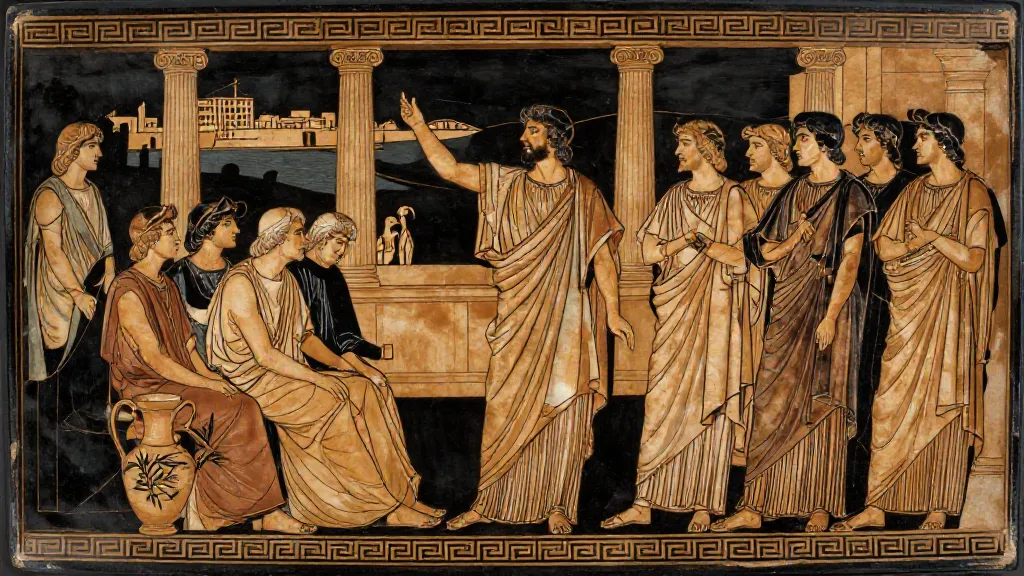
After overthrowing the Magi usurpers, seven Persian conspirators debate what form of government Persia should adopt. Otanes argues for democracy, Megabyzus for oligarchy, Darius for monarchy. The debate is a genuine intellectual exercise — and also a rigged game, since Darius has already decided to become king.
Herodotus frames the Constitutional Debate as a genuine intellectual moment — Persian nobles reasoning about political structure with sophistication that Greek audiences found surprising. The surprise is the point. Herodotus is telling his Greek audience that the barbarians think about governance with rigor, which makes their choice of monarchy more interesting than if they had simply fallen into it by tradition.
Otanes' argument for democracy runs on transparency: in a monarchy, the ruler can do what he wants without accountability; power corrupts even the best men; only popular government provides the checks that prevent tyranny. Megabyzus counters that the masses are ignorant and impulsive — worse than a tyrant because they are foolish without knowing it. Oligarchy concentrates power in the hands of the competent. Darius demolishes both alternatives: democracy devolves into factional chaos until a strongman restores order; oligarchy devolves into rivalry until the factions destroy each other and, again, a strongman emerges. All roads lead to monarchy — better to start there intentionally than arrive there through catastrophe.
Darius's argument is structurally identical to Han Fei's case for centralized rule, though neither thinker knew of the other. Both argue from failure rather than virtue: monarchy is best not because kings are wise but because the alternatives are unstable. Both treat oligarchy as the most dangerous system — a small group with enough power to obstruct but not enough cohesion to govern. Both see democracy (or popular rule) as a transitional phase that produces its own tyrant. The convergence is remarkable because it emerges from entirely independent political traditions facing similar structural problems.
The debate's resolution is telling: four of the seven side with Darius — but Otanes is allowed to opt out entirely, receiving personal freedom from royal authority in perpetuity. This detail suggests that even the victorious monarchists recognized the force of Otanes' argument. Monarchy wins the debate but cannot refute the democratic critique; it can only offer an individual exception as consolation.
Cross-Civilizational Connection
Parallel: Han Fei's chapters on the Way of the Ruler and Having Standards make Darius's argument with more systematic rigor: the state must function regardless of who holds power, which requires centralized authority operating through impersonal law. Both Darius and Han Fei argue that monarchy's virtue is not the monarch's wisdom but the system's stability — a single decision-point eliminates the coordination failures that plague collective rule.
Difference: Darius claims personal excellence — 'the best man should rule, and I am the best man.' Han Fei would find this claim structurally irrelevant and dangerously naive. Han Fei's entire system is designed so that the ruler's personal quality does not matter: institutional mechanisms (the 'Two Handles' of reward and punishment) do the governing regardless of who holds them. Darius personalizes what Han Fei systematizes.
Limit: The Constitutional Debate is a one-time founding moment; Han Fei's political theory addresses ongoing governance. Darius is arguing for why he should be king; Han Fei is arguing for how any king should govern. The Greek text treats constitutional choice as a discrete decision; the Chinese text treats it as an engineering problem requiring continuous institutional maintenance. The analogy captures the shared skepticism of alternatives but misses the difference between choosing a system and operating one.
The Constitutional Debate's lasting significance is not that Darius won — in a room full of Persian nobles, monarchy was always going to win — but that Herodotus staged the debate at all. By giving each position its strongest formulation, he forced his Greek audience to confront the possibility that their own democratic assumptions were arguments, not axioms. Darius's case is not stupid or barbaric; it is logically coherent and empirically supported. The uncomfortable implication is that the choice between systems is not between good and evil but between different kinds of failure — and reasonable people, reasoning well, can reach opposite conclusions.
See Also
- hanfeizi/05-zhu-dao — Han Fei's 'Way of the Ruler' makes Darius's case for centralized authority with far more institutional rigor — monarchy justified not by the ruler's virtue but by the system's need for a single decision-point.
- hanfeizi/07-er-bing — The 'Two Handles' provides the institutional mechanism that Darius's argument lacks — how to make monarchy function regardless of the monarch's personal quality.
- hanfeizi/06-you-du — Han Fei's 'Having Standards' addresses the same problem Otanes raises — how to prevent the ruler's arbitrary will from destroying the state — but solves it through institutional design rather than constitutional change.
Edition & Source
- Author
- Ἡρόδοτος Herodotus
- Greek Text
- Perseus Digital Library
- Translation
- G.C. Macaulay (1890)