Herodotus · Book VII, Sections 101–105
Demaratus on Freedom
Δημάρατος περὶ Ἐλευθερίας
801 words · 248 unique lemmas
Herodotus > How a Coalition Holds > Demaratus on Freedom
The Demaratus-Xerxes exchange is the sharpest ancient formulation of a question that still has no settled answer: do free men under law fight harder than subjects under compulsion? Demaratus says yes. Shang Yang says no. The evidence is inconclusive, which is why both traditions keep returning to it.
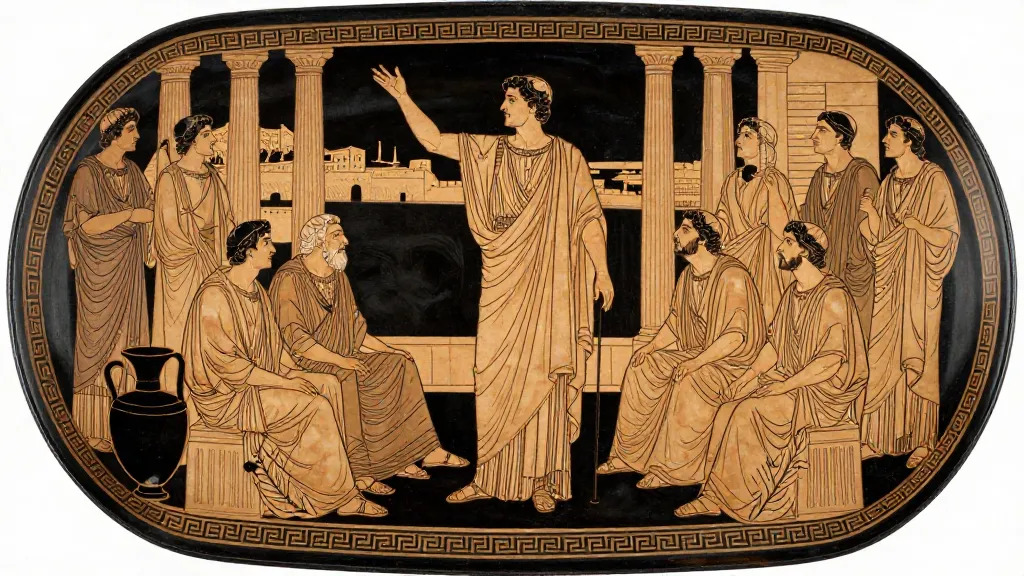
Xerxes, reviewing his vast army before the invasion of Greece, asks the exiled Spartan king Demaratus whether the Greeks will dare to resist. Demaratus replies that the Spartans will fight regardless of numbers, because they obey a master more terrible than any king — the law. Xerxes laughs.
The exchange operates as a controlled experiment in political theory, staged by Herodotus with characteristic subtlety. Xerxes' question is not idle curiosity — it is a genuine strategic assessment. He commands the largest army the ancient world had ever assembled. By any rational calculation, Greek resistance is futile. His question to Demaratus is really a question about whether rational calculation governs military behavior.
Demaratus's answer rejects the premise. The Spartans will fight not because they calculate they can win but because their law commands it. They are free in the sense that no man is their master — but they are slaves to their nomos (law/custom), which is a harsher master than any Persian king. This is a paradox that Herodotus wants his audience to sit with: freedom, in the Spartan formulation, is not the absence of compulsion but the internalization of compulsion so complete that external force becomes irrelevant. The Spartan fights to the death at Thermopylae not because he chooses to but because his entire formation — social, legal, psychological — makes retreat unthinkable.
Xerxes' skepticism is strategically rational. He has seen armies break. He knows that soldiers under the lash can be made to advance. His imperial model works: conscript vast numbers, use fear and reward, overwhelm through scale. What he cannot process is Demaratus's claim that a small force bound by internal discipline will outperform a large force bound by external discipline. The claim seems mystical to Xerxes because the mechanism is cultural, not organizational, and cultures are not visible to outsiders.
The deeper question Herodotus raises is whether Demaratus is right or merely persuasive. Thermopylae vindicates him tactically — the three hundred fight to the last man. But Athens, not Sparta, wins the war, and Athens' military advantage is naval and financial, not cultural-disciplinary. The Spartan model produces magnificent last stands; the Athenian model produces strategic victories. Herodotus leaves the tension unresolved because it is genuinely unresolvable.
Cross-Civilizational Connection
Parallel: Shang Yang's reforms in Qin represent the systematic rejection of Demaratus's thesis. The Book of Lord Shang argues that reliable soldiers are produced not by internalized law or cultural identity but by a precise system of rewards and punishments — ranks for heads taken, punishments for retreat. Sun Tzu's opening chapter on 'Moral Law' (道, dao) acknowledges that alignment between ruler and people matters, but frames it as one calculable factor among five, not as the mystical force Demaratus describes.
Difference: Demaratus claims that free men fight harder because freedom produces a quality of commitment that compulsion cannot replicate. Shang Yang and the Legalist tradition claim the opposite: that systematized incentives produce more reliable soldiers precisely because they do not depend on cultural variables like 'freedom' or 'honor.' The Greek argument is about identity; the Chinese argument is about engineering. Sparta asks 'who are you?'; Qin asks 'what do you get?'
Limit: Sparta's military culture produced extraordinary individual and small-unit performance but could not scale — Sparta never fielded more than a few thousand Spartiates. Qin's system produced massive armies of adequate soldiers who conquered everything. The analogy breaks on scale: Demaratus's thesis may be correct for elite units in defensive wars and wrong for mass armies in wars of conquest. Freedom may produce better soldiers; it does not necessarily produce more of them.
The Demaratus exchange endures because it poses a question that military institutions have never stopped asking: is intrinsic motivation superior to extrinsic incentive? Every army in history has tried to produce both — to build esprit de corps and to enforce discipline through punishment. Demaratus and Shang Yang represent the two poles of a debate that cannot be resolved because both are right in their own domain. Free men under law fight harder in defense of what they value; disciplined subjects under systematic incentives deploy more reliably in wars of expansion. The error is to think the question has one answer. It has two, and the strategic situation determines which one applies.
See Also
- sunzi-bingfa/01-laying-plans — Sun Tzu's first factor — Moral Law, the alignment of ruler and people — is the Chinese strategic framework closest to Demaratus's claim that political legitimacy produces military superiority.
- sunzi-bingfa/10-terrain — Sun Tzu's analysis of soldiers in 'desperate ground' who fight hardest when retreat is impossible parallels the Spartan position — but Sun Tzu attributes this to situation, not culture.
- zhanguoce/03-qin-1 — Qin's military reforms under Shang Yang represent the systematic alternative to Spartan cultural discipline — incentive-based rather than identity-based soldier motivation.
Edition & Source
- Author
- Ἡρόδοτος Herodotus
- Greek Text
- Perseus Digital Library
- Translation
- G.C. Macaulay (1890)