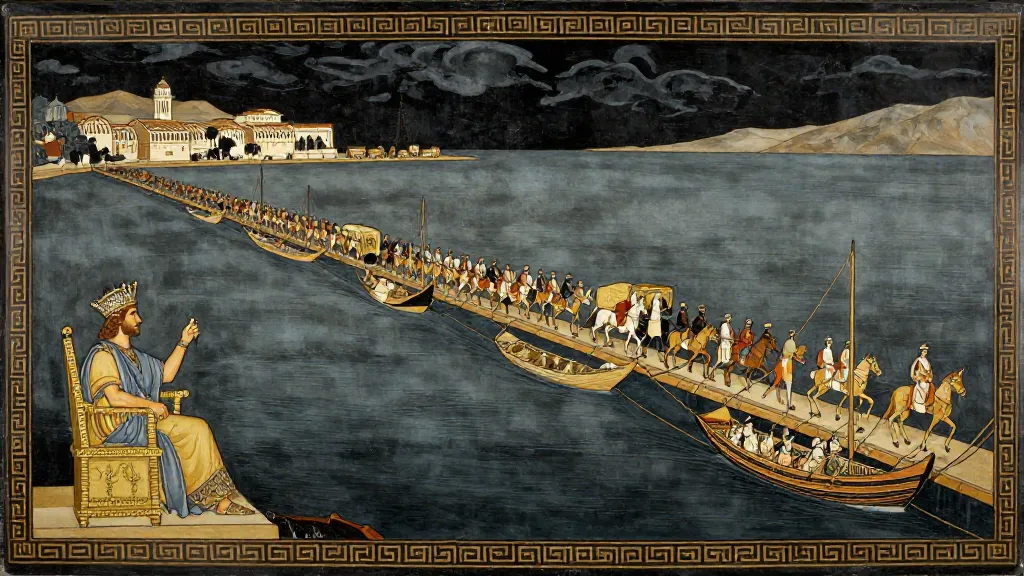
Xerxes' Hubris: The Bridge and the Crossing — Attic red-figure pottery painting

Herodotus · Book VII, Chapters 33–56

Xerxes' Hubris: The Bridge and the Crossing

Ξέρξου ὕβρις

2,794 words · 652 unique lemmas

View:

Hover over any Greek word for its dictionary form and definition

μετὰ δὲ ταῦτα παρεσκευάζετο ὡς ἐλῶν ἐς Ἄβυδον οἳ δὲ ἐν τούτῳ τὸν Ἑλλήσποντον ἐζεύγνυσαν ἐκ τῆς Ἀσίης ἐς τὴν Εὐρώπην ἔστι δὲ τῆς Χερσονήσου τῆς ἐν Ἑλλησπόντῳ Σηστοῦ τε πόλιος μεταξὺ καὶ Μαδύτου ἀκτὴ παχέα ἐς θάλασσαν κατήκουσα Ἀβύδῳ καταντίον ἔνθα μετὰ ταῦτα χρόνῳ ὕστερον οὐ πολλῷ ἐπὶ Ξανθίππου τοῦ Ἀρίφρονος στρατηγοῦ Ἀθηναῖοι Ἀρταΰκτην ἄνδρα Πέρσην λαβόντες Σηστοῦ ὕπαρχον ζῶντα πρὸς σανίδα διεπασσάλευσαν ὃς καὶ ἐς τοῦ Πρωτεσίλεω τὸ ἱρὸν ἐς Ἐλαιοῦντα ἀγινεόμενος γυναῖκας ἀθέμιστα ἔρδεσκε

ἐς ταύτην ὦν τὴν ἀκτὴν ἐξ Ἀβύδου ὁρμώμενοι ἐγεφύρουν τοῖσι προσέκειτο τὴν μὲν λευκολίνου Φοίνικες τὴν δ᾽ ἑτέρην τὴν βυβλίνην Αἰγύπτιοι ἔστι δὲ ἑπτὰ στάδιοι ἐξ Ἀβύδου ἐς τὴν ἀπαντίον καὶ δὴ ἐζευγμένου τοῦ πόρου ἐπιγενόμενος χειμὼν μέγας συνέκοψέ τε ἐκεῖνα πάντα καὶ διέλυσε

ὡς δ᾽ ἐπύθετο Ξέρξης δεινὰ ποιεύμενος τὸν Ἑλλήσποντον ἐκέλευσε τριηκοσίας ἐπικέσθαι μάστιγι πληγὰς καὶ κατεῖναι ἐς τὸ πέλαγος πεδέων ζεῦγος ἤδη δὲ ἤκουσα ὡς καὶ στιγέας ἅμα τούτοισι ἀπέπεμψε στίξοντας τὸν Ἑλλήσποντον [ ] ἐνετέλλετο δὲ ὦν ῥαπίζοντας λέγειν βάρβαρά τε καὶ ἀτάσθαλα πικρὸν ὕδωρ δεσπότης τοι δίκην ἐπιτιθεῖ τήνδε ὅτι μιν ἠδίκησας οὐδὲν πρὸς ἐκείνου ἄδικον παθόν καὶ βασιλεὺς μὲν Ξέρξης διαβήσεταί σε ἤν τε σύ γε βούλῃ ἤν τε μή σοὶ δὲ κατὰ δίκην ἄρα οὐδεὶς ἀνθρώπων θύει ὡς ἐόντι καὶ θολερῷ καὶ ἁλμυρῷ ποταμῷ [ ] τήν τε δὴ θάλασσαν ἐνετέλλετο τούτοισι ζημιοῦν καὶ τῶν ἐπεστεώτων τῇ ζεύξι τοῦ Ἑλλησπόντου ἀποταμεῖν τὰς κεφαλάς

καὶ οἳ μὲν ταῦτα ἐποίεον τοῖσι προσέκειτο αὕτη ἄχαρις τιμή τὰς δὲ ἄλλοι ἀρχιτέκτονες ἐζεύγνυσαν ἐζεύγνυσαν δὲ ὧδε πεντηκοντέρους καὶ τριήρεας συνθέντες ὑπὸ μὲν τὴν πρὸς τοῦ Εὐξείνου πόντου ἑξήκοντά τε καὶ τριηκοσίας ὑπὸ δὲ τὴν ἑτέρην τεσσερεσκαίδεκα καὶ τριηκοσίας τοῦ μὲν Πόντου ἐπικαρσίας τοῦ δὲ Ἑλλησπόντου κατὰ ῥόον ἵνα ἀνακωχεύῃ τὸν τόνον τῶν ὅπλων [ ] συνθέντες δὲ ἀγκύρας κατῆκαν περιμήκεας τὰς μὲν πρὸς τοῦ Πόντου τῆς ἑτέρης τῶν ἀνέμων εἵνεκεν τῶν ἔσωθεν ἐκπνεόντων τῆς δὲ ἑτέρης πρὸς ἑσπέρης τε καὶ τοῦ Αἰγαίου ζεφύρου τε καὶ νότου εἵνεκα διέκπλοον δὲ ὑπόφαυσιν κατέλιπον τῶν πεντηκοντέρων καὶ τριηρέων ἵνα καὶ ἐς τὸν Πόντον ἔχῃ βουλόμενος πλέειν πλοίοισι λεπτοῖσι καὶ ἐκ τοῦ Πόντου ἔξω [ ] ταῦτα δὲ ποιήσαντες κατέτεινον ἐκ γῆς στρεβλοῦντες ὄνοισι ξυλίνοισι τὰ ὅπλα οὐκέτι χωρὶς ἑκάτερα τάξαντες ἀλλὰ δύο μὲν λευκολίνου δασάμενοι ἐς ἑκατέρην τέσσερα δὲ τῶν βυβλίνων παχύτης μὲν ἦν αὐτὴ καὶ καλλονή κατὰ λόγον δὲ ἐμβριθέστερα ἦν τὰ λίνεα τοῦ τάλαντον πῆχυς εἷλκε [ ] ἐπειδὴ δὲ ἐγεφυρώθη πόρος κορμοὺς ξύλων καταπρίσαντες καὶ ποιήσαντες ἴσους τῆς σχεδίης τῷ εὔρεϊ κόσμῳ ἐτίθεσαν κατύπερθε τῶν ὅπλων τοῦ τόνου θέντες δὲ ἐπεξῆς ἐνθαῦτα αὖτις ἐπεζεύγνυον [ ] ποιήσαντες δὲ ταῦτα ὕλην ἐπεφόρησαν κόσμῳ δὲ θέντες καὶ τὴν ὕλην γῆν ἐπεφόρησαν κατανάξαντες δὲ καὶ τὴν γῆν φραγμὸν παρείρυσαν ἔνθεν καὶ ἔνθεν ἵνα μὴ φοβέηται τὰ ὑποζύγια τὴν θάλασσαν ὑπερορῶντα καὶ οἱ ἵπποι

ὡς δὲ τά τε τῶν γεφυρέων κατεσκεύαστο καὶ τὰ περὶ τὸν Ἄθων οἵ τε χυτοὶ περὶ τὰ στόματα τῆς διώρυχος οἳ τῆς ῥηχίης εἵνεκεν ἐποιήθησαν ἵνα μὴ πίμπληται τὰ στόματα τοῦ ὀρύγματος καὶ αὐτὴ διῶρυξ παντελέως πεποιημένη ἀγγέλλετο ἐνθαῦτα χειμερίσας ἅμα τῶ ἔαρι παρεσκευασμένος στρατὸς ἐκ τῶν Σαρδίων ὁρμᾶτο ἐλῶν ἐς Ἄβυδον [ ] ὁρμημένῳ δέ οἱ ἥλιος ἐκλιπὼν τὴν ἐκ τοῦ οὐρανοῦ ἕδρην ἀφανὴς ἦν οὔτ᾽ ἐπινεφέλων ἐόντων αἰθρίης τε τὰ μάλιστα ἀντὶ ἡμέρης τε νὺξ ἐγένετο ἰδόντι δὲ καὶ μαθόντι τοῦτο τῷ Ξέρξῃ ἐπιμελὲς ἐγένετο καὶ εἴρετο τοὺς Μάγους τὸ θέλει προφαίνειν τὸ φάσμα [ ] οἱ δὲ ἔφραζον ὡς Ἕλλησι προδεικνύει θεὸς ἔκλειψιν τῶν πολίων λέγοντες ἥλιον εἶναι Ἑλλήνων προδέκτορα σελήνην δὲ σφέων ταῦτα πυθόμενος Ξέρξης περιχαρὴς ἐὼν ἐποιέετο τὴν ἔλασιν

ὡς δ᾽ ἐξήλαυνε τὴν στρατιήν Πύθιος Λυδὸς καταρρωδήσας τὸ ἐκ τοῦ οὐρανοῦ φάσμα ἐπαερθείς τε τοῖσι δωρήμασι ἐλθὼν παρὰ Ξέρξην ἔλεγε τάδε δέσποτα χρηίσας ἄν τι σεῦ βουλοίμην τυχεῖν τὸ σοὶ μὲν ἐλαφρὸν τυγχάνει ἐὸν ὑπουργῆσαι ἐμοὶ δὲ μέγα γενόμενον [ ] Ξέρξης δὲ πᾶν μᾶλλον δοκέων μιν χρηίσειν τὸ ἐδεήθη ἔφη τε ὑπουργήσειν καὶ δὴ ἀγορεύειν ἐκέλευε ὅτευ δέοιτο δὲ ἐπείτε ταῦτα ἤκουσε ἔλεγε θαρσήσας τάδε δέσποτα τυγχάνουσί μοι παῖδες ἐόντες πέντε καί σφεας καταλαμβάνει πάντας ἅμα σοὶ στρατεύεσθαι ἐπὶ τὴν Ἑλλάδα [ ] σὺ δέ βασιλεῦ ἐμὲ ἐς τόδε ἡλικίης ἥκοντα οἰκτείρας τῶν μοι παίδων ἕνα παράλυσον τῆς στρατηίης τὸν πρεσβύτατον ἵνα αὐτοῦ τε ἐμεῦ καὶ τῶν χρημάτων μελεδωνός τοὺς δὲ τέσσερας ἄγευ ἅμα σεωυτῷ καὶ πρήξας τὰ νοέεις νοστήσειας ὀπίσω

κάρτα τε ἐθυμώθη Ξέρξης καὶ ἀμείβετο τοῖσιδε κακὲ ἄνθρωπε σὺ ἐτόλμησας ἐμεῦ στρατευομένου αὐτοῦ ἐπὶ τὴν Ἑλλάδα καὶ ἄγοντος παῖδας ἐμοὺς καὶ ἀδελφεοὺς καὶ οἰκηίους καὶ φίλους μνήσασθαι περὶ σέο παιδός ἐὼν ἐμὸς δοῦλος τὸν χρῆν πανοικίῃ αὐτῇ τῇ γυναικὶ συνέπεσθαι εὖ νυν τόδ᾽ ἐξεπίστασο ὡς ἐν τοῖσι ὠσὶ τῶν ἀνθρώπων οἰκέει θυμός ὃς χρηστὰ μὲν ἀκούσας τέρψιος ἐμπιπλεῖ τὸ σῶμα ὑπεναντία δὲ τούτοισι ἀκούσας ἀνοιδέει [ ] ὅτε μέν νυν χρηστὰ ποιήσας ἕτερα τοιαῦτα ἐπηγγέλλεο εὐεργεσίῃσι βασιλέα οὐ καυχήσεαι ὑπερβαλέσθαι ἐπείτε δὲ ἐς τὸ ἀναιδέστερον ἐτράπευ τὴν μὲν ἀξίην οὐ λάμψεαι ἐλάσσω δὲ τῆς ἀξίης σὲ μὲν γὰρ καὶ τοὺς τέσσερας τῶν παίδων ῥύεται τὰ ξείνια τοῦ δὲ ἑνός τοῦ περιέχεαι μάλιστα τῇ ψυχῇ ζημιώσεαι [ ] ὡς δὲ ταῦτα ὑπεκρίνατο αὐτίκα ἐκέλευε τοῖσι προσετέτακτο ταῦτα πρήσσειν τῶν Πυθίου παίδων ἐξευρόντας τὸν πρεσβύτατον μέσον διαταμεῖν διαταμόντας δὲ τὰ ἡμίτομα διαθεῖναι τὸ μὲν ἐπὶ δεξιὰ τῆς ὁδοῦ τὸ δ᾽ ἐπ᾽ ἀριστερά καὶ ταύτῃ διεξιέναι τὸν στρατόν

ποιησάντων δὲ τούτων τοῦτο μετὰ ταῦτα διεξήιε στρατός ἡγέοντο δὲ πρῶτοι μὲν οἱ σκευοφόροι τε καὶ τὰ ὑποζύγια μετὰ δὲ τούτους σύμμικτος στρατὸς παντοίων ἐθνέων ἀναμίξ οὐ διακεκριμένοι τῇ δὲ ὑπερημίσεες ἦσαν ἐνθαῦτα διελέλειπτο καὶ οὐ συνέμισγον οὗτοι βασιλέι [ ] προηγεῦντο μὲν δὴ ἱππόται χίλιοι ἐκ Περσέων πάντων ἀπολελεγμένοι μετὰ δὲ αἰχμοφόροι χίλιοι καὶ οὗτοι ἐκ πάντων ἀπολελεγμένοι τὰς λόγχας κάτω ἐς τὴν γῆν τρέψαντες μετὰ δὲ ἱροὶ Νησαῖοι καλεόμενοι ἵπποι δέκα κεκοσμημένοι ὡς κάλλιστα [ ] Νησαῖοι δὲ καλέονται ἵπποι ἐπὶ τοῦδε ἔστι πεδίον μέγα τῆς Μηδικῆς τῷ οὔνομα ἐστὶ Νήσαιον τοὺς ὦν δὴ ἵππους τοὺς μεγάλους φέρει τὸ πεδίον τοῦτο [ ] ὄπισθε δὲ τούτων τῶν δέκα ἵππων ἅρμα Διὸς ἱρὸν ἐπετέτακτο τὸ ἵπποι μὲν εἷλκον λευκοὶ ὀκτώ ὄπισθε δὲ αὖ τῶν ἵππων εἵπετο πεζῇ ἡνίοχος ἐχόμενος τῶν χαλινῶν οὐδεὶς γὰρ δὴ ἐπὶ τοῦτον τὸν θρόνον ἀνθρώπων ἐπιβαίνει τούτου δὲ ὄπισθε αὐτὸς Ξέρξης ἐπ᾽ ἅρματος ἵππων Νησαίων παραβεβήκεε δέ οἱ ἡνίοχος τῷ οὔνομα ἦν Πατιράμφης Ὀτάνεω ἀνδρὸς Πέρσεω παῖς

ἐξήλασε μὲν οὕτω ἐκ Σαρδίων Ξέρξης μετεκβαίνεσκε δέ ὅκως μιν λόγος αἱρέοι ἐκ τοῦ ἅρματος ἐς ἁρμάμαξαν αὐτοῦ δὲ ὄπισθε αἰχμοφόροι Περσέων οἱ ἄριστοί τε καὶ γενναιότατοι χίλιοι κατὰ νόμον τὰς λόγχας ἔχοντες μετὰ δὲ ἵππος ἄλλη χιλίη ἐκ Περσέων ἀπολελεγμένη μετὰ δὲ τὴν ἵππον ἐκ τῶν λοιπῶν Περσέων ἀπολελεγμένοι μύριοι οὗτος πεζὸς ἦν [ ] καὶ τούτων χίλιοι μὲν ἐπὶ τοῖσι δόρασι ἀντὶ τῶν σαυρωτήρων ῥοιὰς εἶχον χρυσέας καὶ πέριξ συνεκλήιον τοὺς ἄλλους οἱ δὲ εἰνακισχίλιοι ἐντὸς τούτων ἐόντες ἀργυρέας ῥοιὰς εἶχον εἶχον δὲ χρυσέας ῥοιὰς καὶ οἱ ἐς τὴν γῆν τρέποντες τὰς λόγχας καὶ μῆλα οἱ ἄγχιστα ἑπόμενοι Ξέρξῃ τοῖσι δὲ μυρίοισι ἐπετέτακτο ἵππος Περσέων μυρίη μετὰ δὲ τὴν ἵππον διέλειπε καὶ δύο σταδίους καὶ ἔπειτα λοιπὸς ὅμιλος ἤιε ἀναμίξ

ἐποιέετο δὲ τὴν ὁδὸν ἐκ τῆς Λυδίης στρατὸς ἐπί τε ποταμὸν Κάικον καὶ γῆν τὴν Μυσίην ἀπὸ δὲ Καΐκου ὁρμώμενος Κάνης ὄρος ἔχων ἐν ἀριστερῇ διὰ τοῦ Ἀταρνέος ἐς Καρήνην πόλιν ἀπὸ δὲ ταύτης διὰ Θήβης πεδίου ἐπορεύετο Ἀδραμύττειόν τε πόλιν καὶ Ἄντανδρον τὴν Πελασγίδα παραμειβόμενος [ ] τὴν Ἴδην δὲ λαβὼν ἐς ἀριστερὴν χεῖρα ἤιε ἐς τὴν Ἰλιάδα γῆν καὶ πρῶτα μέν οἱ ὑπὸ τῇ Ἴδῃ νύκτα ἀναμείναντι βρονταί τε καὶ πρηστῆρες ἐπεσπίπτουσι καί τινα αὐτοῦ ταύτῃ συχνὸν ὅμιλον διέφθειραν

ἀπικομένου δὲ τοῦ στρατοῦ ἐπὶ ποταμὸν Σκάμανδρον ὃς πρῶτος ποταμῶν ἐπείτε ἐκ Σαρδίων ὁρμηθέντες ἐπεχείρησαν τῇ ὁδῷ ἐπέλιπε τὸ ῥέεθρον οὐδ᾽ ἀπέχρησε τῇ στρατιῇ τε καὶ τοῖσι κτήνεσι πινόμενος ἐπὶ τοῦτον δὴ τὸν ποταμὸν ὡς ἀπίκετο Ξέρξης ἐς τὸ Πριάμου Πέργαμον ἀνέβη ἵμερον ἔχων θεήσασθαι [ ] θεησάμενος δὲ καὶ πυθόμενος ἐκείνων ἕκαστα τῇ Ἀθηναίῃ τῇ Ἰλιάδι ἔθυσε βοῦς χιλίας χοὰς δὲ οἱ Μάγοι τοῖσι ἥρωσι ἐχέαντο ταῦτα δὲ ποιησαμένοισι νυκτὸς φόβος ἐς τὸ στρατόπεδον ἐνέπεσε ἅμα ἡμέρῃ δὲ ἐπορεύετο ἐνθεῦτεν ἐν ἀριστερῇ μὲν ἀπέργων Ῥοίτιον πόλιν καὶ Ὀφρύνειον καὶ Δάρδανον περ δὴ Ἀβύδῳ ὅμουρος ἐστί ἐν δεξιῇ δὲ Γέργιθας Τευκρούς

ἐπεὶ δ᾽ ἐγένετο ἐν Ἀβύδῳ μέσῃ ἠθέλησε Ξέρξης ἰδέσθαι πάντα τὸν στρατόν καὶ προεπεποίητο γὰρ ἐπὶ κολωνοῦ ἐπίτηδες αὐτῷ ταύτῃ προεξέδρη λίθου λευκοῦ ἐποίησαν δὲ Ἀβυδηνοὶ ἐντειλαμένου πρότερον βασιλέος ἐνθαῦτα ὡς ἵζετο κατορῶν ἐπὶ τῆς ἠιόνος ἐθηεῖτο καὶ τὸν πεζὸν καὶ τὰς νέας θηεύμενος δὲ ἱμέρθη τῶν νεῶν ἅμιλλαν γινομένην ἰδέσθαι ἐπεὶ δὲ ἐγένετό τε καὶ ἐνίκων Φοίνικες Σιδώνιοι ἥσθη τε τῇ ἁμίλλῃ καὶ τῇ στρατιῇ

ὡς δὲ ὥρα πάντα μὲν τὸν Ἑλλήσποντον ὑπὸ τῶν νεῶν ἀποκεκρυμμένον πάσας δὲ τὰς ἀκτὰς καὶ τὰ Ἀβυδηνῶν πεδία ἐπίπλεα ἀνθρώπων ἐνθαῦτα Ξέρξης ἑωυτὸν ἐμακάρισε μετὰ δὲ τοῦτο ἐδάκρυσε

μαθὼν δέ μιν Ἀρτάβανος πάτρως ὃς τὸ πρῶτον γνώμην ἀπεδέξατο ἐλευθέρως οὐ συμβουλεύων Ξέρξῃ στρατεύεσθαι ἐπὶ τὴν Ἑλλάδα οὗτος ὡνὴρ φρασθεὶς Ξέρξην δακρύσαντα εἴρετο τάδε βασιλεῦ ὡς πολλὸν ἀλλήλων κεχωρισμένα ἐργάσαο νῦν τε καὶ ὀλίγῳ πρότερον μακαρίσας γὰρ σεωυτὸν δακρύεις [ ] δὲ εἶπε ἐσῆλθε γάρ με λογισάμενον κατοικτεῖραι ὡς βραχὺς εἴη πᾶς ἀνθρώπινος βίος εἰ τούτων γε ἐόντων τοσούτων οὐδεὶς ἐς ἑκατοστὸν ἔτος περιέσται δὲ ἀμείβετο λέγων ἕτερα τούτου παρὰ τὴν ζόην πεπόνθαμεν οἰκτρότερα [ ] ἐν γὰρ οὕτω βραχέι βίῳ οὐδεὶς οὕτω ἄνθρωπος ἐὼν εὐδαίμων πέφυκε οὔτε τούτων οὔτε τῶν ἄλλων τῷ οὐ παραστήσεται πολλάκις καὶ οὐκὶ ἅπαξ τεθνάναι βούλεσθαι μᾶλλον ζώειν αἵ τε γὰρ συμφοραὶ προσπίπτουσαι καὶ αἱ νοῦσοι συνταράσσουσαι καὶ βραχὺν ἐόντα μακρὸν δοκέειν εἶναι ποιεῦσι τὸν βίον [ ] οὕτω μὲν θάνατος μοχθηρῆς ἐούσης τῆς ζόης καταφυγὴ αἱρετωτάτη τῷ ἀνθρώπῳ γέγονε δὲ θεὸς γλυκὺν γεύσας τὸν αἰῶνα φθονερὸς ἐν αὐτῷ εὑρίσκεται ἐών

Ξέρξης δὲ ἀμείβετο λέγων Ἀρτάβανε βιοτῆς μέν νυν ἀνθρωπηίης πέρι ἐούσης τοιαύτης οἵην περ σὺ διαιρέαι εἶναι παυσώμεθα μηδὲ κακῶν μεμνώμεθα χρηστὰ ἔχοντες πρήγματα ἐν χερσί φράσον δέ μοι τόδε εἴ τοι ὄψις τοῦ ἐνυπνίου μὴ ἐναργὴς οὕτω ἐφάνη εἶχες ἂν τὴν ἀρχαίην γνώμην οὐκ ἐῶν με στρατεύεσθαι ἐπὶ τὴν Ἑλλάδα μετέστης ἄν φέρε τοῦτό μοι ἀτρεκέως εἰπέ [ ] δὲ ἀμείβετο λέγων βασιλεῦ ὄψις μὲν ἐπιφανεῖσα τοῦ ὀνείρου ὡς βουλόμεθα ἀμφότεροι τελευτήσειε ἐγὼ δ᾽ ἔτι καὶ ἐς τόδε δείματος εἰμὶ ὑπόπλεος οὐδ᾽ ἐντὸς ἐμεωυτοῦ ἄλλα τε πολλὰ ἐπιλεγόμενος καὶ δὴ καὶ ὁρῶν τοι δύο τὰ μέγιστα πάντων ἐόντα πολεμιώτατα

Ξέρξης δὲ πρὸς ταῦτα ἀμείβετο τοῖσιδε δαιμόνιε ἀνδρῶν κοῖα ταῦτα λέγεις εἶναι δύο μοι πολεμιώτατα κότερά τοι πεζὸς μεμπτὸς κατὰ πλῆθος ἐστὶ καὶ τὸ Ἑλληνικὸν στράτευμα φαίνεται πολλαπλήσιον ἔσεσθαι τοῦ ἡμετέρου τὸ ναυτικὸν τὸ ἡμέτερον λείψεσθαι τοῦ ἐκείνων καὶ συναμφότερα ταῦτα εἰ γάρ τοι ταύτῃ φαίνεται ἐνδεέστερα εἶναι τὰ ἡμέτερα πρήγματα στρατοῦ ἂν ἄλλου τις τὴν ταχίστην ἄγερσιν ποιέοιτο

δ᾽ ἀμείβετο λέγων βασιλεῦ οὔτε στρατὸν τοῦτον ὅστις γε σύνεσιν ἔχει μέμφοιτ᾽ ἂν οὔτε τῶν νεῶν τὸ πλῆθος ἢν δὲ πλεῦνας συλλέξῃς τὰ δύο τοι τὰ λέγω πολλῷ ἔτι πολεμιώτερα γίνεται τὰ δὲ δύο ταῦτα ἐστὶ γῆ τε καὶ θάλασσα [ ] οὔτε γὰρ τῆς θαλάσσης ἐστὶ λιμὴν τοσοῦτος οὐδαμόθι ὡς ἐγὼ εἰκάζω ὅστις ἐγειρομένου χειμῶνος δεξάμενός σευ τοῦτο τὸ ναυτικὸν φερέγγυος ἔσται διασῶσαι τὰς νέας καίτοι οὐκὶ ἕνα αὐτὸν δεῖ εἶναι τὸν λιμένα ἀλλὰ παρὰ πᾶσαν τὴν ἤπειρον παρ᾽ ἣν δὴ κομίζεαι [ ] οὔκων δὴ ἐόντων τοι λιμένων ὑποδεξίων μάθε ὅτι αἱ συμφοραὶ τῶν ἀνθρώπων ἄρχουσι καὶ οὐκὶ ὥνθρωποι τῶν συμφορέων καὶ δὴ τῶν δύο τοι τοῦ ἑτέρου εἰρημένου τὸ ἕτερον ἔρχομαι ἐρέων [ ] γῆ δὲ πολεμίη τῇδέ τοι κατίσταται εἰ θέλει τοι μηδὲν ἀντίξοον καταστῆναι τοσούτῳ τοι γίνεται πολεμιωτέρη ὅσῳ ἂν προβαίνῃς ἑκαστέρω τὸ πρόσω αἰεὶ κλεπτόμενος εὐπρηξίης δὲ οὐκ ἔστι ἀνθρώποισι οὐδεμία πληθώρη [ ] καὶ δή τοι ὡς οὐδενὸς ἐναντιευμένου λέγω τὴν χώρην πλεῦνα ἐν πλέονι χρόνῳ γινομένην λιμὸν τέξεσθαι ἀνὴρ δὲ οὕτω ἂν εἴη ἄριστος εἰ βουλευόμενος μὲν ἀρρωδέοι πᾶν ἐπιλεγόμενος πείσεσθαι χρῆμα ἐν δὲ τῷ ἔργῳ θρασὺς εἴη

ἀμείβεται Ξέρξης τοῖσιδε Ἀρτάβανε οἰκότως μὲν σύ γε τούτων ἕκαστα διαιρέαι ἀτὰρ μήτε πάντα φοβέο μήτε πᾶν ὁμοίως ἐπιλέγεο εἰ γὰρ δὴ βούλοιο ἐπὶ τῷ αἰεὶ ἐπεσφερομένῳ πρήγματι τὸ πᾶν ὁμοίως ἐπιλέγεσθαι ποιήσειας ἂν οὐδαμὰ οὐδέν κρέσσον δὲ πάντα θαρσέοντα ἥμισυ τῶν δεινῶν πάσχειν μᾶλλον πᾶν χρῆμα προδειμαίνοντα μηδαμὰ μηδὲν παθεῖν [ ] εἰ δὲ ἐρίξων πρὸς πᾶν τὸ λεγόμενον μὴ τὸ βέβαιον ἀποδέξεις σφάλλεσθαι ὀφείλεις ἐν αὐτοῖσι ὁμοίως καὶ ὑπεναντία τούτοισι λέξας τοῦτο μέν νυν ἐπ᾽ ἴσης ἔχει εἰδέναι δὲ ἄνθρωπον ἐόντα κῶς χρὴ τὸ βέβαιον δοκέω μὲν οὐδαμῶς τοῖσι τοίνυν βουλομένοισι ποιέειν ὡς τὸ ἐπίπαν φιλέει γίνεσθαι τὰ κέρδεα τοῖσι δὲ ἐπιλεγομένοισί τε πάντα καὶ ὀκνέουσι οὐ μάλα ἐθέλει [ ] ὁρᾷς τὰ Περσέων πρήγματα ἐς δυνάμιος προκεχώρηκε εἰ τοίνυν ἐκεῖνοι οἱ πρὸ ἐμεῦ γενόμενοι βασιλέες γνώμῃσι ἐχρέωντο ὁμοίῃσι καὶ σύ μὴ χρεώμενοι γνώμῃσι τοιαύτῃσι ἄλλους συμβούλους εἶχον τοιούτους οὐκ ἄν κοτε εἶδες αὐτὰ ἐς τοῦτο προελθόντα νῦν δὲ κινδύνους ἀναρριπτέοντες ἐς τοῦτο σφέα προηγάγοντο μεγάλα γὰρ πρήγματα μεγάλοισι κινδύνοισι ἐθέλει καταιρέεσθαι [ ] ἡμεῖς τοίνυν ὁμοιεύμενοι ἐκείνοισι ὥρην τε τοῦ ἔτεος καλλίστην πορευόμεθα καὶ καταστρεψάμενοι πᾶσαν τὴν Εὐρώπην νοστήσομεν ὀπίσω οὔτε λιμῷ ἐντυχόντες οὐδαμόθι οὔτε ἄλλο ἄχαρι οὐδὲν παθόντες τοῦτο μὲν γὰρ αὐτοὶ πολλὴν φορβὴν φερόμενοι πορευόμεθα τοῦτο δέ τῶν ἄν κου ἐπιβέωμεν γῆν καὶ ἔθνος τούτων τὸν σῖτον ἕξομεν ἐπ᾽ ἀροτῆρας δὲ καὶ οὐ νομάδας στρατευόμεθα ἄνδρας

λέγει Ἀρτάβανος μετὰ ταῦτα βασιλεῦ ἐπείτε ἀρρωδέειν οὐδὲν ἐᾷς πρῆγμα σὺ δέ μευ συμβουλίην ἔνδεξαι ἀναγκαίως γὰρ ἔχει περὶ πολλῶν πρηγμάτων πλεῦνα λόγον ἐκτεῖναι Κῦρος Καμβύσεω Ἰωνίην πᾶσαν πλὴν Ἀθηναίων κατεστρέψατο δασμοφόρον εἶναι Πέρσῃσι [ ] τούτους ὦν τοὺς ἄνδρας συμβουλεύω τοι μηδεμιῇ μηχανῇ ἄγειν ἐπὶ τοὺς πατέρας καὶ γὰρ ἄνευ τούτων οἷοί τε εἰμὲν τῶν ἐχθρῶν κατυπέρτεροι γίνεσθαι γὰρ σφέας ἢν ἕπωνται δεῖ ἀδικωτάτους γίνεσθαι καταδουλουμένους τὴν μητρόπολιν δικαιοτάτους συνελευθεροῦντας [ ] ἀδικώτατοι μέν νυν γινόμενοι οὐδὲν κέρδος μέγα ἡμῖν προσβάλλουσι δικαιότατοι δὲ γινόμενοι οἷοί τε δηλήσασθαι μεγάλως τὴν σὴν στρατιὴν γίνονται ἐς θυμὸν ὦν βάλευ καὶ τὸ παλαιὸν ἔπος ὡς εὖ εἴρηται τὸ μὴ ἅμα ἀρχῇ πᾶν τέλος καταφαίνεσθαι

ἀμείβεται πρὸς ταῦτα Ξέρξης Ἀρτάβανε τῶν ἀπεφήναο γνωμέων σφάλλεαι κατὰ ταύτην δὴ μάλιστα ὃς Ἴωνας φοβέαι μὴ μεταβάλωσι τῶν ἔχομεν γνῶμα μέγιστον τῶν σύ τε μάρτυς γίνεαι καὶ οἱ συστρατευσάμενοι Δαρείῳ ἄλλοι ἐπὶ Σκύθας ὅτι ἐπὶ τούτοισι πᾶσα Περσικὴ στρατιὴ ἐγένετο διαφθεῖραι καὶ περιποιῆσαι οἳ δὲ δικαιοσύνην καὶ πιστότητα ἐνέδωκαν ἄχαρι δὲ οὐδέν [ ] πάρεξ δὲ τούτου ἐν τῇ ἡμετέρῃ καταλιπόντας τέκνα καὶ γυναῖκας καὶ χρήματα οὐδ᾽ ἐπιλέγεσθαι χρὴ νεώτερόν τι ποιήσειν οὕτω μηδὲ τοῦτο φοβέο ἀλλὰ θυμὸν ἔχων ἀγαθὸν σῶζε οἶκόν τε τὸν ἐμὸν καὶ τυραννίδα τὴν ἐμήν σοὶ γὰρ ἐγὼ μούνῳ ἐκ πάντων σκῆπτρα τὰ ἐμὰ ἐπιτράπω

ταῦτα εἴπας καὶ Ἀρτάβανον ἀποστείλας ἐς Σοῦσα δεύτερα μετεπέμψατο Ξέρξης Περσέων τοὺς δοκιμωτάτους ἐπεὶ δέ οἱ παρῆσαν ἔλεγέ σφι τάδε Πέρσαι τῶνδ᾽ ἐγὼ ὑμέων χρηίζων συνέλεξα ἄνδρας τε γενέσθαι ἀγαθοὺς καὶ μὴ καταισχύνειν τὰ πρόσθε ἐργασμένα Πέρσῃσι ἐόντα μεγάλα τε καὶ πολλοῦ ἄξια ἀλλ᾽ εἷς τε ἕκαστος καὶ οἱ σύμπαντες προθυμίην ἔχωμεν ξυνὸν γὰρ πᾶσι τοῦτο ἀγαθὸν σπεύδεται [ ] τῶνδε δὲ εἵνεκα προαγορεύω ἀντέχεσθαι τοῦ πολέμου ἐντεταμένως ὡς γὰρ ἐγὼ πυνθάνομαι ἐπ᾽ ἄνδρας στρατευόμεθα ἀγαθούς τῶν ἢν κρατήσωμεν οὐ μή τις ἡμῖν ἄλλος στρατὸς ἀντιστῇ κοτε ἀνθρώπων νῦν δὲ διαβαίνωμεν ἐπευξάμενοι τοῖσι θεοῖσι οἳ Πέρσας λελόγχασι

ταύτην μὲν τὴν ἡμέρην παρεσκευάζοντο ἐς τὴν διάβασιν τῇ δὲ ὑστεραίῃ ἀνέμενον τὸν ἥλιον ἐθέλοντες ἰδέσθαι ἀνίσχοντα θυμιήματά τε παντοῖα ἐπὶ τῶν γεφυρέων καταγίζοντες καὶ μυρσίνῃσι στορνύντες τὴν ὁδόν [ ] ὡς δ᾽ ἐπανέτελλε ἥλιος σπένδων ἐκ χρυσέης φιάλης Ξέρξης ἐς τὴν θάλασσαν εὔχετο πρὸς τὸν ἥλιον μηδεμίαν οἱ συντυχίην τοιαύτην γενέσθαι μιν παύσει καταστρέψασθαι τὴν Εὐρώπην πρότερον ἐπὶ τέρμασι τοῖσι ἐκείνης γένηται εὐξάμενος δὲ ἐσέβαλε τὴν φιάλην ἐς τὸν Ἑλλήσποντον καὶ χρύσεον κρητῆρα καὶ Περσικὸν ξίφος τὸν ἀκινάκην καλέουσι [ ] ταῦτα οὐκ ἔχω ἀτρεκέως διακρῖναι οὔτε εἰ τῷ ἡλίῳ ἀνατιθεὶς κατῆκε ἐς τὸ πέλαγος οὔτε εἰ μετεμέλησέ οἱ τὸν Ἑλλήσποντον μαστιγώσαντι καὶ ἀντὶ τούτων τὴν θάλασσαν ἐδωρέετο

ὡς δὲ ταῦτά οἱ ἐπεποίητο διέβαινον κατὰ μὲν τὴν ἑτέρην τῶν γεφυρέων τὴν πρὸς τοῦ Πόντου πεζός τε καὶ ἵππος ἅπασα κατὰ δὲ τὴν πρὸς τὸ Αἰγαῖον τὰ ὑποζύγια καὶ θεραπηίη [ ] ἡγέοντο δὲ πρῶτα μὲν οἱ μύριοι Πέρσαι ἐστεφανωμένοι πάντες μετὰ δὲ τούτους σύμμικτος στρατὸς παντοίων ἐθνέων ταύτην μὲν τὴν ἡμέρην οὗτοι τῇ δὲ ὑστεραίῃ πρῶτοι μὲν οἵ τε ἱππόται καὶ οἱ τὰς λόγχας κάτω τρέποντες ἐστεφάνωντο δὲ καὶ οὗτοι [ ] μετὰ δὲ οἵ τε ἵπποι οἱ ἱροὶ καὶ τὸ ἅρμα τὸ ἱρόν ἐπὶ δὲ αὐτός τε Ξέρξης καὶ οἱ αἰχμοφόροι καὶ οἱ ἱππόται οἱ χίλιοι ἐπὶ δὲ τούτοισι ἄλλος στρατός καὶ αἱ νέες ἅμα ἀνήγοντο ἐς τὴν ἀπεναντίον ἤδη δὲ ἤκουσα καὶ ὕστατον διαβῆναι βασιλέα πάντων

Ξέρξης δὲ ἐπεὶ διέβη ἐς τὴν Εὐρώπην ἐθηεῖτο τὸν στρατὸν ὑπὸ μαστίγων διαβαίνοντα διέβη δὲ στρατὸς αὐτοῦ ἐν ἑπτὰ ἡμέρῃσι καὶ ἐν ἑπτὰ εὐφρόνῃσι ἐλινύσας οὐδένα χρόνον [ ] ἐνθαῦτα λέγεται Ξέρξεω ἤδη διαβεβηκότος τὸν Ἑλλήσποντον ἄνδρα εἰπεῖν Ἑλλησπόντιον Ζεῦ τί δὴ ἀνδρὶ εἰδόμενος Πέρσῃ καὶ οὔνομα ἀντὶ Διὸς Ξέρξην θέμενος ἀνάστατον τὴν Ἑλλάδα θέλεις ποιῆσαι ἄγων πάντας ἀνθρώπους καὶ γὰρ ἄνευ τούτων ἐξῆν τοι ποιέειν ταῦτα

> **Citation**

> Source: Project Gutenberg (gutenberg.org)

> Edition: G.C. Macaulay translation (1890), public domain

> Original: Ancient Greek

> Source URL: https://www.gutenberg.org/ebooks/2456

> Downloaded: 2026-03-15

Xerxes' Hubris: The Bridge and the Crossing (Book VII, Sections 33–56)

33. After this he made his preparations intending to march to Abydos:

and meanwhile they were bridging over the Hellespont from Asia to

Europe. Now there is in the Chersonese of the Hellespont between the

city of Sestos and Madytos, a broad foreland 32 running down into

the sea right opposite Abydos; this is the place where no long time

afterwards the Athenians under the command of Xanthippos the son of

Ariphron, having taken Artaÿctes a Persian, who was the governor of

Sestos, nailed him alive to a board with hands and feet extended (he was

the man who was wont to take women with him to the temple of Protesilaos

at Elaius and to do things there which are not lawful).

34. To this foreland they on whom this work was laid were making their

bridges, starting from Abydos, the Phenicians constructing the one with

ropes of white flax, and the Egyptians the other, which was made with

papyrus rope. Now from Abydos to the opposite shore is a distance of

seven furlongs. But when the strait had been bridged over, a great storm

came on and dashed together all the work that had been made and broke it

up. Then when Xerxes heard it he was exceedingly enraged, and bade them

scourge the Hellespont with three hundred strokes of the lash and let

down into the sea a pair of fetters. Nay, I have heard further that he

sent branders also with them to brand the Hellespont. However this

may be, he enjoined them, as they were beating, to say Barbarian and

presumptuous words as follows: "Thou bitter water, thy master lays upon

thee this penalty, because thou didst wrong him not having suffered any

wrong from him: and Xerxes the king will pass over thee whether thou be

willing or no; but with right, as it seems, no man doeth sacrifice to

thee, seeing that thou art a treacherous 33 and briny stream." The sea

he enjoined them to chastise thus, and also he bade them cut off the

heads of those who were appointed to have charge over the bridging of

the Hellespont.

36. Thus then the men did, to whom this ungracious office belonged; and

meanwhile other chief-constructors proceeded to make the bridges;

and thus they made them:--They put together fifty-oared galleys and

triremes, three hundred and sixty to be under the bridge towards the

Euxine Sea, and three hundred and fourteen to be under the other, the

vessels lying in the direction of the stream of the Hellespont (though

crosswise in respect to the Pontus), to support the tension of the

ropes. 34 They placed them together thus, and let down very large

anchors, those on the one side 35 towards the Pontus because of the

winds which blow from within outwards, and on the other side, towards

the West and the Egean, because of the South-East 36 and South Winds.

They left also an opening for a passage through, so that any who wished

might be able to sail into the Pontus with small vessels, 37 and also

from the Pontus outwards. Having thus done, they proceeded to stretch

tight the ropes, straining them with wooden windlasses, not now

appointing the two kinds of rope to be used apart from one another, but

assigning to each bridge two ropes of white flax and four of the papyrus

ropes. The thickness and beauty of make was the same for both, but the

flaxen ropes were heavier in proportion, 38 and of this rope a cubit

weighed one talent. When the passage was bridged over, they sawed up

logs of wood, and making them equal in length to the breadth of the

bridge they laid them above the stretched ropes, and having set them

thus in order they again fastened them above. 39 When this was done,

they carried on brushwood, and having set the brushwood also in place,

they carried on to it earth; and when they had stamped down the

earth firmly, they built a barrier along on each side, so that the

baggage-animals and horses might not be frightened by looking out over

the sea.

37. When the construction of the bridges had been finished, and the

works about Athos, both the embankments about the mouths of the channel,

which were made because of the breaking of the sea upon the beach, that

the mouths of it might not be filled up, and the channel itself, were

reported to be fully completed, then, after they had passed the winter

at Sardis, the army set forth from thence fully equipped, at the

beginning of spring, to march to Abydos; and when it had just set forth,

the Sun left his place in the heaven and was invisible, though there was

no gathering of clouds and the sky was perfectly clear; and instead of

day it became night. When Xerxes saw and perceived this, it became a

matter of concern to him; and he asked the Magians what the appearance

meant to portend. These declared that the god was foreshowing to the

Hellenes a leaving 40 of their cities, saying that the Sun was the

foreshower of events for the Hellenes, but the Moon for the Persians.

Having been thus informed, Xerxes proceeded on the march with very great

joy.

38. Then Xerxes was exceedingly angry and made answer with these words:

"Thou wretched man, dost thou dare, when I am going on a march myself

against Hellas, and am taking my sons and my brothers and my relations

and friends, dost thou dare to make any mention of a son of thine,

seeing that thou art my slave, who ought to have been accompanying me

thyself with thy whole household and thy wife as well? Now therefore

be assured of this, that the passionate spirit of man dwells within the

ears; and when it has heard good things, it fills the body with delight,

but when it has heard the opposite things to this, it swells up with

anger. As then thou canst not boast of having surpassed the king in

conferring benefits formerly, when thou didst to us good deeds and

madest offer to do more of the same kind, so now that thou hast turned

to shamelessness, thou shalt receive not thy desert but less than thou

deservest: for thy gifts of hospitality shall rescue from death thyself

and the four others of thy sons, but thou shalt pay the penalty with the

life of the one to whom thou dost cling most." Having answered thus, he

forthwith commanded those to whom it was appointed to do these things,

to find out the eldest of the sons of Pythios and to cut him in two in

the middle; and having cut him in two, to dispose the halves, one on

the right hand of the road and the other on the left, and that the army

should pass between them by this way.

40. When these had so done, the army proceeded to pass between; and

first the baggage-bearers led the way together with their horses, and

after these the host composed of all kinds of nations mingled together

without distinction: and when more than the half had gone by, an

interval was left and these were separated from the king. For before

him went first a thousand horsemen, chosen out of all the Persians; and

after them a thousand spearmen chosen also from all the Persians, having

the points of their spears turned down to the ground; and then ten

sacred horses, called "Nesaian," 41 with the fairest possible trappings.

Now the horses are called Nesaian for this reason:--there is a wide

plain in the land of Media which is called the Nesaian plain, and this

plain produces the great horses of which I speak. Behind these ten

horses the sacred chariot of Zeus was appointed to go, which was drawn

by eight white horses; and behind the horses again followed on foot a

charioteer holding the reins, for no human creature mounts upon the seat

of that chariot. Then behind this came Xerxes himself in a chariot drawn

by Nesaian horses, and by the side of him rode a charioteer, whose name

was Patiramphes, son of Otanes a Persian.

41. Thus did Xerxes march forth out of Sardis; and he used to change,

whenever he was so disposed, from the chariot to a carriage. And behind

him went spearmen, the best and most noble of the Persians, a thousand

in number, holding their spear-points in the customary way; 42 and after

them another thousand horsemen chosen out from the Persians; and after

the horsemen ten thousand men chosen out from the remainder of the

Persians. This body went on foot; and of these a thousand had upon their

spears pomegranates of gold instead of the spikes at the butt-end, and

these enclosed the others round, while the remaining nine thousand were

within these and had silver pomegranates. And those also had golden

pomegranates who had their spear-points turned towards the earth, while

those who followed next after Xerxes had golden apples. Then to follow

the ten thousand there was appointed a body of ten thousand Persian

cavalry; and after the cavalry there was an interval of as much as two

furlongs. Then the rest of the host came marching without distinction.

42. So the army proceeded on its march from Lydia to the river Caïcos

and the land of Mysia; and then setting forth from the Caïcos and

keeping the mountain of Cane on the left hand, it marched through the

region of Atarneus to the city of Carene. From this it went through the

plain of Thebe, passing by the cities of Adramytteion and Antandros of

the Pelasgians; and taking mount Ida on the left hand, it came on to the

land of Ilion. And first, when it had stopped for the night close under

mount Ida, thunder and bolts of lightning fell upon it, and destroyed

here in this place a very large number of men. 43

43. Then when the army had come to the river Scamander,--which of all

rivers to which they had come, since they set forth from Sardis and

undertook their march, was the first of which the stream failed and

was not sufficient for the drinking of the army and of the animals

with it,--when, I say, Xerxes had come to this river, he went up to the

Citadel of Priam, 44 having a desire to see it; and having seen it

and learnt by inquiry of all those matters severally, he sacrificed a

thousand heifers to Athene of Ilion, and the Magians poured libations in

honour of the heroes: and after they had done this, a fear fell upon

the army in the night. Then at break of day he set forth from thence,

keeping on his left hand the cities of Rhoition and Ophryneion and

Dardanos, which last borders upon Abydos, and having on the right hand

the Gergith Teucrians.

44. When Xerxes had come into the midst of Abydos, 45 he had a desire to

see all the army; and there had been made purposely for him beforehand

upon a hill in this place a raised seat of white stone, 46 which the

people of Abydos had built at the command of the king given beforehand.

There he took his seat, and looking down upon the shore he gazed both

upon the land-army and the ships; and gazing upon them he had a longing

to see a contest take place between the ships; and when it had taken

place and the Phenicians of Sidon were victorious, he was delighted both

with the contest and with the whole armament.

45. And seeing all the Hellespont covered over with the ships, and all

the shores and the plains of Abydos full of men, then Xerxes pronounced

himself a happy man, and after that he fell to weeping.

46. Artabanos his uncle therefore perceiving him,--the same who at

first boldly declared his opinion advising Xerxes not to march against

Hellas,--this man, I say, having observed that Xerxes wept, asked as

follows: "O king, how far different from one another are the things

which thou hast done now and a short while before now! for having

pronounced thyself a happy man, thou art now shedding tears." He said:

"Yea, for after I had reckoned up, it came into my mind to feel pity at

the thought how brief was the whole life of man, seeing that of these

multitudes not one will be alive when a hundred years have gone by." He

then made answer and said: "To another evil more pitiful than this we

are made subject in the course of our life; for in the period of life,

short as it is, no man, either of these here or of others, is made by

nature so happy, that there will not come to him many times, and not

once only, the desire to be dead rather than to live; for misfortunes

falling upon us and diseases disturbing our happiness make the time

of life, though short indeed, seem long: thus, since life is full of

trouble, death has become the most acceptable refuge for man; and God,

having given him to taste of the sweetness of life, is discovered in

this matter to be full of jealousy."

47. Xerxes made answer saying: "Artabanos, of human life, which is such

as thou dost define it to be, let us cease to speak, and do not remember

evils when we have good things in hand: but do thou declare to me

this:--If the vision of the dream had not appeared with so much

evidence, wouldest thou still be holding thy former opinion,

endeavouring to prevent me from marching against Hellas, or wouldest

thou have changed from it? Come, tell me this exactly." He answered

saying: "O king, may the vision of the dream which appeared have such

fulfilment as we both desire! but I am even to this moment full of

apprehension and cannot contain myself, taking into account many things

besides, and also seeing that two things, which are the greatest things

of all, are utterly hostile to thee."

48. To this Xerxes made answer in these words: "Thou strangest of men,

47 of what nature are these two things which thou sayest are utterly

hostile to me? Is it that the land-army is to be found fault with in

the matter of numbers, and that the army of the Hellenes appears to thee

likely to be many times as large as ours? or dost thou think that our

fleet will fall short of theirs? or even that both of these things

together will prove true? For if thou thinkest that in these respects

our power is deficient, one might make gathering at once of another

force."

49. Then he made answer and said: "O king, neither with this army would

any one who has understanding find fault, nor with the number of the

ships; and indeed if thou shalt assemble more, the two things of which

I speak will be made thereby yet more hostile: and these two things

are--the land and the sea. For neither in the sea is there, as I

suppose, a harbour anywhere large enough to receive this fleet of thine,

if a storm should arise, and to ensure the safety of the ships till it

be over; and yet not one alone 48 ought this harbour to be, but there

should be such harbours along the whole coast of the continent by which

thou sailest; and if there are not harbours to receive thy ships, know

that accidents will rule men and not men the accidents. Now having told

thee of one of the two things, I am about to tell thee of the other. The

land, I say, becomes hostile to thee in this way:--if nothing shall

come to oppose thee, the land is hostile to thee by so much the more

in proportion as thou shalt advance more, ever stealing on further and

further, 49 for there is no satiety of good fortune felt by men:

and this I say, that with no one to stand against thee the country

traversed, growing more and more as time goes on, will produce for

thee famine. Man, however, will be in the best condition, if when he is

taking counsel he feels fear, reckoning to suffer everything that can

possibly come, but in doing the deed he is bold."

50. Xerxes made answer in these words: "Artabanos, reasonably dost thou

set forth these matters; but do not thou fear everything nor reckon

equally for everything: for if thou shouldest set thyself with regard to

all matters which come on at any time, to reckon for everything equally,

thou wouldest never perform any deed. It is better to have good courage

about everything and to suffer half the evils which threaten, than to

have fear beforehand about everything and not to suffer any evil at all:

and if, while contending against everything which is said, thou omit to

declare the course which is safe, thou dost incur in these matters the

reproach of failure equally with him who says the opposite to this. This

then, I say, is evenly balanced: but how should one who is but man know

the course which is safe? I think, in no way. To those then who choose

to act, for the most part gain is wont to come; but to those who reckon

for everything and shrink back, it is not much wont to come. Thou seest

the power of the Persians, to what great might it has advanced: if then

those who came to be kings before me had had opinions like to thine, or,

though not having such opinions, had had such counsellors as thou, thou

wouldest never have seen it brought forward to this point. As it is

however, by running risks they conducted it on to this: for great power

is in general gained by running great risks. We therefore, following

their example, are making our march now during the fairest season of the

year; and after we have subdued all Europe we shall return back home,

neither having met with famine anywhere nor having suffered any other

thing which is unpleasant. For first we march bearing with us ourselves

great store of food, and secondly we shall possess the corn-crops of all

the peoples to whose land and nation we come; and we are making a march

now against men who plough the soil, and not against nomad tribes."

51. After this Artabanos said: "O king, since thou dost urge us not to

have fear of anything, do thou I pray thee accept a counsel from me;

for when speaking of many things it is necessary to extend speech to a

greater length. Cyrus the son of Cambyses subdued all Ionia except the

Athenians, so that it was tributary to the Persians. These men therefore

I counsel thee by no means to lead against their parent stock, seeing

that even without these we are able to get the advantage over our

enemies. For supposing that they go with us, either they must prove

themselves doers of great wrong, if they join in reducing their mother

city to slavery, or doers of great right, if they join in freeing her:

now if they show themselves doers of great wrong, they bring us no

very large gain in addition; but if they show themselves doers of great

right, they are able then to cause much damage to thy army. Therefore

lay to heart also the ancient saying, how well it has been said that at

the first beginning of things the end does not completely appear."

52. To this Xerxes made answer: "Artabanos, of all the opinions which

thou hast uttered, thou art mistaken most of all in this; seeing that

thou fearest lest the Ionians should change side, about whom we have a

most sure proof, of which thou art a witness thyself and also the

rest are witnesses who went with Dareios on his march against the

Scythians,--namely this, that the whole Persian army then came to be

dependent upon these men, whether they would destroy or whether they

would save it, and they displayed righteous dealing and trustworthiness,

and nought at all that was unfriendly. Besides this, seeing that they

have left children and wives and wealth in our land, we must not even

imagine that they will make any rebellion. 50 Fear not then this thing

either, but have a good heart and keep safe my house and my government;

for to thee of all men I entrust my sceptre of rule."

53. Having thus spoken and having sent Artabanos back to Susa, next

Xerxes summoned to his presence the men of most repute among the

Persians, and when they were come before him, he spoke to them as

follows: "Persians, I assembled you together desiring this of you, that

ye should show yourselves good men and should not disgrace the deeds

done in former times by the Persians, which are great and glorious; but

let us each one of us by himself, and all together also, be zealous in

our enterprise; for this which we labour for is a common good for all.

And I exhort you that ye preserve in the war without relaxing your

efforts, because, as I am informed, we are marching against good men,

and if we shall overcome them, there will not be any other army of

men which will ever stand against us. Now therefore let us begin the

crossing, after having made prayer to those gods who have the Persians

51 for their allotted charge."

54. During this day then they were making preparation to cross over; and

on the next day they waited for the Sun, desiring to see him rise, and

in the meantime they offered all kinds of incense upon the bridges and

strewed the way with branches of myrtle. Then, as the Sun was rising,

Xerxes made libation from a golden cup into the sea, and prayed to the

Sun, that no accident might befall him such as should cause him to cease

from subduing Europe, until he had come to its furthest limits. After

having thus prayed he threw the cup into the Hellespont and with it a

golden mixing-bowl and a Persian sword, which they call akinakes: but

whether he cast them into the sea as an offering dedicated to the

Sun, or whether he had repented of his scourging of the Hellespont and

desired to present a gift to the sea as amends for this, I cannot for

certain say.

55. When Xerxes had done this, they proceeded to cross over, the whole

army both the footmen and the horsemen going by one bridge, namely that

which was on the side of the Pontus, while the baggage-animals and the

attendants went over the other, which was towards the Egean. First the

ten thousand Persians led the way, all with wreaths, and after them came

the mixed body of the army made up of all kinds of nations: these on

that day; and on the next day, first the horsemen and those who had

their spear-points turned downwards, these also wearing wreaths; and

after them the sacred horses and the sacred chariot, and then Xerxes

himself and the spear-bearers and the thousand horsemen; and after them

the rest of the army. In the meantime the ships also put out from shore

and went over to the opposite side. I have heard however another account

which says that the king crossed over the very last of all.

56. When Xerxes had crossed over into Europe, he gazed upon the army

crossing under the lash; and his army crossed over in seven days and

seven nights, going on continuously without any pause. Then, it is said,

after Xerxes had now crossed over the Hellespont, a man of that coast

exclaimed: "Why, O Zeus, in the likeness of a Persian man and taking for

thyself the name of Xerxes instead of Zeus, art thou proposing to

lay waste Hellas, taking with thee all the nations of men? for it was

possible for thee to do so even without the help of these."

Edition & Source

Author
Ἡρόδοτος Herodotus
Greek Text
Perseus Digital Library
Translation
G.C. Macaulay (1890)