Shahnameh · 4 chapters · 632-651 AD
The End of a Civilization
When internal rot meets external momentum, the question is not whether the empire falls but how fast — Yazdegerd's reign is a controlled demolition that nobody is controlling.
Commentary
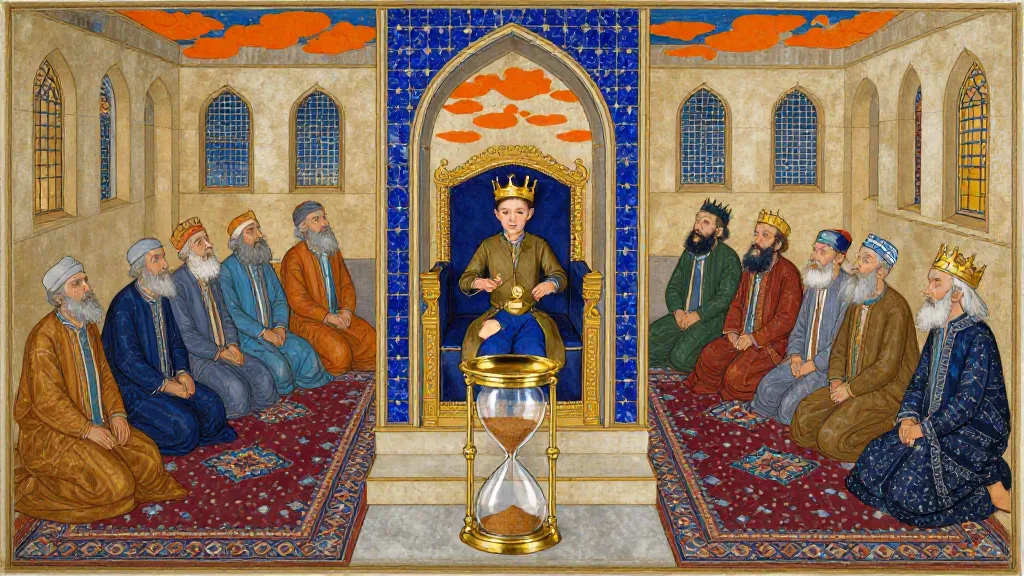
Yazdegerd III ascends the throne in 632 AD at roughly eight years old, inheriting what the succession crisis of the previous four years has left: a court without coherent command, an army without a settled paymaster, and provincial governors who have been making their own arrangements. The throne is real but the machinery behind it is not. He will spend the next nineteen years fleeing eastward in a straight line from the Arab advance — from Ctesiphon to Khuzestan to Isfahan to Ray to Nishapur to Merv — until a local governor has him murdered in a mill outside that last city in 651 AD. That trajectory is the reign.
The Shahnameh's account of this period is structured around a single strategic insight: Yazdegerd cannot decide whether he is still a belligerent or already a fugitive, and the ambiguity costs him both options. He issues commands in the register of an emperor — requisitioning forty thousand oxen, twelve thousand donkey-loads of grain, three hundred camel-loads of gold brocade — while writing letters that read like a man settling his affairs before death. The commands have no executor capable of carrying them out. The letters are accurate.
Rostam Farrokhzad, the general dispatched to fight the Arabs at Qadisiyyah in 636 AD, is the most clear-eyed figure in the entire arc. He reads the stars, determines that the battle is lost before it is fought, and writes his brother a letter of prophetic precision: the pulpit will stand level with the throne; the great names will all become Abu Bakr and Umar; his own armor will serve as his burial cloth. Then he goes to fight anyway, because that is what you do when you are the last professional commander of a dying state. He is killed at Qadisiyyah. The Sasanian army in Iraq collapses after him.
What follows is not a military campaign but a pursuit. The Arabs take Ctesiphon, the ancient capital, without a decisive second battle — Yazdegerd has already left. He gathers forces in Khorasan, writes again to frontier lords asking for provisions and loyalty, and receives diminishing responses. The lords of the marches calculate their own odds. Mahuy Suri of Merv, who promises refuge, instead has the king killed when his presence becomes a liability. The act is betrayal by any measure, but it is also rational: a king with no army and no treasury is an expensive guest.
Ferdowsi's lament at the end is not sentimental — it is diagnostic. Christian monks, with no stake in Zoroastrian legitimacy, are the ones who find the body, wash it, and bury it in a garden with brocade and rosewater. The empire's own religious establishment has nothing left to offer. Four hundred years of Sasanian rule — from Ardashir I's overthrow of the Parthians in 224 AD to this mill outside Merv — end with a foreign minority performing the last rites because no one else is left.
The strategic lesson is not that the Arabs were irresistible. It is that the Sasanians had already consumed the reserves — financial, political, military, institutional — that would have been needed to mount a coherent defense. Twenty years of civil war after Khosrow Parviz's fall (628 AD) had burned through four rulers, purged the officer class, and dissolved the center. By 636 AD, when the armies met at Qadisiyyah, the Sasanian Empire was structurally incapable of absorbing a single major defeat. The Arabs gave them one. That was enough.
Chapters in this Arc
Rostam Farrokhzad reads the stars before Qadisiyyah and writes his brother a farewell letter that is also a precise forecast of civilizational collapse.
Yazdegerd issues imperial-scale logistics orders from a position where he controls almost nothing, mobilizing resources from frontier lords who are already calculating their own survival.
Yazdegerd III is murdered by Mahouy Suri's agents near Merv in 651 AD. Christian monks wash and bury the last Sasanian king because no one else remains to do it.
Sa'd ibn Abi Waqqas leads the Arab forces into Iran; Yazdegerd sends Rostam to meet them at Qadisiyyah. The battle Rostam knew he would lose ends Sasanian power in Iraq.