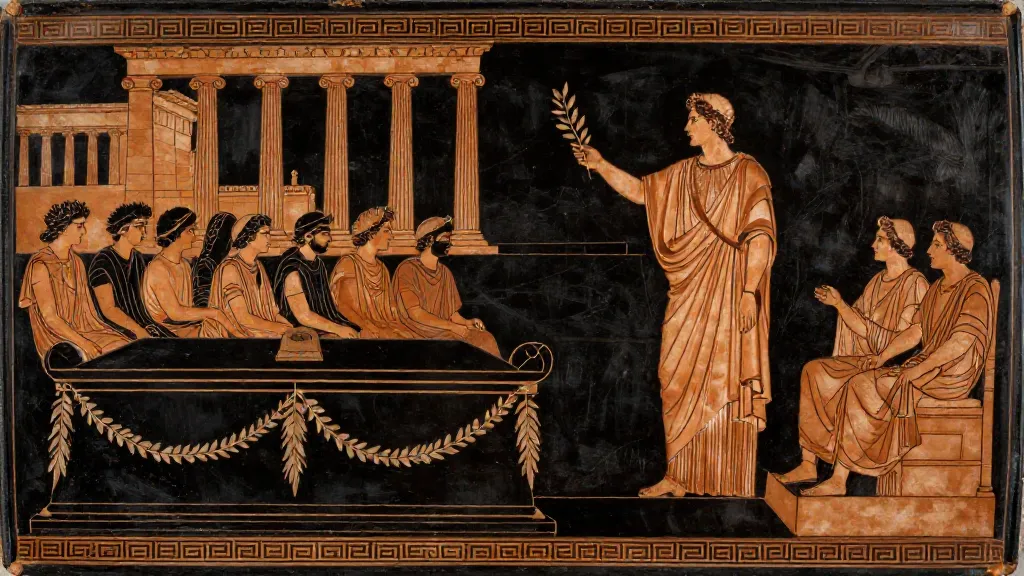
Pericles' Funeral Oration — Attic red-figure pottery painting

Thucydides · Book II, Chapters 34–46

Pericles' Funeral Oration

Ἐπιτάφιος Λόγος

2,216 words · 534 unique lemmas

View:

Hover over any Greek word for its dictionary form and definition

ἐν δὲ τῷ αὐτῷ χειμῶνι Ἀθηναῖοι τῷ πατρίῳ νόμῳ χρώμενοι δημοσίᾳ ταφὰς ἐποιήσαντο τῶν ἐν τῷδε τῷ πολέμῳ πρώτων ἀποθανόντων τρόπῳ τοιῷδε [ ] τὰ μὲν ὀστᾶ προτίθενται τῶν ἀπογενομένων πρότριτα σκηνὴν ποιήσαντες καὶ ἐπιφέρει τῷ αὑτοῦ ἕκαστος ἤν τι βούληται [ ] ἐπειδὰν δὲ ἐκφορὰ λάρνακας κυπαρισσίνας ἄγουσιν ἅμαξαι φυλῆς ἑκάστης μίαν ἔνεστι δὲ τὰ ὀστᾶ ἧς ἕκαστος ἦν φυλῆς μία δὲ κλίνη κενὴ φέρεται ἐστρωμένη τῶν ἀφανῶν οἳ ἂν μὴ εὑρεθῶσιν ἐς ἀναίρεσιν [ ] ξυνεκφέρει δὲ βουλόμενος καὶ ἀστῶν καὶ ξένων καὶ γυναῖκες πάρεισιν αἱ προσήκουσαι ἐπὶ τὸν τάφον ὀλοφυρόμεναι [ ] τιθέασιν οὖν ἐς τὸ δημόσιον σῆμα ἐστιν ἐπὶ τοῦ καλλίστου προαστείου τῆς πόλεως καὶ αἰεὶ ἐν αὐτῷ θάπτουσι τοὺς ἐκ τῶν πολέμων πλήν γε τοὺς ἐν Μαραθῶνι ἐκείνων δὲ διαπρεπῆ τὴν ἀρετὴν κρίναντες αὐτοῦ καὶ τὸν τάφον ἐποίησαν [ ] ἐπειδὰν δὲ κρύψωσι γῇ ἀνὴρ ᾑρημένος ὑπὸ τῆς πόλεως ὃς ἂν γνώμῃ τε δοκῇ μὴ ἀξύνετος εἶναι καὶ ἀξιώσει προήκῃ λέγει ἐπ᾽ αὐτοῖς ἔπαινον τὸν πρέποντα μετὰ δὲ τοῦτο ἀπέρχονται [ ] ὧδε μὲν θάπτουσιν καὶ διὰ παντὸς τοῦ πολέμου ὁπότε ξυμβαίη αὐτοῖς ἐχρῶντο τῷ νόμῳ [ ] ἐπὶ δ᾽ οὖν τοῖς πρώτοις τοῖσδε Περικλῆς Ξανθίππου ᾑρέθη λέγειν καὶ ἐπειδὴ καιρὸς ἐλάμβανε προελθὼν ἀπὸ τοῦ σήματος ἐπὶ βῆμα ὑψηλὸν πεποιημένον ὅπως ἀκούοιτο ὡς ἐπὶ πλεῖστον τοῦ ὁμίλου ἔλεγε τοιάδε

οἱ μὲν πολλοὶ τῶν ἐνθάδε ἤδη εἰρηκότων ἐπαινοῦσι τὸν προσθέντα τῷ νόμῳ τὸν λόγον τόνδε ὡς καλὸν ἐπὶ τοῖς ἐκ τῶν πολέμων θαπτομένοις ἀγορεύεσθαι αὐτόν ἐμοὶ δὲ ἀρκοῦν ἂν ἐδόκει εἶναι ἀνδρῶν ἀγαθῶν ἔργῳ γενομένων ἔργῳ καὶ δηλοῦσθαι τὰς τιμάς οἷα καὶ νῦν περὶ τὸν τάφον τόνδε δημοσίᾳ παρασκευασθέντα ὁρᾶτε καὶ μὴ ἐν ἑνὶ ἀνδρὶ πολλῶν ἀρετὰς κινδυνεύεσθαι εὖ τε καὶ χεῖρον εἰπόντι πιστευθῆναι [ ] χαλεπὸν γὰρ τὸ μετρίως εἰπεῖν ἐν μόλις καὶ δόκησις τῆς ἀληθείας βεβαιοῦται τε γὰρ ξυνειδὼς καὶ εὔνους ἀκροατὴς τάχ᾽ ἄν τι ἐνδεεστέρως πρὸς βούλεταί τε καὶ ἐπίσταται νομίσειε δηλοῦσθαι τε ἄπειρος ἔστιν καὶ πλεονάζεσθαι διὰ φθόνον εἴ τι ὑπὲρ τὴν αὑτοῦ φύσιν ἀκούοι μέχρι γὰρ τοῦδε ἀνεκτοὶ οἱ ἔπαινοί εἰσι περὶ ἑτέρων λεγόμενοι ἐς ὅσον ἂν καὶ αὐτὸς ἕκαστος οἴηται ἱκανὸς εἶναι δρᾶσαί τι ὧν ἤκουσεν τῷ δὲ ὑπερβάλλοντι αὐτῶν φθονοῦντες ἤδη καὶ ἀπιστοῦσιν [ ] ἐπειδὴ δὲ τοῖς πάλαι οὕτως ἐδοκιμάσθη ταῦτα καλῶς ἔχειν χρὴ καὶ ἐμὲ ἑπόμενον τῷ νόμῳ πειρᾶσθαι ὑμῶν τῆς ἑκάστου βουλήσεώς τε καὶ δόξης τυχεῖν ὡς ἐπὶ πλεῖστον

ἄρξομαι δὲ ἀπὸ τῶν προγόνων πρῶτον δίκαιον γὰρ αὐτοῖς καὶ πρέπον δὲ ἅμα ἐν τῷ τοιῷδε τὴν τιμὴν ταύτην τῆς μνήμης δίδοσθαι τὴν γὰρ χώραν οἱ αὐτοὶ αἰεὶ οἰκοῦντες διαδοχῇ τῶν ἐπιγιγνομένων μέχρι τοῦδε ἐλευθέραν δι᾽ ἀρετὴν παρέδοσαν [ ] καὶ ἐκεῖνοί τε ἄξιοι ἐπαίνου καὶ ἔτι μᾶλλον οἱ πατέρες ἡμῶν κτησάμενοι γὰρ πρὸς οἷς ἐδέξαντο ὅσην ἔχομεν ἀρχὴν οὐκ ἀπόνως ἡμῖν τοῖς νῦν προσκατέλιπον [ ] τὰ δὲ πλείω αὐτῆς αὐτοὶ ἡμεῖς οἵδε οἱ νῦν ἔτι ὄντες μάλιστα ἐν τῇ καθεστηκυίᾳ ἡλικίᾳ ἐπηυξήσαμεν καὶ τὴν πόλιν τοῖς πᾶσι παρεσκευάσαμεν καὶ ἐς πόλεμον καὶ ἐς εἰρήνην αὐταρκεστάτην [ ] ὧν ἐγὼ τὰ μὲν κατὰ πολέμους ἔργα οἷς ἕκαστα ἐκτήθη εἴ τι αὐτοὶ οἱ πατέρες ἡμῶν βάρβαρον Ἕλληνα πολέμιον ἐπιόντα προθύμως ἠμυνάμεθα μακρηγορεῖν ἐν εἰδόσιν οὐ βουλόμενος ἐάσω ἀπὸ δὲ οἵας τε ἐπιτηδεύσεως ἤλθομεν ἐπ᾽ αὐτὰ καὶ μεθ᾽ οἵας πολιτείας καὶ τρόπων ἐξ οἵων μεγάλα ἐγένετο ταῦτα δηλώσας πρῶτον εἶμι καὶ ἐπὶ τὸν τῶνδε ἔπαινον νομίζων ἐπί τε τῷ παρόντι οὐκ ἂν ἀπρεπῆ λεχθῆναι αὐτὰ καὶ τὸν πάντα ὅμιλον καὶ ἀστῶν καὶ ξένων ξύμφορον εἶναι ἐπακοῦσαι αὐτῶν

χρώμεθα γὰρ πολιτείᾳ οὐ ζηλούσῃ τοὺς τῶν πέλας νόμους παράδειγμα δὲ μᾶλλον αὐτοὶ ὄντες τισὶν μιμούμενοι ἑτέρους καὶ ὄνομα μὲν διὰ τὸ μὴ ἐς ὀλίγους ἀλλ᾽ ἐς πλείονας οἰκεῖν δημοκρατία κέκληται μέτεστι δὲ κατὰ μὲν τοὺς νόμους πρὸς τὰ ἴδια διάφορα πᾶσι τὸ ἴσον κατὰ δὲ τὴν ἀξίωσιν ὡς ἕκαστος ἔν τῳ εὐδοκιμεῖ οὐκ ἀπὸ μέρους τὸ πλέον ἐς τὰ κοινὰ ἀπ᾽ ἀρετῆς προτιμᾶται οὐδ᾽ αὖ κατὰ πενίαν ἔχων γέ τι ἀγαθὸν δρᾶσαι τὴν πόλιν ἀξιώματος ἀφανείᾳ κεκώλυται [ ] ἐλευθέρως δὲ τά τε πρὸς τὸ κοινὸν πολιτεύομεν καὶ ἐς τὴν πρὸς ἀλλήλους τῶν καθ᾽ ἡμέραν ἐπιτηδευμάτων ὑποψίαν οὐ δι᾽ ὀργῆς τὸν πέλας εἰ καθ᾽ ἡδονήν τι δρᾷ ἔχοντες οὐδὲ ἀζημίους μέν λυπηρὰς δὲ τῇ ὄψει ἀχθηδόνας προστιθέμενοι [ ] ἀνεπαχθῶς δὲ τὰ ἴδια προσομιλοῦντες τὰ δημόσια διὰ δέος μάλιστα οὐ παρανομοῦμεν τῶν τε αἰεὶ ἐν ἀρχῇ ὄντων ἀκροάσει καὶ τῶν νόμων καὶ μάλιστα αὐτῶν ὅσοι τε ἐπ᾽ ὠφελίᾳ τῶν ἀδικουμένων κεῖνται καὶ ὅσοι ἄγραφοι ὄντες αἰσχύνην ὁμολογουμένην φέρουσιν

καὶ μὴν καὶ τῶν πόνων πλείστας ἀναπαύλας τῇ γνώμῃ ἐπορισάμεθα ἀγῶσι μέν γε καὶ θυσίαις διετησίοις νομίζοντες ἰδίαις δὲ κατασκευαῖς εὐπρεπέσιν ὧν καθ᾽ ἡμέραν τέρψις τὸ λυπηρὸν ἐκπλήσσει [ ] ἐπεσέρχεται δὲ διὰ μέγεθος τῆς πόλεως ἐκ πάσης γῆς τὰ πάντα καὶ ξυμβαίνει ἡμῖν μηδὲν οἰκειοτέρᾳ τῇ ἀπολαύσει τὰ αὐτοῦ ἀγαθὰ γιγνόμενα καρποῦσθαι καὶ τὰ τῶν ἄλλων ἀνθρώπων

διαφέρομεν δὲ καὶ ταῖς τῶν πολεμικῶν μελέταις τῶν ἐναντίων τοῖσδε τήν τε γὰρ πόλιν κοινὴν παρέχομεν καὶ οὐκ ἔστιν ὅτε ξενηλασίαις ἀπείργομέν τινα μαθήματος θεάματος μὴ κρυφθὲν ἄν τις τῶν πολεμίων ἰδὼν ὠφεληθείη πιστεύοντες οὐ ταῖς παρασκευαῖς τὸ πλέον καὶ ἀπάταις τῷ ἀφ᾽ ἡμῶν αὐτῶν ἐς τὰ ἔργα εὐψύχῳ καὶ ἐν ταῖς παιδείαις οἱ μὲν ἐπιπόνῳ ἀσκήσει εὐθὺς νέοι ὄντες τὸ ἀνδρεῖον μετέρχονται ἡμεῖς δὲ ἀνειμένως διαιτώμενοι οὐδὲν ἧσσον ἐπὶ τοὺς ἰσοπαλεῖς κινδύνους χωροῦμεν [ ] τεκμήριον δέ οὔτε γὰρ Λακεδαιμόνιοι καθ᾽ ἑαυτούς μεθ᾽ ἁπάντων δὲ ἐς τὴν γῆν ἡμῶν στρατεύουσι τήν τε τῶν πέλας αὐτοὶ ἐπελθόντες οὐ χαλεπῶς ἐν τῇ ἀλλοτρίᾳ τοὺς περὶ τῶν οἰκείων ἀμυνομένους μαχόμενοι τὰ πλείω κρατοῦμεν [ ] ἁθρόᾳ τε τῇ δυνάμει ἡμῶν οὐδείς πω πολέμιος ἐνέτυχε διὰ τὴν τοῦ ναυτικοῦ τε ἅμα ἐπιμέλειαν καὶ τὴν ἐν τῇ γῇ ἐπὶ πολλὰ ἡμῶν αὐτῶν ἐπίπεμψιν ἢν δέ που μορίῳ τινὶ προσμείξωσι κρατήσαντές τέ τινας ἡμῶν πάντας αὐχοῦσιν ἀπεῶσθαι καὶ νικηθέντες ὑφ᾽ ἁπάντων ἡσσῆσθαι [ ] καίτοι εἰ ῥᾳθυμίᾳ μᾶλλον πόνων μελέτῃ καὶ μὴ μετὰ νόμων τὸ πλέον τρόπων ἀνδρείας ἐθέλομεν κινδυνεύειν περιγίγνεται ἡμῖν τοῖς τε μέλλουσιν ἀλγεινοῖς μὴ προκάμνειν καὶ ἐς αὐτὰ ἐλθοῦσι μὴ ἀτολμοτέρους τῶν αἰεὶ μοχθούντων φαίνεσθαι καὶ ἔν τε τούτοις τὴν πόλιν ἀξίαν εἶναι θαυμάζεσθαι καὶ ἔτι ἐν ἄλλοις

φιλοκαλοῦμέν τε γὰρ μετ᾽ εὐτελείας καὶ φιλοσοφοῦμεν ἄνευ μαλακίας πλούτῳ τε ἔργου μᾶλλον καιρῷ λόγου κόμπῳ χρώμεθα καὶ τὸ πένεσθαι οὐχ ὁμολογεῖν τινὶ αἰσχρόν ἀλλὰ μὴ διαφεύγειν ἔργῳ αἴσχιον [ ] ἔνι τε τοῖς αὐτοῖς οἰκείων ἅμα καὶ πολιτικῶν ἐπιμέλεια καὶ ἑτέροις πρὸς ἔργα τετραμμένοις τὰ πολιτικὰ μὴ ἐνδεῶς γνῶναι μόνοι γὰρ τόν τε μηδὲν τῶνδε μετέχοντα οὐκ ἀπράγμονα ἀλλ᾽ ἀχρεῖον νομίζομεν καὶ οἱ αὐτοὶ ἤτοι κρίνομέν γε ἐνθυμούμεθα ὀρθῶς τὰ πράγματα οὐ τοὺς λόγους τοῖς ἔργοις βλάβην ἡγούμενοι ἀλλὰ μὴ προδιδαχθῆναι μᾶλλον λόγῳ πρότερον ἐπὶ δεῖ ἔργῳ ἐλθεῖν [ ] διαφερόντως γὰρ δὴ καὶ τόδε ἔχομεν ὥστε τολμᾶν τε οἱ αὐτοὶ μάλιστα καὶ περὶ ὧν ἐπιχειρήσομεν ἐκλογίζεσθαι τοῖς ἄλλοις ἀμαθία μὲν θράσος λογισμὸς δὲ ὄκνον φέρει κράτιστοι δ᾽ ἂν τὴν ψυχὴν δικαίως κριθεῖεν οἱ τά τε δεινὰ καὶ ἡδέα σαφέστατα γιγνώσκοντες καὶ διὰ ταῦτα μὴ ἀποτρεπόμενοι ἐκ τῶν κινδύνων [ ] καὶ τὰ ἐς ἀρετὴν ἐνηντιώμεθα τοῖς πολλοῖς οὐ γὰρ πάσχοντες εὖ ἀλλὰ δρῶντες κτώμεθα τοὺς φίλους βεβαιότερος δὲ δράσας τὴν χάριν ὥστε ὀφειλομένην δι᾽ εὐνοίας δέδωκε σῴζειν δὲ ἀντοφείλων ἀμβλύτερος εἰδὼς οὐκ ἐς χάριν ἀλλ᾽ ἐς ὀφείλημα τὴν ἀρετὴν ἀποδώσων [ ] καὶ μόνοι οὐ τοῦ ξυμφέροντος μᾶλλον λογισμῷ τῆς ἐλευθερίας τῷ πιστῷ ἀδεῶς τινὰ ὠφελοῦμεν

ξυνελών τε λέγω τήν τε πᾶσαν πόλιν τῆς Ἑλλάδος παίδευσιν εἶναι καὶ καθ᾽ ἕκαστον δοκεῖν ἄν μοι τὸν αὐτὸν ἄνδρα παρ᾽ ἡμῶν ἐπὶ πλεῖστ᾽ ἂν εἴδη καὶ μετὰ χαρίτων μάλιστ᾽ ἂν εὐτραπέλως τὸ σῶμα αὔταρκες παρέχεσθαι [ ] καὶ ὡς οὐ λόγων ἐν τῷ παρόντι κόμπος τάδε μᾶλλον ἔργων ἐστὶν ἀλήθεια αὐτὴ δύναμις τῆς πόλεως ἣν ἀπὸ τῶνδε τῶν τρόπων ἐκτησάμεθα σημαίνει [ ] μόνη γὰρ τῶν νῦν ἀκοῆς κρείσσων ἐς πεῖραν ἔρχεται καὶ μόνη οὔτε τῷ πολεμίῳ ἐπελθόντι ἀγανάκτησιν ἔχει ὑφ᾽ οἵων κακοπαθεῖ οὔτε τῷ ὑπηκόῳ κατάμεμψιν ὡς οὐχ ὑπ᾽ ἀξίων ἄρχεται [ ] μετὰ μεγάλων δὲ σημείων καὶ οὐ δή τοι ἀμάρτυρόν γε τὴν δύναμιν παρασχόμενοι τοῖς τε νῦν καὶ τοῖς ἔπειτα θαυμασθησόμεθα καὶ οὐδὲν προσδεόμενοι οὔτε Ὁμήρου ἐπαινέτου οὔτε ὅστις ἔπεσι μὲν τὸ αὐτίκα τέρψει τῶν δ᾽ ἔργων τὴν ὑπόνοιαν ἀλήθεια βλάψει ἀλλὰ πᾶσαν μὲν θάλασσαν καὶ γῆν ἐσβατὸν τῇ ἡμετέρᾳ τόλμῃ καταναγκάσαντες γενέσθαι πανταχοῦ δὲ μνημεῖα κακῶν τε κἀγαθῶν ἀίδια ξυγκατοικίσαντες [ ] περὶ τοιαύτης οὖν πόλεως οἵδε τε γενναίως δικαιοῦντες μὴ ἀφαιρεθῆναι αὐτὴν μαχόμενοι ἐτελεύτησαν καὶ τῶν λειπομένων πάντα τινὰ εἰκὸς ἐθέλειν ὑπὲρ αὐτῆς κάμνειν

δι᾽ δὴ καὶ ἐμήκυνα τὰ περὶ τῆς πόλεως διδασκαλίαν τε ποιούμενος μὴ περὶ ἴσου ἡμῖν εἶναι τὸν ἀγῶνα καὶ οἷς τῶνδε μηδὲν ὑπάρχει ὁμοίως καὶ τὴν εὐλογίαν ἅμα ἐφ᾽ οἷς νῦν λέγω φανερὰν σημείοις καθιστάς [ ] καὶ εἴρηται αὐτῆς τὰ μέγιστα γὰρ τὴν πόλιν ὕμνησα αἱ τῶνδε καὶ τῶν τοιῶνδε ἀρεταὶ ἐκόσμησαν καὶ οὐκ ἂν πολλοῖς τῶν Ἑλλήνων ἰσόρροπος ὥσπερ τῶνδε λόγος τῶν ἔργων φανείη δοκεῖ δέ μοι δηλοῦν ἀνδρὸς ἀρετὴν πρώτη τε μηνύουσα καὶ τελευταία βεβαιοῦσα νῦν τῶνδε καταστροφή [ ] καὶ γὰρ τοῖς τἆλλα χείροσι δίκαιον τὴν ἐς τοὺς πολέμους ὑπὲρ τῆς πατρίδος ἀνδραγαθίαν προτίθεσθαι ἀγαθῷ γὰρ κακὸν ἀφανίσαντες κοινῶς μᾶλλον ὠφέλησαν ἐκ τῶν ἰδίων ἔβλαψαν [ ] τῶνδε δὲ οὔτε πλούτου τις τὴν ἔτι ἀπόλαυσιν προτιμήσας ἐμαλακίσθη οὔτε πενίας ἐλπίδι ὡς κἂν ἔτι διαφυγὼν αὐτὴν πλουτήσειεν ἀναβολὴν τοῦ δεινοῦ ἐποιήσατο τὴν δὲ τῶν ἐναντίων τιμωρίαν ποθεινοτέραν αὐτῶν λαβόντες καὶ κινδύνων ἅμα τόνδε κάλλιστον νομίσαντες ἐβουλήθησαν μετ᾽ αὐτοῦ τοὺς μὲν τιμωρεῖσθαι τῶν δὲ ἐφίεσθαι ἐλπίδι μὲν τὸ ἀφανὲς τοῦ κατορθώσειν ἐπιτρέψαντες ἔργῳ δὲ περὶ τοῦ ἤδη ὁρωμένου σφίσιν αὐτοῖς ἀξιοῦντες πεποιθέναι καὶ ἐν αὐτῷ τῷ ἀμύνεσθαι καὶ παθεῖν μᾶλλον ἡγησάμενοι [τὸ] ἐνδόντες σῴζεσθαι τὸ μὲν αἰσχρὸν τοῦ λόγου ἔφυγον τὸ δ᾽ ἔργον τῷ σώματι ὑπέμειναν καὶ δι᾽ ἐλαχίστου καιροῦ τύχης ἅμα ἀκμῇ τῆς δόξης μᾶλλον τοῦ δέους ἀπηλλάγησαν

καὶ οἵδε μὲν προσηκόντως τῇ πόλει τοιοίδε ἐγένοντο τοὺς δὲ λοιποὺς χρὴ ἀσφαλεστέραν μὲν εὔχεσθαι ἀτολμοτέραν δὲ μηδὲν ἀξιοῦν τὴν ἐς τοὺς πολεμίους διάνοιαν ἔχειν σκοποῦντας μὴ λόγῳ μόνῳ τὴν ὠφελίαν ἣν ἄν τις πρὸς οὐδὲν χεῖρον αὐτοὺς ὑμᾶς εἰδότας μηκύνοι λέγων ὅσα ἐν τῷ τοὺς πολεμίους ἀμύνεσθαι ἀγαθὰ ἔνεστιν ἀλλὰ μᾶλλον τὴν τῆς πόλεως δύναμιν καθ᾽ ἡμέραν ἔργῳ θεωμένους καὶ ἐραστὰς γιγνομένους αὐτῆς καὶ ὅταν ὑμῖν μεγάλη δόξῃ εἶναι ἐνθυμουμένους ὅτι τολμῶντες καὶ γιγνώσκοντες τὰ δέοντα καὶ ἐν τοῖς ἔργοις αἰσχυνόμενοι ἄνδρες αὐτὰ ἐκτήσαντο καὶ ὁπότε καὶ πείρᾳ του σφαλεῖεν οὐκ οὖν καὶ τὴν πόλιν γε τῆς σφετέρας ἀρετῆς ἀξιοῦντες στερίσκειν κάλλιστον δὲ ἔρανον αὐτῇ προϊέμενοι [ ] κοινῇ γὰρ τὰ σώματα διδόντες ἰδίᾳ τὸν ἀγήρων ἔπαινον ἐλάμβανον καὶ τὸν τάφον ἐπισημότατον οὐκ ἐν κεῖνται μᾶλλον ἀλλ᾽ ἐν δόξα αὐτῶν παρὰ τῷ ἐντυχόντι αἰεὶ καὶ λόγου καὶ ἔργου καιρῷ αἰείμνηστος καταλείπεται [ ] ἀνδρῶν γὰρ ἐπιφανῶν πᾶσα γῆ τάφος καὶ οὐ στηλῶν μόνον ἐν τῇ οἰκείᾳ σημαίνει ἐπιγραφή ἀλλὰ καὶ ἐν τῇ μὴ προσηκούσῃ ἄγραφος μνήμη παρ᾽ ἑκάστῳ τῆς γνώμης μᾶλλον τοῦ ἔργου ἐνδιαιτᾶται [ ] οὓς νῦν ὑμεῖς ζηλώσαντες καὶ τὸ εὔδαιμον τὸ ἐλεύθερον τὸ δ᾽ ἐλεύθερον τὸ εὔψυχον κρίναντες μὴ περιορᾶσθε τοὺς πολεμικοὺς κινδύνους [ ] οὐ γὰρ οἱ κακοπραγοῦντες δικαιότερον ἀφειδοῖεν ἂν τοῦ βίου οἷς ἐλπὶς οὐκ ἔστιν ἀγαθοῦ ἀλλ᾽ οἷς ἐναντία μεταβολὴ ἐν τῷ ζῆν ἔτι κινδυνεύεται καὶ ἐν οἷς μάλιστα μεγάλα τὰ διαφέροντα ἤν τι πταίσωσιν [ ] ἀλγεινοτέρα γὰρ ἀνδρί γε φρόνημα ἔχοντι μετὰ τοῦ [ἐν τῷ] μαλακισθῆναι κάκωσις μετὰ ῥώμης καὶ κοινῆς ἐλπίδος ἅμα γιγνόμενος ἀναίσθητος θάνατος

δι᾽ ὅπερ καὶ τοὺς τῶνδε νῦν τοκέας ὅσοι πάρεστε οὐκ ὀλοφύρομαι μᾶλλον παραμυθήσομαι ἐν πολυτρόποις γὰρ ξυμφοραῖς ἐπίστανται τραφέντες τὸ δ᾽ εὐτυχές οἳ ἂν τῆς εὐπρεπεστάτης λάχωσιν ὥσπερ οἵδε μὲν νῦν τελευτῆς ὑμεῖς δὲ λύπης καὶ οἷς ἐνευδαιμονῆσαί τε βίος ὁμοίως καὶ ἐντελευτῆσαι ξυνεμετρήθη [ ] χαλεπὸν μὲν οὖν οἶδα πείθειν ὄν ὧν καὶ πολλάκις ἕξετε ὑπομνήματα ἐν ἄλλων εὐτυχίαις αἷς ποτὲ καὶ αὐτοὶ ἠγάλλεσθε καὶ λύπη οὐχ ὧν ἄν τις μὴ πειρασάμενος ἀγαθῶν στερίσκηται ἀλλ᾽ οὗ ἂν ἐθὰς γενόμενος ἀφαιρεθῇ [ ] καρτερεῖν δὲ χρὴ καὶ ἄλλων παίδων ἐλπίδι οἷς ἔτι ἡλικία τέκνωσιν ποιεῖσθαι ἰδίᾳ τε γὰρ τῶν οὐκ ὄντων λήθη οἱ ἐπιγιγνόμενοί τισιν ἔσονται καὶ τῇ πόλει διχόθεν ἔκ τε τοῦ μὴ ἐρημοῦσθαι καὶ ἀσφαλείᾳ ξυνοίσει οὐ γὰρ οἷόν τε ἴσον τι δίκαιον βουλεύεσθαι οἳ ἂν μὴ καὶ παῖδας ἐκ τοῦ ὁμοίου παραβαλλόμενοι κινδυνεύωσιν [ ] ὅσοι δ᾽ αὖ παρηβήκατε τόν τε πλέονα κέρδος ὃν ηὐτυχεῖτε βίον ἡγεῖσθε καὶ τόνδε βραχὺν ἔσεσθαι καὶ τῇ τῶνδε εὐκλείᾳ κουφίζεσθε τὸ γὰρ φιλότιμον ἀγήρων μόνον καὶ οὐκ ἐν τῷ ἀχρείῳ τῆς ἡλικίας τὸ κερδαίνειν ὥσπερ τινές φασι μᾶλλον τέρπει ἀλλὰ τὸ τιμᾶσθαι

παισὶ δ᾽ αὖ ὅσοι τῶνδε πάρεστε ἀδελφοῖς ὁρῶ μέγαν τὸν ἀγῶνα τὸν γὰρ οὐκ ὄντα ἅπας εἴωθεν ἐπαινεῖν καὶ μόλις ἂν καθ᾽ ὑπερβολὴν ἀρετῆς οὐχ ὁμοῖοι ἀλλ᾽ ὀλίγῳ χείρους κριθεῖτε φθόνος γὰρ τοῖς ζῶσι πρὸς τὸ ἀντίπαλον τὸ δὲ μὴ ἐμποδὼν ἀνανταγωνίστῳ εὐνοίᾳ τετίμηται [ ] εἰ δέ με δεῖ καὶ γυναικείας τι ἀρετῆς ὅσαι νῦν ἐν χηρείᾳ ἔσονται μνησθῆναι βραχείᾳ παραινέσει ἅπαν σημανῶ τῆς τε γὰρ ὑπαρχούσης φύσεως μὴ χείροσι γενέσθαι ὑμῖν μεγάλη δόξα καὶ ἧς ἂν ἐπ᾽ ἐλάχιστον ἀρετῆς πέρι ψόγου ἐν τοῖς ἄρσεσι κλέος

εἴρηται καὶ ἐμοὶ λόγῳ κατὰ τὸν νόμον ὅσα εἶχον πρόσφορα καὶ ἔργῳ οἱ θαπτόμενοι τὰ μὲν ἤδη κεκόσμηνται τὰ δὲ αὐτῶν τοὺς παῖδας τὸ ἀπὸ τοῦδε δημοσίᾳ πόλις μέχρι ἥβης θρέψει ὠφέλιμον στέφανον τοῖσδέ τε καὶ τοῖς λειπομένοις τῶν τοιῶνδε ἀγώνων προτιθεῖσα ἆθλα γὰρ οἷς κεῖται ἀρετῆς μέγιστα τοῖς δὲ καὶ ἄνδρες ἄριστοι πολιτεύουσιν [ ] νῦν δὲ ἀπολοφυράμενοι ὃν προσήκει ἑκάστῳ ἄπιτε

Pericles' Funeral Oration (Book II, Chapter VI)

First Year of the War — The Funeral Oration of Pericles

In the same winter the Athenians gave a funeral at the public cost to

those who had first fallen in this war. It was a custom of their

ancestors, and the manner of it is as follows. Three days before the

ceremony, the bones of the dead are laid out in a tent which has been

erected; and their friends bring to their relatives such offerings as

they please. In the funeral procession cypress coffins are borne in

cars, one for each tribe; the bones of the deceased being placed in the

coffin of their tribe. Among these is carried one empty bier decked for

the missing, that is, for those whose bodies could not be recovered.

Any citizen or stranger who pleases, joins in the procession: and the

female relatives are there to wail at the burial. The dead are laid in

the public sepulchre in the Beautiful suburb of the city, in which

those who fall in war are always buried; with the exception of those

slain at Marathon, who for their singular and extraordinary valour were

interred on the spot where they fell. After the bodies have been laid

in the earth, a man chosen by the state, of approved wisdom and eminent

reputation, pronounces over them an appropriate panegyric; after which

all retire. Such is the manner of the burying; and throughout the whole

of the war, whenever the occasion arose, the established custom was

observed. Meanwhile these were the first that had fallen, and Pericles,

son of Xanthippus, was chosen to pronounce their eulogium. When the

proper time arrived, he advanced from the sepulchre to an elevated

platform in order to be heard by as many of the crowd as possible, and

spoke as follows:

“Most of my predecessors in this place have commended him who made this

speech part of the law, telling us that it is well that it should be

delivered at the burial of those who fall in battle. For myself, I

should have thought that the worth which had displayed itself in deeds

would be sufficiently rewarded by honours also shown by deeds; such as

you now see in this funeral prepared at the people’s cost. And I could

have wished that the reputations of many brave men were not to be

imperilled in the mouth of a single individual, to stand or fall

according as he spoke well or ill. For it is hard to speak properly

upon a subject where it is even difficult to convince your hearers that

you are speaking the truth. On the one hand, the friend who is familiar

with every fact of the story may think that some point has not been set

forth with that fullness which he wishes and knows it to deserve; on

the other, he who is a stranger to the matter may be led by envy to

suspect exaggeration if he hears anything above his own nature. For men

can endure to hear others praised only so long as they can severally

persuade themselves of their own ability to equal the actions

recounted: when this point is passed, envy comes in and with it

incredulity. However, since our ancestors have stamped this custom with

their approval, it becomes my duty to obey the law and to try to

satisfy your several wishes and opinions as best I may.

“I shall begin with our ancestors: it is both just and proper that they

should have the honour of the first mention on an occasion like the

present. They dwelt in the country without break in the succession from

generation to generation, and handed it down free to the present time

by their valour. And if our more remote ancestors deserve praise, much

more do our own fathers, who added to their inheritance the empire

which we now possess, and spared no pains to be able to leave their

acquisitions to us of the present generation. Lastly, there are few

parts of our dominions that have not been augmented by those of us

here, who are still more or less in the vigour of life; while the

mother country has been furnished by us with everything that can enable

her to depend on her own resources whether for war or for peace. That

part of our history which tells of the military achievements which gave

us our several possessions, or of the ready valour with which either we

or our fathers stemmed the tide of Hellenic or foreign aggression, is a

theme too familiar to my hearers for me to dilate on, and I shall

therefore pass it by. But what was the road by which we reached our

position, what the form of government under which our greatness grew,

what the national habits out of which it sprang; these are questions

which I may try to solve before I proceed to my panegyric upon these

men; since I think this to be a subject upon which on the present

occasion a speaker may properly dwell, and to which the whole

assemblage, whether citizens or foreigners, may listen with advantage.

“Our constitution does not copy the laws of neighbouring states; we are

rather a pattern to others than imitators ourselves. Its administration

favours the many instead of the few; this is why it is called a

democracy. If we look to the laws, they afford equal justice to all in

their private differences; if no social standing, advancement in public

life falls to reputation for capacity, class considerations not being

allowed to interfere with merit; nor again does poverty bar the way, if

a man is able to serve the state, he is not hindered by the obscurity

of his condition. The freedom which we enjoy in our government extends

also to our ordinary life. There, far from exercising a jealous

surveillance over each other, we do not feel called upon to be angry

with our neighbour for doing what he likes, or even to indulge in those

injurious looks which cannot fail to be offensive, although they

inflict no positive penalty. But all this ease in our private relations

does not make us lawless as citizens. Against this fear is our chief

safeguard, teaching us to obey the magistrates and the laws,

particularly such as regard the protection of the injured, whether they

are actually on the statute book, or belong to that code which,

although unwritten, yet cannot be broken without acknowledged disgrace.

“Further, we provide plenty of means for the mind to refresh itself

from business. We celebrate games and sacrifices all the year round,

and the elegance of our private establishments forms a daily source of

pleasure and helps to banish the spleen; while the magnitude of our

city draws the produce of the world into our harbour, so that to the

Athenian the fruits of other countries are as familiar a luxury as

those of his own.

“If we turn to our military policy, there also we differ from our

antagonists. We throw open our city to the world, and never by alien

acts exclude foreigners from any opportunity of learning or observing,

although the eyes of an enemy may occasionally profit by our

liberality; trusting less in system and policy than to the native

spirit of our citizens; while in education, where our rivals from their

very cradles by a painful discipline seek after manliness, at Athens we

live exactly as we please, and yet are just as ready to encounter every

legitimate danger. In proof of this it may be noticed that the

Lacedaemonians do not invade our country alone, but bring with them all

their confederates; while we Athenians advance unsupported into the

territory of a neighbour, and fighting upon a foreign soil usually

vanquish with ease men who are defending their homes. Our united force

was never yet encountered by any enemy, because we have at once to

attend to our marine and to dispatch our citizens by land upon a

hundred different services; so that, wherever they engage with some

such fraction of our strength, a success against a detachment is

magnified into a victory over the nation, and a defeat into a reverse

suffered at the hands of our entire people. And yet if with habits not

of labour but of ease, and courage not of art but of nature, we are

still willing to encounter danger, we have the double advantage of

escaping the experience of hardships in anticipation and of facing them

in the hour of need as fearlessly as those who are never free from

them.

“Nor are these the only points in which our city is worthy of

admiration. We cultivate refinement without extravagance and knowledge

without effeminacy; wealth we employ more for use than for show, and

place the real disgrace of poverty not in owning to the fact but in

declining the struggle against it. Our public men have, besides

politics, their private affairs to attend to, and our ordinary

citizens, though occupied with the pursuits of industry, are still fair

judges of public matters; for, unlike any other nation, regarding him

who takes no part in these duties not as unambitious but as useless, we

Athenians are able to judge at all events if we cannot originate, and,

instead of looking on discussion as a stumbling-block in the way of

action, we think it an indispensable preliminary to any wise action at

all. Again, in our enterprises we present the singular spectacle of

daring and deliberation, each carried to its highest point, and both

united in the same persons; although usually decision is the fruit of

ignorance, hesitation of reflection. But the palm of courage will

surely be adjudged most justly to those, who best know the difference

between hardship and pleasure and yet are never tempted to shrink from

danger. In generosity we are equally singular, acquiring our friends by

conferring, not by receiving, favours. Yet, of course, the doer of the

favour is the firmer friend of the two, in order by continued kindness

to keep the recipient in his debt; while the debtor feels less keenly

from the very consciousness that the return he makes will be a payment,

not a free gift. And it is only the Athenians, who, fearless of

consequences, confer their benefits not from calculations of

expediency, but in the confidence of liberality.

“In short, I say that as a city we are the school of Hellas, while I

doubt if the world can produce a man who, where he has only himself to

depend upon, is equal to so many emergencies, and graced by so happy a

versatility, as the Athenian. And that this is no mere boast thrown out

for the occasion, but plain matter of fact, the power of the state

acquired by these habits proves. For Athens alone of her contemporaries

is found when tested to be greater than her reputation, and alone gives

no occasion to her assailants to blush at the antagonist by whom they

have been worsted, or to her subjects to question her title by merit to

rule. Rather, the admiration of the present and succeeding ages will be

ours, since we have not left our power without witness, but have shown

it by mighty proofs; and far from needing a Homer for our panegyrist,

or other of his craft whose verses might charm for the moment only for

the impression which they gave to melt at the touch of fact, we have

forced every sea and land to be the highway of our daring, and

everywhere, whether for evil or for good, have left imperishable

monuments behind us. Such is the Athens for which these men, in the

assertion of their resolve not to lose her, nobly fought and died; and

well may every one of their survivors be ready to suffer in her cause.

“Indeed if I have dwelt at some length upon the character of our

country, it has been to show that our stake in the struggle is not the

same as theirs who have no such blessings to lose, and also that the

panegyric of the men over whom I am now speaking might be by definite

proofs established. That panegyric is now in a great measure complete;

for the Athens that I have celebrated is only what the heroism of these

and their like have made her, men whose fame, unlike that of most

Hellenes, will be found to be only commensurate with their deserts. And

if a test of worth be wanted, it is to be found in their closing scene,

and this not only in cases in which it set the final seal upon their

merit, but also in those in which it gave the first intimation of their

having any. For there is justice in the claim that steadfastness in his

country’s battles should be as a cloak to cover a man’s other

imperfections; since the good action has blotted out the bad, and his

merit as a citizen more than outweighed his demerits as an individual.

But none of these allowed either wealth with its prospect of future

enjoyment to unnerve his spirit, or poverty with its hope of a day of

freedom and riches to tempt him to shrink from danger. No, holding that

vengeance upon their enemies was more to be desired than any personal

blessings, and reckoning this to be the most glorious of hazards, they

joyfully determined to accept the risk, to make sure of their

vengeance, and to let their wishes wait; and while committing to hope

the uncertainty of final success, in the business before them they

thought fit to act boldly and trust in themselves. Thus choosing to die

resisting, rather than to live submitting, they fled only from

dishonour, but met danger face to face, and after one brief moment,

while at the summit of their fortune, escaped, not from their fear, but

from their glory.

“So died these men as became Athenians. You, their survivors, must

determine to have as unfaltering a resolution in the field, though you

may pray that it may have a happier issue. And not contented with ideas

derived only from words of the advantages which are bound up with the

defence of your country, though these would furnish a valuable text to

a speaker even before an audience so alive to them as the present, you

must yourselves realize the power of Athens, and feed your eyes upon

her from day to day, till love of her fills your hearts; and then, when

all her greatness shall break upon you, you must reflect that it was by

courage, sense of duty, and a keen feeling of honour in action that men

were enabled to win all this, and that no personal failure in an

enterprise could make them consent to deprive their country of their

valour, but they laid it at her feet as the most glorious contribution

that they could offer. For this offering of their lives made in common

by them all they each of them individually received that renown which

never grows old, and for a sepulchre, not so much that in which their

bones have been deposited, but that noblest of shrines wherein their

glory is laid up to be eternally remembered upon every occasion on

which deed or story shall call for its commemoration. For heroes have

the whole earth for their tomb; and in lands far from their own, where

the column with its epitaph declares it, there is enshrined in every

breast a record unwritten with no tablet to preserve it, except that of

the heart. These take as your model and, judging happiness to be the

fruit of freedom and freedom of valour, never decline the dangers of

war. For it is not the miserable that would most justly be unsparing of

their lives; these have nothing to hope for: it is rather they to whom

continued life may bring reverses as yet unknown, and to whom a fall,

if it came, would be most tremendous in its consequences. And surely,

to a man of spirit, the degradation of cowardice must be immeasurably

more grievous than the unfelt death which strikes him in the midst of

his strength and patriotism!

“Comfort, therefore, not condolence, is what I have to offer to the

parents of the dead who may be here. Numberless are the chances to

which, as they know, the life of man is subject; but fortunate indeed

are they who draw for their lot a death so glorious as that which has

caused your mourning, and to whom life has been so exactly measured as

to terminate in the happiness in which it has been passed. Still I know

that this is a hard saying, especially when those are in question of

whom you will constantly be reminded by seeing in the homes of others

blessings of which once you also boasted: for grief is felt not so much

for the want of what we have never known, as for the loss of that to

which we have been long accustomed. Yet you who are still of an age to

beget children must bear up in the hope of having others in their

stead; not only will they help you to forget those whom you have lost,

but will be to the state at once a reinforcement and a security; for

never can a fair or just policy be expected of the citizen who does

not, like his fellows, bring to the decision the interests and

apprehensions of a father. While those of you who have passed your

prime must congratulate yourselves with the thought that the best part

of your life was fortunate, and that the brief span that remains will

be cheered by the fame of the departed. For it is only the love of

honour that never grows old; and honour it is, not gain, as some would

have it, that rejoices the heart of age and helplessness.

“Turning to the sons or brothers of the dead, I see an arduous struggle

before you. When a man is gone, all are wont to praise him, and should

your merit be ever so transcendent, you will still find it difficult

not merely to overtake, but even to approach their renown. The living

have envy to contend with, while those who are no longer in our path

are honoured with a goodwill into which rivalry does not enter. On the

other hand, if I must say anything on the subject of female excellence

to those of you who will now be in widowhood, it will be all comprised

in this brief exhortation. Great will be your glory in not falling

short of your natural character; and greatest will be hers who is least

talked of among the men, whether for good or for bad.

“My task is now finished. I have performed it to the best of my

ability, and in word, at least, the requirements of the law are now

satisfied. If deeds be in question, those who are here interred have

received part of their honours already, and for the rest, their

children will be brought up till manhood at the public expense: the

state thus offers a valuable prize, as the garland of victory in this

race of valour, for the reward both of those who have fallen and their

survivors. And where the rewards for merit are greatest, there are

found the best citizens.

“And now that you have brought to a close your lamentations for your

relatives, you may depart.”

Edition & Source

Author
Θουκυδίδης Thucydides
Greek Text
Perseus Digital Library
Translation
Richard Crawley (1874)