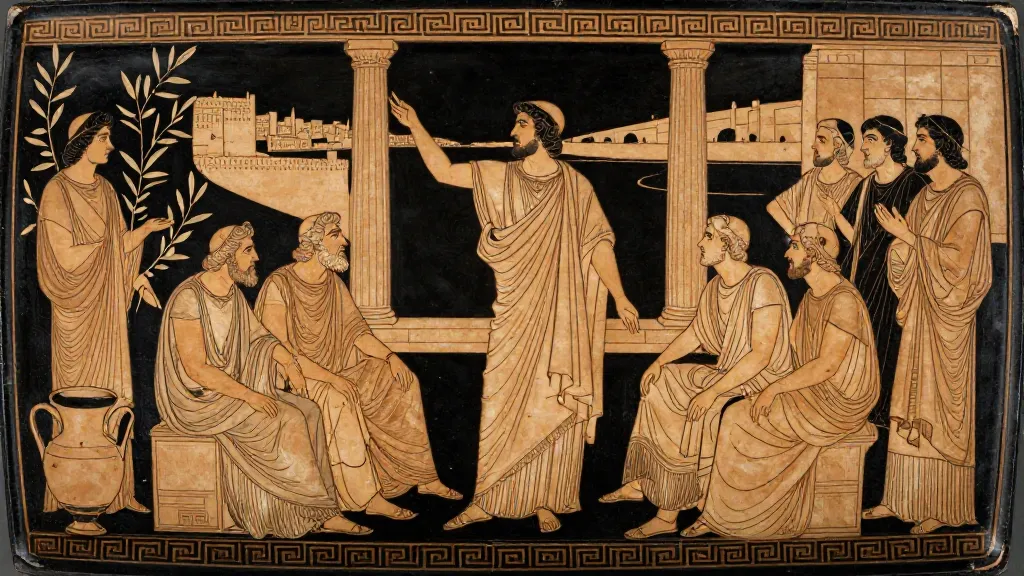
Thucydides · Book II, Chapters 47–65
The Plague and the Fall of Pericles
Ὁ Λοιμὸς καὶ ἡ Πτῶσις τοῦ Περικλέους
3,668 words · 771 unique lemmas
Thucydides > The Idealist's Wager > The Plague and the Fall of Pericles
The plague sequence is the first test of Pericles' grand strategy — and it destroys the strategist while vindicating nothing. It demonstrates that strategic systems dependent on a single irreplaceable leader carry a catastrophic single point of failure.
Athens is at the peak of its confidence. Pericles' strategy is working: avoid land battles, trust the navy, wait for Sparta to exhaust itself. Then the plague arrives inside the walls that were supposed to protect them. By 429 BC, Pericles is dead, and Athens has lost the one person who could enforce strategic patience on a democratic assembly.
Pericles' strategy was elegant and sound: retreat behind the Long Walls, cede the countryside to Spartan devastation, use naval supremacy to raid the Peloponnese, and wait. Sparta had no navy, no money, and no way to breach the walls. Time favored Athens. The strategy required only one thing — that the Athenian demos accept the psychological cost of watching their farms burn without marching out to fight. Pericles could enforce this discipline. No one else could.
The plague shattered the strategy not by defeating Athens militarily but by destroying the social compact that made strategic patience possible. Crowded behind the walls — the very defensive posture that was supposed to save them — Athenians died in conditions that mocked Pericles' promises of security. Thucydides describes the collapse of social norms in clinical detail: the sick abandoned by their families, the dead stacked unburied, religious observance abandoned because the pious died as readily as the impious. The plague did not just kill people; it killed the civic trust that Periclean strategy required.
Pericles himself was fined, removed from office, reinstated, and then died of the plague — a sequence that Thucydides narrates with devastating compression. The reinstatement is the cruelest detail: the demos needed him back precisely because no one else could manage the situation, but by then the situation was unmanageable. His death left Athens with his strategy but without his judgment — the institutions remained, the fleet remained, the empire remained, but the capacity to exercise restraint did not.
Thucydides' epitaph for Pericles is the sharpest strategic assessment in the History: Athens lost the war because Pericles' successors did the opposite of what he advised. They pursued aggressive expansion instead of patient defense, driven by private ambition and private profit. The system Pericles built could not survive his absence — not because the system was flawed, but because it was a system that required a specific operator.
Cross-Civilizational Connection
Parallel: The pattern — peak confidence, unforeseen catastrophe, loss of the irreplaceable leader, institutional decay — maps directly onto Qin's trajectory after unification. Qin Shi Huang built a system of total administrative control that functioned while he lived and collapsed within four years of his death. Both cases demonstrate that centralized systems optimized around a single decision-maker are brittle in ways their architects cannot anticipate.
Difference: Pericles died of an external shock (plague); Qin Shi Huang died of natural causes after decades of paranoid overreach. Athens' post-Pericles decline was gradual and contested — bad leaders could be removed, strategies debated, mistakes partially corrected. Qin's collapse was swift and total because the imperial system had eliminated all mechanisms for self-correction. Democracy degrades slowly; autocracy shatters.
Limit: Athens after Pericles still won battles, still projected power, still lasted another quarter-century before final defeat. Qin after the First Emperor lasted three years. The analogy overstates Athens' fragility — democratic institutions provided resilience that pure autocracy cannot, even degraded democratic institutions. The parallel illuminates the single-point-of-failure problem but obscures the real difference in institutional durability.
The plague episode reveals something uncomfortable about strategic planning: the best strategy in the world is worthless if it cannot survive contact with randomness. Pericles planned for every contingency that could be planned for — Spartan invasions, allied revolts, financial shortfalls. He did not plan for a pandemic, because pandemics are not strategic variables. But the plague did not need to be foreseeable to be decisive. It killed the strategist and broke the social discipline his strategy required. The lesson is not that Pericles should have planned better; it is that any strategy dependent on conditions that cannot be guaranteed is a bet, not a plan.
See Also
- shiji/06-qin-shi-huang-ben-ji — The First Emperor's death triggers the same structural crisis — a system optimized around one decision-maker collapses when that decision-maker is removed.
- sunzi-bingfa/01-laying-plans — Sun Tzu's insistence on calculating conditions before war assumes those conditions remain stable — the plague demonstrates that the most critical variables may be uncalculable.
- hanfeizi/07-er-bing — Han Fei's 'Two Handles' argues that systems should function regardless of the ruler's personal quality — precisely the institutional design Athens lacked after Pericles.
Edition & Source
- Author
- Θουκυδίδης Thucydides
- Greek Text
- Perseus Digital Library
- Translation
- Richard Crawley (1874)