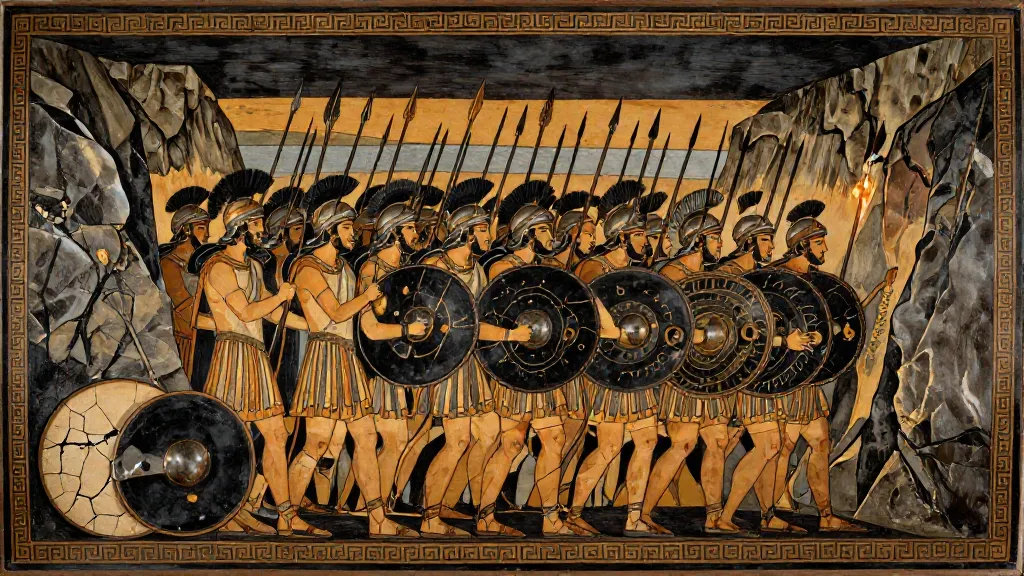
Herodotus · Book VII
Thermopylae
Θερμοπύλαι
7,068 words · 1069 unique lemmas
Hover over any Greek word for its dictionary form and definition
οἱ δὲ Ἕλληνες ἐπείτε ἀπίκατο ἐς τὸν Ἰσθμόν ἐβουλεύοντο πρὸς τὰ λεχθέντα ἐξ Ἀλεξάνδρου τῇ τε στήσονται τὸν πόλεμον καὶ ἐν οἵοισι χώροισι ἡ νικῶσα δὲ γνώμη ἐγίνετο τὴν ἐν Θερμοπύλῃσι ἐσβολὴν φυλάξαι στεινοτέρη γὰρ ἐφαίνετο ἐοῦσα τῆς ἐς Θεσσαλίην καὶ ἅμα ἀγχοτέρη τῆς ἑωυτῶν [ ] τὴν δὲ ἀτραπόν δι᾽ ἣλωσαν οἱ ἁλόντες Ἑλλήνων ἐν Θερμοπύλῃσι οὐδὲ ᾔδεσαν ἐοῦσαν πρότερον ἤ περ ἀπικόμενοι ἐς Θερμοπύλας ἐπύθοντο Τρηχινίων ταύτην ὦν ἐβουλεύσαντο φυλάσσοντες τὴν ἐσβολὴν μὴ παριέναι ἐς τὴν Ἑλλάδα τὸν βάρβαρον τὸν δὲ ναυτικὸν στρατὸν πλέειν γῆς τῆς Ἱστιαιώτιδος ἐπὶ Ἀρτεμίσιον ταῦτα γὰρ ἀγχοῦ τε ἀλλήλων ἐστὶ ὥστε πυνθάνεσθαι τὰ κατὰ ἑκατέρους ἐόντα οἵ τε χῶροι οὕτω ἔχουσι
τοῦτο μὲν τὸ Ἀρτεμίσιον ἐκ τοῦ πελάγεος τοῦ Θρηικίου ἐξ εὐρέος συνάγεται ἐς στεινὸν ἐόντα τὸν πόρον τὸν μεταξὺ νήσου τε Σκιάθου καὶ ἠπείρου Μαγνησίης ἐκ δὲ τοῦ στεινοῦ τῆς Εὐβοίης ἤδη τὸ Ἀρτεμίσιον δέκεται αἰγιαλός ἐν δὲ Ἀρτέμιδος ἱρόν [ ] ἡ δὲ αὖ διὰ Τρηχῖνος ἔσοδος ἐς τὴν Ἑλλάδα ἐστὶ τῇ στεινοτάτη ἡμίπλεθρον οὐ μέντοι κατὰ τοῦτό γε ἐστὶ τὸ στεινότατον τῆς χώρης τῆς ἄλλης ἀλλ᾽ ἔμπροσθέ τε Θερμοπυλέων καὶ ὄπισθε κατὰ τε Ἀλπηνοὺς ὄπισθε ἐόντας ἐοῦσα ἁμαξιτὸς μούνη καὶ ἔμπροσθε κατὰ Φοίνικα ποταμὸν ἀγχοῦ Ἀνθήλης πόλιος ἄλλη ἁμαξιτὸς μούνη [ ] τῶν δὲ Θερμοπυλέων τὸ μὲν πρὸς ἑσπέρης ὄρος ἄβατόν τε καὶ ἀπόκρημνον ὑψηλόν ἀνατεῖνον ἐς τὴν Οἴτην τὸ δὲ πρὸς τὴν ἠῶ τῆς ὁδοῦ θάλασσα ὑποδέκεται καὶ τενάγεα ἔστι δὲ ἐν τῇ ἐσόδῳ ταύτῃ θερμὰ λουτρά τὰ Χύτρους καλέουσι οἱ ἐπιχώριοι καὶ βωμὸς ἵδρυται Ἡρακλέος ἐπ᾽ αὐτοῖσι ἐδέδμητο δὲ τεῖχος κατὰ ταύτας τὰς ἐσβολάς καὶ τό γε παλαιὸν πύλαι ἐπῆσαν [ ] ἔδειμαν δὲ Φωκέες τὸ τεῖχος δείσαντες ἐπεὶ Θεσσαλοὶ ἦλθον ἐκ Θεσπρωτῶν οἰκήσοντες γῆν τὴν Αἰολίδα τήν νῦν ἐκτέαται ἅτε δὴ πειρωμένων τῶν Θεσσαλῶν καταστρέφεσθαι σφέας τοῦτο προεφυλάξαντο οἱ Φωκέες καὶ τὸ ὕδωρ τὸ θερμὸν τότε ἐπῆκαν ἐπὶ τὴν ἔσοδον ὡς ἂν χαραδρωθείη ὁ χῶρος πᾶν μηχανώμενοι ὅκως μή σφι ἐσβάλοιεν οἱ Θεσσαλοὶ ἐπὶ τὴν χώρην [ ] τὸ μέν νυν τεῖχος τὸ ἀρχαῖον ἐκ παλαιοῦ τε ἐδέδμητο καὶ τὸ πλέον αὐτοῦ ἤδη ὑπὸ χρόνου ἔκειτο τοῖσι δὲ αὖτις ὀρθώσασι ἔδοξε ταύτῃ ἀπαμύνειν ἀπὸ τῆς Ἑλλάδος τὸν βάρβαρον κώμη δὲ ἐστὶ ἀγχοτάτω τῆς ὁδοῦ Ἀλπηνοὶ οὔνομα ἐκ ταύτης δὲ ἐπισιτιεῖσθαι ἐλογίζοντο οἱ Ἕλληνες
οἱ μέν νυν χῶροι οὗτοι τοῖσι Ἕλλησι εἶναι ἐφαίνοντο ἐπιτήδεοι πάντα γὰρ προσκεψάμενοι καὶ ἐπιλογισθέντες ὅτι οὔτε πλήθεϊ ἕξουσι χρᾶσθαι οἱ βάρβαροι οὔτε ἵππῳ ταύτῃ σφι ἔδοξε δέκεσθαι τὸν ἐπιόντα ἐπὶ τὴν Ἑλλάδα ὡς δὲ ἐπύθοντο τὸν Πέρσην ἐόντα ἐν Πιερίῃ διαλυθέντες ἐκ τοῦ Ἰσθμοῦ ἐστρατεύοντο αὐτῶν οἳ μὲν ἐς Θερμοπύλας πεζῇ ἄλλοι δὲ κατὰ θάλασσαν ἐπ᾽ Ἀρτεμίσιον
οἱ μὲν δὴ Ἕλληνες κατὰ τάχος ἐβοήθεον διαταχθέντες Δελφοὶ δ᾽ ἐν τούτῳ τῷ χρόνῳ ἐχρηστηριάζοντο τῷ θεῷ ὑπὲρ ἑωυτῶν καὶ τῆς Ἑλλάδος καταρρωδηκότες καί σφι ἐχρήσθη ἀνέμοισι εὔχεσθαι μεγάλους γὰρ τούτους ἔσεσθαι τῇ Ἑλλάδι συμμάχους [ ] Δελφοὶ δὲ δεξάμενοι τὸ μαντήιον πρῶτα μὲν Ἑλλήνων τοῖσι βουλομένοισι εἶναι ἐλευθέροισι ἐξήγγειλαν τὰ χρησθέντα αὐτοῖσι καί σφι δεινῶς καταρρωδέουσι τὸν βάρβαρον ἐξαγγείλαντες χάριν ἀθάνατον κατέθεντο μετὰ δὲ ταῦτα οἱ Δελφοὶ τοῖσι ἀνέμοισι βωμόν τε ἀπέδεξαν ἐν Θυίῃ τῇ περ τῆς Κηφισοῦ θυγατρὸς Θυίης τὸ τέμενος ἐστί ἐπ᾽ ἧς καὶ ὁ χῶρος οὗτος τὴν ἐπωνυμίην ἔχει καὶ θυσίῃσι σφέας μετήισαν
Δελφοὶ μὲν δὴ κατὰ τὸ χρηστήριον ἔτι καὶ νῦν τοὺς ἀνέμους ἱλάσκονται ὁ δὲ ναυτικὸς Ξέρξεω στρατὸς ὁρμώμενος ἐκ Θέρμης πόλιος παρέβαλε νηυσὶ τῇσι ἄριστα πλεούσῃσι δέκα ἰθὺ Σκιάθου ἔνθα ἦσαν προφυλάσσουσαι νέες τρεῖς Ἑλληνίδες Τροιζηνίη τε καὶ Αἰγιναίη καὶ Ἀττική προϊδόντες δὲ οὗτοι τὰς νέας τῶν βαρβάρων ἐς φυγὴν ὅρμησαν
τὴν μὲν δὴ Τροιζηνίην τῆς ἦρχε Πρηξῖνος αὐτίκα αἱρέουσι ἐπισπόμενοι οἱ βάρβαροι καὶ ἔπειτα τῶν ἐπιβατέων αὐτῆς τὸν καλλιστεύοντα ἀγαγόντες ἐπὶ τῆς πρῴρης τῆς νεὸς ἔσφαξαν διαδέξιον ποιεύμενοι τὸν εἷλον τῶν Ἑλλήνων πρῶτον καὶ κάλλιστον τῷ δὲ σφαγιασθέντι τούτῳ οὔνομα ἦν Λέων τάχα δ᾽ ἄν τι καὶ τοῦ οὐνόματος ἐπαύροιτο
ἡ δὲ Αἰγιναίη τῆς ἐτριηράρχεε Ἀσωνίδης καὶ τινά σφι θόρυβον παρέσχε Πυθέω τοῦ Ἰσχενόου ἐπιβατεύοντος ἀνδρὸς ἀρίστου γενομένου ταύτην τὴν ἡμέρην ὃς ἐπειδὴ ἡ νηῦς ἡλίσκετο ἐς τοῦτο ἀντεῖχε μαχόμενος ἐς ὃ κατεκρεουργήθη ἅπας [ ] ὡς δὲ πεσὼν οὐκ ἀπέθανε ἀλλ᾽ ἦν ἔμπνοος οἱ Πέρσαι οἵ περ ἐπεβάτευον ἐπὶ τῶν νεῶν δι᾽ ἀρετὴν τὴν ἐκείνου περιποιῆσαί μιν περὶ πλείστου ἐποιήσαντο σμύρνῃσί τε ἰώμενοι τὰ ἕλκεα καὶ σινδόνος βυσσίνης τελαμῶσι κατειλίσσοντες [ ] καί μιν ὡς ὀπίσω ἀπίκοντο ἐς τὸ ἑωυτῶν στρατόπεδον ἐπεδείκνυσαν ἐκπαγλεόμενοι πάσῃ τῇ στρατιῇ περιέποντες εὖ τοὺς δὲ ἄλλους τοὺς ἔλαβον ἐν τῇ νηὶ ταύτῃ περιεῖπον ὡς ἀνδράποδα
αἱ μὲν δὴ δύο τῶν νεῶν οὕτω ἐχειρώθησαν ἡ δὲ τρίτη τῆς ἐτριηράρχεε Φόρμος ἀνὴρ Ἀθηναῖοις φεύγουσα ἐξοκέλλει ἐς τὰς ἐκβολὰς τοῦ Πηνειοῦ καὶ τοῦ μὲν σκάφεος ἐκράτησαν οἱ βάρβαροι τῶν δὲ ἀνδρῶν οὔ ὡς γὰρ δὴ τάχιστα ἐπώκειλαν τὴν νέα οἱ Ἀθηναῖοι ἀποθορόντες κατὰ Θεσσαλίην πορευόμενοι ἐκομίσθησαν ἐς Ἀθήνας
ταῦτα οἱ Ἕλληνες οἱ ἐπ᾽ Ἀρτεμισίῳ στρατοπεδευόμενοι πυνθάνονται παρὰ πυρσῶν ἐκ Σκιάθου πυθόμενοι δὲ καὶ καταρρωδήσαντες ἀπὸ τοῦ Ἀρτεμισίου μετορμίζοντο ἐς Χαλκίδα φυλάξοντες μὲν τὸν Εὔριπον λείποντες δὲ ἡμεροσκόπους περὶ τὰ ὑψηλὰ τῆς Εὐβοίης [ ] τῶν δὲ δέκα νεῶν τῶν βαρβάρων τρεῖς ἐπήλασαν περὶ τὸ ἕρμα τὸ μεταξὺ ἐὸν Σκιάθου τε καὶ Μαγνησίης καλεόμενον δὲ Μύρμηκα ἐνθαῦτα οἱ βάρβαροι ἐπειδὴ στήλην λίθου ἐπέθηκαν κομίσαντες ἐπὶ τὸ ἕρμα ὁρμηθέντες αὐτοὶ ἐκ Θέρμης ὥς σφι τὸ ἐμποδὼν ἐγεγόνεε καθαρόν ἐπέπλεον πάσῃσι τῇσι νηυσί ἕνδεκα ἡμέρας παρέντες μετὰ τὴν βασιλέος ἐξέλασιν ἐκ Θέρμης [ ] τὸ δὲ ἕρμα σφι κατηγήσατο ἐὸν ἐν πόρῳ μάλιστα Πάμμων Σκύριος πανημερὸν δὲ πλέοντες οἱ βάρβαροι ἐξανύουσι τῆς Μαγνησίης χώρης ἐπὶ Σηπιάδα τε καὶ τὸν αἰγιαλὸν τὸν μεταξὺ Κασθαναίης τε πόλιος ἐόντα καὶ Σηπιάδος ἀκτῆς
μέχρι μέν νυν τούτου τοῦ χώρου καὶ Θερμοπυλέων ἀπαθής τε κακῶν ἦν ὁ στρατός καὶ πλῆθος ἦν τηνικαῦτα ἔτι ὡς ἐγὼ συμβαλλόμενος εὑρίσκω τῶν μὲν ἐκ τῶν νεῶν τῶν ἐκ τῆς Ἀσίης ἐουσέων ἑπτὰ καὶ διηκοσιέων καὶ χιλιέων τὸν μὲν ἀρχαῖον ἑκάστων τῶν ἐθνέων ἐόντα ὅμιλον τέσσερας καὶ εἴκοσι μυριάδας καὶ πρὸς χιλιάδα τε καὶ τετρακοσίους ὡς ἀνὰ διηκοσίους ἄνδρας λογιζομένοισι ἐν ἑκάστῃ νηί [ ] ἐπεβάτευον δὲ ἐπὶ τουτέων τῶν νεῶν χωρὶς ἑκάστων τῶν ἐπιχωρίων ἐπιβατέων Περσέων τε καὶ Μήδων καὶ Σακέων τριήκοντα ἄνδρες οὗτος ἄλλος ὅμιλος γίνεται τρισμύριοι καὶ ἑξακισχίλιοι καὶ πρὸς διηκόσιοί τε καὶ δέκα [ ] προσθήσω δ᾽ ἔτι τούτῳ καὶ τῷ προτέρῳ ἀριθμῷ τοὺς ἐκ τῶν πεντηκοντέρων ποιήσας ὅ τι πλέον ἦν αὐτῶν ἢ ἔλασσον ἀν᾽ ὀγδώκοντα ἄνδρας ἐνεῖναι συνελέχθη δὲ ταῦτα τὰ πλοῖα ὡς καὶ πρότερον εἰρέθη τρισχίλια ἤδη ὦν ἄνδρες ἂν εἶεν ἐν αὐτοῖσι τέσσερες μυριάδες καὶ εἴκοσι [ ] τοῦτο μὲν δὴ τό ἐκ τῆς Ἀσίης ναυτικὸν ἦν σύμπαν ἐὸν πεντήκοντα μυριάδες καὶ μία χιλιάδες δὲ ἔπεισι ἐπὶ ταύτῃσι ἑπτὰ καὶ πρὸς ἑκατοντάδες ἓξ καὶ δεκάς τοῦ δὲ πεζοῦ ἑβδομήκοντα καὶ ἑκατὸν μυριάδες ἐγένοντο τῶν δὲ ἱππέων ὀκτὼ μυριάδες προσθήσω δ᾽ ἔτι τούτοισι τὰς καμήλους τοὺς ἐλαύνοντας Ἀραβίους καὶ τοὺς τὰ ἅρματα Λίβυας πλῆθος ποιήσας δισμυρίους ἄνδρας [ ] καὶ δὴ τό τε ἐκ τῶν νεῶν καὶ τοῦ πεζοῦ πλῆθος συντιθέμενον γίνεται διηκόσιαί τε μυριάδες καὶ τριήκοντα καὶ μία καὶ πρὸς χιλιάδες ἑπτὰ καὶ ἑκατοντάδες ἓξ καὶ δεκάς τοῦτο μὲν τὸ ἐξ αὐτῆς τῆς Ἀσίης στράτευμα ἐξαναχθὲν εἴρηται ἄνευ τε τῆς θεραπηίης τῆς ἑπομένης καὶ τῶν σιταγωγῶν πλοίων καὶ ὅσοι ἐνέπλεον τούτοισι
τὸ δὲ δὴ ἐκ τῆς Εὐρώπης ἀγόμενον στράτευμα ἔτι προσλογιστέα τούτῳ παντὶ τῷ ἐξηριθμημένῳ δόκησιν δὲ δεῖ λέγειν νέας μέν νυν οἱ ἀπὸ Θρηίκης Ἕλληνες καὶ οἱ ἐκ τῶν νήσων τῶν ἐπικειμενέων τῇ Θρηίκῃ παρείχοντο εἴκοσι καὶ ἑκατόν ἐκ μέν νυν τουτέων τῶν νεῶν ἄνδρες τετρακισχίλιοι καὶ δισμύριοι γίνονται [ ] πεζοῦ δὲ τὸν Θρήικες παρείχοντο καὶ Παίονες καὶ Ἐορδοὶ καὶ Βοττιαῖοι καὶ τὸ Χαλκιδικὸν γένος καὶ Βρύγοι καὶ Πίερες καὶ Μακεδόνες καὶ Περραιβοὶ καὶ Ἐνιῆνες καὶ Δόλοπες καὶ Μάγνητες καὶ Ἀχαιοὶ καὶ ὅσοι τῆς Θρηίκης τὴν παραλίην νέμονται τούτων τῶν ἐθνέων τριήκοντα μυριάδας δοκέω γενέσθαι [ ] αὗται ὦν αἱ μυριάδες ἐκείνῃσι προστεθεῖσαι τῇσι ἐκ τῆς Ἀσίης γίνονται αἱ πᾶσαι ἀνδρῶν αἱ μάχιμοι μυριάδες διηκόσιαι καὶ ἑξήκοντα καὶ τέσσερες ἔπεισι δὲ ταύτῃσι ἑκατοντάδες ἑκκαίδεκα καὶ δεκάς
τοῦ μαχίμου δὲ τούτου ἐόντος ἀριθμὸν τοσούτου τὴν θεραπηίην τὴν ἑπομένην τούτοισι καὶ τοὺς ἐν τοῖσι σιταγωγοῖσι ἀκάτοισι ἐόντας καὶ μάλα ἐν τοῖσι ἄλλοισι πλοίοισι τοῖσι ἅμα πλέουσι τῇ στρατιῇ τούτους τῶν μαχίμων ἀνδρῶν οὐ δοκέω εἶναι ἐλάσσονας ἀλλὰ πλεῦνας [ ] καὶ δή σφεας ποιέω ἴσους ἐκείνοισι εἶναι καὶ οὔτε πλεῦνας οὔτε ἐλάσσονας οὐδέν ἐξισούμενοι δὲ οὗτοι τῷ μαχίμῳ ἐκπληροῦσι τὰς ἴσας μυριάδας ἐκείνοισι οὕτω πεντακοσίας τε μυριάδας καὶ εἴκοσι καὶ ὀκτὼ καὶ χιλιάδας τρεῖς καὶ ἑκατοντάδας δύο καὶ δεκάδας δύο ἀνδρῶν ἤγαγε Ξέρξης ὁ Δαρείου μέχρι Σηπιάδος καὶ Θερμοπυλέων
οὗτος μὲν δὴ τοῦ συνάπαντος τοῦ Ξέρξεω στρατεύματος ἀριθμός γυναικῶν δὲ σιτοποιῶν καὶ παλλακέων καὶ εὐνούχων οὐδεὶς ἂν εἴποι ἀτρεκέα ἀριθμόν οὐδ᾽ αὖ ὑποζυγίων τε καὶ τῶν ἄλλων κτηνέων τῶν ἀχθοφόρων καὶ κυνῶν Ἰνδικῶν τῶν ἑπομένων οὐδ᾽ ἂν τούτων ὑπὸ πλήθεος οὐδεὶς ἂν εἴποι ἀριθμόν ὥστε οὐδέν μοι θῶμα παρίσταται προδοῦναι τὰ ῥέεθρα τῶν ποταμῶν ἔστι ὧν ἀλλὰ μᾶλλον ὅκως τὰ σιτία ἀντέχρησε θῶμά μοι μυριάσι τοσαύτῃσι [ ] εὑρίσκω γὰρ συμβαλλόμενος εἰ χοίνικα πυρῶν ἕκαστος τῆς ἡμέρης ἐλάμβανε καὶ μηδὲν πλέον ἕνδεκα μυριάδας μεδίμνων τελεομένας ἐπ᾽ ἡμέρῃ ἑκάστῃ καὶ πρὸς τριηκοσίους τε ἄλλους μεδίμνους καὶ τεσσεράκοντα γυναιξὶ δὲ καὶ εὐνούχοισι καὶ ὑποζυγίοισι καὶ κυσὶ οὐ λογίζομαι ἀνδρῶν δὲ ἐουσέων τοσουτέων μυριάδων κάλλεός τε εἵνεκα καὶ μεγάθεος οὐδεὶς αὐτῶν ἀξιονικότερος ἦν αὐτοῦ Ξέρξεω ἔχειν τοῦτο τὸ κράτος
ὁ δὲ δὴ ναυτικὸς στρατὸς ἐπείτε ὁρμηθεὶς ἔπλεε καὶ κατέσχε τῆς Μαγνησίης χώρης ἐς τὸν αἰγιαλὸν τὸν μεταξὺ Κασθαναίης τε πόλιος ἐόντα καὶ Σηπιάδος ἀκτῆς αἱ μὲν δὴ πρῶται τῶν νεῶν ὅρμεον πρὸς γῇ ἄλλαι δ᾽ ἐπ᾽ ἐκείνῃσι ἐπ᾽ ἀγκυρέων ἅτε γὰρ τοῦ αἰγιαλοῦ ἐόντος οὐ μεγάλου πρόκροσσαι ὁρμέοντο ἐς πόντον καὶ ἐπὶ ὀκτὼ νέας [ ] ταύτην μὲν τὴν εὐφρόνην οὕτω ἅμα δὲ ὄρθρῳ ἐξ αἰθρίης τε καὶ νηνεμίης τῆς θαλάσσης ζεσάσης ἐπέπεσέ σφι χειμών τε μέγας καὶ πολλὸς ἄνεμος ἀπηλιώτης τὸν δὴ Ἑλλησποντίην καλέουσι οἱ περὶ ταῦτα τὰ χωρία οἰκημένοι [ ] ὅσοι μέν νυν αὐτῶν αὐξόμενον ἔμαθον τὸν ἄνεμον καὶ τοῖσι οὕτω εἶχε ὅρμου οἳ δ᾽ ἔφθησαν τὸν χειμῶνα ἀνασπάσαντες τὰς νέας καὶ αὐτοί τε περιῆσαν καὶ αἱ νέες αὐτῶν ὅσας δὲ τῶν νεῶν μεταρσίας ἔλαβε τὰς μὲν ἐξέφερε πρὸς Ἴπνους καλεομένους τοὺς ἐν Πηλίῳ τὰς δὲ ἐς τὸν αἰγιαλόν αἳ δὲ περὶ αὐτὴν τὴν Σηπιάδα περιέπιπτον αἳ δὲ ἐς Μελίβοιαν πόλιν αἳ δὲ ἐς Κασθαναίην ἐξεβράσσοντο ἦν τε τοῦ χειμῶνος χρῆμα ἀφόρητον
λέγεται δὲ λόγος ὡς Ἀθηναῖοι τὸν Βορέην ἐκ θεοπροπίου ἐπεκαλέσαντο ἐλθόντος σφι ἄλλου χρηστηρίου τὸν γαμβρὸν ἐπίκουρον καλέσασθαι Βορέης δὲ κατὰ τὸν Ἑλλήνων λόγον ἔχει γυναῖκα Ἀττικήν Ὠρειθυίην τὴν Ἐρεχθέος [ ] κατὰ δὴ τὸ κῆδος τοῦτο οἱ Ἀθηναῖοι ὡς φάτις ὅρμηται συμβαλλόμενοι σφίσι τὸν Βορέην γαμβρὸν εἶναι ναυλοχέοντες τῆς Εὐβοίης ἐν Χαλκίδι ὡς ἔμαθον αὐξόμενον τὸν χειμῶνα ἢ καὶ πρὸ τούτου ἐθύοντό τε καὶ ἐπεκαλέοντο τόν τε Βορέην καὶ τὴν Ὠρειθυίην τιμωρῆσαι σφίσι καὶ διαφθεῖραι τῶν βαρβάρων τὰς νέας ὡς καὶ πρότερον περὶ Ἄθων [ ] εἰ μέν νυν διὰ ταῦτα τοῖσι βαρβάροισι ὁρμέουσι Βορέης ἐπέπεσε οὐκ ἔχω εἰπεῖν οἱ δ᾽ ὦν Ἀθηναῖοι σφίσι λέγουσι βοηθήσαντα τὸν Βορέην πρότερον καὶ τότε ἐκεῖνα κατεργάσασθαι καὶ ἱρὸν ἀπελθόντες Βορέω ἱδρύσαντο παρὰ ποταμὸν Ἰλισσόν
ἐν τούτῳ τῷ πόνῳ νέας οἳ ἐλαχίστας λέγουσι διαφθαρῆναι τετρακοσιέων οὐκ ἐλάσσονας ἄνδρας τε ἀναριθμήτους χρημάτων τε πλῆθος ἄφθονον ὥστε Ἀμεινοκλέι τῷ Κρητίνεω ἀνδρὶ Μάγνητι γηοχέοντι περὶ Σηπιάδα μεγάλως ἡ ναυηγίη αὕτη ἐγένετο χρηστή ὃς πολλὰ μὲν χρύσεα ποτήρια ὑστέρῳ χρόνῳ ἐκβρασσόμενα ἀνείλετο πολλὰ δὲ ἀργύρεα θησαυρούς τε τῶν Περσέων εὗρε ἄλλα τε ἄφατα χρήματα περιεβάλετο ἀλλ᾽ ὃ μὲν τἆλλα οὐκ εὐτυχέων εὑρήμασι μέγα πλούσιος ἐγένετο ἦν γάρ τις καὶ τοῦτον ἄχαρις συμφορὴ λυπεῦσα παιδοφόνος
σιταγωγῶν δὲ ὁλκάδων καὶ τῶν ἄλλων πλοίων διαφθειρομένων οὐκ ἐπῆν ἀριθμός ὥστε δείσαντες οἱ στρατηγοὶ τοῦ ναυτικοῦ στρατοῦ μή σφι κεκακωμένοισι ἐπιθέωνται οἱ Θεσσαλοί ἕρκος ὑψηλὸν ἐκ τῶν ναυηγίων περιεβάλοντο [ ] ἡμέρας γὰρ δὴ ἐχείμαζε τρεῖς τέλος δὲ ἔντομά τε ποιεῦντες καὶ καταείδοντες γόησι οἱ Μάγοι τῷ ἀνέμῳ πρός τε τούτοισι καὶ τῇ Θέτι καὶ τῇσι Νηρηίσι θύοντες ἔπαυσαν τετάρτῃ ἡμέρῃ ἢ ἄλλως κως αὐτὸς ἐθέλων ἐκόπασε τῇ δὲ Θέτι ἔθυον πυθόμενοι παρὰ τῶν Ἰώνων τὸν λόγον ὡς ἐκ τοῦ χώρου τούτου ἁρπασθείη ὑπὸ Πηλέος εἴη τε ἅπασα ἡ ἀκτὴ ἡ Σηπιὰς ἐκείνης τε καὶ τῶν ἀλλέων Νηρηίδων
ὃ μὲν δὴ τετάρτῃ ἡμέρῃ ἐπέπαυτο τοῖσι δὲ Ἕλλησι οἱ ἡμεροσκόποι ἀπὸ τῶν ἄκρων τῶν Εὐβοϊκῶν καταδραμόντες δευτέρῃ ἡμέρῃ ἀπ᾽ ἧς ὁ χειμὼν ὁ πρῶτος ἐγένετο ἐσήμαινον πάντα τὰ γενόμενα περὶ τὴν ναυηγίην [ ] οἳ δὲ ὡς ἐπύθοντο Ποσειδέωνι σωτῆρι εὐξάμενοι καὶ σπονδὰς προχέαντες τὴν ταχίστην ὀπίσω ἠπείγοντο ἐπὶ τὸ Ἀρτεμίσιον ἐλπίσαντες ὀλίγας τινάς σφι ἀντιξόους ἔσεσθαι νέας
οἳ μὲν δὴ τὸ δεύτερον ἐλθόντες περὶ τὸ Ἀρτεμίσιον ἐναυλόχεον Ποσειδέωνος σωτῆρος ἐπωνυμίην ἀπὸ τούτου ἔτι καὶ ἐς τόδε νομίζοντες οἱ δὲ βάρβαροι ὡς ἐπαύσατό τε ὁ ἄνεμος καὶ τὸ κῦμα ἔστρωτο κατασπάσαντες τὰς νέας ἔπλεον παρὰ τὴν ἤπειρον κάμψαντες δὲ τὴν ἄκρην τῆς Μαγνησίης ἰθέαν ἔπλεον ἐς τὸν κόλπον τὸν ἐπὶ Παγασέων φέροντα [ ] ἔστι δὲ χῶρος ἐν τῷ κόλπῳ τούτῳ τῆς Μαγνησίης ἔνθα λέγεται τὸν Ἡρακλέα καταλειφθῆναι ὑπὸ Ἰήσονος τε καὶ τῶν συνεταίρων ἐκ τῆς Ἀργοῦς ἐπ᾽ ὕδωρ πεμφθέντα εὖτ᾽ ἐπὶ τὸ κῶας ἔπλεον ἐς Αἶαν τὴν Κολχίδα ἐνθεῦτεν γὰρ ἔμελλον ὑδρευσάμενοι ἐς τὸ πέλαγος ἀφήσειν ἐπὶ τούτου δὲ τῷ χώρῳ οὔνομα γέγονε Ἀφέται ἐν τούτῳ ὦν ὅρμον οἱ Ξέρξεω ἐποιεῦντο
πεντεκαίδεκα δὲ τῶν νεῶν τουτέων ἔτυχόν τε ὕσταται πολλὸν ἐξαναχθεῖσαι καί κως κατεῖδον τὰς ἐπ᾽ Ἀρτεμισίῳ τῶν Ἑλλήνων νέας ἔδοξάν τε δὴ τὰς σφετέρας εἶναι οἱ βάρβαροι καὶ πλέοντες ἐσέπεσον ἐς τοὺς πολεμίους τῶν ἐστρατήγεε ὁ ἀπὸ Κύμης τῆς Αἰολίδος ὕπαρχος Σανδώκης ὁ Θαμασίου τὸν δὴ πρότερον τούτων βασιλεὺς Δαρεῖος ἐπ᾽ αἰτίῃ τοιῇδε λαβὼν ἀνεσταύρωσε ἐόντα τῶν βασιληίων δικαστέων ὁ Σανδώκης ἐπὶ χρήμασι ἄδικον δίκην ἐδίκασε [ ] ἀνακρεμασθέντος ὦν αὐτοῦ λογιζόμενος ὁ Δαρεῖος εὗρέ οἱ πλέω ἀγαθὰ τῶν ἁμαρτημάτων πεποιημένα ἐς οἶκον τὸν βασιλήιον εὑρὼν δὲ τοῦτο ὁ Δαρεῖος καὶ γνοὺς ὡς ταχύτερα αὐτὸς ἢ σοφώτερα ἐργασμένος εἴη ἔλυσε [ ] βασιλέα μὲν δὴ Δαρεῖον οὕτω διαφυγὼν μὴ ἀπολέσθαι περιῆν τότε δὲ ἐς τοὺς Ἕλληνας καταπλώσας ἔμελλε οὐ τὸ δεύτερον διαφυγὼν ἔσεσθαι ὡς γὰρ σφέας εἶδον προσπλέοντας οἱ Ἕλληνες μαθόντες αὐτῶν τὴν γινομένην ἁμαρτάδα ἐπαναχθέντες εὐπετέως σφέας εἷλον
ἐν τουτέων μιῇ Ἀρίδωλις πλέων ἥλω τύραννος Ἀλαβάνδων τῶν ἐν Καρίῃ ἐν ἑτέρῃ δὲ ὁ Πάφιος στρατηγὸς Πενθύλος ὁ Δημονόου ὃς ἦγε μὲν δυώδεκα νέας ἐκ Πάφου ἀποβαλὼν δὲ σφέων τὰς ἕνδεκα τῷ χειμῶνι τῷ γενομένῳ κατὰ Σηπιάδα μιῇ τῇ περιγενομένῃ καταπλέων ἐπ᾽ Ἀρτεμίσιον ἥλω τούτους οἱ Ἕλληνες ἐξιστορήσαντες τὰ ἐβούλοντο πυθέσθαι ἀπὸ τῆς Ξέρξεω στρατιῆς ἀποπέμπουσι δεδεμένους ἐς τὸν Κορινθίων ἰσθμόν
ὁ μὲν δὴ ναυτικὸς ὁ τῶν βαρβάρων στρατός πάρεξ τῶν πεντεκαίδεκα νεῶν τῶν εἶπον Σανδώκεα στρατηγέειν ἀπίκοντο ἐς Ἀφέτας Ξέρξης δὲ καὶ ὁ πεζὸς πορευθεὶς διὰ Θεσσαλίης καὶ Ἀχαιίης ἐσβεβληκὼς ἦν καὶ δὴ τριταῖος ἐς Μηλιέας ἐν Θεσσαλίῃ μὲν ἅμιλλαν ποιησάμενος ἵππων τῶν τε ἑωυτοῦ ἀποπειρώμενος καὶ τῆς Θεσσαλίης ἵππου πυθόμενος ὡς ἀρίστη εἴη τῶν ἐν Ἕλλησι ἔνθα δὴ αἱ Ἑλληνίδες ἵπποι ἐλείποντο πολλόν τῶν μέν νυν ἐν Θεσσαλίῃ ποταμῶν Ὀνόχωνος μοῦνος οὐκ ἀπέχρησε τῇ στρατιῇ τὸ ῥέεθρον πινόμενος τῶν δὲ ἐν Ἀχαιίῃ ποταμῶν ῥεόντων οὐδὲ ὅστις μέγιστος αὐτῶν ἐστι Ἠπιδανός οὐδὲ οὗτος ἀντέσχε εἰ μὴ φλαύρως
ἐς Ἄλον δὲ τῆς Ἀχαιίης ἀπικομένῳ Ξέρξῃ οἱ κατηγεμόνες τῆς ὁδοῦ βουλόμενοι τὸ πᾶν ἐξηγέεσθαι ἔλεγόν οἱ ἐπιχώριον λόγον τὰ περὶ τὸ ἱρὸν τοῦ Λαφυστίου Διός ὡς Ἀθάμας ὁ Αἰόλου ἐμηχανήσατο Φρίξῳ μόρον σὺν Ἰνοῖ βουλεύσας μετέπειτα δὲ ὡς ἐκ θεοπροπίου Ἀχαιοὶ προτιθεῖσι τοῖσι ἐκείνου ἀπογόνοισι ἀέθλους τοιούσδε [ ] ὃς ἂν ᾖ τοῦ γένεος τούτου πρεσβύτατος τούτῳ ἐπιτάξαντες ἔργεσθαι τοῦ ληίτου αὐτοὶ φυλακὰς ἔχουσι λήιτον δὲ καλέουσι τὸ πρυτανήιον οἱ Ἀχαιοί ἢν δὲ ἐσέλθῃ οὐκ ἔστι ὅκως ἔξεισι πρὶν ἢ θύσεσθαι μέλλῃ ὥς τ᾽ ἔτι πρὸς τούτοισι πολλοὶ ἤδη τούτων τῶν μελλόντων θύσεσθαι δείσαντες οἴχοντο ἀποδράντες ἐς ἄλλην χώρην χρόνου δὲ προϊόντος ὀπίσω κατελθόντες ἢν ἁλίσκωνται ἐστέλλοντο ἐς τὸ πρυτανήιον ὡς θύεταί τε ἐξηγέοντο στέμμασι πᾶς πυκασθεὶς καὶ ὡς σὺν πομπῇ ἐξαχθείς [ ] ταῦτα δὲ πάσχουσι οἱ Κυτισσώρου τοῦ Φρίξου παιδὸς ἀπόγονοι διότι καθαρμὸν τῆς χώρης ποιευμένων Ἀχαιῶν ἐκ θεοπροπίου Ἀθάμαντα τὸν Αἰόλου καὶ μελλόντων μιν θύειν ἀπικόμενος οὗτος ὁ Κυτίσσωρος ἐξ Αἴης τῆς Κολχίδος ἐρρύσατο ποιήσας δὲ τοῦτο τοῖσι ἐπιγενομένοισι ἐξ ἑωυτοῦ μῆνιν τοῦ θεοῦ ἐνέβαλε [ ] Ξέρξης δὲ ταῦτα ἀκούσας ὡς κατὰ τὸ ἄλσος ἐγίνετο αὐτός τε ἔργετο αὐτοῦ καὶ τῇ στρατιῇ πάσῃ παρήγγειλε τῶν τε Ἀθάμαντος ἀπογόνων τὴν οἰκίην ὁμοίως καὶ τὸ τέμενος ἐσέβετο
ταῦτα μὲν τὰ ἐν Θεσσαλίῃ καὶ τὰ ἐν Ἀχαιίῃ ἀπὸ δὲ τούτων τῶν χώρων ἤιε ἐς τὴν Μηλίδα παρὰ κόλπον θαλάσσης ἐν τῷ ἄμπωτίς τε καὶ ῥηχίη ἀνὰ πᾶσαν ἡμέρην γίνεται περὶ δὲ τὸν κόλπον τοῦτον ἐστὶ χῶρος πεδινός τῇ μὲν εὐρὺς τῇ δὲ καὶ κάρτα στεινός περὶ δὲ τὸν χῶρον ὄρεα ὑψηλὰ καὶ ἄβατα περικληίει πᾶσαν τὴν Μηλίδα γῆν Τρηχίνιαι πέτραι καλεόμεναι [ ] πρώτη μέν νυν πόλις ἐστὶ ἐν τῷ κόλπῳ ἰόντι ἀπὸ Ἀχαιίης Ἀντικύρη παρ᾽ ἣν Σπερχειὸς ποταμὸς ῥέων ἐξ Ἐνιήνων ἐς θάλασσαν ἐκδιδοῖ ἀπὸ δὲ τούτου διὰ εἴκοσί κου σταδίων ἄλλος ποταμὸς τῷ οὔνομα κεῖται Δύρας τὸν βοηθέοντα τῷ Ἡρακλέι καιομένῳ λόγος ἐστὶ ἀναφανῆναι ἀπὸ δὲ τούτου δι᾽ ἄλλων εἴκοσι σταδίων ἄλλος ποταμός ἐστι ὃς καλέεται Μέλας
Τρηχὶς δὲ πόλις ἀπὸ τοῦ Μέλανος τούτου ποταμοῦ πέντε στάδια ἀπέχει ταύτῃ δὲ καὶ εὐρύτατον ἐστὶ πάσης τῆς χώρης ταύτης ἐκ τῶν ὀρέων ἐς θάλασσαν κατ᾽ ἃ Τρηχὶς πεπόλισται δισχίλιά τε γὰρ καὶ δισμύρια πλέθρα τοῦ πεδίου ἐστί τοῦ δὲ ὄρεος τὸ περικληίει τὴν γῆν τὴν Τρηχινίην ἐστὶ διασφὰξ πρὸς μεσαμβρίην Τρηχῖνος διὰ δὲ τῆς διασφάγος Ἀσωπὸς ποταμὸς ῥέει παρὰ τὴν ὑπωρείαν τοῦ ὄρεος
ἔστι δὲ ἄλλος Φοῖνιξ ποταμὸς οὐ μέγας πρὸς μεσαμβρίην τοῦ Ἀσωποῦ ὃς ἐκ τῶν ὀρέων τούτων ῥέων ἐς τὸν Ἀσωπὸν ἐκδιδοῖ κατὰ δὲ τὸν Φοίνικα ποταμὸν στεινότατον ἐστί ἁμαξιτὸς γὰρ μούνη δέδμηται ἀπὸ δὲ τοῦ Φοίνικος ποταμοῦ πεντεκαίδεκα στάδια ἐστὶ ἐς Θερμοπύλας [ ] ἐν δὲ τῷ μεταξὺ Φοίνικος ποταμοῦ καὶ Θερμοπυλέων κώμη τε ἐστὶ τῇ οὔνομα Ἀνθήλη κεῖται παρ᾽ ἣν δὴ παραρρέων ὁ Ἀσωπὸς ἐς θάλασσαν ἐκδιδοῖ καὶ χῶρος περὶ αὐτὴν εὐρύς ἐν τῷ Δήμητρός τε ἱρὸν Ἀμφικτυονίδος ἵδρυται καὶ ἕδραι εἰσὶ Ἀμφικτύοσι καὶ αὐτοῦ τοῦ Ἀμφικτύονος ἱρόν
βασιλεὺς μὲν δὴ Ξέρξης ἐστρατοπεδεύετο τῆς Μηλίδος ἐν τῇ Τρηχινίῃ οἱ δὲ δὴ Ἕλληνες ἐν τῇ διόδῳ καλέεται δὲ ὁ χῶρος οὗτος ὑπὸ μὲν τῶν πλεόνων Ἑλλήνων Θερμοπύλαι ὑπὸ δὲ τῶν ἐπιχωρίων καὶ περιοίκων Πύλαι ἐστρατοπεδεύοντο μέν νυν ἑκάτεροι ἐν τούτοισι τοῖσι χωρίοισι ἐπεκράτεε δὲ ὃ μὲν τῶν πρὸς βορέην ἄνεμον ἐχόντων πάντων μέχρι Τρηχῖνος οἳ δὲ τῶν πρὸς νότον καὶ μεσαμβρίην φερόντων τὸ ἐπὶ ταύτης τῆς ἠπείρου
ἦσαν δὲ οἵδε Ἑλλήνων οἱ ὑπομένοντες τὸν Πέρσην ἐν τούτῳ τῷ χώρῳ Σπαρτιητέων τε τριηκόσιοι ὁπλῖται καὶ Τεγεητέων καὶ Μαντινέων χίλιοι ἡμίσεες ἑκατέρων ἐξ Ὀρχομενοῦ τε τῆς Ἀρκαδίης εἴκοσι καὶ ἑκατόν καὶ ἐκ τῆς λοιπῆς Ἀρκαδίης χίλιοι τοσοῦτοι μὲν Ἀρκάδων ἀπὸ δὲ Κορίνθου τετρακόσιοι καὶ ἀπὸ Φλειοῦντος διηκόσιοι καὶ Μυκηναίων ὀγδώκοντα οὗτοι μὲν ἀπὸ Πελοποννήσου παρῆσαν ἀπὸ δὲ Βοιωτῶν Θεσπιέων τε ἑπτακόσιοι καὶ Θηβαίων τετρακόσιοι
πρὸς τούτοισι ἐπίκλητοι ἐγένοντο Λοκροί τε οἱ Ὀπούντιοι πανστρατιῇ καὶ Φωκέων χίλιοι αὐτοὶ γὰρ σφέας οἱ Ἕλληνες ἐπεκαλέσαντο λέγοντες δι᾽ ἀγγέλων ὡς αὐτοὶ μὲν ἥκοιεν πρόδρομοι τῶν ἄλλων οἱ δὲ λοιποὶ τῶν συμμάχων προσδόκιμοι πᾶσαν εἶεν ἡμέρην ἡ θάλασσά τέ σφι εἴη ἐν φυλακῇ ὑπ᾽ Ἀθηναίων τε φρουρεομένη καὶ Αἰγινητέων καὶ τῶν ἐς τὸν ναυτικὸν στρατὸν ταχθέντων καί σφι εἴη δεινὸν οὐδέν [ ] οὐ γὰρ θεὸν εἶναι τὸν ἐπιόντα ἐπὶ τὴν Ἑλλάδα ἀλλ᾽ ἄνθρωπον εἶναι δὲ θνητὸν οὐδένα οὐδὲ ἔσεσθαι τῷ κακὸν ἐξ ἀρχῆς γινομένῳ οὐ συνεμίχθη τοῖσι δὲ μεγίστοισι αὐτῶν μέγιστα ὀφείλειν ὦν καὶ τὸν ἐπελαύνοντα ὡς ἐόντα θνητόν ἀπὸ τῆς δόξης πεσεῖν ἄν οἳ δὲ ταῦτα πυνθανόμενοι ἐβοήθεον ἐς τὴν Τρηχῖνα
τούτοισι ἦσαν μέν νυν καὶ ἄλλοι στρατηγοὶ κατὰ πόλιας ἑκάστων ὁ δὲ θωμαζόμενος μάλιστα καὶ παντὸς τοῦ στρατεύματος ἡγεόμενος Λακεδαιμόνιος ἦν Λεωνίδης ὁ Ἀναξανδρίδεω τοῦ Λέοντος τοῦ Εὐρυκρατίδεω τοῦ Ἀναξάνδρου τοῦ Εὐρυκράτεος τοῦ Πολυδώρου τοῦ Ἀλκαμένεος τοῦ Τηλέκλου τοῦ Ἀρχέλεω τοῦ Ἡγησίλεω τοῦ Δορύσσου τοῦ Λεωβώτεω τοῦ Ἐχεστράτου τοῦ Ἤγιος τοῦ Εὐρυσθένεος τοῦ Ἀριστοδήμου τοῦ Ἀριστομάχου τοῦ Κλεοδαίου τοῦ Ὕλλου τοῦ Ἡρακλέος κτησάμενος τὴν βασιληίην ἐν Σπάρτῃ ἐξ ἀπροσδοκήτου
διξῶν γάρ οἱ ἐόντων πρεσβυτέρων ἀδελφεῶν Κλεομένεός τε καὶ Δωριέος ἀπελήλατο τῆς φροντίδος περὶ τῆς βασιληίης ἀποθανόντος δὲ Κλεομένεος ἄπαιδος ἔρσενος γόνου Δωριέος τε οὐκέτι ἐόντος ἀλλὰ τελευτήσαντος καὶ τούτου ἐν Σικελίῃ οὕτω δὴ ἐς Λεωνίδην ἀνέβαινε ἡ βασιληίη καὶ διότι πρότερος ἐγεγόνεε Κλεομβρότου οὗτος γὰρ ἦν νεώτατος Ἀναξανδρίδεω παῖς καὶ δὴ καὶ εἶχε Κλεομένεος θυγατέρα [ ] ὃς τότε ἤιε ἐς Θερμοπύλας ἐπιλεξάμενος ἄνδρας τε τοὺς κατεστεῶτας τριηκοσίους καὶ τοῖσι ἐτύγχανον παῖδες ἐόντες παραλαβὼν δὲ ἀπίκετο καὶ Θηβαίων τοὺς ἐς τὸν ἀριθμὸν λογισάμενος εἶπον τῶν ἐστρατήγεε Λεοντιάδης ὁ Εὐρυμάχου [ ] τοῦδε δὲ εἵνεκα τούτους σπουδὴν ἐποιήσατο Λεωνίδης μούνους Ἑλλήνωι παραλαβεῖν ὅτι σφέων μεγάλως κατηγόρητο μηδίζειν παρεκάλεε ὦν ἐς τὸν πόλεμον θέλων εἰδέναι εἴτε συμπέμψουσι εἴτε καὶ ἀπερέουσι ἐκ τοῦ ἐμφανέος τὴν Ἑλλήνων συμμαχίην οἳ δὲ ἀλλοφρονέοντες ἔπεμπον
τούτους μὲν τοὺς ἀμφὶ Λεωνίδην πρώτους ἀπέπεμψαν Σπαρτιῆται ἵνα τούτους ὁρῶντες οἱ ἄλλοι σύμμαχοι στρατεύωνται μηδὲ καὶ οὗτοι μηδίσωσι ἢν αὐτοὺς πυνθάνωνται ὑπερβαλλομένους μετὰ δέ Κάρνεια γάρ σφι ἦν ἐμποδών ἔμελλον ὁρτάσαντες καὶ φυλακὰς λιπόντες ἐν τῇ Σπάρτῃ κατὰ τάχος βοηθέειν πανδημεί [ ] ὣς δὲ καὶ οἱ λοιποὶ τῶν συμμάχων ἐνένωντο καὶ αὐτοὶ ἕτερα τοιαῦτα ποιήσειν ἦν γὰρ κατὰ τὠυτὸ Ὀλυμπιὰς τούτοισι τοῖσι πρήγμασι συμπεσοῦσα οὔκων δοκέοντες κατὰ τάχος οὕτω διακριθήσεσθαι τὸν ἐν Θερμοπύλῃσι πόλεμον ἔπεμπον τοὺς προδρόμους
οὗτοι μὲν δὴ οὕτω διενένωντο ποιήσειν οἱ δὲ ἐν Θερμοπύλῃσι Ἕλληνες ἐπειδὴ πέλας ἐγένετο τῆς ἐσβολῆς ὁ Πέρσης καταρρωδέοντες ἐβουλεύοντο περὶ ἀπαλλαγῆς τοῖσι μέν νυν ἄλλοισι Πελοποννησίοισι ἐδόκεε ἐλθοῦσι ἐς Πελοπόννησον τὸν Ἰσθμὸν ἔχειν ἐν φυλακῇ Λεωνίδης δέ Φωκέων καὶ Λοκρῶν περισπερχεόντων τῇ γνώμῃ ταύτῃ αὐτοῦ τε μένειν ἐψηφίζετο πέμπειν τε ἀγγέλους ἐς τὰς πόλιας κελεύοντάς σφι ἐπιβοηθέειν ὡς ἐόντων αὐτῶν ὀλίγων στρατὸν τὸν Μήδων ἀλέξασθαι
ταῦτα βουλευομένων σφέων ἔπεμπε Ξέρξης κατάσκοπον ἱππέα ἰδέσθαι ὁκόσοι εἰσὶ καὶ ὅ τι ποιέοιεν ἀκηκόεε δὲ ἔτι ἐὼν ἐν Θεσσαλίῃ ὡς ἁλισμένη εἴη ταύτῃ στρατιὴ ὀλίγη καὶ τοὺς ἡγεμόνας ὡς εἴησαν Λακεδαιμόνιοί τε καὶ Λεωνίδης ἐὼν γένος Ἡρακλείδης [ ] ὡς δὲ προσήλασε ὁ ἱππεὺς πρὸς τὸ στρατόπεδον ἐθηεῖτό τε καὶ κατώρα πᾶν μὲν οὒ τὸ στρατόπεδον τοὺς γὰρ ἔσω τεταγμένους τοῦ τείχεος τὸ ἀνορθώσαντες εἶχον ἐν φυλακῇ οὐκ οἷά τε ἦν κατιδέσθαι ὁ δὲ τοὺς ἔξω ἐμάνθανε τοῖσι πρὸ τοῦ τείχεος τὰ ὅπλα ἔκειτο ἔτυχον δὲ τοῦτον τὸν χρόνον Λακεδαιμόνιοι ἔξω τεταγμένοι [ ] τοὺς μὲν δὴ ὥρα γυμναζομένους τῶν ἀνδρῶν τοὺς δὲ τὰς κόμας κτενιζομένους ταῦτα δὴ θεώμενος ἐθώμαζε καὶ τὸ πλῆθος ἐμάνθανε μαθὼν δὲ πάντα ἀτρεκέως ἀπήλαυνε ὀπίσω κατ᾽ ἡσυχίην οὔτε γάρ τις ἐδίωκε ἀλογίης τε ἐνεκύρησε πολλῆς ἀπελθών τε ἔλεγε πρὸς Ξέρξην τά περ ὀπώπεε πάντα
ἀκούων δὲ Ξέρξης οὐκ εἶχε συμβαλέσθαι τὸ ἐόν ὅτι παρασκευάζοιντο ὡς ἀπολεόμενοί τε καὶ ἀπολέοντες κατὰ δύναμιν ἀλλ᾽ αὐτῷ γελοῖα γὰρ ἐφαίνοντο ποιέειν μετεπέμψατο Δημάρητον τὸν Ἀρίστωνος ἐόντα ἐν τῷ στρατοπέδῳ [ ] ἀπικόμενον δέ μιν εἰρώτα Ξέρξης ἕκαστα τούτων ἐθέλων μαθεῖν τὸ ποιεύμενον πρὸς τῶν Λακεδαιμονίων ὁ δὲ εἶπε Ἤκουσας μὲν καὶ πρότερόν μευ εὖτε ὁρμῶμεν ἐπὶ τὴν Ἑλλάδα περὶ τῶν ἀνδρῶν τούτων ἀκούσας δὲ γέλωτά με ἔθευ λέγοντα τῇ περ ὥρων ἐκβησόμενα πρήγματα ταῦτα ἐμοὶ γὰρ τὴν ἀληθείην ἀσκέειν ἀντία σεῦ βασιλεῦ ἀγὼν μέγιστος ἐστί [ ] ἄκουσον δὲ καὶ νῦν οἱ ἄνδρες οὗτοι ἀπίκαται μαχησόμενοι ἡμῖν περὶ τῆς ἐσόδου καὶ ταῦτα παρασκευάζονται νόμος γάρ σφι ἔχων οὕτω ἐστί ἐπεὰν μέλλωσι κινδυνεύειν τῇ ψυχῇ τότε τὰς κεφαλὰς κοσμέονται [ ] ἐπίστασο δέ εἰ τούτους γε καὶ τὸ ὑπομένον ἐν Σπάρτῃ καταστρέψεαι ἔστι οὐδὲν ἄλλο ἔθνος ἀνθρώπων τὸ σὲ βασιλεῦ ὑπομενέει χεῖρας ἀνταειρόμενον νῦν γὰρ πρὸς βασιληίην τε καὶ καλλίστην πόλιν τῶν ἐν Ἕλλησι προσφέρεαι καὶ ἄνδρας ἀρίστους [ ] κάρτα τε δὴ Ξέρξῃ ἄπιστα ἐφαίνετο τὰ λεγόμενα εἶναι καὶ δεύτερα ἐπειρώτα ὅντινα τρόπον τοσοῦτοι ἐόντες τῇ ἑωυτοῦ στρατιῇ μαχήσονται ὁ δὲ εἶπε ὦ βασιλεῦ ἐμοὶ χρᾶσθαι ὡς ἀνδρὶ ψεύστῃ ἢν μὴ ταῦτά τοι ταύτῃ ἐκβῇ τῇ ἐγὼ λέγω
ταῦτα λέγων οὐκ ἔπειθε τὸν Ξέρξην τέσσερας μὲν δὴ παρεξῆκε ἡμέρας ἐλπίζων αἰεί σφεας ἀποδρήσεσθαι πέμπτῃ δέ ὡς οὐκ ἀπαλλάσσοντο ἀλλά οἱ ἐφαίνοντο ἀναιδείῃ τε καὶ ἀβουλίῃ διαχρεώμενοι μένειν πέμπει ἐπ᾽ αὐτοὺς Μήδους τε καὶ Κισσίους θυμωθείς ἐντειλάμενος σφέας ζωγρήσαντας ἄγειν ἐς ὄψιν τὴν ἑωυτοῦ [ ] ὡς δ᾽ ἐσέπεσον φερόμενοι ἐς τοὺς Ἕλληνας οἱ Μῆδοι ἔπιπτον πολλοί ἄλλοι δ᾽ ἐπεσήισαν καὶ οὐκ ἀπηλαύνοντο καίπερ μεγάλως προσπταίοντες δῆλον δ᾽ ἐποίευν παντί τεῳ καὶ οὐκ ἥκιστα αὐτῷ βασιλέι ὅτι πολλοὶ μὲν ἄνθρωποι εἶεν ὀλίγοι δὲ ἄνδρες ἐγίνετο δὲ ἡ συμβολὴ δι᾽ ἡμέρης
ἐπείτε δὲ οἱ Μῆδοι τρηχέως περιείποντο ἐνθαῦτα οὗτοι μὲν ὑπεξήισαν οἱ δὲ Πέρσαι ἐκδεξάμενοι ἐπήισαν τοὺς ἀθανάτους ἐκάλεε βασιλεύς τῶν ἦρχε Ὑδάρνης ὡς δὴ οὗτοί γε εὐπετέως κατεργασόμενοι [ ] ὡς δὲ καὶ οὗτοι συνέμισγον τοῖσι Ἕλλησι οὐδὲν πλέον ἐφέροντο τῆς στρατιῆς τῆς Μηδικῆς ἀλλὰ τὰ αὐτά ἅτε ἐν στεινοπόρῳ τε χώρῳ μαχόμενοι καὶ δόρασι βραχυτέροισι χρεώμενοι ἤ περ οἱ Ἕλληνες καὶ οὐκ ἔχοντες πλήθεϊ χρήσασθαι [ ] Λακεδαιμόνιοι δὲ ἐμάχοντο ἀξίως λόγου ἄλλα τε ἀποδεικνύμενοι ἐν οὐκ ἐπισταμένοισι μάχεσθαι ἐξεπιστάμενοι καὶ ὅκως ἐντρέψειαν τὰ νῶτα ἁλέες φεύγεσκον δῆθεν οἱ δὲ βάρβαροι ὁρῶντες φεύγοντας βοῇ τε καὶ πατάγῳ ἐπήισαν οἳ δ᾽ ἂν καταλαμβανόμενοι ὑπέστρεφον ἀντίοι εἶναι τοῖσι βαρβάροισι μεταστρεφόμενοι δὲ κατέβαλλον πλήθεϊ ἀναριθμήτους τῶν Περσέων ἔπιπτον δὲ καὶ αὐτῶν τῶν Σπαρτιητέων ἐνθαῦτα ὀλίγοι ἐπεὶ δὲ οὐδὲν ἐδυνέατο παραλαβεῖν οἱ Πέρσαι τῆς ἐσόδου πειρώμενοι καὶ κατὰ τέλεα καὶ παντοίως προσβάλλοντες ἀπήλαυνον ὀπίσω
ἐν ταύτῃσι τῇσι προσόδοισι τῆς μάχης λέγεται βασιλέα θηεύμενον τρὶς ἀναδραμεῖν ἐκ τοῦ θρόνου δείσαντα περὶ τῇ στρατιῇ τότε μὲν οὕτω ἠγωνίσαντο τῇ δ᾽ ὑστεραίῃ οἱ βάρβαροι οὐδὲν ἄμεινον ἀέθλεον ἅτε γὰρ ὀλίγων ἐόντων ἐλπίσαντες σφέας κατατετρωματίσθαι τε καὶ οὐκ οἵους τε ἔσεσθαι ἔτι χεῖρας ἀνταείρασθαι συνέβαλλον [ ] οἱ δὲ Ἕλληνες κατὰ τάξις τε καὶ κατὰ ἔθνεα κεκοσμημένοι ἦσαν καὶ ἐν μέρεϊ ἕκαστοι ἐμάχοντο πλὴν Φωκέων οὗτοι δὲ ἐς τὸ ὄρος ἐτάχθησαν φυλάξοντες τὴν ἀτραπόν ὡς δὲ οὐδὲν εὕρισκον ἀλλοιότερον οἱ Πέρσαι ἢ τῇ προτεραίῃ ἐνώρων ἀπήλαυνον
ἀπορέοντος δὲ βασιλέος ὅ τι χρήσηται τῷ παρεόντι πρήγματι Ἐπιάλτης ὁ Εὐρυδήμου ἀνὴρ Μηλιεὺς ἦλθέ οἱ ἐς λόγους ὃς μέγα τι παρὰ βασιλέος δοκέων οἴσεσθαι ἔφρασέ τε τὴν ἀτραπὸν τὴν διὰ τοῦ ὄρεος φέρουσαν ἐς Θερμοπύλας καὶ διέφθειρε τοὺς ταύτῃ ὑπομείναντας Ἑλλήνων [ ] ὕστερον δὲ δείσας Λακεδαιμονίους ἔφυγε ἐς Θεσσαλίην καί οἱ φυγόντι ὑπὸ τῶν Πυλαγόρων τῶν Ἀμφικτυόνων ἐς τὴν Πυλαίην συλλεγομένων ἀργύριον ἐπεκηρύχθη χρόνῳ δὲ ὕστερον κατῆλθε γὰρ ἐς Ἀντικύρην ἀπέθανε ὑπὸ Ἀθηνάδεω ἀνδρὸς Τρηχινίου [ ] ὁ δὲ Ἀθηνάδης οὗτος ἀπέκτεινε μὲν Ἐπιάλτεα δι᾽ ἄλλην αἰτίην τὴν ἐγὼ ἐν τοῖσι ὄπισθε λόγοισι σημανέω ἐτιμήθη μέντοι ὑπὸ Λακεδαιμονίων οὐδὲν ἧσσον
Ἐπιάλτης μὲν οὕτω ὕστερον τούτων ἀπέθανε ἔστι δὲ ἕτερος λεγόμενος λόγος ὡς Ὀνήτης τε ὁ Φαναγόρεω ἀνὴρ Καρύστιος καὶ Κορυδαλλὸς Ἀντικυρεὺς εἰσὶ οἱ εἴπαντες πρὸς βασιλέα τούτους τοὺς λόγους καὶ περιηγησάμενοι τὸ ὄρος τοῖσι Πέρσῃσι οὐδαμῶς ἔμοιγε πιστός [ ] τοῦτο μὲν γὰρ τῷδε χρὴ σταθμώσασθαι ὅτι οἱ τῶν Ἑλλήνων Πυλαγόροι ἐπεκήρυξαν οὐκ ἐπὶ Ὀνήτῃ τε καὶ Κορυδαλλῷ ἀργύριον ἀλλ᾽ ἐπὶ Ἐπιάλτῃ τῷ Τρηχινίῳ πάντως κου τὸ ἀτρεκέστατον πυθόμενοι τοῦτο δὲ φεύγοντα Ἐπιάλτην ταύτην τὴν αἰτίην οἴδαμεν [ ] εἰδείη μὲν γὰρ ἂν καὶ ἐὼν μὴ Μηλιεὺς ταύτην τὴν ἀτραπὸν Ὀνήτης εἰ τῇ χώρῃ πολλὰ ὡμιληκὼς εἴη ἀλλ᾽ Ἐπιάλτης γὰρ ἐστὶ ὁ περιηγησάμενος τὸ ὄρος κατὰ τὴν ἀτραπόν τοῦτον αἴτιον γράφω
Ξέρξης δέ ἐπεὶ ἤρεσε τὰ ὑπέσχετο ὁ Ἐπιάλτης κατεργάσασθαι αὐτίκα περιχαρὴς γενόμενος ἔπεμπε Ὑδάρνεα καὶ τῶν ἐστρατήγεε Ὑδάρνης ὁρμέατο δὲ περὶ λύχνων ἁφὰς ἐκ τοῦ στρατοπέδου τὴν δὲ ἀτραπὸν ταύτην ἐξεῦρον μὲν οἱ ἐπιχώριοι Μηλιέες ἐξευρόντες δὲ Θεσσαλοῖσι κατηγήσαντο ἐπὶ Φωκέας τότε ὅτε οἱ Φωκέες φράξαντες τείχεϊ τὴν ἐσβολὴν ἦσαν ἐν σκέπῃ τοῦ πολέμου ἔκ τε τόσου δὴ κατεδέδεκτο ἐοῦσα οὐδὲν χρηστὴ Μηλιεῦσι
ἔχει δὲ ὧδε ἡ ἀτραπὸς αὕτη ἄρχεται μὲν ἀπὸ τοῦ Ἀσωποῦ ποταμοῦ τοῦ διὰ τῆς διασφάγος ῥέοντος οὔνομα δὲ τῷ ὄρεϊ τούτῳ καὶ τῇ ἀτραπῷ τὠυτὸ κεῖται Ἀνόπαια τείνει δὲ ἡ Ἀνόπαια αὕτη κατὰ ῥάχιν τοῦ ὄρεος λήγει δὲ κατά τε Ἀλπηνὸν πόλιν πρώτην ἐοῦσαν τῶν Λοκρίδων πρὸς τῶν Μηλιέων καὶ κατὰ Μελαμπύγου τε καλεόμενον λίθον καὶ κατὰ Κερκώπων ἕδρας τῇ καὶ τὸ στεινότατον ἐστί
κατὰ ταύτην δὴ τὴν ἀτραπὸν καὶ οὕτω ἔχουσαν οἱ Πέρσαι τὸν Ἀσωπὸν διαβάντες ἐπορεύοντο πᾶσαν τὴν νύκτα ἐν δεξιῇ μὲν ἔχοντες ὄρεα τὰ Οἰταίων ἐν ἀριστερῇ δὲ τὰ Τρηχινίων ἠώς τε δὴ διέφαινε καὶ οἳ ἐγένοντο ἐπ᾽ ἀκρωτηρίῳ τοῦ ὄρεος [ ] κατὰ δὲ τοῦτο τοῦ ὄρεος ἐφύλασσον ὡς καὶ πρότερόν μοι εἴρηται Φωκέων χίλιοι ὁπλῖται ῥυόμενοί τε τὴν σφετέρην χώρην καὶ φρουρέοντες τὴν ἀτραπόν ἡ μὲν γὰρ κάτω ἐσβολὴ ἐφυλάσσετο ὑπὸ τῶν εἴρηται τὴν δὲ διὰ τοῦ ὄρεος ἀτραπὸν ἐθελονταὶ Φωκέες ὑποδεξάμενοι Λεωνίδῃ ἐφύλασσον
ἔμαθον δὲ σφέας οἱ Φωκέες ὧδε ἀναβεβηκότας ἀναβαίνοντες γὰρ ἐλάνθανον οἱ Πέρσαι τὸ ὄρος πᾶν ἐὸν δρυῶν ἐπίπλεον ἦν μὲν δὴ νηνεμίη ψόφου δὲ γινομένου πολλοῦ ὡς οἰκὸς ἦν φύλλων ὑποκεχυμένων ὑπὸ τοῖσι ποσί ἀνά τε ἔδραμον οἱ Φωκέες καὶ ἐνέδυνον τὰ ὅπλα καὶ αὐτίκα οἱ βάρβαροι παρῆσαν [ ] ὡς δὲ εἶδον ἄνδρας ἐνδυομένους ὅπλα ἐν θώματι ἐγένοντο ἐλπόμενοι γὰρ οὐδένα σφι φανήσεσθαι ἀντίξοον ἐνεκύρησαν στρατῷ ἐνθαῦτα Ὑδάρνης καταρρωδήσας μὴ οἱ Φωκέες ἔωσι Λακεδαιμόνιοι εἴρετο Ἐπιάλτην ὁποδαπὸς εἴη ὁ στρατός πυθόμενος δὲ ἀτρεκέως διέτασσε τοὺς Πέρσας ὡς ἐς μάχην [ ] οἱ δὲ Φωκέες ὡς ἐβάλλοντο τοῖσι τοξεύμασι πολλοῖσί τε καὶ πυκνοῖσι οἴχοντο φεύγοντες ἐπὶ τοῦ ὄρεος τὸν κόρυμβον ἐπιστάμενοι ὡς ἐπὶ σφέας ὁρμήθησαν ἀρχήν καὶ παρεσκευάδατο ὡς ἀπολεόμενοι οὗτοι μὲν δὴ ταῦτα ἐφρόνεον οἱ δὲ ἀμφὶ Ἐπιάλτην καὶ Ὑδάρνεα Πέρσαι Φωκέων μὲν οὐδένα λόγον ἐποιεῦντο οἳ δὲ κατέβαινον τὸ ὄρος κατὰ τάχος
τοῖσι δὲ ἐν Θερμοπύλῃσι Ἑλλήνων πρῶτον μὲν ὁ μάντις Μεγιστίης ἐσιδὼν ἐς τὰ ἱρὰ ἔφρασε τὸν μέλλοντα ἔσεσθαι ἅμα ἠοῖ σφι θάνατον ἐπὶ δὲ καὶ αὐτόμολοι ἦσαν οἱ ἐξαγγείλαντες τῶν Περσέων τὴν περίοδον οὗτοι μὲν ἔτι νυκτὸς ἐσήμηναν τρίτοι δὲ οἱ ἡμεροσκόποι καταδραμόντες ἀπὸ τῶν ἄκρων ἤδη διαφαινούσης ἡμέρης [ ] ἐνθαῦτα ἐβουλεύοντο οἱ Ἕλληνες καί σφεων ἐσχίζοντο αἱ γνῶμαι οἳ μὲν γὰρ οὐκ ἔων τὴν τάξιν ἐκλιπεῖν οἳ δὲ ἀντέτεινον μετὰ δὲ τοῦτο διακριθέντες οἳ μὲν ἀπαλλάσσοντο καὶ διασκεδασθέντες κατὰ πόλις ἕκαστοι ἐτράποντο οἳ δὲ αὐτῶν ἅμα Λεωνίδῃ μένειν αὐτοῦ παρεσκευάδατο
λέγεται δὲ καὶ ὡς αὐτός σφεας ἀπέπεμψε Λεωνίδης μὴ ἀπόλωνται κηδόμενος αὐτῷ δὲ καὶ Σπαρτιητέων τοῖσι παρεοῦσι οὐκ ἔχειν εὐπρεπέως ἐκλιπεῖν τὴν τάξιν ἐς τὴν ἦλθον φυλάξοντες ἀρχήν [ ] ταύτῃ καὶ μᾶλλον τὴν γνώμην πλεῖστος εἰμί Λεωνίδην ἐπείτε ᾔσθετο τοὺς συμμάχους ἐόντας ἀπροθύμους καὶ οὐκ ἐθέλοντας συνδιακινδυνεύειν κελεῦσαι σφέας ἀπαλλάσσεσθαι αὐτῷ δὲ ἀπιέναι οὐ καλῶς ἔχειν μένοντι δὲ αὐτοῦ κλέος μέγα ἐλείπετο καὶ ἡ Σπάρτης εὐδαιμονίη οὐκ ἐξηλείφετο [ ] ἐκέχρηστο γὰρ ὑπὸ τῆς Πυθίης τοῖσι Σπαρτιήτῃσι χρεωμένοισι περὶ τοῦ πολέμου τούτου αὐτίκα κατ᾽ ἀρχὰς ἐγειρομένου ἢ Λακεδαίμονα ἀνάστατον γενέσθαι ὑπὸ τῶν βαρβάρων ἢ τὴν βασιλέα σφέων ἀπολέσθαι ταῦτα δέ σφι ἐν ἔπεσι ἑξαμέτροισι χρᾷ λέγοντα ὧδε [ ] ὑμῖν δ᾽ ὦ Σπάρτης οἰκήτορες εὐρυχόροιο ἢ μέγα ἄστυ ἐρικυδὲς ὑπ᾽ ἀνδράσι Περσεΐδῃσι πέρθεται ἢ τὸ μὲν οὐχί ἀφ᾽ Ἡρακλέους δὲ γενέθλης πενθήσει βασιλῆ φθίμενον Λακεδαίμονος οὖρος οὐ γὰρ τὸν ταύρων σχήσει μένος οὐδὲ λεόντων ἀντιβίην Ζηνὸς γὰρ ἔχει μένος οὐδέ ἑ φημί σχήσεσθαι πρὶν τῶνδ᾽ ἕτερον διὰ πάντα δάσηται ταῦτά τε δὴ ἐπιλεγόμενον Λεωνίδην καὶ βουλόμενον κλέος καταθέσθαι μούνων Σπαρτιητέων ἀποπέμψαι τοὺς συμμάχους μᾶλλον ἢ γνώμῃ διενειχθέντας οὕτω ἀκόσμως οἴχεσθαι τοὺς οἰχομένους
μαρτύριον δέ μοι καὶ τόδε οὐκ ἐλάχιστον τούτου πέρι γέγονε ὅτι καὶ τὸν μάντιν ὃς εἵπετο τῇ στρατιῇ ταύτῃ Μεγιστίην τὸν Ἀκαρνῆνα λεγόμενον εἶναι τὰ ἀνέκαθεν ἀπὸ Μελάμποδος τοῦτον εἴπαντα ἐκ τῶν ἱρῶν τὰ μέλλοντά σφι ἐκβαίνειν φανερός ἐστι Λεωνίδης ἀποπέμπων ἵνα μὴ συναπόληταί σφι ὁ δὲ ἀποπεμπόμενος αὐτὸς μὲν οὐκ ἀπέλιπε τὸν δὲ παῖδα συστρατευόμενον ἐόντα οἱ μουνογενέα ἀπέπεμψε
οἱ μέν νυν σύμμαχοι οἱ ἀποπεμπόμενοι οἴχοντό τε ἀπιόντες καὶ ἐπείθοντο Λεωνίδῃ Θεσπιέες δὲ καὶ Θηβαῖοι κατέμειναν μοῦνοι παρὰ Λακεδαιμονίοισι τούτων δὲ Θηβαῖοι μὲν ἀέκοντες ἔμενον καὶ οὐ βουλόμενοι κατεῖχε γὰρ σφέας Λεωνίδης ἐν ὁμήρων λόγῳ ποιεύμενος Θεσπιέες δὲ ἑκόντες μάλιστα οἳ οὐκ ἔφασαν ἀπολιπόντες Λεωνίδην καὶ τοὺς μετ᾽ αὐτοῦ ἀπαλλάξεσθαι ἀλλὰ καταμείναντες συναπέθανον ἐστρατήγεε δὲ αὐτῶν Δημόφιλος Διαδρόμεω
Ξέρξης δὲ ἐπεὶ ἡλίου ἀνατείλαντος σπονδὰς ἐποιήσατο ἐπισχὼν χρόνον ἐς ἀγορῆς κου μάλιστα πληθώρην πρόσοδον ἐποιέετο καὶ γὰρ ἐπέσταλτο ἐξ Ἐπιάλτεω οὕτω ἀπὸ γὰρ τοῦ ὄρεος ἡ κατάβασις συντομωτέρη τε ἐστὶ καὶ βραχύτερος ὁ χῶρος πολλὸν ἤ περ ἡ περίοδός τε καὶ ἀνάβασις [ ] οἵ τε δὴ βάρβαροι οἱ ἀμφὶ Ξέρξην προσήισαν καὶ οἱ ἀμφὶ Λεωνίδην Ἕλληνες ὡς τὴν ἐπὶ θανάτῳ ἔξοδον ποιεύμενοι ἤδη πολλῶ μᾶλλον ἢ κατ᾽ ἀρχὰς ἐπεξήισαν ἐς τὸ εὐρύτερον τοῦ αὐχένος τὸ μὲν γὰρ ἔρυμα τοῦ τείχεος ἐφυλάσσετο οἳ δὲ ἀνὰ τὰς προτέρας ἡμέρας ὑπεξιόντες ἐς τὰ στεινόπορα ἐμάχοντο [ ] τότε δὲ συμμίσγοντες ἔξω τῶν στεινῶν ἔπιπτον πλήθεϊ πολλοὶ τῶν βαρβάρων ὄπισθε γὰρ οἱ ἡγεμόνες τῶν τελέων ἔχοντες μάστιγας ἐρράπιζον πάντα ἄνδρα αἰεὶ ἐς τὸ πρόσω ἐποτρύνοντες πολλοὶ μὲν δὴ ἐσέπιπτον αὐτῶν ἐς τὴν θάλασσαν καὶ διεφθείροντο πολλῷ δ᾽ ἔτι πλεῦνες κατεπατέοντο ζωοὶ ὑπ᾽ ἀλλήλων ἦν δὲ λόγος οὐδεὶς τοῦ ἀπολλυμένου [ ] ἅτε γὰρ ἐπιστάμενοι τὸν μέλλοντα σφίσι ἔσεσθαι θάνατον ἐκ τῶν περιιόντων τὸ ὄρος ἀπεδείκνυντο ῥώμης ὅσον εἶχον μέγιστον ἐς τοὺς βαρβάρους παραχρεώμενοί τε καὶ ἀτέοντες
δόρατα μέν νυν τοῖσι πλέοσι αὐτῶν τηνικαῦτα ἤδη ἐτύγχανε κατεηγότα οἳ δὲ τοῖσι ξίφεσι διεργάζοντο τοὺς Πέρσας καὶ Λεωνίδης τε ἐν τούτῳ τῷ πόνῳ πίπτει ἀνὴρ γενόμενος ἄριστος καὶ ἕτεροι μετ᾽ αὐτοῦ ὀνομαστοὶ Σπαρτιητέων τῶν ἐγὼ ὡς ἀνδρῶν ἀξίων γενομένων ἐπυθόμην τὰ οὐνόματα ἐπυθόμην δὲ καὶ ἁπάντων τῶν τριηκοσίων [ ] καὶ δὴ Περσέων πίπτουσι ἐνθαῦτα ἄλλοι τε πολλοὶ καὶ ὀνομαστοί ἐν δὲ δὴ καὶ Δαρείου δύο παῖδες Ἀβροκόμης τε καὶ Ὑπεράνθης ἐκ τῆς Ἀρτάνεω θυγατρὸς Φραταγούνης γεγονότες Δαρείῳ ὁ δὲ Ἀρτάνης Δαρείου μὲν τοῦ βασιλέος ἦν ἀδελφεός Ὑστάσπεος δὲ τοῦ Ἀρσάμεος παῖς ὃς καὶ ἐκδιδοὺς τὴν θυγατέρα Δαρείῳ τὸν οἶκον πάντα τὸν ἑωυτοῦ ἐπέδωκε ὡς μούνης οἱ ἐούσης ταύτης τέκνου
Ξέρξεώ τε δὴ δύο ἀδελφεοὶ ἐνθαῦτα πίπτουσι μαχόμενοι καὶ ὑπὲρ τοῦ νεκροῦ τοῦ Λεωνίδεω Περσέων τε καὶ Λακεδαιμονίων ὠθισμὸς ἐγίνετο πολλός ἐς ὃ τοῦτόν τε ἀρετῇ οἱ Ἕλληνες ὑπεξείρυσαν καὶ ἐτρέψαντο τοὺς ἐναντίους τετράκις τοῦτο δὲ συνεστήκεε μέχρι οὗ οἱ σὺν Ἐπιάλτῃ παρεγένοντο [ ] ὡς δὲ τούτους ἥκειν ἐπύθοντο οἱ Ἕλληνες ἐνθεῦτεν ἤδη ἑτεροιοῦτο τὸ νεῖκος ἔς τε γὰρ τὸ στεινὸν τῆς ὁδοῦ ἀνεχώρεον ὀπίσω καὶ παραμειψάμενοι τὸ τεῖχος ἐλθόντες ἵζοντο ἐπὶ τὸν κολωνὸν πάντες ἁλέες οἱ ἄλλοι πλὴν Θηβαίων ὁ δὲ κολωνὸς ἐστὶ ἐν τῇ ἐσόδῳ ὅκου νῦν ὁ λίθινος λέων ἕστηκε ἐπὶ Λεωνίδῃ [ ] ἐν τούτῳ σφέας τῷ χώρῳ ἀλεξομένους μαχαίρῃσι τοῖσι αὐτῶν ἐτύγχανον ἔτι περιεοῦσαι καὶ χερσὶ καὶ στόμασι κατέχωσαν οἱ βάρβαροι βάλλοντες οἳ μὲν ἐξ ἐναντίης ἐπισπόμενοι καὶ τὸ ἔρυμα τοῦ τείχεος συγχώσαντες οἳ δὲ περιελθόντες πάντοθεν περισταδόν
Λακεδαιμονίων δὲ καὶ Θεσπιέων τοιούτων γενομένων ὅμως λέγεται ἀνὴρ ἄριστος γενέσθαι Σπαρτιήτης Διηνέκης τὸν τόδε φασὶ εἰπεῖν τὸ ἔπος πρὶν ἢ συμμῖξαι σφέας τοῖσι Μήδοισι πυθόμενον πρός τευ τῶν Τρηχινίων ὡς ἐπεὰν οἱ βάρβαροι ἀπίωσι τὰ τοξεύματα τὸν ἥλιον ὑπὸ τοῦ πλήθεος τῶν ὀιστῶν ἀποκρύπτουσι τοσοῦτο πλῆθος αὐτῶν εἶναι [ ] τὸν δὲ οὐκ ἐκπλαγέντα τούτοισι εἰπεῖν ἐν ἀλογίῃ ποιεύμενον τὸ Μήδων πλῆθος ὡς πάντα σφι ἀγαθὰ ὁ Τρηχίνιος ξεῖνος ἀγγέλλοι εἰ ἀποκρυπτόντων τῶν Μήδων τὸν ἥλιον ὑπὸ σκιῇ ἔσοιτο πρὸς αὐτοὺς ἡ μάχη καὶ οὐκ ἐν ἡλίῳ
ταῦτα μὲν καὶ ἄλλα τοιουτότροπα ἔπεα φασὶ Διηνέκεα τὸν Λακεδαιμόνιον λιπέσθαι μνημόσυνα μετὰ δὲ τοῦτον ἀριστεῦσαι λέγονται Λακεδαιμόνιοι δύο ἀδελφεοί Ἀλφεός τε καὶ Μάρων Ὀρσιφάντου παῖδες Θεσπιέων δὲ εὐδοκίμεε μάλιστα τῷ οὔνομα ἦν Διθύραμβος Ἁρματίδεω
θαφθεῖσι δέ σφι αὐτοῦ ταύτῃ τῇ περ ἔπεσον καὶ τοῖσι πρότερον τελευτήσασι ἢ ὑπὸ Λεωνίδεω ἀποπεμφθέντας οἴχεσθαι ἐπιγέγραπται γράμματα λέγοντα τάδε μυριάσιν ποτὲ τῇδε τριηκοσίαις ἐμάχοντο ἐκ Πελοποννάσου χιλιάδες τέτορες [ ] ταῦτα μὲν δὴ τοῖσι πᾶσι ἐπιγέγραπται τοῖσι δὲ Σπαρτιήτῃσι ἰδίῃ ὦ ξεῖν᾽ ἀγγέλλειν Λακεδαιμονίοις ὅτι τῇδε κείμεθα τοῖς κείνων ῥήμασι πειθόμενοι [ ] Λακεδαιμονίοισι μὲν δὴ τοῦτο τῷ δὲ μάντι τόδε μνῆμα τόδε κλεινοῖο Μεγιστία ὅν ποτε Μῆδοι Σπερχειὸν ποταμὸν κτεῖναν ἀμειψάμενοι μάντιος ὃς τότε κῆρας ἐπερχομένας σάφα εἰδώς οὐκ ἔτλη Σπάρτης ἡγεμόνα προλιπεῖν [ ] ἐπιγράμμασι μέν νυν καὶ στήλῃσι ἔξω ἢ τὸ τοῦ μάντιος ἐπίγραμμα Ἀμφικτύονες εἰσὶ σφέας οἱ ἐπικοσμήσαντες τὸ δὲ τοῦ μάντιος Μεγιστίεω Σιμωνίδης ὁ Λεωπρέπεος ἐστὶ κατὰ ξεινίην ὁ ἐπιγράψας
δύο δὲ τούτων τῶν τριηκοσίων λέγεται Εὔρυτόν τε καὶ Ἀριστόδημον παρεὸν αὐτοῖσι ἀμφοτέροισι κοινῷ λόγῳ χρησαμένοισι ἢ ἀποσωθῆναι ὁμοῦ ἐς Σπάρτην ὡς μεμετιμένοι γε ἦσαν ἐκ τοῦ στρατοπέδου ὑπὸ Λεωνίδεω καὶ κατεκέατο ἐν Ἀλπηνοῖσι ὀφθαλμιῶντες ἐς τὸ ἔσχατον ἢ εἴ γε μὴ ἐβούλοντο νοστῆσαι ἀποθανεῖν ἅμα τοῖσι ἄλλοισι παρεόν σφι τούτων τὰ ἕτερα ποιέειν οὐκ ἐθελῆσαι ὁμοφρονέειν ἀλλὰ γνώμῃ διενειχθέντας Εὔρυτον μέν πυθόμενον τῶν Περσέων τὴν περίοδον αἰτήσαντά τε τὰ ὅπλα καὶ ἐνδύντα ἄγειν ἑωυτὸν κελεῦσαι τὸν εἵλωτα ἐς τοὺς μαχομένους ὅκως δὲ αὐτὸν ἤγαγε τὸν μὲν ἀγαγόντα οἴχεσθαι φεύγοντα τὸν δὲ ἐσπεσόντα ἐς τὸν ὅμιλον διαφθαρῆναι Ἀριστόδημον δὲ λιποψυχέοντα λειφθῆναι [ ] εἰ μέν νυν ἢ μοῦνον Ἀριστόδημον ἀλγήσαντα ἀπονοστῆσαι ἐς Σπάρτην ἢ καὶ ὁμοῦ σφεων ἀμφοτέρων τὴν κομιδὴν γενέσθαι δοκέειν ἐμοί οὐκ ἄν σφι Σπαρτιήτας μῆνιν οὐδεμίαν προσθέσθαι νυνὶ δὲ τοῦ μὲν αὐτῶν ἀπολομένου τοῦ δὲ τῆς μὲν αὐτῆς ἐχομένου προφάσιος οὐκ ἐθελήσαντος δὲ ἀποθνήσκειν ἀναγκαίως σφι ἔχειν μηνῖσαι μεγάλως Ἀριστοδήμῳ
οἳ μέν νυν οὕτω σωθῆναι λέγουσι Ἀριστόδημον ἐς Σπάρτην καὶ διὰ πρόφασιν τοιήνδε οἳ δὲ ἄγγελον πεμφθέντα ἐκ τοῦ στρατοπέδου ἐξεὸν αὐτῷ καταλαβεῖν τὴν μάχην γινομένην οὐκ ἐθελῆσαι ἀλλ᾽ ὑπομείναντα ἐν τῇ ὁδῷ περιγενέσθαι τὸν δὲ συνάγγελον αὐτοῦ ἀπικόμενον ἐς τὴν μάχην ἀποθανεῖν
ἀπονοστήσας δὲ ἐς Λακεδαίμονα ὁ Ἀριστόδημος εἶχε ὄνειδός τε καὶ ἀτιμίην πάσχων δὲ τοιάδε ἠτίμωτο οὔτε οἱ πῦρ οὐδεὶς ἔναυε Σπαρτιητέων οὔτε διελέγετο ὄνειδος δὲ εἶχε ὁ τρέσας Ἀριστόδημος καλεόμενος ἀλλ᾽ ὃ μὲν ἐν τῇ ἐν Πλαταιῇσι μάχῃ ἀνέλαβε πᾶσαν τὴν ἐπενειχθεῖσαν αἰτίην
λέγεται δὲ καὶ ἄλλον ἀποπεμφθέντα ἄγγελον ἐς Θεσσαλίην τῶν τριηκοσίων τούτων περιγενέσθαι τῷ οὔνομα εἶναι Παντίτην νοστήσαντα δὲ τοῦτον ἐς Σπάρτην ὡς ἠτίμωτο ἀπάγξασθαι
οἱ δὲ Θηβαῖοι τῶν ὁ Λεοντιάδης ἐστρατήγεε τέως μὲν μετὰ τῶν Ἑλλήνων ἐόντες ἐμάχοντο ὑπ᾽ ἀναγκαίης ἐχόμενοι πρὸς τὴν βασιλέος στρατιήν ὡς δὲ εἶδον κατυπέρτερα τῶν Περσέων γινόμενα τὰ πρήγματα οὕτω δή τῶν σὺν Λεωνίδῃ Ἑλλήνων ἐπειγομένων ἐπὶ τὸν κολωνόν ἀποσχισθέντες τούτων χεῖράς τε προέτεινον καὶ ἤισαν ἆσσον τῶν βαρβάρων λέγοντες τὸν ἀληθέστατον τῶν λόγων ὡς καὶ μηδίζουσι καὶ γῆν τε καὶ ὕδωρ ἐν πρώτοισι ἔδοσαν βασιλέι ὑπὸ δὲ ἀναγκαίης ἐχόμενοι ἐς Θερμοπύλας ἀπικοίατο καὶ ἀναίτιοι εἶεν τοῦ τρώματος τοῦ γεγονότος βασιλέι [ ] ὥστε ταῦτα λέγοντες περιεγίνοντο εἶχον γὰρ καὶ Θεσσαλοὺς τούτων τῶν λόγων μάρτυρας οὐ μέντοι τά γε πάντα εὐτύχησαν ὡς γὰρ αὐτοὺς ἔλαβον οἱ βάρβαροι ἐλθόντας τοὺς μὲν τινὰς καὶ ἀπέκτειναν προσιόντας τοὺς δὲ πλεῦνας αὐτῶν κελεύσαντος Ξέρξεω ἔστιζον στίγματα βασιλήια ἀρξάμενοι ἀπὸ τοῦ στρατηγοῦ Λεοντιάδεω τοῦ τὸν παῖδα Εὐρύμαχον χρόνῳ μετέπειτα ἐφόνευσαν Πλαταιέες στρατηγήσαντα ἀνδρῶν Θηβαίων τετρακοσίων καὶ σχόντα τὸ ἄστυ τὸ Πλαταιέων
οἱ μὲν δὴ περὶ Θερμοπύλας Ἕλληνες οὕτω ἠγωνίσαντο Ξέρξης δὲ καλέσας Δημάρητον εἰρώτα ἀρξάμενος ἐνθένδε Δημάρητε ἀνὴρ εἶς ἀγαθός τεκμαίρομαι δὲ τῇ ἀληθείῃ ὅσα γὰρ εἶπας ἅπαντα ἀπέβη οὕτω νῦν δέ μοι εἰπέ κόσοι τινὲς εἰσὶ οἱ λοιποὶ Λακεδαιμόνιοι καὶ τούτων ὁκόσοι τοιοῦτοι τὰ πολέμια εἴτε καὶ ἅπαντες [ ] ὃ δ᾽ εἶπε ὦ βασιλεῦ πλῆθος μὲν πολλὸν πάντων τῶν Λακεδαιμονίων καὶ πόλιες πολλαί τὸ δὲ θέλεις ἐκμαθεῖν εἰδήσεις ἔστι ἐν τῇ Λακεδαίμονι Σπάρτη πόλις ἀνδρῶν ὀκτακισχιλίων μάλιστα καὶ οὗτοι πάντες εἰσὶ ὅμοιοι τοῖσι ἐνθάδε μαχεσαμένοισι οἵ γε μὲν ἄλλοι Λακεδαιμόνιοι τούτοισι μὲν οὐκ ὅμοιοι ἀγαθοὶ δέ [ ] εἶπε πρὸς ταῦτα Ξέρξης Δημάρητε τέῳ τρόπῳ ἀπονητότατα τῶν ἀνδρῶν τούτων ἐπικρατήσομεν ἴθι ἐξηγέο σὺ γὰρ ἔχεις αὐτῶν τὰς διεξόδους τῶν βουλευμάτων οἷα βασιλεὺς γενόμενος
ὃ δ᾽ ἀμείβετο ὦ βασιλεῦ εἰ μὲν δὴ συμβουλεύεαί μοι προθύμως δίκαιόν με σοί ἐστι φράζειν τὸ ἄριστον εἰ τῆς ναυτικῆς στρατιῆς νέας τριηκοσίας ἀποστείλειας ἐπὶ τὴν Λάκαιναν χώρην [ ] ἔστι δὲ ἐπ᾽ αὐτῇ νῆσος ἐπικειμένη τῇ οὔνομα ἐστὶ Κύθηρα τὴν Χίλων ἀνὴρ παρ᾽ ἡμῖν σοφώτατος γενόμενος κέρδος μέζον ἂν ἔφη εἶναι Σπαρτιήτῃσι κατὰ τῆς θαλάσσης καταδεδυκέναι μᾶλλον ἢ ὑπερέχειν αἰεί τι προσδοκῶν ἀπ᾽ αὐτῆς τοιοῦτο ἔσεσθαι οἷόν τοι ἐγὼ ἐξηγέομαι οὔτι τὸν σὸν στόλον προειδώς ἀλλὰ πάντα ὁμοίως φοβεόμενος ἀνδρῶν στόλον [ ] ἐκ ταύτης τῆς νήσου ὁρμώμενοι φοβεόντων τοὺς Λακεδαιμονίους παροίκου δὲ πολέμου σφι ἐόντος οἰκηίου οὐδὲν δεινοὶ ἔσονταί τοι μὴ τῆς ἄλλης Ἑλλάδος ἁλισκομένης ὑπὸ τοῦ πεζοῦ βοηθέωσι ταύτῃ καταδουλωθείσης δὲ τῆς ἄλλης Ἑλλάδος ἀσθενὲς ἤδη τὸ Λακωνικὸν μοῦνον λείπεται [ ] ἢν δὲ ταῦτα μὴ ποιέῃς τάδε τοι προσδόκα ἔσεσθαι ἔστι τῆς Πελοποννήσου ἰσθμὸς στεινός ἐν τούτῳ τῷ χώρῳ πάντων Πελοποννησίων συνομοσάντων ἐπὶ σοὶ μάχας ἰσχυροτέρας ἄλλας τῶν γενομενέων προσδέκεο ἔσεσθαί τοι ἐκεῖνο δὲ ποιήσαντι ἀμαχητὶ ὅ τε ἰσθμὸς οὗτος καὶ αἱ πόλιες προσχωρήσουσι
λέγει μετὰ τοῦτον Ἀχαιμένης ἀδελφεός τε ἐὼν Ξέρξεω καὶ τοῦ ναυτικοῦ στρατοῦ στρατηγός παρατυχών τε τῷ λόγῳ καὶ δείσας μὴ ἀναγνωσθῇ Ξέρξης ποιέειν ταῦτα ὦ βασιλεῦ ὁρῶ σε ἀνδρὸς ἐνδεκόμενον λόγους ὃς φθονέει τοι εὖ πρήσσοντι ἢ καὶ προδιδοῖ πρήγματα τὰ σά καὶ γὰρ δὴ καὶ τρόποισι τοιούτοισι χρεώμενοι Ἕλληνες χαίρουσι τοῦ τε εὐτυχέειν φθονέουσι καὶ τὸ κρέσσον στυγέουσι [ ] εἰ δ᾽ ἐπὶ τῇσι παρεούσῃσι τύχῃσι τῶν νέες νεναυηγήκασι τετρακόσιαι ἄλλας ἐκ τοῦ στρατοπέδου τριηκοσίας ἀποπέμψεις περιπλέειν Πελοπόννησον ἀξιόμαχοί τοι γίνονται οἱ ἀντίπαλοι ἁλὴς δὲ ἐὼν ὁ ναυτικὸς στρατὸς δυσμεταχείριστός τε αὐτοῖσι γίνεται καὶ ἀρχὴν οὐκ ἀξιόμαχοί τοι ἔσονται καὶ πᾶς ὁ ναυτικὸς τῷ πεζῷ ἀρήξει καὶ ὁ πεζὸς τῷ ναυτικῷ ὁμοῦ πορευόμενος εἰ δὲ διασπάσεις οὔτε σὺ ἔσεαι ἐκείνοισι χρήσιμος οὔτε ἐκεῖνοι σοί [ ] τὰ σεωτοῦ δὲ τιθέμενον εὖ γνώμην ἔχω τὰ τῶν ἀντιπολέμων μὴ ἐπιλέγεσθαι πρήγματα τῇ τε στήσονται τὸν πόλεμον τά τε ποιήσουσι ὅσοι τε πλῆθος εἰσί ἱκανοὶ γὰρ ἐκεῖνοί γε αὐτοὶ ἑωυτῶν πέρι φροντίζειν εἰσί ἡμεῖς δὲ ἡμέων ὡσαύτως Λακεδαιμόνιοι δὲ ἢν ἴωσι ἀντία Πέρσῃσι ἐς μάχην οὐδὲν τὸ παρεὸν τρῶμα ἀκεῦνται
ἀμείβεται Ξέρξης τοῖσιδε Ἀχαίμενες εὖ τε μοι δοκέεις λέγειν καὶ ποιήσω ταῦτα Δημάρητος δὲ λέγει μὲν τὰ ἄριστα ἔλπεται εἶναι ἐμοί γνώμῃ μέντοι ἑσσοῦται ὑπὸ σεῦ [ ] οὐ γὰρ δὴ κεῖνό γε ἐνδέξομαι ὅκως οὐκ εὐνοέει τοῖσι ἐμοῖσι πρήγμασι τοῖσί τε λεγομένοισι πρότερον ἐκ τούτου σταθμώμενος καὶ τῷ ἐόντι ὅτι πολιήτης μὲν πολιήτῃ εὖ πρήσσοντι φθονέει καὶ ἔστι δυσμενὴς τῇ σιγῇ οὐδ᾽ ἂν συμβουλευομένου τοῦ ἀστοῦ πολιήτης ἀνὴρ τὰ ἄριστά οἱ δοκέοντα εἶναι ὑποθέοιτο εἰ μὴ πρόσω ἀρετῆς ἀνήκοι σπάνιοι δὲ εἰσὶ οἱ τοιοῦτοι [ ] ξεῖνος δὲ ξείνῳ εὖ πρήσσοντι ἐστὶ εὐμενέστατον πάντων συμβουλευομένου τε ἂν συμβουλεύσειε τὰ ἄριστα οὕτω ὦν κακολογίης τῆς ἐς Δημάρητον ἐόντος ἐμοὶ ξείνου πέρι ἔχεσθαι τινὰ τοῦ λοιποῦ κελεύω
ταῦτα εἴπας Ξέρξης διεξήιε διὰ τῶν νεκρῶν καὶ Λεωνίδεω ἀκηκοὼς ὅτι βασιλεύς τε ἦν καὶ στρατηγὸς Λακεδαιμονίων ἐκέλευσε ἀποταμόντας τὴν κεφαλὴν ἀνασταυρῶσαι [ ] δῆλά μοι πολλοῖσι μὲν καὶ ἄλλοισι τεκμηρίοισι ἐν δὲ καὶ τῷδε οὐκ ἥκιστα γέγονε ὅτι βασιλεὺς Ξέρξης πάντων δὴ μάλιστα ἀνδρῶν ἐθυμώθη ζῶντι Λεωνίδῃ οὐ γὰρ ἄν κοτε ἐς τὸν νεκρὸν ταῦτα παρενόμησε ἐπεὶ τιμᾶν μάλιστα νομίζουσι τῶν ἐγὼ οἶδα ἀνθρώπων Πέρσαι ἄνδρας ἀγαθοὺς τὰ πολέμια οἳ μὲν δὴ ταῦτα ἐποίευν τοῖσι ἐπετέτακτο ποιέειν
ἄνειμι δὲ ἐκεῖσε τοῦ λόγου τῇ μοι τὸ πρότερον ἐξέλιπε ἐπύθοντο Λακεδαιμόνιοι ὅτι βασιλεὺς στέλλοιτο ἐπὶ τὴν Ἑλλάδα πρῶτοι καὶ οὕτω δὴ ἐς τὸ χρηστήριον τὸ ἐς Δελφοὺς ἀπέπεμψαν ἔνθα δή σφι ἐχρήσθη τὰ ὀλίγῳ πρότερον εἶπον ἐπύθοντο δὲ τρόπῳ θωμασίῳ [ ] Δημάρητος γὰρ ὁ Ἀρίστωνος φυγὼν ἐς Μήδους ὡς μὲν ἐγὼ δοκέω καὶ τὸ οἰκὸς ἐμοὶ συμμάχεται οὐκ ἦν εὔνοος Λακεδαιμονίοισι πάρεστι δὲ εἰκάζειν εἴτε εὐνοίῃ ταῦτα ἐποίησε εἴτε καὶ καταχαίρων ἐπείτε γὰρ Ξέρξῃ ἔδοξε στρατηλατέειν ἐπὶ τὴν Ἑλλάδα ἐὼν ἐν Σούσοισι ὁ Δημάρητος καὶ πυθόμενος ταῦτα ἠθέλησε Λακεδαιμονίοισι ἐξαγγεῖλαι [ ] ἄλλως μὲν δὴ οὐκ εἶχε σημῆναι ἐπικίνδυνον γὰρ ἦν μὴ λαμφθείη ὁ δὲ μηχανᾶται τοιάδε δελτίον δίπτυχον λαβὼν τὸν κηρὸν αὐτοῦ ἐξέκνησε καὶ ἔπειτα ἐν τῷ ξύλῳ τοῦ δελτίου ἔγραψε τὴν βασιλέος γνώμην ποιήσας δὲ ταῦτα ὀπίσω ἐπέτηξε τὸν κηρὸν ἐπὶ τὰ γράμματα ἵνα φερόμενον κεινὸν τὸ δελτίον μηδὲν πρῆγμα παρέχοι πρὸς τῶν ὁδοφυλάκων [ ] ἐπεὶ δὲ καὶ ἀπίκετο ἐς τὴν Λακεδαίμονα οὐκ εἶχον συμβαλέσθαι οἱ Λακεδαιμόνιοι πρίν γε δή σφι ὡς ἐγὼ πυνθάνομαι Κλεομένεος μὲν θυγάτηρ Λεωνίδεω δὲ γυνὴ Γοργὼ ὑπέθετο ἐπιφρασθεῖσα αὐτή τὸν κηρὸν κνᾶν κελεύουσα καὶ εὑρήσειν σφέας γράμματα ἐν τῷ ξύλῳ πειθόμενοι δὲ εὗρον καὶ ἐπελέξαντο ἔπειτα δὲ τοῖσι ἄλλοισι Ἕλλησι ἐπέστειλαν ταῦτα μὲν δὴ οὕτω λέγεται γενέσθαι
The Battle of Thermopylae (Book VII, Sections 175–239)
175. When the Hellenes had returned to the Isthmus, they deliberated,
having regard to that which had been said by Alexander, where and in
what regions they should set the war on foot: and the opinion which
prevailed was to guard the pass at Thermopylai; for it was seen to be
narrower than that leading into Thessaly, and at the same time it was
single, 166 and nearer also to their own land; and as for the path by
means of which were taken those of the Hellenes who were taken by the
enemy at Thermopylai, they did not even know of its existence until
they were informed by the people of Trachis after they had come to
Thermopylai. This pass then they resolved to guard, and not permit the
Barbarian to go by into Hellas; and they resolved that the fleet should
sail to Artemision in the territory of Histiaia: for these points are
near to one another, so that each division of their forces could have
information of what was happening to the other. And the places are so
situated as I shall describe.
176. As to Artemision first, coming out of the Thracian Sea the space
is contracted from great width to that narrow channel which lies between
the island of Skiathos and the mainland of Magnesia; and after the
strait there follows at once in Euboea the sea-beach called Artemision,
upon which there is a temple of Artemis. Then secondly the passage into
Hellas by Trechis is, where it is narrowest, but fifty feet wide: it is
not here however that the narrowest part of this whole region lies,
but in front of Thermopylai and also behind it, consisting of a single
wheel-track only 167 both by Alpenoi, which lies behind Thermopylai and
again by the river Phoinix near the town of Anthela there is no space
but a single wheel-track only: and on the West of Thermopylai there is
a mountain which is impassable and precipitous, rising up to a great
height and extending towards the range of Oite, while on the East of the
road the sea with swampy pools succeeds at once. In this passage there
are hot springs, which the natives of the place call the "Pots," 168 and
an altar of Heracles is set up near them. Moreover a wall had once been
built at this pass, and in old times there was a gate set in it; which
wall was built by the Phokians, who were struck with fear because the
Thessalians had come from the land of the Thesprotians to settle in
the Aiolian land, the same which they now possess. Since then the
Thessalians, as they supposed, were attempting to subdue them, the
Phokians guarded themselves against this beforehand; and at that time
they let the water of the hot springs run over the passage, that the
place might be converted into a ravine, and devised every means that the
Thessalians might not make invasion of their land. Now the ancient wall
had been built long before, and the greater part of it was by that time
in ruins from lapse of time; the Hellenes however resolved to set it
up again, and at this spot to repel the Barbarian from Hellas: and very
near the road there is a village called Alpenoi, from which the Hellenes
counted on getting supplies.
177. These places then the Hellenes perceived to be such as their
purpose required; for they considered everything beforehand and
calculated that the Barbarians would not be able to take advantage
either of superior numbers or of cavalry, and therefore they resolved
here to receive the invader of Hellas: and when they were informed that
the Persian was in Pieria, they broke up from the Isthmus and set forth
for the campaign, some going to Thermopylai by land, and others making
for Artemision by sea.
178. The Hellenes, I say, were coming to the rescue with speed, having
been appointed to their several places: and meanwhile the men of Delphi
consulted the Oracle of the god on behalf of themselves and on behalf
of Hellas, being struck with dread; and a reply was given them that they
should pray to the Winds, for these would be powerful helpers of Hellas
in fight. So the Delphians, having accepted the oracle, first reported
the answer which had been given them to those of the Hellenes who
desired to be free; and having reported this to them at a time when they
were in great dread of the Barbarian, they laid up for themselves
an immortal store of gratitude: then after this the men of Delphi
established an altar for the Winds in Thuia, where is the sacred
enclosure of Thuia the daughter of Kephisos, after whom moreover this
place has its name; and also they approached them with sacrifices.
179. The Delphians then according to the oracle even to this day make
propitiary offerings to the Winds: and meanwhile the fleet of Xerxes
setting forth from the city of Therma had passed over with ten of its
ships, which were those that sailed best, straight towards Skiathos,
where three Hellenic ships, a Troizenian, an Eginetan and an Athenian,
were keeping watch in advance. When the crews of these caught sight of
the ships of the Barbarians, they set off to make their escape:
180, and the ship of Troizen, of which Prexinos was in command, was
pursued and captured at once by the Barbarians; who upon that took the
man who was most distinguished by beauty among the fighting-men on board
of her, 169 and cut his throat at the prow of the ship, making a good
omen for themselves of the first of the Hellenes whom they had captured
who was pre-eminent for beauty. The name of this man who was sacrificed
was Leon, and perhaps he had also his name to thank in some degree for
what befell him.
181. The ship of Egina however, of which Asonides was master, even
gave them some trouble to capture it, seeing that Pytheas the son of
Ischenoös served as a fighting-man on board of her, who proved himself a
most valiant man on this day; for when the ship was being taken, he
held out fighting until he was hacked all to pieces: and as when he had
fallen he did not die, but had still breath in him, the Persians who
served as fighting-men on board the ships, because of his valour used
all diligence to save his life, both applying unguents of myrrh to heal
his wounds and also wrapping him up in bands of the finest linen; and
when they came back to their own main body, they showed him to all the
army, making a marvel of him and giving him good treatment; but the rest
whom they had taken in this ship they treated as slaves.
182. Two of the three ships, I say, were captured thus; but the third,
of which Phormos an Athenian was master, ran ashore in its flight at
the mouth of the river Peneios; and the Barbarians got possession of
the vessel but not of the crew; for so soon as the Athenians had run the
ship ashore, they leapt out of her, and passing through Thessaly made
their way to Athens.
183. Of these things the Hellenes who were stationed at Artemision were
informed by fire-signals from Skiathos; and being informed of them
and being struck with fear, they removed their place of anchorage from
Atermision to Chalkis, intending to guard the Euripos, but leaving at
the same time watchers by day 170 on the heights of Euboea. Of the ten
ships of the Barbarians three sailed up to the reef called Myrmex, 171
which lies between Skiathos and Magnesia; and when the Barbarians had
there erected a stone pillar, which for that purpose they brought to
the reef, they set forth with their main body 172 from Therma, the
difficulties of the passage having now been cleared away, and sailed
thither with all their ships, having let eleven days go by since the
king set forth on his march from Therma. Now of this reef lying exactly
in the middle of the fairway they were informed by Pammon of Skyros.
Sailing then throughout the day the Barbarians accomplished the voyage
to Sepias in Magnesia and to the sea-beach which is between the city of
Casthanaia and the headland of Sepias.
184. So far as this place and so far as Thermopylai the army was exempt
from calamity; and the number was then still, as I find by computation,
this:--Of the ships which came from Asia, which were one thousand two
hundred and seven, the original number of the crews supplied by the
several nations I find to have been twenty-four myriads and also in
addition to them one thousand four hundred, 173 if one reckons at the
rate of two hundred men to each ship: and on board of each of these
ships there served as fighting-men, 174 besides the fighting-men
belonging to its own nation in each case, thirty men who were Persians,
Medes, or Sacans; and this amounts to three myriads six thousand two
hundred and ten 175 in addition to the others. I will add also to this
and to the former number the crews of the fifty-oared galleys, assuming
that there were eighty men, more or less, 176 in each one. Of these
vessels there were gathered together, as was before said, three
thousand: it would follow therefore that there were in them
four-and-twenty myriads 177 of men. This was the naval force which came
from Asia, amounting in all to fifty-one myriads and also seven thousand
six hundred and ten in addition. 178 Then of the footmen there had been
found to be a hundred and seventy myriads, 179 and of the horsemen eight
myriads: 180 and I will add also to these the Arabian camel-drivers
and the Libyan drivers of chariots, assuming them to amount to twenty
thousand men. The result is then that the number of the ships'
crews combined with that of the land-army amounts to two hundred and
thirty-one myriads and also in addition seven thousand six hundred and
ten. 181 This is the statement of the Army which was brought up out of
Asia itself, without counting the attendants which accompanied it or the
corn-transports and the men who sailed in these.
185. There is still to be reckoned, in addition to all this which has
been summed up, the force which was being led from Europe; and of this
we must give a probable estimate. 182 The Hellenes of Thrace and of the
islands which lie off the coast of Thrace supplied a hundred and twenty
ships; from which ships there results a sum of twenty-four thousand
men: and as regards the land-force which was supplied by the Thracians,
Paionians, Eordians, Bottiaians, the race which inhabits Chalkidike, the
Brygians, Pierians, Macedonians, Perraibians, Enianians, 183 Dolopians,
Magnesians, Achaians, and all those who dwell in the coast-region of
Thrace, of these various nations I estimate that there were thirty
myriads. 184 These myriads then added to those from Asia make a total
sum of two hundred and sixty-four myriads of fighting men and in
addition to these sixteen hundred and ten. 185
186. Such being the number of this body of fighting-men, 186 the
attendants who went with these and the men who were in the small vessels
187 which carried corn, and again in the other vessels which sailed
with the army, these I suppose were not less in number but more than
the fighting men. I assume them to be equal in number with these, and
neither at all more nor less; and so, being supposed equal in number
with the fighting body, they make up the same number of myriads as they.
Thus five hundred and twenty-eight myriads three thousand two hundred
and twenty 188 was the number of men whom Xerxes son of Dareios led as
far as Sepias and Thermopylai.
187. This is the number of the whole army of Xerxes; but of the women
who made bread for it, and of the concubines and eunuchs no man can
state any exact number, nor again of the draught-animals and other
beasts of burden or of the Indian hounds, which accompanied it, could
any one state the number by reason of their multitude: so that it does
not occur to me to wonder that the streams of some rivers should have
failed them, but I wonder rather how the provisions were sufficient
to feed so many myriads; for I find on computation that if each man
received a quart 189 of wheat every day and nothing more, there would be
expended every day eleven myriads of medimnoi 190 and three hundred and
forty medimnoi besides: and here I am not reckoning anything for the
women, eunuchs, baggage-animals, or dogs. Of all these men, amounting
to so many myriads, not one was for beauty and stature more worthy than
Xerxes himself to possess this power.
188. The fleet, I say, set forth and sailed: and when it had put in to
land in the region of Magnesia at the beach which is between the city of
Casthanaia and the headland of Sepias, the first of the ships which came
lay moored by the land and the others rode at anchor behind them; for,
as the beach was not large in extent, they lay at anchor with prows
projecting 191 towards the sea in an order which was eight ships deep.
For that night they lay thus; but at early dawn, after clear sky and
windless calm, the sea began to be violently agitated and a great storm
fell upon them with a strong East 192 Wind, that wind which they who
dwell about those parts call Hellespontias. Now as many of them as
perceived that the wind was rising and who were so moored that it was
possible for them to do so, drew up their ships on land before the storm
came, and both they and their ships escaped; but as for those of the
ships which it caught out at sea, some it cast away at the place called
Ipnoi 193 in Pelion and others on the beach, while some were wrecked
on the headland of Sepias itself, others at the city of Meliboia, and
others were thrown up on shore 194 at Casthanaia: and the violence of
the storm could not be resisted.
189. There is a story reported that the Athenians had called upon Boreas
to aid them, by suggestion of an oracle, because there had come to them
another utterance of the god bidding them call upon their brother by
marriage to be their helper. Now according to the story of the
Hellenes Boreas has a wife who is of Attica, Oreithuia the daughter
of Erechththeus. By reason of this affinity, I say, the Athenians,
according to the tale which has gone abroad, conjectured that their
"brother by marriage" was Boreas, and when they perceived the wind
rising, as they lay with their ships at Chalkis in Euboea, or even
before that, they offered sacrifices and called upon Boreas and
Oreithuia to assist them and to destroy the ships of the Barbarians, as
they had done before round about mount Athos. Whether it was for this
reason that the wind Boreas fell upon the Barbarians while they lay at
anchor, I am not able to say; but however that may be, the Athenians
report that Boreas had come to their help in former times, and that at
this time he accomplished those things for them of which I speak; and
when they had returned home they set up a temple dedicated to Boreas by
the river Ilissos.
190. In this disaster the number of the ships which were lost was not
less than four hundred, according to the report of those who state the
number which is lowest, with men innumerable and an immense quantity
of valuable things; insomuch that to Ameinocles the son of Cretines,
a Magnesian who held lands about Sepias, this shipwreck proved very
gainful; for he picked up many cups of gold which were thrown
up afterwards on the shore, and many also of silver, and found
treasure-chests 195 which had belonged to the Persians, and made
acquisition of other things of gold 196 more than can be described. This
man however, though he became very wealthy by the things which he found,
yet in other respects was not fortunate; for he too suffered misfortune,
being troubled by the slaying of a child. 197
191. Of the corn-transports and other vessels which perished there was
no numbering made; and so great was the loss that the commanders of the
fleet, being struck with fear lest the Thessalians should attack them
now that they had been brought into an evil plight, threw round their
camp a lofty palisade built of the fragments of wreck. For the storm
continued during three days; but at last the Magians, making sacrifice
of victims and singing incantations to appease the Wind by enchantments,
198 and in addition to this, offering to Thetis and the Nereïds, caused
it to cease on the fourth day, or else for some other reason it abated
of its own will. Now they offered sacrifice to Thetis, being informed
by the Ionians of the story that she was carried off from the place by
Peleus, and that the whole headland of Sepias belonged to her and to the
other Nereïds.
192. The storm then had ceased on the fourth day; and meanwhile the
day-watchers had run down from the heights of Euboea on the day after
the first storm began, and were keeping the Hellenes informed of all
that had happened as regards the shipwreck. They then, being informed of
it, prayed first to Poseidon the Saviour and poured libations, and then
they hastened to go back to Artemision, expecting that there would be
but a very few ships of the enemy left to come against them.
193. They, I say, came for the second time and lay with their ships
about Artemision: and from that time even to this they preserve the use
of the surname "Saviour" for Poseidon. Meanwhile the Barbarians, when
the wind had ceased and the swell of the sea had calmed down, drew their
ships into the sea and sailed on along the shore of the mainland, and
having rounded the extremity of Magnesia they sailed straight into the
gulf which leads towards Pagasai. In this gulf of Magnesia there is a
place where it is said that Heracles was left behind by Jason and his
comrades, having been sent from the Argo to fetch water, at the time
when they were sailing for the fleece to Aia in the land of Colchis: for
from that place they designed, when they had taken in water, to loose
199 their ship into the open sea; and from this the place has come
to have the name Aphetai. Here then the fleet of Xerxes took up its
moorings.
194. Now it chanced that fifteen of these ships put out to sea a good
deal later than the rest, and they happened to catch sight of the ships
of the Hellenes at Artemision. These ships the Barbarians supposed to be
their own, and they sailed thither accordingly and fell among the enemy.
Of these the commander was Sandokes the son of Thamasios, the governor
of Kyme in Aiolia, whom before this time king Dareios had taken and
crucified (he being one of the Royal Judges) for this reason, 19901
namely that Sandokes had pronounced judgment unjustly for money. So then
after he was hung up, Dareios reckoned and found that more good services
had been done by him to the royal house than were equal to his offences;
and having found this, and perceived that he had himself acted with more
haste than wisdom, he let him go. Thus he escaped from king Dareios, and
did not perish but survived; now, however, when he sailed in toward the
Hellenes, he was destined not to escape the second time; for when the
Hellenes saw them sailing up, perceiving the mistake which was being
made they put out against them and captured them without difficulty.
195. Sailing in one of these ships Aridolis was captured, the despot of
Alabanda in Caria, and in another the Paphian commander Penthylos son of
Demonoös, who brought twelve ships from Paphos, but had lost eleven
of them in the storm which had come on by Sepias, and now was captured
sailing in towards Artemision with the one which had escaped. These men
the Hellenes sent away in bonds to the Isthmus of the Corinthians, after
having inquired of them that which they desired to learn of the army of
Xerxes.
196. The fleet of the Barbarians then, except the fifteen ships of which
I said that Sandokes was in command, had arrived at Aphetai; and Xerxes
meanwhile with the land-army, having marched through Thessalia and
Achaia, had already entered the land of the Malians two days before, 200
after having held in Thessaly a contest for his own horses, making trial
also of the Thessalian cavalry, because he was informed that it was the
best of all among the Hellenes; and in this trial the horses of Hellas
were far surpassed by the others. Now of the rivers in Thessalia the
Onochonos alone failed to suffice by its stream for the drinking of
the army; but of the rivers which flow in Achaia even that which is the
largest of them, namely Epidanos, even this, I say, held out but barely.
197. When Xerxes had reached Alos of Achaia, the guides who gave him
information of the way, wishing to inform him fully of everything,
reported to him a legend of the place, the things, namely, which have to
do with the temple of Zeus Laphystios; 201 how Athamas the son of Aiolos
contrived death for Phrixos, having taken counsel with Ino, and after
this how by command of an oracle the Achaians propose to his descendants
the following tasks to be performed:--whosoever is the eldest of this
race, on him they lay an injunction that he is forbidden to enter the
City Hall, 202 and they themselves keep watch; now the City Hall is
called by the Achaians the "Hall of the People"; 203 and if he enter
it, it may not be that he shall come forth until he is about to be
sacrificed. They related moreover in addition to this, that many of
these who were about to be sacrificed had before now run away and
departed to another land, because they were afraid; and if afterwards
in course of time they returned to their own land and were caught,
they were placed 204 in the City Hall: and they told how the man is
sacrificed all thickly covered with wreaths, and with what form of
procession he is brought forth to the sacrifice. This is done to the
descendants of Kytissoros the son of Phrixos, because, when the Achaians
were making of Athamas the son of Aiolos a victim to purge the sins of
the land according to the command of an oracle, and were just about to
sacrifice him, this Kytissoros coming from Aia of the Colchians rescued
him; and having done so he brought the wrath of the gods upon his own
descendants. Having heard these things, Xerxes, when he came to the
sacred grove, both abstained from entering it himself, and gave the
command to his whole army to so likewise; and he paid reverence both to
the house and to the sacred enclosure of the descendants of Athamas.
198. These then are the things which happened in Thessalia and in
Achaia; and from these regions he proceeded to the Malian land, going
along by a gulf of the sea, in which there is an ebb and flow of the
tide every day. Round about this gulf there is a level space, which in
parts is broad but in other parts very narrow; and mountains lofty and
inaccessible surrounding this place enclose the whole land of Malis and
are called the rocks of Trachis. The first city upon this gulf as one
goes from Achaia is Antikyra, by which the river Spercheios flowing from
the land of the Enianians 205 runs out into the sea. At a distance of
twenty furlongs 206 or thereabouts from this river there is another,
of which the name is Dyras; this is said to have appeared that it
might bring assistance to Heracles when he was burning: then again at
a distance of twenty furlongs from this there is another river called
Melas.
199. From this river Melas the city of Trachis is distant five furlongs;
and here, in the parts where Trachis is situated, is even the widest
portion of all this district, as regards the space from the mountains to
the sea; for the plain has an extent of twenty-two thousand plethra.
207 In the mountain-range which encloses the land of Trachis there is a
cleft to the South of Trachis itself; and through this cleft the river
Asopos flows, and runs along by the foot of the mountain.
200. There is also another river called Phoinix, to the South of the
Asopos, of no great size, which flowing from these mountains runs out
into the Asopos; and at the river Phoinix is the narrowest place, for
here has been constructed a road with a single wheel-track only.
Then from the river Phoinix it is a distance of fifteen furlongs to
Thermopylai; and in the space between the river Phoinix and Thermopylai
there is a village called Anthela, by which the river Asopos flows, and
so runs out into the sea; and about this village there is a wide space
in which is set up a temple dedicated to Demeter of the Amphictyons, and
there are seats for the Amphictyonic councillors and a temple dedicated
to Amphictyon himself.
201. King Xerxes, I say, was encamped within the region of Trachis in
the land of the Malians, and the Hellenes within the pass. This place is
called by the Hellenes in general Thermopylai, but by the natives of the
place and those who dwell in the country round it is called Pylai. Both
sides then were encamped hereabout, and the one had command of all that
lies beyond Trachis 208 in the direction of the North Wind, and the
others of that which tends towards the South Wind and the mid-day on
this side of the continent. 209
202. These were the Hellenes who awaited the attack of the Persian in
this place:--of the Spartans three hundred hoplites; of the men of
Tegea and Mantineia a thousand, half from each place, from Orchomenos
in Arcadia a hundred and twenty, and from the rest of Arcadia a
thousand,--of the Arcadians so many; from Corinth four hundred, from
Phlius two hundred, and of the men of Mykene eighty: these were they who
came from the Peloponnese; and from the Boeotians seven hundred of the
Thespians, and of the Thebans four hundred.
203. In addition to these the Locrians of Opus had been summoned to come
in their full force, and of the Phokians a thousand: for the Hellenes
had of themselves sent a summons to them, saying by messengers that they
had come as forerunners of the others, that the rest of the allies
were to be expected every day, that their sea was safely guarded, being
watched by the Athenians and the Eginetans and by those who had been
appointed to serve in the fleet, and that they need fear nothing: for
he was not a god, they said, who was coming to attack Hellas, but a man;
and there was no mortal, nor would be any, with those fortunes evil
had not been mingled at his very birth, and the greatest evils for the
greatest men; therefore he also who was marching against them, being
mortal, would be destined to fail of his expectation. They accordingly,
hearing this, came to the assistance of the others at Trachis.
204. Of these troops, although there were other commanders also
according to the State to which each belonged, yet he who was most held
in regard and who was leader of the whole army was the Lacedemonian
Leonidas son of Anaxandrides, son of Leon, son of Eurycratides, son of
Anaxander, son of Eurycrates, son of Polydoros, son of Alcamenes, son of
Teleclos, son of Archelaos, son of Hegesilaos, son of Doryssos, son of
Leobotes, son of Echestratos, son of Agis, son of Eurysthenes, son of
Aristodemos, son of Aristomachos, son of Cleodaios, son of Hyllos,
son of Heracles; who had obtained the kingdom of Sparta contrary to
expectation.
205. For as he had two brothers each older than himself, namely
Cleomenes and Dorieos, he had been far removed from the thought of
becoming king. Since however Cleomenes had died without male child, and
Dorieos was then no longer alive, but he also had brought his life to an
end in Sicily, 210 thus the kingdom came to Leonidas, both because was
of elder birth than Cleombrotos (for Cleombrotos was the youngest of the
sons of Anaxandrides) and also because he had in marriage the daughter
of Cleomenes. He then at this time went to Thermopylai, having chosen
the three hundred who were appointed by law 211 and men who chanced
to have sons; and he took with him besides, before he arrived, those
Thebans whom I mentioned when I reckoned them in the number of the
troops, of whom the commander was Leontiades the son of Eurymachos: and
for this reason Leonidas was anxious to take up these with him of all
the Hellenes, namely because accusations had been strongly brought
against them that they were taking the side of the Medes; therefore
he summoned them to the war, desiring to know whether they would send
troops with them or whether they would openly renounce the alliance of
the Hellenes; and they sent men, having other thoughts in their mind the
while.
206. These with Leonidas the Spartans had sent out first, in order that
seeing them the other allies might join in the campaign, and for fear
that they also might take the side of the Medes, if they heard that the
Spartans were putting off their action. Afterwards, however, when they
had kept the festival, (for the festival of the Carneia stood in their
way), they intended then to leave a garrison in Sparta and to come to
help in full force with speed: and just so also the rest of the allies
had thought of doing themselves; for it chanced that the Olympic
festival fell at the same time as these events. Accordingly, since
they did not suppose that the fighting in Thermopylai would so soon be
decided, they sent only the forerunners of their force.
207. These, I say, had intended to do thus: and meanwhile the Hellenes
at Thermopylai, when the Persian had come near to the pass, were in
dread, and deliberated about making retreat from their position. To the
rest of the Peloponnesians then it seemed best that they should go to
the Peloponnese and hold the Isthmus in guard; but Leonidas, when the
Phokians and Locrians were indignant at this opinion, gave his vote
for remaining there, and for sending at the same time messengers to the
several States bidding them to come up to help them, since they were but
few to repel the army of the Medes.
208. As they were thus deliberating, Xerxes sent a scout on horseback
to see how many they were in number and what they were doing; for he had
heard while he was yet in Thessaly that there had been assembled in
this place a small force, and that the leaders of it were Lacedemonians
together with Leonidas, who was of the race of Heracles. And when the
horseman had ridden up towards their camp, he looked upon them and had
a view not indeed of the whole of their army, for of those which were
posted within the wall, which they had repaired and were keeping a
guard, it was not possible to have a view, but he observed those who
were outside, whose station was in front of the wall; and it chanced at
that time that the Lacedemonians were they who were posted outside.
So then he saw some of the men practising athletic exercises and
some combing their long hair: and as he looked upon these things he
marvelled, and at the same time he observed their number: and when he
had observed all exactly, he rode back unmolested, for no one attempted
to pursue him and he found himself treated with much indifference. And
when he returned he reported to Xerxes all that which he had seen.
209. Hearing this Xerxes was not able to conjecture the truth about the
matter, namely that they were preparing themselves to die and to deal
death to the enemy so far as they might; but it seemed to him that they
were acting in a manner merely ridiculous; and therefore he sent for
Demaratos the son of Ariston, who was in his camp, and when he came,
Xerxes asked him of these things severally, desiring to discover what
this was which the Lacedemonians were doing: and he said: "Thou didst
hear from my mouth at a former time, when we were setting forth to go
against Hellas, the things concerning these men; and having heard them
thou madest me an object of laughter, because I told thee of these
things which I perceived would come to pass; for to me it is the
greatest of all ends to speak the truth continually before thee, O
king. Hear then now also: these men have come to fight with us for the
passage, and this is it that they are preparing to do; for they have a
custom which is as follows;--whenever they are about to put their lives
in peril, then they attend to the arrangement of their hair. Be assured
however, that if thou shalt subdue these and the rest of them which
remain behind in Sparta, there is no other race of men which will await
thy onset, O king, or will raise hands against thee: for now thou art
about to fight against the noblest kingdom and city of those which are
among the Hellenes, and the best men." To Xerxes that which was said
seemed to be utterly incredible, and he asked again a second time in
what manner being so few they would fight with his host. He said; "O
king, deal with me as with a liar, if thou find not that these things
come to pass as I say."
210. Thus saying he did not convince Xerxes, who let four days go by,
expecting always that they would take to flight; but on the fifth day,
when they did not depart but remained, being obstinate, as he thought,
in impudence and folly, he was enraged and sent against them the Medes
and the Kissians, charging them to take the men alive and bring them
into his presence. Then when the Medes moved forward and attacked
the Hellenes, there fell many of them, and others kept coming up
continually, and they were not driven back, though suffering great loss:
and they made it evident to every man, and to the king himself not least
of all, that human beings are many but men are few. This combat went on
throughout the day:
211, and when the Medes were being roughly handled, then these retired
from the battle, and the Persians, those namely whom the king called
"Immortals," of whom Hydarnes was commander, took their place and came
to the attack, supposing that they at least would easily overcome the
enemy. When however these also engaged in combat with the Hellenes,
they gained no more success than the Median troops but the same as they,
seeing that they were fighting in a place with a narrow passage, using
shorter spears than the Hellenes, and not being able to take advantage
of their superior numbers. The Lacedemonians meanwhile were fighting
in a memorable fashion, and besides other things of which they made
display, being men perfectly skilled in fighting opposed to men who were
unskilled, they would turn their backs to the enemy and make a pretence
of taking to flight; and the Barbarians, seeing them thus taking a
flight, would follow after them with shouting and clashing of arms: then
the Lacedemonians, when they were being caught up, turned and faced
the Barbarians; and thus turning round they would slay innumerable
multitudes of the Persians; and there fell also at these times a few of
the Spartans themselves. So, as the Persians were not able to obtain any
success by making trial of the entrance and attacking it by divisions
and every way, they retired back.
212. And during these onsets it is said that the king, looking on, three
times leapt up from his seat, struck with fear for his army. Thus they
contended then: and on the following day the Barbarians strove with no
better success; for because the men opposed to them were few in number,
they engaged in battle with the expectation that they would be found to
be disabled and would not be capable any longer of raising their hands
against them in fight. The Hellenes however were ordered by companies as
well as by nations, and they fought successively each in turn, excepting
the Phokians, for these were posted upon the mountain to guard the path.
So the Persians, finding nothing different from that which they had seen
on the former day, retired back from the fight.
213. Then when the king was in a strait as to what he should do in the
matter before him, Epialtes the son of Eurydemos, a Malian, came to
speech with him, supposing that he would win a very great reward
from the king; and this man told him of the path which leads over the
mountain to Thermopylai, and brought about the destruction of those
Hellenes who remained in that place. Afterwards from fear of the
Lacedemonians he fled to Thessaly, and when he had fled, a price was
proclaimed for his life by the Deputies, 212 when the Amphictyons
met for their assembly at Pylai. 213 Then some time afterwards having
returned to Antikyra he was slain by Athenades a man of Trachis. Now
this Athenades killed Epialtes for another cause, which I shall set
forth in the following part of the history, 214 but he was honoured for
it none the less by the Lacedemonians.
214. Thus Epialtes after these events was slain: there is however
another tale told, that Onetes the son of Phanagoras, a man of Carystos,
and Corydallos of Antikyra were those who showed the Persians the way
round the mountain; but this I can by no means accept: for first we must
judge by this fact, namely that the Deputies of the Hellenes did not
proclaim a price for the lives of Onetes and Corydallos, but for that
of Epialtes the Trachinian, having surely obtained the most exact
information of the matter; and secondly we know that Epialtes was an
exile from his country to avoid this charge. True it is indeed that
Onetes might know of this path, even though he were not a Malian, if he
had had much intercourse with the country; but Epialtes it was who led
them round the mountain by the path, and him therefore I write down as
the guilty man.
215. Xerxes accordingly, being pleased by that which Epialtes engaged
to accomplish, at once with great joy proceeded to send Hydarnes and the
men of whom Hydarnes was commander; 215 and they set forth from the camp
about the time when the lamps are lit. This path of which we speak
had been discovered by the Malians who dwell in that land, and having
discovered it they led the Thessalians by it against the Phokians, at
the time when the Phokians had fenced the pass with a wall and thus were
sheltered from the attacks upon them: so long ago as this had the pass
been proved by the Malians to be of no value. 216 And this path lies
as follows:--it begins from the river Asopos, which flows through the
cleft, and the name of this mountain and of the path is the same, namely
Anopaia; and this Anopaia stretches over the ridge of the mountain and
ends by the town of Alpenos, which is the first town of the Locrians
towards Malis, and by the stone called Black Buttocks 217 and the seats
of the Kercopes, where is the very narrowest part.
217. By this path thus situated the Persians after crossing over the
Asopos proceeded all through the night, having on their right hand the
mountains of the Oitaians and on the left those of the Trachinians: and
when dawn appeared, they had reached the summit of the mountain. In
this part of the mountain there were, as I have before shown, a thousand
hoplites of the Phokians keeping guard, to protect their own country and
to keep the path: for while the pass below was guarded by those whom I
have mentioned, the path over the mountain was guarded by the Phokians,
who had undertaken the business for Leonidas by their own offer.
218. While the Persians were ascending they were concealed from these,
since all the mountain was covered with oak-trees; and the Phokians
became aware of them after they had made the ascent as follows:--the day
was calm, and not a little noise was made by the Persians, as was likely
when leaves were lying spread upon the ground under their feet; upon
which the Phokians started up and began to put on their arms, and by
this time the Barbarians were close upon them. These, when they saw men
arming themselves, fell into wonder, for they were expecting that no one
would appear to oppose them, and instead of that they had met with an
armed force. Then Hydarnes, seized with fear lest the Phokians should
be Lacedemonians, asked Epialtes of what people the force was; and
being accurately informed he set the Persians in order for battle. The
Phokians however, when they were hit by the arrows of the enemy, which
flew thickly, fled and got away at once to the topmost peak of the
mountain, fully assured that it was against them that the enemy had
designed to come, 218 and here they were ready to meet death. These,
I say, were in this mind; but the Persians meanwhile with Epialtes and
Hydarnes made no account of the Phokians, but descended the mountain
with all speed.
219. To the Hellenes who were in Thermopylai first the soothsayer
Megistias, after looking into the victims which were sacrificed,
declared the death which was to come to them at dawn of day; and
afterwards deserters brought the report 219 of the Persians having gone
round. These signified it to them while it was yet night, and thirdly
came the day-watchers, who had run down from the heights when day was
already dawning. Then the Hellenes deliberated, and their opinions were
divided; for some urged that they should not desert their post, while
others opposed this counsel. After this they departed from their
assembly, 220 and some went away and dispersed each to their several
cities, while others of them were ready to remain there together with
Leonidas.
220. However it is reported also that Leonidas himself sent them away,
having a care that they might not perish, but thinking that it was not
seemly for himself and for the Spartans who were present to leave the
post to which they had come at first to keep guard there. I am inclined
rather to be of this latter opinion, 221 namely that because Leonidas
perceived that the allies were out of heart and did not desire to face
the danger with him to the end, he ordered them to depart, but held that
for himself to go away was not honourable, whereas if he remained, a
great fame of him would be left behind, and the prosperity of Sparta
would not be blotted out: for an oracle had been given by the Pythian
prophetess to the Spartans, when they consulted about this war at the
time when it was being first set on foot, to the effect that either
Lacedemon must be destroyed by the Barbarians, or their king must lose
his life. This reply the prophetess gave them in hexameter verses, and
it ran thus:
"But as for you, ye men who in wide-spaced Sparta inhabit,
Either your glorious city is sacked by the children of Perses,
Or, if it be not so, then a king of the stock Heracleian
Dead shall be mourned for by all in the boundaries of broad Lacedemon.
Him 222 nor the might of bulls nor the raging of lions shall hinder;
For he hath might as of Zeus; and I say he shall not be restrained,
Till one of the other of these he have utterly torn and divided." 223
I am of opinion that Leonidas considering these things and desiring to
lay up for himself glory above all the other Spartans, 224 dismissed the
allies, rather than that those who departed did so in such disorderly
fashion, because they were divided in opinion.
221. Of this the following has been to my mind a proof as convincing as
any other, namely that Leonidas is known to have endeavoured to dismiss
the soothsayer also who accompanied this army, Megistias the Acarnanian,
who was said to be descended from Melampus, that he might not perish
with them after he had declared from the victims that which was about
to come to pass for them. He however when he was bidden to go would
not himself depart, but sent away his son who was with him in the army,
besides whom he had no other child.
222. The allies then who were dismissed departed and went away, obeying
the word of Leonidas, and only the Thespians and the Thebans remained
behind with the Lacedemonians. Of these the Thebans stayed against their
will and not because they desired it, for Leonidas kept them, counting
them as hostages; but the Thespians very willingly, for they said that
they would not depart and leave Leonidas and those with him, but they
stayed behind and died with them. The commander of these was Demophilos
the son of Diadromes.
223. Xerxes meanwhile, having made libations at sunrise, stayed for
some time, until about the hour when the market fills, and then made
an advance upon them; for thus it had been enjoined by Epialtes, seeing
that the descent of the mountain is shorter and the space to be passed
over much less than the going round and the ascent. The Barbarians
accordingly with Xerxes were advancing to the attack; and the Hellenes
with Leonidas, feeling that they were going forth to death, now advanced
out much further than at first into the broader part of the defile; for
when the fence of the wall was being guarded, 225 they on the former
days fought retiring before the enemy into the narrow part of the pass;
but now they engaged with them outside the narrows, and very many of
the Barbarians fell: for behind them the leaders of the divisions with
scourges in their hands were striking each man, ever urging them on to
the front. Many of them then were driven into the sea and perished, and
many more still were trodden down while yet alive by one another, and
there was no reckoning of the number that perished: for knowing the
death which was about to come upon them by reason of those who were
going round the mountain, they 226 displayed upon the Barbarians all the
strength which they had, to its greatest extent, disregarding danger and
acting as if possessed by a spirit of recklessness.
224. Now by this time the spears of the greater number of them were
broken, so it chanced, in this combat, and they were slaying the
Persians with their swords; and in this fighting fell Leonidas, having
proved himself a very good man, and others also of the Spartans with
him, men of note, of whose names I was informed as of men who had proved
themselves worthy, and indeed I was told also the names of all the three
hundred. Moreover of the Persians there fell here, besides many others
of note, especially two sons of Dareios, Abrocomes and Hyperanthes, born
to Dareios of Phratagune the daughter of Artanes: now Artanes was the
brother of king Dareios and the son of Hystaspes, the son of Arsames;
and he in giving his daughter in marriage to Dareios gave also with her
all his substance, because she was his only child.
225. Two brothers of Xerxes, I say, fell here fighting; and meanwhile
over the body of Leonidas there arose a great struggle between the
Persians and the Lacedemonians, until the Hellenes by valour dragged
this away from the enemy and turned their opponents to flight four
times. This conflict continued until those who had gone with Epialtes
came up; and when the Hellenes learnt that these had come, from that
moment the nature of the combat was changed; for they retired backwards
to the narrow part of the way, and having passed by the wall they went
and placed themselves upon the hillock, 227 all in a body together
except only the Thebans: now this hillock is in the entrance, where
now the stone lion is placed for Leonidas. On this spot while defending
themselves with daggers, that is those who still had them left, and also
with hands and with teeth, they were overwhelmed by the missiles of
the Barbarians, some of these having followed directly after them and
destroyed the fence of the wall, while others had come round and stood
about them on all sides.
226. Such were the proofs of valour given by the Lacedemonians and
Thespians; yet the Spartan Dienekes is said to have proved himself
the best man of all, the same who, as they report, uttered this saying
before they engaged battle with the Medes:--being informed by one of
the men of Trachis that when the Barbarians discharged their arrows they
obscured the light of the sun by the multitude of the arrows, so great
was the number of their host, he was not dismayed by this, but making
small account of the number of the Medes, he said that their guest from
Trachis brought them very good news, for if the Medes obscured the light
of the sun, the battle against them would be in the shade and not in the
sun.
227. This and other sayings of this kind they report that Dienekes the
Lacedemonian left as memorials of himself; and after him the bravest
they say of the Lacedemonians were two brothers Alpheos and Maron, sons
of Orsiphantos. Of the Thespians the man who gained most honour was
named Dithyrambos son of Harmatides.
228. The men were buried where they fell; and for these, as well as for
those who were slain before being sent away 228 by Leonidas, there is an
inscription which runs thus:
"Here once, facing in fight three hundred myriads of foemen,
Thousands four did contend, men of the Peloponnese."
This is the inscription for the whole body; and for the Spartans
separately there is this:
"Stranger, report this word, we pray, to the Spartans, that lying
Here in this spot we remain, faithfully keeping their laws." 229
This, I say, for the Lacedemonians; and for the soothsayer as follows:
"This is the tomb of Megistias renowned, whom the Median foemen,
Where Sperchios doth flow, slew when they forded the stream;
Soothsayer he, who then knowing clearly the fates that were coming,
Did not endure in the fray Sparta's good leaders to leave."
The Amphictyons it was who honoured them with inscriptions and
memorial pillars, excepting only in the case of the inscription to
the soothsayer; but that of the soothsayer Megistias was inscribed by
Simonides the son of Leoprepes on account of guest-friendship.
229. Two of these three hundred, it is said, namely Eurystos and
Aristodemos, who, if they had made agreement with one another, might
either have come safe home to Sparta together (seeing that they had
been dismissed from the camp by Leonidas and were lying at Alpenoi with
disease of the eyes, suffering extremely), or again, if they had not
wished to return home, they might have been slain together with the
rest,--when they might, I say, have done either one of these two
things, would not agree together; but the two being divided in opinion,
Eurystos, it is said, when he was informed that the Persians had gone
round, asked for his arms and having put them on ordered his Helot to
lead him to those who were fighting; and after he had led him thither,
the man who had led him ran away and departed, but Eurystos plunged into
the thick of the fighting, and so lost his life: but Aristodemos was
left behind fainting. 230 Now if either Aristodemos had been ill 231
alone, and so had returned home to Sparta, or the men had both of
them come back together, I do not suppose that the Spartans would have
displayed any anger against them; but in this case, as the one of them
had lost his life and the other, clinging to an excuse which the first
also might have used, 232 had not been willing to die, it necessarily
happened that the Spartans had great indignation against Aristodemos.
230. Some say that Aristodemos came safe to Sparta in this manner, and
on a pretext such as I have said; but others, that he had been sent as a
messenger from the camp, and when he might have come up in time to find
the battle going on, was not willing to do so, but stayed upon the road
and so saved his life, while his fellow-messenger reached the battle and
was slain.
231. When Aristodemos, I say, had returned home to Lacedemon, he
had reproach and dishonour; 233 and that which he suffered by way of
dishonour was this,--no one of the Spartans would either give him light
for a fire or speak with him, and he had reproach in that he was called
Aristodemos the coward. 234
232. He however in the battle at Plataia repaired all the guilt that was
charged against him: but it is reported that another man also survived
of these three hundred, whose name was Pantites, having been sent as a
messenger to Thessaly, and this man, when he returned back to Sparta and
found himself dishonoured, is said to have strangled himself.
233. The Thebans however, of whom the commander was Leontiades, being
with the Hellenes had continued for some time to fight against the
king's army, constrained by necessity; but when they saw that the
fortunes of the Persians were prevailing, then and not before, while the
Hellenes with Leonidas were making their way with speed to the hillock,
they separated from these and holding out their hands came near to the
Barbarians, saying at the same time that which was most true, namely
that they were on the side of the Medes and that they had been among the
first to give earth and water to the king; and moreover that they had
come to Thermopylai constrained by necessity, and were blameless for the
loss which had been inflicted upon the king: so that thus saying they
preserved their lives, for they had also the Thessalians to bear witness
to these words. However, they did not altogether meet with good fortune,
for some had even been slain as they had been approaching, and when they
had come and the Barbarians had them in their power, the greater
number of them were branded by command of Xerxes with the royal marks,
beginning with their leader Leontiades, the same whose son Eurymachos
was afterwards slain by the Plataians, when he had been made commander
of four hundred Thebans and had seized the city of the Plataians. 235
234. Thus did the Hellenes at Thermopylai contend in fight; and
Xerxes summoned Demaratos and inquired of him, having first said this:
"Demaratos, thou art a good man; and this I conclude by the truth of thy
words, for all that thou saidest turned out so as thou didst say. Now,
however, tell me how many in number are the remaining Lacedemonians, and
of them how many are like these in matters of war; or are they so even
all of them?" He said: "O king, the number of all the Lacedemonians is
great and their cities are many, but that which thou desirest to learn,
thou shalt know. There is in Lacedemon the city of Sparta, having about
eight thousand men; and these are all equal to those who fought here:
the other Lacedemonians are not equal to these, but they are good men
too." To this Xerxes said: "Demaratos, in what manner shall we with
least labour get the better of these men? Come set forth to us this; for
thou knowest the courses of their counsels, 236 seeing that thou wert
once their king."
235. He made answer: "O king, if thou dost in very earnest take counsel
with me, it is right that I declare to thee the best thing. What if thou
shouldest send three hundred ships from thy fleet to attack the Laconian
land? Now there is lying near it an island named Kythera, about which
Chilon, who was a very wise man among us, said that it would be a
greater gain for the Spartans that it should be sunk under the sea than
that it should remain above it; for he always anticipated that something
would happen from it of such a kind as I am now setting forth to thee:
not that he knew of thy armament beforehand, but that he feared equally
every armament of men. Let thy forces then set forth from this island
and keep the Lacedemonians in fear; and while they have a war of their
own close at their doors, there will be no fear for thee from them that
when the remainder of Hellas is being conquered by the land-army, they
will come to the rescue there. Then after the remainder of Hellas has
been reduced to subjection, from that moment the Lacedemonian power will
be left alone and therefore feeble. If however thou shalt not do this,
I will tell thee what thou must look for. There is a narrow isthmus
leading to the Peloponnese, and in this place thou must look that other
battles will be fought more severe than those which have taken place,
seeing that all the Peloponnesians have sworn to a league against thee:
but if thou shalt do the other thing of which I spoke, this isthmus and
the cities within it will come over to thy side without a battle."
236. After him spoke Achaimenes, brother of Xerxes and also commander
of the fleet, who chanced to have been present at this discourse and was
afraid lest Xerxes should be persuaded to do this: "O king," he said,
"I see that thou art admitting the speech of a man who envies thy good
fortune, or is even a traitor to thy cause: for in truth the Hellenes
delight in such a temper as this; they envy a man for his good luck, and
they hate that which is stronger than themselves. And if, besides other
misfortunes which we have upon us, seeing that four hundred of our ships
237 have suffered wreck, thou shalt send away another three hundred from
the station of the fleet to sail round Peloponnese, then thy antagonists
become a match for thee in fight; whereas while it is all assembled
together our fleet is hard for them to deal with, and they will not be
at all a match for thee: and moreover the whole sea-force will support
the land-force and be supported by it, if they proceed onwards together;
but if thou shalt divide them, neither wilt thou be of service to them
nor they to thee. My determination is rather to set thy affairs in good
order 238 and not to consider the affairs of the enemy, either where
they will set on foot the war or what they will do or how many in number
they are; for it is sufficient that they should themselves take thought
for themselves, and we for ourselves likewise: and if the Lacedemonians
come to stand against the Persians in fight, they will assuredly not
heal the wound from which they are now suffering." 239
237. To him Xerxes made answer as follows: "Achaimenes, I think that
thou speakest well, and so will I do; but Demaratos speaks that which he
believes to be best for me, though his opinion is defeated by thine: for
I will not certainly admit that which thou saidest, namely that he is
not well-disposed to my cause, judging both by what was said by him
before this, and also by that which is the truth, namely that though one
citizen envies another for his good fortune and shows enmity to him by
his silence, 240 nor would a citizen when a fellow-citizen consulted him
suggest that which seemed to him the best, unless he had attained to a
great height of virtue, and such men doubtless are few; yet guest-friend
to guest-friend in prosperity is well-disposed as nothing else on
earth, and if his friend should consult him, he would give him the best
counsel. Thus then as regards the evil-speaking against Demaratos, that
is to say about one who is my guest-friend, I bid every one abstain from
it in the future."
238. Having thus said Xerxes passed in review the bodies of the dead;
and as for Leonidas, hearing that he had been the king and commander of
the Lacedemonians he bade them cut off his head and crucify him. And
it has been made plain to me by many proofs besides, but by none more
strongly than by this, that king Xerxes was enraged with Leonidas while
alive more than with any other man on earth; for otherwise he would
never have done this outrage to his corpse; since of all the men whom I
know, the Persians are accustomed most to honour those who are good men
in war. They then to whom it was appointed to do these things, proceeded
to do so.
239. I will return now to that point of my narrative where it remained
unfinished. 241 The Lacedemonians had been informed before all others
that the king was preparing an expedition against Hellas; and thus it
happened that they sent to the Oracle at Delphi, where that reply was
given them which I reported shortly before this. And they got this
information in a strange manner; for Demaratos the son of Ariston
after he had fled for refuge to the Medes was not friendly to the
Lacedemonians, as I am of opinion and as likelihood suggests supporting
my opinion; but it is open to any man to make conjecture whether he did
this thing which follows in a friendly spirit or in malicious triumph
over them. When Xerxes had resolved to make a campaign against Hellas,
Demaratos, being in Susa and having been informed of this, had a desire
to report it to the Lacedemonians. Now in no other way was he able to
signify it, for there was danger that he should be discovered, but he
contrived thus, that is to say, he took a folding tablet and scraped off
the wax which was upon it, and then he wrote the design of the king upon
the wood of the tablet, and having done so he melted the wax and poured
it over the writing, so that the tablet (being carried without writing
upon it) might not cause any trouble to be given by the keepers of the
road. Then when it had arrived at Lacedemon, the Lacedemonians were not
able to make conjecture of the matter; until at last, as I am informed,
Gorgo, the daughter of Cleomenes and wife of Leonidas, suggested a plan
of which she had herself thought, bidding them scrape the wax and they
would find writing upon the wood; and doing as she said they found
the writing and read it, and after that they sent notice to the other
Hellenes. These things are said to have come to pass in this manner. 242
NOTES TO BOOK VII
1 [ {kai ploia}, for transport of horses and also of provisions: however
these words are omitted in some of the best MSS.]
2 [ {all ei}: this is the reading of the better class of MSS. The
rest have {alla}, which with {pressois} could only express a wish for
success, and not an exhortation to action.]
Edition & Source
- Author
- Ἡρόδοτος Herodotus
- Greek Text
- Perseus Digital Library
- Translation
- G.C. Macaulay (1890)