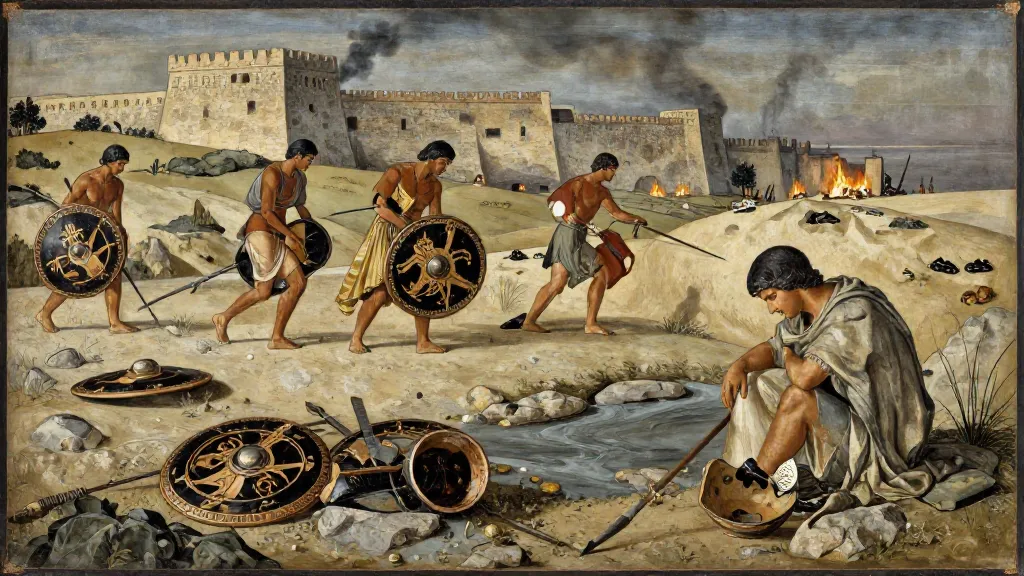
Destruction in Sicily — Attic red-figure pottery painting

Thucydides · Book VII, Chapters 75–87

Destruction in Sicily

Ἡ Καταστροφὴ ἐν Σικελίᾳ

2,842 words · 598 unique lemmas

View:

Hover over any Greek word for its dictionary form and definition

μετὰ δὲ τοῦτο ἐπειδὴ ἐδόκει τῷ Νικίᾳ καὶ τῷ Δημοσθένει ἱκανῶς παρεσκευάσθαι καὶ ἀνάστασις ἤδη τοῦ στρατεύματος τρίτῃ ἡμέρᾳ ἀπὸ τῆς ναυμαχίας ἐγίγνετο [ ] δεινὸν οὖν ἦν οὐ καθ᾽ ἓν μόνον τῶν πραγμάτων ὅτι τάς τε ναῦς ἀπολωλεκότες πάσας ἀπεχώρουν καὶ ἀντὶ μεγάλης ἐλπίδος καὶ αὐτοὶ καὶ πόλις κινδυνεύοντες ἀλλὰ καὶ ἐν τῇ ἀπολείψει τοῦ στρατοπέδου ξυνέβαινε τῇ τε ὄψει ἑκάστῳ ἀλγεινὰ καὶ τῇ γνώμῃ αἰσθέσθαι [ ] τῶν τε γὰρ νεκρῶν ἀτάφων ὄντων ὁπότε τις ἴδοι τινὰ τῶν ἐπιτηδείων κείμενον ἐς λύπην μετὰ φόβου καθίστατο καὶ οἱ ζῶντες καταλειπόμενοι τραυματίαι τε καὶ ἀσθενεῖς πολὺ τῶν τεθνεώτων τοῖς ζῶσι λυπηρότεροι ἦσαν καὶ τῶν ἀπολωλότων ἀθλιώτεροι [ ] πρὸς γὰρ ἀντιβολίαν καὶ ὀλοφυρμὸν τραπόμενοι ἐς ἀπορίαν καθίστασαν ἄγειν τε σφᾶς ἀξιοῦντες καὶ ἕνα ἕκαστον ἐπιβοώμενοι εἴ τινά πού τις ἴδοι ἑταίρων οἰκείων τῶν τε ξυσκήνων ἤδη ἀπιόντων ἐκκρεμαννύμενοι καὶ ἐπακολουθοῦντες ἐς ὅσον δύναιντο εἴ τῳ δὲ προλίποι ῥώμη καὶ τὸ σῶμα οὐκ ἄνευ ὀλίγων ἐπιθειασμῶν καὶ οἰμωγῆς ὑπολειπόμενοι ὥστε δάκρυσι πᾶν τὸ στράτευμα πλησθὲν καὶ ἀπορίᾳ τοιαύτῃ μὴ ῥᾳδίως ἀφορμᾶσθαι καίπερ ἐκ πολεμίας τε καὶ μείζω κατὰ δάκρυα τὰ μὲν πεπονθότας ἤδη τὰ δὲ περὶ τῶν ἐν ἀφανεῖ δεδιότας μὴ πάθωσιν [ ] κατήφειά τέ τις ἅμα καὶ κατάμεμψις σφῶν αὐτῶν πολλὴ ἦν οὐδὲν γὰρ ἄλλο πόλει ἐκπεπολιορκημένῃ ἐῴκεσαν ὑποφευγούσῃ καὶ ταύτῃ οὐ σμικρᾷ μυριάδες γὰρ τοῦ ξύμπαντος ὄχλου οὐκ ἐλάσσους τεσσάρων ἅμα ἐπορεύοντο καὶ τούτων οἵ τε ἄλλοι πάντες ἔφερον ὅτι τις ἐδύνατο ἕκαστος χρήσιμον καὶ οἱ ὁπλῖται καὶ οἱ ἱππῆς παρὰ τὸ εἰωθὸς αὐτοὶ τὰ σφέτερα αὐτῶν σιτία ὑπὸ τοῖς ὅπλοις οἱ μὲν ἀπορίᾳ ἀκολούθων οἱ δὲ ἀπιστίᾳ ἀπηυτομολήκεσαν γὰρ πάλαι τε καὶ οἱ πλεῖστοι παραχρῆμα ἔφερον δὲ οὐδὲ ταῦτα ἱκανά σῖτος γὰρ οὐκέτι ἦν ἐν τῷ στρατοπέδῳ [ ] καὶ μὴν ἄλλη αἰκία καὶ ἰσομοιρία τῶν κακῶν ἔχουσά τινα ὅμως τὸ μετὰ πολλῶν κούφισιν οὐδ᾽ ὣς ῥᾳδία ἐν τῷ παρόντι ἐδοξάζετο ἄλλως τε καὶ ἀπὸ οἵας λαμπρότητος καὶ αὐχήματος τοῦ πρώτου ἐς οἵαν τελευτὴν καὶ ταπεινότητα ἀφῖκτο [ ] μέγιστον γὰρ δὴ τὸ διάφορον τοῦτο [τῷ] Ἑλληνικῷ στρατεύματι ἐγένετο οἷς ἀντὶ μὲν τοῦ ἄλλους δουλωσομένους ἥκειν αὐτοὺς τοῦτο μᾶλλον δεδιότας μὴ πάθωσι ξυνέβη ἀπιέναι ἀντὶ δ᾽ εὐχῆς τε καὶ παιάνων μεθ᾽ ὧν ἐξέπλεον πάλιν τούτων τοῖς ἐναντίοις ἐπιφημίσμασιν ἀφορμᾶσθαι πεζούς τε ἀντὶ ναυβατῶν πορευομένους καὶ ὁπλιτικῷ προσέχοντας μᾶλλον ναυτικῷ ὅμως δὲ ὑπὸ μεγέθους τοῦ ἐπικρεμαμένου ἔτι κινδύνου πάντα ταῦτα αὐτοῖς οἰστὰ ἐφαίνετο

ὁρῶν δὲ Νικίας τὸ στράτευμα ἀθυμοῦν καὶ ἐν μεγάλῃ μεταβολῇ ὄν ἐπιπαριὼν ὡς ἐκ τῶν ὑπαρχόντων ἐθάρσυνέ τε καὶ παρεμυθεῖτο βοῇ τε χρώμενος ἔτι μᾶλλον ἑκάστοις καθ᾽ οὓς γίγνοιτο ὑπὸ προθυμίας καὶ βουλόμενος ὡς ἐπὶ πλεῖστον γεγωνίσκων ὠφελεῖν τι

καὶ ἐκ τῶν παρόντων Ἀθηναῖοι καὶ ξύμμαχοι ἐλπίδα χρὴ ἔχειν ἤδη τινὲς καὶ ἐκ δεινοτέρων τοιῶνδε ἐσώθησαν μηδὲ καταμέμφεσθαι ὑμᾶς ἄγαν αὐτοὺς μήτε ταῖς ξυμφοραῖς μήτε ταῖς παρὰ τὴν ἀξίαν νῦν κακοπαθίαις [ ] κἀγώ τοι οὐδενὸς ὑμῶν οὔτε ῥώμῃ προφέρων ἀλλ᾽ ὁρᾶτε δὴ ὡς διάκειμαι ὑπὸ τῆς νόσου οὔτ᾽ εὐτυχίᾳ δοκῶν που ὕστερός του εἶναι κατά τε τὸν ἴδιον βίον καὶ ἐς τὰ ἄλλα νῦν ἐν τῷ αὐτῷ κινδύνῳ τοῖς φαυλοτάτοις αἰωροῦμαι καίτοι πολλὰ μὲν ἐς θεοὺς νόμιμα δεδιῄτημαι πολλὰ δὲ ἐς ἀνθρώπους δίκαια καὶ ἀνεπίφθονα [ ] ἀνθ᾽ ὧν μὲν ἐλπὶς ὅμως θρασεῖα τοῦ μέλλοντος αἱ δὲ ξυμφοραὶ οὐ κατ᾽ ἀξίαν δὴ φοβοῦσιν τάχα δὲ ἂν καὶ λωφήσειαν ἱκανὰ γὰρ τοῖς τε πολεμίοις ηὐτύχηται καὶ εἴ τῳ θεῶν ἐπίφθονοι ἐστρατεύσαμεν ἀποχρώντως ἤδη τετιμωρήμεθα [ ] ἦλθον γάρ που καὶ ἄλλοι τινὲς ἤδη ἐφ᾽ ἑτέρους καὶ ἀνθρώπεια δράσαντες ἀνεκτὰ ἔπαθον καὶ ἡμᾶς εἰκὸς νῦν τά τε ἀπὸ τοῦ θεοῦ ἐλπίζειν ἠπιώτερα ἕξειν οἴκτου γὰρ ἀπ᾽ αὐτῶν ἀξιώτεροι ἤδη ἐσμὲν φθόνου καὶ ὁρῶντες ὑμᾶς αὐτοὺς οἷοι ὁπλῖται ἅμα καὶ ὅσοι ξυντεταγμένοι χωρεῖτε μὴ καταπέπληχθε ἄγαν λογίζεσθε δὲ ὅτι αὐτοί τε πόλις εὐθύς ἐστε ὅποι ἂν καθέζησθε καὶ ἄλλη οὐδεμία ὑμᾶς τῶν ἐν Σικελίᾳ οὔτ᾽ ἂν ἐπιόντας δέξαιτο ῥᾳδίως οὔτ᾽ ἂν ἱδρυθέντας που ἐξαναστήσειεν [ ] τὴν δὲ πορείαν ὥστ᾽ ἀσφαλῆ καὶ εὔτακτον εἶναι αὐτοὶ φυλάξατε μὴ ἄλλο τι ἡγησάμενος ἕκαστος ἐν ἂν ἀναγκασθῇ χωρίῳ μάχεσθαι τοῦτο καὶ πατρίδα καὶ τεῖχος κρατήσας ἕξειν [ ] σπουδὴ δὲ ὁμοίως καὶ νύκτα καὶ ἡμέραν ἔσται τῆς ὁδοῦ τὰ γὰρ ἐπιτήδεια βραχέα ἔχομεν καὶ ἢν ἀντιλαβώμεθά του φιλίου χωρίου τῶν Σικελῶν οὗτοι γὰρ ἡμῖν διὰ τὸ Συρακοσίων δέος ἔτι βέβαιοι εἰσίν ἤδη νομίζετε ἐν τῷ ἐχυρῷ εἶναι προπέπεμπται δ᾽ ὡς αὐτούς καὶ ἀπαντᾶν εἰρημένον καὶ σιτία ἄλλα κομίζειν [ ] τό τε ξύμπαν γνῶτε ἄνδρες στρατιῶται ἀναγκαῖόν τε ὂν ὑμῖν ἀνδράσιν ἀγαθοῖς γίγνεσθαι ὡς μὴ ὄντος χωρίου ἐγγὺς ὅποι ἂν μαλακισθέντες σωθείητε καί ἢν νῦν διαφύγητε τοὺς πολεμίους οἵ τε ἄλλοι τευξόμενοι ὧν ἐπιθυμεῖτέ που ἐπιδεῖν καὶ οἱ Ἀθηναῖοι τὴν μεγάλην δύναμιν τῆς πόλεως καίπερ πεπτωκυῖαν ἐπανορθώσοντες ἄνδρες γὰρ πόλις καὶ οὐ τείχη οὐδὲ νῆες ἀνδρῶν κεναί

μὲν Νικίας τοιάδε παρακελευόμενος ἅμα ἐπῄει τὸ στράτευμα καὶ εἴ πῃ ὁρῴη διεσπασμένον καὶ μὴ ἐν τάξει χωροῦν ξυνάγων καὶ καθιστάς καὶ Δημοσθένης οὐδὲν ἧσσον τοῖς καθ᾽ ἑαυτὸν τοιαῦτά τε καὶ παραπλήσια λέγων [ ] τὸ δὲ ἐχώρει ἐν πλαισίῳ τεταγμένον πρῶτον μὲν ἡγούμενον τὸ Νικίου ἐφεπόμενον δὲ τὸ Δημοσθένους τοὺς δὲ σκευοφόρους καὶ τὸν πλεῖστον ὄχλον ἐντὸς εἶχον οἱ ὁπλῖται [ ] καὶ ἐπειδή [τε] ἐγένοντο ἐπὶ τῇ διαβάσει τοῦ Ἀνάπου ποταμοῦ ηὗρον ἐπ᾽ αὐτῷ παρατεταγμένους τῶν Συρακοσίων καὶ ξυμμάχων καὶ τρεψάμενοι αὐτοὺς καὶ κρατήσαντες τοῦ πόρου ἐχώρουν ἐς τὸ πρόσθεν οἱ δὲ Συρακόσιοι παριππεύοντές τε προσέκειντο καὶ ἐσακοντίζοντες οἱ ψιλοί [ ] καὶ ταύτῃ μὲν τῇ ἡμέρᾳ προελθόντες σταδίους ὡς τεσσαράκοντα ηὐλίσαντο πρὸς λόφῳ τινὶ οἱ Ἀθηναῖοι τῇ δ᾽ ὑστεραίᾳ πρῲ ἐπορεύοντο καὶ προῆλθον ὡς εἴκοσι σταδίους καὶ κατέβησαν ἐς χωρίον ἄπεδόν τι καὶ αὐτοῦ ἐστρατοπεδεύσαντο βουλόμενοι ἔκ τε τῶν οἰκιῶν λαβεῖν τι ἐδώδιμον ᾠκεῖτο γὰρ χῶρος καὶ ὕδωρ μετὰ σφῶν αὐτῶν φέρεσθαι αὐτόθεν ἐν γὰρ τῷ πρόσθεν ἐπὶ πολλὰ στάδια ἔμελλον ἰέναι οὐκ ἄφθονον ἦν [ ] οἱ δὲ Συρακόσιοι ἐν τούτῳ προελθόντες τὴν δίοδον τὴν ἐν τῷ πρόσθεν ἀπετείχιζον ἦν δὲ λόφος καρτερὸς καὶ ἑκατέρωθεν αὐτοῦ χαράδρα κρημνώδης ἐκαλεῖτο δὲ Ἀκραῖον λέπας [ ] τῇ δ᾽ ὑστεραίᾳ οἱ Ἀθηναῖοι προῇσαν καὶ οἱ τῶν Συρακοσίων καὶ ξυμμάχων αὐτοὺς ἱππῆς καὶ ἀκοντισταὶ ὄντες πολλοὶ ἑκατέρωθεν ἐκώλυον καὶ ἐσηκόντιζόν τε καὶ παρίππευον καὶ χρόνον μὲν πολὺν ἐμάχοντο οἱ Ἀθηναῖοι ἔπειτα ἀνεχώρησαν πάλιν ἐς τὸ αὐτὸ στρατόπεδον καὶ τὰ ἐπιτήδεια οὐκέτι ὁμοίως εἶχον οὐ γὰρ ἔτι ἀποχωρεῖν οἷόν τ᾽ ἦν ὑπὸ τῶν ἱππέων

πρῲ δὲ ἄραντες ἐπορεύοντο αὖθις καὶ ἐβιάσαντο πρὸς τὸν λόφον ἐλθεῖν τὸν ἀποτετειχισμένον καὶ ηὗρον πρὸ ἑαυτῶν ὑπὲρ τοῦ ἀποτειχίσματος τὴν πεζὴν στρατιὰν παρατεταγμένην οὐκ ἐπ᾽ ὀλίγων ἀσπίδων στενὸν γὰρ ἦν τὸ χωρίον [ ] καὶ προσβαλόντες οἱ Ἀθηναῖοι ἐτειχομάχουν καὶ βαλλόμενοι ὑπὸ πολλῶν ἀπὸ τοῦ λόφου ἐπάντους ὄντος διικνοῦντο γὰρ ῥᾷον οἱ ἄνωθεν καὶ οὐ δυνάμενοι βιάσασθαι ἀνεχώρουν πάλιν καὶ ἀνεπαύοντο [ ] ἔτυχον δὲ καὶ βρονταί τινες ἅμα γενόμεναι καὶ ὕδωρ οἷα τοῦ ἔτους πρὸς μετόπωρον ἤδη ὄντος φιλεῖ γίγνεσθαι ἀφ᾽ ὧν οἱ Ἀθηναῖοι μᾶλλον ἔτι ἠθύμουν καὶ ἐνόμιζον ἐπὶ τῷ σφετέρῳ ὀλέθρῳ καὶ ταῦτα πάντα γίγνεσθαι [ ] ἀναπαυομένων δ᾽ αὐτῶν Γύλιππος καὶ οἱ Συρακόσιοι πέμπουσι μέρος τι τῆς στρατιᾶς ἀποτειχιοῦντας αὖ ἐκ τοῦ ὄπισθεν αὐτοὺς προεληλύθεσαν ἀντιπέμψαντες δὲ κἀκεῖνοι σφῶν αὐτῶν τινὰς διεκώλυσαν [ ] καὶ μετὰ ταῦτα πάσῃ τῇ στρατιᾷ ἀναχωρήσαντες πρὸς τὸ πεδίον μᾶλλον οἱ Ἀθηναῖοι ηὐλίσαντο τῇ δ᾽ ὑστεραίᾳ προυχώρουν καὶ οἱ Συρακόσιοι προσέβαλλόν τε πανταχῇ αὐτοῖς κύκλῳ καὶ πολλοὺς κατετραυμάτιζον καὶ εἰ μὲν ἐπίοιεν οἱ Ἀθηναῖοι ὑπεχώρουν εἰ δ᾽ ἀναχωροῖεν ἐπέκειντο καὶ μάλιστα τοῖς ὑστάτοις προσπίπτοντες εἴ πως κατὰ βραχὺ τρεψάμενοι πᾶν τὸ στράτευμα φοβήσειαν [ ] καὶ ἐπὶ πολὺ μὲν τοιούτῳ τρόπῳ ἀντεῖχον οἱ Ἀθηναῖοι ἔπειτα προελθόντες πέντε ἓξ σταδίους ἀνεπαύοντο ἐν τῷ πεδίῳ ἀνεχώρησαν δὲ καὶ οἱ Συρακόσιοι ἀπ᾽ αὐτῶν ἐς τὸ ἑαυτῶν στρατόπεδον

τῆς δὲ νυκτὸς τῷ Νικίᾳ καὶ Δημοσθένει ἐδόκει ἐπειδὴ κακῶς σφίσι τὸ στράτευμα εἶχε τῶν τε ἐπιτηδείων πάντων ἀπορίᾳ ἤδη καὶ κατατετραυματισμένοι ἦσαν πολλοὶ ἐν πολλαῖς προσβολαῖς τῶν πολεμίων γεγενημέναις πυρὰ καύσαντας ὡς πλεῖστα ἀπάγειν τὴν στρατιάν μηκέτι τὴν αὐτὴν ὁδὸν διενοήθησαν ἀλλὰ τοὐναντίον οἱ Συρακόσιοι ἐτήρουν πρὸς τὴν θάλασσαν [ ] ἦν δὲ ξύμπασα ὁδὸς αὕτη οὐκ ἐπὶ Κατάνης τῷ στρατεύματι ἀλλὰ κατὰ τὸ ἕτερον μέρος τῆς Σικελίας τὸ πρὸς Καμάριναν καὶ Γέλαν καὶ τὰς ταύτῃ πόλεις καὶ Ἑλληνίδας καὶ βαρβάρους [ ] καύσαντες οὖν πυρὰ πολλὰ ἐχώρουν ἐν τῇ νυκτί καὶ αὐτοῖς οἷον φιλεῖ καὶ πᾶσι στρατοπέδοις μάλιστα δὲ τοῖς μεγίστοις φόβοι καὶ δείματα ἐγγίγνεσθαι ἄλλως τε καὶ ἐν νυκτί τε καὶ διὰ πολεμίας καὶ ἀπὸ πολεμίων οὐ πολὺ ἀπεχόντων ἰοῦσιν ἐμπίπτει ταραχή [ ] καὶ τὸ μὲν Νικίου στράτευμα ὥσπερ ἡγεῖτο ξυνέμενέ τε καὶ προύλαβε πολλῷ τὸ δὲ Δημοσθένους τὸ ἥμισυ μάλιστα καὶ πλέον ἀπεσπάσθη τε καὶ ἀτακτότερον ἐχώρει [ ] ἅμα δὲ τῇ ἕῳ ἀφικνοῦνται ὅμως πρὸς τὴν θάλασσαν καὶ ἐσβάντες ἐς τὴν ὁδὸν τὴν Ἑλωρίνην καλουμένην ἐπορεύοντο ὅπως ἐπειδὴ γένοιντο ἐπὶ τῷ ποταμῷ τῷ Κακυπάρει παρὰ τὸν ποταμὸν ἴοιεν ἄνω διὰ μεσογείας ἤλπιζον γὰρ καὶ τοὺς Σικελοὺς ταύτῃ οὓς μετεπέμψαντο ἀπαντήσεσθαι [ ] ἐπειδὴ δ᾽ ἐγένοντο ἐπὶ τῷ ποταμῷ ηὗρον καὶ ἐνταῦθα φυλακήν τινα τῶν Συρακοσίων ἀποτειχίζουσάν τε καὶ ἀποσταυροῦσαν τὸν πόρον καὶ βιασάμενοι αὐτὴν διέβησάν τε τὸν ποταμὸν καὶ ἐχώρουν αὖθις πρὸς ἄλλον ποταμὸν τὸν Ἐρινεόν ταύτῃ γὰρ οἱ ἡγεμόνες ἐκέλευον

ἐν τούτῳ δ᾽ οἱ Συρακόσιοι καὶ οἱ ξύμμαχοι ὡς τε ἡμέρα ἐγένετο καὶ ἔγνωσαν τοὺς Ἀθηναίους ἀπεληλυθότας ἐν αἰτίᾳ τε οἱ πολλοὶ τὸν Γύλιππον εἶχον ἑκόντα ἀφεῖναι τοὺς Ἀθηναίους καὶ κατὰ τάχος διώκοντες οὐ χαλεπῶς ᾐσθάνοντο κεχωρηκότας καταλαμβάνουσι περὶ ἀρίστου ὥραν [ ] καὶ ὡς προσέμειξαν τοῖς μετὰ τοῦ Δημοσθένους ὑστέροις τ᾽ οὖσι καὶ σχολαίτερον καὶ ἀτακτότερον χωροῦσιν ὡς τῆς νυκτὸς τότε ξυνεταράχθησαν εὐθὺς προσπεσόντες ἐμάχοντο καὶ οἱ ἱππῆς τῶν Συρακοσίων ἐκυκλοῦντό τε ῥᾷον αὐτοὺς δίχα δὴ ὄντας καὶ ξυνῆγον ἐς ταὐτό [ ] τὸ δὲ Νικίου στράτευμα ἀπεῖχεν ἐν τῷ πρόσθεν καὶ πεντήκοντα σταδίους θᾶσσόν τε γὰρ Νικίας ἦγε νομίζων οὐ τὸ ὑπομένειν ἐν τῷ τοιούτῳ ἑκόντας εἶναι καὶ μάχεσθαι σωτηρίαν ἀλλὰ τὸ ὡς τάχιστα ὑποχωρεῖν τοσαῦτα μαχομένους ὅσα ἀναγκάζονται [ ] δὲ Δημοσθένης ἐτύγχανέ τε τὰ πλείω ἐν πόνῳ ξυνεχεστέρῳ ὢν διὰ τὸ ὑστέρῳ ἀναχωροῦντι αὐτῷ πρώτῳ ἐπικεῖσθαι τοὺς πολεμίους καὶ τότε γνοὺς τοὺς Συρακοσίους διώκοντας οὐ προυχώρει μᾶλλον ἐς μάχην ξυνετάσσετο ἕως ἐνδιατρίβων κυκλοῦταί τε ὑπ᾽ αὐτῶν καὶ ἐν πολλῷ θορύβῳ αὐτός τε καὶ οἱ μετ᾽ αὐτοῦ Ἀθηναῖοι ἦσαν ἀνειληθέντες γὰρ ἔς τι χωρίον κύκλῳ μὲν τειχίον περιῆν ὁδὸς δὲ ἔνθεν [τε] καὶ ἔνθεν ἐλάας δὲ οὐκ ὀλίγας εἶχεν ἐβάλλοντο περισταδόν [ ] τοιαύταις δὲ προσβολαῖς καὶ οὐ ξυσταδὸν μάχαις οἱ Συρακόσιοι εἰκότως ἐχρῶντο τὸ γὰρ ἀποκινδυνεύειν πρὸς ἀνθρώπους ἀπονενοημένους οὐ πρὸς ἐκείνων μᾶλλον ἦν ἔτι πρὸς τῶν Ἀθηναίων καὶ ἅμα φειδώ τέ τις ἐγίγνετο ἐπ᾽ εὐπραγίᾳ ἤδη σαφεῖ μὴ προαναλωθῆναί τῳ καὶ ἐνόμιζον καὶ ὣς ταύτῃ τῇ ἰδέᾳ καταδαμασάμενοι λήψεσθαι αὐτούς

ἐπειδὴ δ᾽ οὖν δι᾽ ἡμέρας βάλλοντες πανταχόθεν τοὺς Ἀθηναίους καὶ ξυμμάχους ἑώρων ἤδη τεταλαιπωρημένους τοῖς τε τραύμασι καὶ τῇ ἄλλῃ κακώσει κήρυγμα ποιοῦνται Γύλιππος καὶ Συρακόσιοι καὶ οἱ ξύμμαχοι πρῶτον μὲν τῶν νησιωτῶν εἴ τις βούλεται ἐπ᾽ ἐλευθερίᾳ ὡς σφᾶς ἀπιέναι καὶ ἀπεχώρησάν τινες πόλεις οὐ πολλαί [ ] ἔπειτα δ᾽ ὕστερον καὶ πρὸς τοὺς ἄλλους ἅπαντας τοὺς μετὰ Δημοσθένους ὁμολογία γίγνεται ὥστε ὅπλα τε παραδοῦναι καὶ μὴ ἀποθανεῖν μηδένα μήτε βιαίως μήτε δεσμοῖς μήτε τῆς ἀναγκαιοτάτης ἐνδείᾳ διαίτης [ ] καὶ παρέδοσαν οἱ πάντες σφᾶς αὐτοὺς ἑξακισχίλιοι καὶ τὸ ἀργύριον εἶχον ἅπαν κατέθεσαν ἐσβαλόντες ἐς ἀσπίδας ὑπτίας καὶ ἐνέπλησαν ἀσπίδας τέσσαρας καὶ τούτους μὲν εὐθὺς ἀπεκόμιζον ἐς τὴν πόλιν Νικίας δὲ καὶ οἱ μετ᾽ αὐτοῦ ταύτῃ τῇ ἡμέρᾳ ἀφικνοῦνται ἐπὶ τὸν ποταμὸν τὸν Ἐρινεόν καὶ διαβὰς πρὸς μετέωρόν τι καθῖσε τὴν στρατιάν

οἱ δὲ Συρακόσιοι τῇ ὑστεραίᾳ καταλαβόντες αὐτὸν ἔλεγον ὅτι οἱ μετὰ Δημοσθένους παραδεδώκοιεν σφᾶς αὐτούς κελεύοντες κἀκεῖνον τὸ αὐτὸ δρᾶν δ᾽ ἀπιστῶν σπένδεται ἱππέα πέμψαι σκεψόμενον [ ] ὡς δ᾽ οἰχόμενος ἀπήγγειλε πάλιν παραδεδωκότας ἐπικηρυκεύεται Γυλίππῳ καὶ Συρακοσίοις εἶναι ἑτοῖμος ὑπὲρ Ἀθηναίων ξυμβῆναι ὅσα ἀνήλωσαν χρήματα Συρακόσιοι ἐς τὸν πόλεμον ταῦτα ἀποδοῦναι ὥστε τὴν μετ᾽ αὐτοῦ στρατιὰν ἀφεῖναι αὐτούς μέχρι οὗ δ᾽ ἂν τὰ χρήματα ἀποδοθῇ ἄνδρας δώσειν Ἀθηναίων ὁμήρους ἕνα κατὰ τάλαντον [ ] οἱ δὲ Συρακόσιοι καὶ Γύλιππος οὐ προσεδέχοντο τοὺς λόγους ἀλλὰ προσπεσόντες καὶ περιστάντες πανταχόθεν ἔβαλλον καὶ τούτους μέχρι ὀψέ [ ] εἶχον δὲ καὶ οὗτοι πονηρῶς σίτου τε καὶ τῶν ἐπιτηδείων ἀπορίᾳ ὅμως δὲ τῆς νυκτὸς φυλάξαντες τὸ ἡσυχάζον ἔμελλον πορεύσεσθαι καὶ ἀναλαμβάνουσί τε τὰ ὅπλα καὶ οἱ Συρακόσιοι αἰσθάνονται καὶ ἐπαιάνισαν [ ] γνόντες δὲ οἱ Ἀθηναῖοι ὅτι οὐ λανθάνουσι κατέθεντο πάλιν πλὴν τριακοσίων μάλιστα ἀνδρῶν οὗτοι δὲ διὰ τῶν φυλάκων βιασάμενοι ἐχώρουν τῆς νυκτὸς ἐδύναντο

Νικίας δ᾽ ἐπειδὴ ἡμέρα ἐγένετο ἦγε τὴν στρατιάν οἱ δὲ Συρακόσιοι καὶ οἱ ξύμμαχοι προσέκειντο τὸν αὐτὸν τρόπον πανταχόθεν βάλλοντές τε καὶ κατακοντίζοντες [ ] καὶ οἱ Ἀθηναῖοι ἠπείγοντο πρὸς τὸν Ἀσσίναρον ποταμόν ἅμα μὲν βιαζόμενοι ὑπὸ τῆς πανταχόθεν προσβολῆς ἱππέων τε πολλῶν καὶ τοῦ ἄλλου ὄχλου οἰόμενοι ῥᾷόν τι σφίσιν ἔσεσθαι ἢν διαβῶσι τὸν ποταμόν ἅμα δ᾽ ὑπὸ τῆς ταλαιπωρίας καὶ τοῦ πιεῖν ἐπιθυμίᾳ [ ] ὡς δὲ γίγνονται ἐπ᾽ αὐτῷ ἐσπίπτουσιν οὐδενὶ κόσμῳ ἔτι ἀλλὰ πᾶς τέ τις διαβῆναι αὐτὸς πρῶτος βουλόμενος καὶ οἱ πολέμιοι ἐπικείμενοι χαλεπὴν ἤδη τὴν διάβασιν ἐποίουν ἁθρόοι γὰρ ἀναγκαζόμενοι χωρεῖν ἐπέπιπτόν τε ἀλλήλοις καὶ κατεπάτουν περί τε τοῖς δορατίοις καὶ σκεύεσιν οἱ μὲν εὐθὺς διεφθείροντο οἱ δὲ ἐμπαλασσόμενοι κατέρρεον [ ] ἐς τὰ ἐπὶ θάτερά τε τοῦ ποταμοῦ παραστάντες οἱ Συρακόσιοι ἦν δὲ κρημνῶδες ἔβαλλον ἄνωθεν τοὺς Ἀθηναίους πίνοντάς τε τοὺς πολλοὺς ἀσμένους καὶ ἐν κοίλῳ ὄντι τῷ ποταμῷ ἐν σφίσιν αὐτοῖς ταρασσομένους [ ] οἵ τε Πελοποννήσιοι ἐπικαταβάντες τοὺς ἐν τῷ ποταμῷ μάλιστα ἔσφαζον καὶ τὸ ὕδωρ εὐθὺς διέφθαρτο ἀλλ᾽ οὐδὲν ἧσσον ἐπίνετό τε ὁμοῦ τῷ πηλῷ ᾑματωμένον καὶ περιμάχητον ἦν τοῖς πολλοῖς

τέλος δὲ νεκρῶν τε πολλῶν ἐπ᾽ ἀλλήλοις ἤδη κειμένων ἐν τῷ ποταμῷ καὶ διεφθαρμένου τοῦ στρατεύματος τοῦ μὲν κατὰ τὸν ποταμόν τοῦ δὲ καί εἴ τι διαφύγοι ὑπὸ τῶν ἱππέων Νικίας Γυλίππῳ ἑαυτὸν παραδίδωσι πιστεύσας μᾶλλον αὐτῷ τοῖς Συρακοσίοις καὶ ἑαυτῷ μὲν χρήσασθαι ἐκέλευεν ἐκεῖνόν τε καὶ Λακεδαιμονίους ὅτι βούλονται τοὺς δὲ ἄλλους στρατιώτας παύσασθαι φονεύοντας [ ] καὶ Γύλιππος μετὰ τοῦτο ζωγρεῖν ἤδη ἐκέλευεν καὶ τούς τε λοιποὺς ὅσους μὴ ἀπεκρύψαντο πολλοὶ δὲ οὗτοι ἐγένοντο ξυνεκόμισαν ζῶντας καὶ ἐπὶ τοὺς τριακοσίους οἳ τὴν φυλακὴν διεξῆλθον τῆς νυκτός πέμψαντες τοὺς διωξομένους ξυνέλαβον [ ] τὸ μὲν οὖν ἁθροισθὲν τοῦ στρατεύματος ἐς τὸ κοινὸν οὐ πολὺ ἐγένετο τὸ δὲ διακλαπὲν πολύ καὶ διεπλήσθη πᾶσα Σικελία αὐτῶν ἅτε οὐκ ἀπὸ ξυμβάσεως ὥσπερ τῶν μετὰ Δημοσθένους ληφθέντων [ ] μέρος δέ τι οὐκ ὀλίγον καὶ ἀπέθανεν πλεῖστος γὰρ δὴ φόνος οὗτος καὶ οὐδενὸς ἐλάσσων τῶν ἐν τῷ [Σικελικῷ] πολέμῳ τούτῳ ἐγένετο καὶ ἐν ταῖς ἄλλαις προσβολαῖς ταῖς κατὰ τὴν πορείαν συχναῖς γενομέναις οὐκ ὀλίγοι ἐτεθνήκεσαν πολλοὶ δὲ ὅμως καὶ διέφυγον οἱ μὲν καὶ παραυτίκα οἱ δὲ καὶ δουλεύσαντες καὶ διαδιδράσκοντες ὕστερον τούτοις δ᾽ ἦν ἀναχώρησις ἐς Κατάνην

ξυναθροισθέντες δὲ οἱ Συρακόσιοι καὶ οἱ ξύμμαχοι τῶν τε αἰχμαλώτων ὅσους ἐδύναντο πλείστους καὶ τὰ σκῦλα ἀναλαβόντες ἀνεχώρησαν ἐς τὴν πόλιν [ ] καὶ τοὺς μὲν ἄλλους Ἀθηναίων καὶ τῶν ξυμμάχων ὁπόσους ἔλαβον κατεβίβασαν ἐς τὰς λιθοτομίας ἀσφαλεστάτην εἶναι νομίσαντες τήρησιν Νικίαν δὲ καὶ Δημοσθένη ἄκοντος τοῦ Γυλίππου ἀπέσφαξαν γὰρ Γύλιππος καλὸν τὸ ἀγώνισμα ἐνόμιζέν οἱ εἶναι ἐπὶ τοῖς ἄλλοις καὶ τοὺς ἀντιστρατήγους κομίσαι Λακεδαιμονίοις [ ] ξυνέβαινε δὲ τὸν μὲν πολεμιώτατον αὐτοῖς εἶναι Δημοσθένη διὰ τὰ ἐν τῇ νήσῳ καὶ Πύλῳ τὸν δὲ διὰ τὰ αὐτὰ ἐπιτηδειότατον τοὺς γὰρ ἐκ τῆς νήσου ἄνδρας τῶν Λακεδαιμονίων Νικίας προυθυμήθη σπονδὰς πείσας τοὺς Ἀθηναίους ποιήσασθαι ὥστε ἀφεθῆναι [ ] ἀνθ᾽ ὧν οἵ τε Λακεδαιμόνιοι ἦσαν αὐτῷ προσφιλεῖς κἀκεῖνος οὐχ ἥκιστα διὰ τοῦτο πιστεύσας ἑαυτὸν τῷ Γυλίππῳ παρέδωκεν ἀλλὰ τῶν Συρακοσίων τινές ὡς ἐλέγετο οἱ μὲν δείσαντες ὅτι πρὸς αὐτὸν ἐκεκοινολόγηντο μὴ βασανιζόμενος διὰ τὸ τοιοῦτο ταραχὴν σφίσιν ἐν εὐπραγίᾳ ποιήσῃ ἄλλοι δέ καὶ οὐχ ἥκιστα οἱ Κορίνθιοι μὴ χρήμασι δὴ πείσας τινάς ὅτι πλούσιος ἦν ἀποδρᾷ καὶ αὖθις σφίσι νεώτερόν τι ἀπ᾽ αὐτοῦ γένηται πείσαντες τοὺς ξυμμάχους ἀπέκτειναν αὐτόν [ ] καὶ μὲν τοιαύτῃ ὅτι ἐγγύτατα τούτων αἰτίᾳ ἐτεθνήκει ἥκιστα δὴ ἄξιος ὢν τῶν γε ἐπ᾽ ἐμοῦ Ἑλλήνων ἐς τοῦτο δυστυχίας ἀφικέσθαι διὰ τὴν πᾶσαν ἐς ἀρετὴν νενομισμένην ἐπιτήδευσιν

τοὺς δ᾽ ἐν ταῖς λιθοτομίαις οἱ Συρακόσιοι χαλεπῶς τοὺς πρώτους χρόνους μετεχείρισαν ἐν γὰρ κοίλῳ χωρίῳ ὄντας καὶ ὀλίγῳ πολλοὺς οἵ τε ἥλιοι τὸ πρῶτον καὶ τὸ πνῖγος ἔτι ἐλύπει διὰ τὸ ἀστέγαστον καὶ αἱ νύκτες ἐπιγιγνόμεναι τοὐναντίον μετοπωριναὶ καὶ ψυχραὶ τῇ μεταβολῇ ἐς ἀσθένειαν ἐνεωτέριζον [ ] πάντα τε ποιούντων αὐτῶν διὰ στενοχωρίαν ἐν τῷ αὐτῷ καὶ προσέτι τῶν νεκρῶν ὁμοῦ ἐπ᾽ ἀλλήλοις ξυννενημένων οἳ ἔκ τε τῶν τραυμάτων καὶ διὰ τὴν μεταβολὴν καὶ τὸ τοιοῦτον ἀπέθνῃσκον καὶ ὀσμαὶ ἦσαν οὐκ ἀνεκτοί καὶ λιμῷ ἅμα καὶ δίψῃ ἐπιέζοντο ἐδίδοσαν γὰρ αὐτῶν ἑκάστῳ ἐπὶ ὀκτὼ μῆνας κοτύλην ὕδατος καὶ δύο κοτύλας σίτου ἄλλα τε ὅσα εἰκὸς ἐν τῷ τοιούτῳ χωρίῳ ἐμπεπτωκότας κακοπαθῆσαι οὐδὲν ὅτι οὐκ ἐπεγένετο αὐτοῖς [ ] καὶ ἡμέρας μὲν ἑβδομήκοντά τινας οὕτω διῃτήθησαν ἁθρόοι ἔπειτα πλὴν Ἀθηναίων καὶ εἴ τινες Σικελιωτῶν Ἰταλιωτῶν ξυνεστράτευσαν τοὺς ἄλλους ἀπέδοντο [ ] ἐλήφθησαν δὲ οἱ ξύμπαντες ἀκριβείᾳ μὲν χαλεπὸν ἐξειπεῖν ὅμως δὲ οὐκ ἐλάσσους ἑπτακισχιλίων [ ] ξυνέβη τε ἔργον τοῦτο [Ἑλληνικὸν] τῶν κατὰ τὸν πόλεμον τόνδε μέγιστον γενέσθαι δοκεῖν δ᾽ ἔμοιγε καὶ ὧν ἀκοῇ Ἑλληνικῶν ἴσμεν καὶ τοῖς τε κρατήσασι λαμπρότατον καὶ τοῖς διαφθαρεῖσι δυστυχέστατον [ ] κατὰ πάντα γὰρ πάντως νικηθέντες καὶ οὐδὲν ὀλίγον ἐς οὐδὲν κακοπαθήσαντες πανωλεθρίᾳ δὴ τὸ λεγόμενον καὶ πεζὸς καὶ νῆες καὶ οὐδὲν ὅτι οὐκ ἀπώλετο καὶ ὀλίγοι ἀπὸ πολλῶν ἐπ᾽ οἴκου ἀπενόστησαν ταῦτα μὲν τὰ περὶ Σικελίαν γενόμενα

The Sicilian Expedition: Defeat and Destruction (Book VII)

BOOK VII

CHAPTER XXI

Eighteenth and Nineteenth Years of the War—Arrival of Gylippus at

Syracuse—Fortification of Decelea—Successes of the Syracusans

After refitting their ships, Gylippus and Pythen coasted along from

Tarentum to Epizephyrian Locris. They now received the more correct

information that Syracuse was not yet completely invested, but that it

was still possible for an army arriving at Epipolae to effect an

entrance; and they consulted, accordingly, whether they should keep

Sicily on their right and risk sailing in by sea, or, leaving it on

their left, should first sail to Himera and, taking with them the

Himeraeans and any others that might agree to join them, go to Syracuse

by land. Finally they determined to sail for Himera, especially as the

four Athenian ships which Nicias had at length sent off, on hearing

that they were at Locris, had not yet arrived at Rhegium. Accordingly,

before these reached their post, the Peloponnesians crossed the strait

and, after touching at Rhegium and Messina, came to Himera. Arrived

there, they persuaded the Himeraeans to join in the war, and not only

to go with them themselves but to provide arms for the seamen from

their vessels which they had drawn ashore at Himera; and they sent and

appointed a place for the Selinuntines to meet them with all their

forces. A few troops were also promised by the Geloans and some of the

Sicels, who were now ready to join them with much greater alacrity,

owing to the recent death of Archonidas, a powerful Sicel king in that

neighbourhood and friendly to Athens, and owing also to the vigour

shown by Gylippus in coming from Lacedaemon. Gylippus now took with him

about seven hundred of his sailors and marines, that number only having

arms, a thousand heavy infantry and light troops from Himera with a

body of a hundred horse, some light troops and cavalry from Selinus, a

few Geloans, and Sicels numbering a thousand in all, and set out on his

march for Syracuse.

Meanwhile the Corinthian fleet from Leucas made all haste to arrive;

and one of their commanders, Gongylus, starting last with a single

ship, was the first to reach Syracuse, a little before Gylippus.

Gongylus found the Syracusans on the point of holding an assembly to

consider whether they should put an end to the war. This he prevented,

and reassured them by telling them that more vessels were still to

arrive, and that Gylippus, son of Cleandridas, had been dispatched by

the Lacedaemonians to take the command. Upon this the Syracusans took

courage, and immediately marched out with all their forces to meet

Gylippus, who they found was now close at hand. Meanwhile Gylippus,

after taking Ietae, a fort of the Sicels, on his way, formed his army

in order of battle, and so arrived at Epipolae, and ascending by

Euryelus, as the Athenians had done at first, now advanced with the

Syracusans against the Athenian lines. His arrival chanced at a

critical moment. The Athenians had already finished a double wall of

six or seven furlongs to the great harbour, with the exception of a

small portion next the sea, which they were still engaged upon; and in

the remainder of the circle towards Trogilus on the other sea, stones

had been laid ready for building for the greater part of the distance,

and some points had been left half finished, while others were entirely

completed. The danger of Syracuse had indeed been great.

Meanwhile the Athenians, recovering from the confusion into which they

had been first thrown by the sudden approach of Gylippus and the

Syracusans, formed in order of battle. Gylippus halted at a short

distance off and sent on a herald to tell them that, if they would

evacuate Sicily with bag and baggage within five days’ time, he was

willing to make a truce accordingly. The Athenians treated this

proposition with contempt, and dismissed the herald without an answer.

After this both sides began to prepare for action. Gylippus, observing

that the Syracusans were in disorder and did not easily fall into line,

drew off his troops more into the open ground, while Nicias did not

lead on the Athenians but lay still by his own wall. When Gylippus saw

that they did not come on, he led off his army to the citadel of the

quarter of Apollo Temenites, and passed the night there. On the

following day he led out the main body of his army, and, drawing them

up in order of battle before the walls of the Athenians to prevent

their going to the relief of any other quarter, dispatched a strong

force against Fort Labdalum, and took it, and put all whom he found in

it to the sword, the place not being within sight of the Athenians. On

the same day an Athenian galley that lay moored off the harbour was

captured by the Syracusans.

After this the Syracusans and their allies began to carry a single

wall, starting from the city, in a slanting direction up Epipolae, in

order that the Athenians, unless they could hinder the work, might be

no longer able to invest them. Meanwhile the Athenians, having now

finished their wall down to the sea, had come up to the heights; and

part of their wall being weak, Gylippus drew out his army by night and

attacked it. However, the Athenians who happened to be bivouacking

outside took the alarm and came out to meet him, upon seeing which he

quickly led his men back again. The Athenians now built their wall

higher, and in future kept guard at this point themselves, disposing

their confederates along the remainder of the works, at the stations

assigned to them. Nicias also determined to fortify Plemmyrium, a

promontory over against the city, which juts out and narrows the mouth

of the Great Harbour. He thought that the fortification of this place

would make it easier to bring in supplies, as they would be able to

carry on their blockade from a less distance, near to the port occupied

by the Syracusans; instead of being obliged, upon every movement of the

enemy’s navy, to put out against them from the bottom of the great

harbour. Besides this, he now began to pay more attention to the war by

sea, seeing that the coming of Gylippus had diminished their hopes by

land. Accordingly, he conveyed over his ships and some troops, and

built three forts in which he placed most of his baggage, and moored

there for the future the larger craft and men-of-war. This was the

first and chief occasion of the losses which the crews experienced. The

water which they used was scarce and had to be fetched from far, and

the sailors could not go out for firewood without being cut off by the

Syracusan horse, who were masters of the country; a third of the

enemy’s cavalry being stationed at the little town of Olympieum, to

prevent plundering incursions on the part of the Athenians at

Plemmyrium. Meanwhile Nicias learned that the rest of the Corinthian

fleet was approaching, and sent twenty ships to watch for them, with

orders to be on the look-out for them about Locris and Rhegium and the

approach to Sicily.

Gylippus, meanwhile, went on with the wall across Epipolae, using the

stones which the Athenians had laid down for their own wall, and at the

same time constantly led out the Syracusans and their allies, and

formed them in order of battle in front of the lines, the Athenians

forming against him. At last he thought that the moment was come, and

began the attack; and a hand-to-hand fight ensued between the lines,

where the Syracusan cavalry could be of no use; and the Syracusans and

their allies were defeated and took up their dead under truce, while

the Athenians erected a trophy. After this Gylippus called the soldiers

together, and said that the fault was not theirs but his; he had kept

their lines too much within the works, and had thus deprived them of

the services of their cavalry and darters. He would now, therefore,

lead them on a second time. He begged them to remember that in material

force they would be fully a match for their opponents, while, with

respect to moral advantages, it were intolerable if Peloponnesians and

Dorians should not feel confident of overcoming Ionians and islanders

with the motley rabble that accompanied them, and of driving them out

of the country.

After this he embraced the first opportunity that offered of again

leading them against the enemy. Now Nicias and the Athenians held the

opinion that even if the Syracusans should not wish to offer battle, it

was necessary for them to prevent the building of the cross wall, as it

already almost overlapped the extreme point of their own, and if it

went any further it would from that moment make no difference whether

they fought ever so many successful actions, or never fought at all.

They accordingly came out to meet the Syracusans. Gylippus led out his

heavy infantry further from the fortifications than on the former

occasion, and so joined battle; posting his horse and darters upon the

flank of the Athenians in the open space, where the works of the two

walls terminated. During the engagement the cavalry attacked and routed

the left wing of the Athenians, which was opposed to them; and the rest

of the Athenian army was in consequence defeated by the Syracusans and

driven headlong within their lines. The night following the Syracusans

carried their wall up to the Athenian works and passed them, thus

putting it out of their power any longer to stop them, and depriving

them, even if victorious in the field, of all chance of investing the

city for the future.

After this the remaining twelve vessels of the Corinthians, Ambraciots,

and Leucadians sailed into the harbour under the command of Erasinides,

a Corinthian, having eluded the Athenian ships on guard, and helped the

Syracusans in completing the remainder of the cross wall. Meanwhile

Gylippus went into the rest of Sicily to raise land and naval forces,

and also to bring over any of the cities that either were lukewarm in

the cause or had hitherto kept out of the war altogether. Syracusan and

Corinthian envoys were also dispatched to Lacedaemon and Corinth to get

a fresh force sent over, in any way that might offer, either in

merchant vessels or transports, or in any other manner likely to prove

successful, as the Athenians too were sending for reinforcements; while

the Syracusans proceeded to man a fleet and to exercise, meaning to try

their fortune in this way also, and generally became exceedingly

confident.

Nicias perceiving this, and seeing the strength of the enemy and his

own difficulties daily increasing, himself also sent to Athens. He had

before sent frequent reports of events as they occurred, and felt it

especially incumbent upon him to do so now, as he thought that they

were in a critical position, and that, unless speedily recalled or

strongly reinforced from home, they had no hope of safety. He feared,

however, that the messengers, either through inability to speak, or

through failure of memory, or from a wish to please the multitude,

might not report the truth, and so thought it best to write a letter,

to ensure that the Athenians should know his own opinion without its

being lost in transmission, and be able to decide upon the real facts

of the case.

His emissaries, accordingly, departed with the letter and the requisite

verbal instructions; and he attended to the affairs of the army, making

it his aim now to keep on the defensive and to avoid any unnecessary

danger.

At the close of the same summer the Athenian general Euetion marched in

concert with Perdiccas with a large body of Thracians against

Amphipolis, and failing to take it brought some galleys round into the

Strymon, and blockaded the town from the river, having his base at

Himeraeum.

Summer was now over. The winter ensuing, the persons sent by Nicias,

reaching Athens, gave the verbal messages which had been entrusted to

them, and answered any questions that were asked them, and delivered

the letter. The clerk of the city now came forward and read out to the

Athenians the letter, which was as follows:

“Our past operations, Athenians, have been made known to you by many

other letters; it is now time for you to become equally familiar with

our present condition, and to take your measures accordingly. We had

defeated in most of our engagements with them the Syracusans, against

whom we were sent, and we had built the works which we now occupy, when

Gylippus arrived from Lacedaemon with an army obtained from Peloponnese

and from some of the cities in Sicily. In our first battle with him we

were victorious; in the battle on the following day we were overpowered

by a multitude of cavalry and darters, and compelled to retire within

our lines. We have now, therefore, been forced by the numbers of those

opposed to us to discontinue the work of circumvallation, and to remain

inactive; being unable to make use even of all the force we have, since

a large portion of our heavy infantry is absorbed in the defence of our

lines. Meanwhile the enemy have carried a single wall past our lines,

thus making it impossible for us to invest them in future, until this

cross wall be attacked by a strong force and captured. So that the

besieger in name has become, at least from the land side, the besieged

in reality; as we are prevented by their cavalry from even going for

any distance into the country.

“Besides this, an embassy has been dispatched to Peloponnese to procure

reinforcements, and Gylippus has gone to the cities in Sicily, partly

in the hope of inducing those that are at present neutral to join him

in the war, partly of bringing from his allies additional contingents

for the land forces and material for the navy. For I understand that

they contemplate a combined attack, upon our lines with their land

forces and with their fleet by sea. You must none of you be surprised

that I say by sea also. They have discovered that the length of the

time we have now been in commission has rotted our ships and wasted our

crews, and that with the entireness of our crews and the soundness of

our ships the pristine efficiency of our navy has departed. For it is

impossible for us to haul our ships ashore and careen them, because,

the enemy’s vessels being as many or more than our own, we are

constantly anticipating an attack. Indeed, they may be seen exercising,

and it lies with them to take the initiative; and not having to

maintain a blockade, they have greater facilities for drying their

ships.

“This we should scarcely be able to do, even if we had plenty of ships

to spare, and were freed from our present necessity of exhausting all

our strength upon the blockade. For it is already difficult to carry in

supplies past Syracuse; and were we to relax our vigilance in the

slightest degree it would become impossible. The losses which our crews

have suffered and still continue to suffer arise from the following

causes. Expeditions for fuel and for forage, and the distance from

which water has to be fetched, cause our sailors to be cut off by the

Syracusan cavalry; the loss of our previous superiority emboldens our

slaves to desert; our foreign seamen are impressed by the unexpected

appearance of a navy against us, and the strength of the enemy’s

resistance; such of them as were pressed into the service take the

first opportunity of departing to their respective cities; such as were

originally seduced by the temptation of high pay, and expected little

fighting and large gains, leave us either by desertion to the enemy or

by availing themselves of one or other of the various facilities of

escape which the magnitude of Sicily affords them. Some even engage in

trade themselves and prevail upon the captains to take Hyccaric slaves

on board in their place; thus they have ruined the efficiency of our

navy.

“Now I need not remind you that the time during which a crew is in its

prime is short, and that the number of sailors who can start a ship on

her way and keep the rowing in time is small. But by far my greatest

trouble is, that holding the post which I do, I am prevented by the

natural indocility of the Athenian seaman from putting a stop to these

evils; and that meanwhile we have no source from which to recruit our

crews, which the enemy can do from many quarters, but are compelled to

depend both for supplying the crews in service and for making good our

losses upon the men whom we brought with us. For our present

confederates, Naxos and Catana, are incapable of supplying us. There is

only one thing more wanting to our opponents, I mean the defection of

our Italian markets. If they were to see you neglect to relieve us from

our present condition, and were to go over to the enemy, famine would

compel us to evacuate, and Syracuse would finish the war without a

blow.

“I might, it is true, have written to you something different and more

agreeable than this, but nothing certainly more useful, if it is

desirable for you to know the real state of things here before taking

your measures. Besides I know that it is your nature to love to be told

the best side of things, and then to blame the teller if the

expectations which he has raised in your minds are not answered by the

result; and I therefore thought it safest to declare to you the truth.

“Now you are not to think that either your generals or your soldiers

have ceased to be a match for the forces originally opposed to them.

But you are to reflect that a general Sicilian coalition is being

formed against us; that a fresh army is expected from Peloponnese,

while the force we have here is unable to cope even with our present

antagonists; and you must promptly decide either to recall us or to

send out to us another fleet and army as numerous again, with a large

sum of money, and someone to succeed me, as a disease in the kidneys

unfits me for retaining my post. I have, I think, some claim on your

indulgence, as while I was in my prime I did you much good service in

my commands. But whatever you mean to do, do it at the commencement of

spring and without delay, as the enemy will obtain his Sicilian

reinforcements shortly, those from Peloponnese after a longer interval;

and unless you attend to the matter the former will be here before you,

while the latter will elude you as they have done before.”

Such were the contents of Nicias’s letter. When the Athenians had heard

it they refused to accept his resignation, but chose him two

colleagues, naming Menander and Euthydemus, two of the officers at the

seat of war, to fill their places until their arrival, that Nicias

might not be left alone in his sickness to bear the whole weight of

affairs. They also voted to send out another army and navy, drawn

partly from the Athenians on the muster-roll, partly from the allies.

The colleagues chosen for Nicias were Demosthenes, son of Alcisthenes,

and Eurymedon, son of Thucles. Eurymedon was sent off at once, about

the time of the winter solstice, with ten ships, a hundred and twenty

talents of silver, and instructions to tell the army that

reinforcements would arrive, and that care would be taken of them; but

Demosthenes stayed behind to organize the expedition, meaning to start

as soon as it was spring, and sent for troops to the allies, and

meanwhile got together money, ships, and heavy infantry at home.

The Athenians also sent twenty vessels round Peloponnese to prevent any

one crossing over to Sicily from Corinth or Peloponnese. For the

Corinthians, filled with confidence by the favourable alteration in

Sicilian affairs which had been reported by the envoys upon their

arrival, and convinced that the fleet which they had before sent out

had not been without its use, were now preparing to dispatch a force of

heavy infantry in merchant vessels to Sicily, while the Lacedaemonians

did the like for the rest of Peloponnese. The Corinthians also manned a

fleet of twenty-five vessels, intending to try the result of a battle

with the squadron on guard at Naupactus, and meanwhile to make it less

easy for the Athenians there to hinder the departure of their

merchantmen, by obliging them to keep an eye upon the galleys thus

arrayed against them.

In the meantime the Lacedaemonians prepared for their invasion of

Attica, in accordance with their own previous resolve, and at the

instigation of the Syracusans and Corinthians, who wished for an

invasion to arrest the reinforcements which they heard that Athens was

about to send to Sicily. Alcibiades also urgently advised the

fortification of Decelea, and a vigorous prosecution of the war. But

the Lacedaemonians derived most encouragement from the belief that

Athens, with two wars on her hands, against themselves and against the

Siceliots, would be more easy to subdue, and from the conviction that

she had been the first to infringe the truce. In the former war, they

considered, the offence had been more on their own side, both on

account of the entrance of the Thebans into Plataea in time of peace,

and also of their own refusal to listen to the Athenian offer of

arbitration, in spite of the clause in the former treaty that where

arbitration should be offered there should be no appeal to arms. For

this reason they thought that they deserved their misfortunes, and took

to heart seriously the disaster at Pylos and whatever else had befallen

them. But when, besides the ravages from Pylos, which went on without

any intermission, the thirty Athenian ships came out from Argos and

wasted part of Epidaurus, Prasiae, and other places; when upon every

dispute that arose as to the interpretation of any doubtful point in

the treaty, their own offers of arbitration were always rejected by the

Athenians, the Lacedaemonians at length decided that Athens had now

committed the very same offence as they had before done, and had become

the guilty party; and they began to be full of ardour for the war. They

spent this winter in sending round to their allies for iron, and in

getting ready the other implements for building their fort; and

meanwhile began raising at home, and also by forced requisitions in the

rest of Peloponnese, a force to be sent out in the merchantmen to their

allies in Sicily. Winter thus ended, and with it the eighteenth year of

this war of which Thucydides is the historian.

In the first days of the spring following, at an earlier period than

usual, the Lacedaemonians and their allies invaded Attica, under the

command of Agis, son of Archidamus, king of the Lacedaemonians. They

began by devastating the parts bordering upon the plain, and next

proceeded to fortify Decelea, dividing the work among the different

cities. Decelea is about thirteen or fourteen miles from the city of

Athens, and the same distance or not much further from Boeotia; and the

fort was meant to annoy the plain and the richest parts of the country,

being in sight of Athens. While the Peloponnesians and their allies in

Attica were engaged in the work of fortification, their countrymen at

home sent off, at about the same time, the heavy infantry in the

merchant vessels to Sicily; the Lacedaemonians furnishing a picked

force of Helots and Neodamodes (or freedmen), six hundred heavy

infantry in all, under the command of Eccritus, a Spartan; and the

Boeotians three hundred heavy infantry, commanded by two Thebans, Xenon

and Nicon, and by Hegesander, a Thespian. These were among the first to

put out into the open sea, starting from Taenarus in Laconia. Not long

after their departure the Corinthians sent off a force of five hundred

heavy infantry, consisting partly of men from Corinth itself, and

partly of Arcadian mercenaries, placed under the command of Alexarchus,

a Corinthian. The Sicyonians also sent off two hundred heavy infantry

at same time as the Corinthians, under the command of Sargeus, a

Sicyonian. Meantime the five-and-twenty vessels manned by Corinth

during the winter lay confronting the twenty Athenian ships at

Naupactus until the heavy infantry in the merchantmen were fairly on

their way from Peloponnese; thus fulfilling the object for which they

had been manned originally, which was to divert the attention of the

Athenians from the merchantmen to the galleys.

During this time the Athenians were not idle. Simultaneously with the

fortification of Decelea, at the very beginning of spring, they sent

thirty ships round Peloponnese, under Charicles, son of Apollodorus,

with instructions to call at Argos and demand a force of their heavy

infantry for the fleet, agreeably to the alliance. At the same time

they dispatched Demosthenes to Sicily, as they had intended, with sixty

Athenian and five Chian vessels, twelve hundred Athenian heavy infantry

from the muster-roll, and as many of the islanders as could be raised

in the different quarters, drawing upon the other subject allies for

whatever they could supply that would be of use for the war.

Demosthenes was instructed first to sail round with Charicles and to

operate with him upon the coasts of Laconia, and accordingly sailed to

Aegina and there waited for the remainder of his armament, and for

Charicles to fetch the Argive troops.

In Sicily, about the same time in this spring, Gylippus came to

Syracuse with as many troops as he could bring from the cities which he

had persuaded to join. Calling the Syracusans together, he told them

that they must man as many ships as possible, and try their hand at a

sea-fight, by which he hoped to achieve an advantage in the war not

unworthy of the risk. With him Hermocrates actively joined in trying to

encourage his countrymen to attack the Athenians at sea, saying that

the latter had not inherited their naval prowess nor would they retain

it for ever; they had been landsmen even to a greater degree than the

Syracusans, and had only become a maritime power when obliged by the

Mede. Besides, to daring spirits like the Athenians, a daring adversary

would seem the most formidable; and the Athenian plan of paralysing by

the boldness of their attack a neighbour often not their inferior in

strength could now be used against them with as good effect by the

Syracusans. He was convinced also that the unlooked-for spectacle of

Syracusans daring to face the Athenian navy would cause a terror to the

enemy, the advantages of which would far outweigh any loss that

Athenian science might inflict upon their inexperience. He accordingly

urged them to throw aside their fears and to try their fortune at sea;

and the Syracusans, under the influence of Gylippus and Hermocrates,

and perhaps some others, made up their minds for the sea-fight and

began to man their vessels.

When the fleet was ready, Gylippus led out the whole army by night; his

plan being to assault in person the forts on Plemmyrium by land, while

thirty-five Syracusan galleys sailed according to appointment against

the enemy from the great harbour, and the forty-five remaining came

round from the lesser harbour, where they had their arsenal, in order

to effect a junction with those inside and simultaneously to attack

Plemmyrium, and thus to distract the Athenians by assaulting them on

two sides at once. The Athenians quickly manned sixty ships, and with

twenty-five of these engaged the thirty-five of the Syracusans in the

great harbour, sending the rest to meet those sailing round from the

arsenal; and an action now ensued directly in front of the mouth of the

great harbour, maintained with equal tenacity on both sides; the one

wishing to force the passage, the other to prevent them.

In the meantime, while the Athenians in Plemmyrium were down at the

sea, attending to the engagement, Gylippus made a sudden attack on the

forts in the early morning and took the largest first, and afterwards

the two smaller, whose garrisons did not wait for him, seeing the

largest so easily taken. At the fall of the first fort, the men from it

who succeeded in taking refuge in their boats and merchantmen, found

great difficulty in reaching the camp, as the Syracusans were having

the best of it in the engagement in the great harbour, and sent a

fast-sailing galley to pursue them. But when the two others fell, the

Syracusans were now being defeated; and the fugitives from these sailed

alongshore with more ease. The Syracusan ships fighting off the mouth

of the harbour forced their way through the Athenian vessels and

sailing in without any order fell foul of one another, and transferred

the victory to the Athenians; who not only routed the squadron in

question, but also that by which they were at first being defeated in

the harbour, sinking eleven of the Syracusan vessels and killing most

of the men, except the crews of three ships whom they made prisoners.

Their own loss was confined to three vessels; and after hauling ashore

the Syracusan wrecks and setting up a trophy upon the islet in front of

Plemmyrium, they retired to their own camp.

Unsuccessful at sea, the Syracusans had nevertheless the forts in

Plemmyrium, for which they set up three trophies. One of the two last

taken they razed, but put in order and garrisoned the two others. In

the capture of the forts a great many men were killed and made

prisoners, and a great quantity of property was taken in all. As the

Athenians had used them as a magazine, there was a large stock of goods

and corn of the merchants inside, and also a large stock belonging to

the captains; the masts and other furniture of forty galleys being

taken, besides three galleys which had been drawn up on shore. Indeed

the first and chiefest cause of the ruin of the Athenian army was the

capture of Plemmyrium; even the entrance of the harbour being now no

longer safe for carrying in provisions, as the Syracusan vessels were

stationed there to prevent it, and nothing could be brought in without

fighting; besides the general impression of dismay and discouragement

produced upon the army.

After this the Syracusans sent out twelve ships under the command of

Agatharchus, a Syracusan. One of these went to Peloponnese with

ambassadors to describe the hopeful state of their affairs, and to

incite the Peloponnesians to prosecute the war there even more actively

than they were now doing, while the eleven others sailed to Italy,

hearing that vessels laden with stores were on their way to the

Athenians. After falling in with and destroying most of the vessels in

question, and burning in the Caulonian territory a quantity of timber

for shipbuilding, which had been got ready for the Athenians, the

Syracusan squadron went to Locri, and one of the merchantmen from

Peloponnese coming in, while they were at anchor there, carrying

Thespian heavy infantry, took these on board and sailed alongshore

towards home. The Athenians were on the look-out for them with twenty

ships at Megara, but were only able to take one vessel with its crew;

the rest getting clear off to Syracuse. There was also some skirmishing

in the harbour about the piles which the Syracusans had driven in the

sea in front of the old docks, to allow their ships to lie at anchor

inside, without being hurt by the Athenians sailing up and running them

down. The Athenians brought up to them a ship of ten thousand talents

burden furnished with wooden turrets and screens, and fastened ropes

round the piles from their boats, wrenched them up and broke them, or

dived down and sawed them in two. Meanwhile the Syracusans plied them

with missiles from the docks, to which they replied from their large

vessel; until at last most of the piles were removed by the Athenians.

But the most awkward part of the stockade was the part out of sight:

some of the piles which had been driven in did not appear above water,

so that it was dangerous to sail up, for fear of running the ships upon

them, just as upon a reef, through not seeing them. However divers went

down and sawed off even these for reward; although the Syracusans drove

in others. Indeed there was no end to the contrivances to which they

resorted against each other, as might be expected between two hostile

armies confronting each other at such a short distance: and skirmishes

and all kinds of other attempts were of constant occurrence. Meanwhile

the Syracusans sent embassies to the cities, composed of Corinthians,

Ambraciots, and Lacedaemonians, to tell them of the capture of

Plemmyrium, and that their defeat in the sea-fight was due less to the

strength of the enemy than to their own disorder; and generally, to let

them know that they were full of hope, and to desire them to come to

their help with ships and troops, as the Athenians were expected with a

fresh army, and if the one already there could be destroyed before the

other arrived, the war would be at an end.

While the contending parties in Sicily were thus engaged, Demosthenes,

having now got together the armament with which he was to go to the

island, put out from Aegina, and making sail for Peloponnese, joined

Charicles and the thirty ships of the Athenians. Taking on board the

heavy infantry from Argos they sailed to Laconia, and, after first

plundering part of Epidaurus Limera, landed on the coast of Laconia,

opposite Cythera, where the temple of Apollo stands, and, laying waste

part of the country, fortified a sort of isthmus, to which the Helots

of the Lacedaemonians might desert, and from whence plundering

incursions might be made as from Pylos. Demosthenes helped to occupy

this place, and then immediately sailed on to Corcyra to take up some

of the allies in that island, and so to proceed without delay to

Sicily; while Charicles waited until he had completed the fortification

of the place and, leaving a garrison there, returned home subsequently

with his thirty ships and the Argives also.

This same summer arrived at Athens thirteen hundred targeteers,

Thracian swordsmen of the tribe of the Dii, who were to have sailed to

Sicily with Demosthenes. Since they had come too late, the Athenians

determined to send them back to Thrace, whence they had come; to keep

them for the Decelean war appearing too expensive, as the pay of each

man was a drachma a day. Indeed since Decelea had been first fortified

by the whole Peloponnesian army during this summer, and then occupied

for the annoyance of the country by the garrisons from the cities

relieving each other at stated intervals, it had been doing great

mischief to the Athenians; in fact this occupation, by the destruction

of property and loss of men which resulted from it, was one of the

principal causes of their ruin. Previously the invasions were short,

and did not prevent their enjoying their land during the rest of the

time: the enemy was now permanently fixed in Attica; at one time it was

an attack in force, at another it was the regular garrison overrunning

the country and making forays for its subsistence, and the

Lacedaemonian king, Agis, was in the field and diligently prosecuting

the war; great mischief was therefore done to the Athenians. They were

deprived of their whole country: more than twenty thousand slaves had

deserted, a great part of them artisans, and all their sheep and beasts

of burden were lost; and as the cavalry rode out daily upon excursions

to Decelea and to guard the country, their horses were either lamed by

being constantly worked upon rocky ground, or wounded by the enemy.

Besides, the transport of provisions from Euboea, which had before been

carried on so much more quickly overland by Decelea from Oropus, was

now effected at great cost by sea round Sunium; everything the city

required had to be imported from abroad, and instead of a city it

became a fortress. Summer and winter the Athenians were worn out by

having to keep guard on the fortifications, during the day by turns, by

night all together, the cavalry excepted, at the different military

posts or upon the wall. But what most oppressed them was that they had

two wars at once, and had thus reached a pitch of frenzy which no one

would have believed possible if he had heard of it before it had come

to pass. For could any one have imagined that even when besieged by the

Peloponnesians entrenched in Attica, they would still, instead of

withdrawing from Sicily, stay on there besieging in like manner

Syracuse, a town (taken as a town) in no way inferior to Athens, or

would so thoroughly upset the Hellenic estimate of their strength and

audacity, as to give the spectacle of a people which, at the beginning

of the war, some thought might hold out one year, some two, none more

than three, if the Peloponnesians invaded their country, now seventeen

years after the first invasion, after having already suffered from all

the evils of war, going to Sicily and undertaking a new war nothing

inferior to that which they already had with the Peloponnesians? These

causes, the great losses from Decelea, and the other heavy charges that

fell upon them, produced their financial embarrassment; and it was at

this time that they imposed upon their subjects, instead of the

tribute, the tax of a twentieth upon all imports and exports by sea,

which they thought would bring them in more money; their expenditure

being now not the same as at first, but having grown with the war while

their revenues decayed.

Accordingly, not wishing to incur expense in their present want of

money, they sent back at once the Thracians who came too late for

Demosthenes, under the conduct of Diitrephes, who was instructed, as

they were to pass through the Euripus, to make use of them if possible

in the voyage alongshore to injure the enemy. Diitrephes first landed

them at Tanagra and hastily snatched some booty; he then sailed across

the Euripus in the evening from Chalcis in Euboea and disembarking in

Boeotia led them against Mycalessus. The night he passed unobserved

near the temple of Hermes, not quite two miles from Mycalessus, and at

daybreak assaulted and took the town, which is not a large one; the

inhabitants being off their guard and not expecting that any one would

ever come up so far from the sea to molest them, the wall too being

weak, and in some places having tumbled down, while in others it had

not been built to any height, and the gates also being left open

through their feeling of security. The Thracians bursting into

Mycalessus sacked the houses and temples, and butchered the

inhabitants, sparing neither youth nor age, but killing all they fell

in with, one after the other, children and women, and even beasts of

burden, and whatever other living creatures they saw; the Thracian

race, like the bloodiest of the barbarians, being even more so when it

has nothing to fear. Everywhere confusion reigned and death in all its

shapes; and in particular they attacked a boys’ school, the largest

that there was in the place, into which the children had just gone, and

massacred them all. In short, the disaster falling upon the whole town

was unsurpassed in magnitude, and unapproached by any in suddenness and

in horror.

Meanwhile the Thebans heard of it and marched to the rescue, and

overtaking the Thracians before they had gone far, recovered the

plunder and drove them in panic to the Euripus and the sea, where the

vessels which brought them were lying. The greatest slaughter took

place while they were embarking, as they did not know how to swim, and

those in the vessels on seeing what was going on on on shore moored

them out of bowshot: in the rest of the retreat the Thracians made a

very respectable defence against the Theban horse, by which they were

first attacked, dashing out and closing their ranks according to the

tactics of their country, and lost only a few men in that part of the

affair. A good number who were after plunder were actually caught in

the town and put to death. Altogether the Thracians had two hundred and

fifty killed out of thirteen hundred, the Thebans and the rest who came

to the rescue about twenty, troopers and heavy infantry, with

Scirphondas, one of the Boeotarchs. The Mycalessians lost a large

proportion of their population.

While Mycalessus thus experienced a calamity for its extent as

lamentable as any that happened in the war, Demosthenes, whom we left

sailing to Corcyra, after the building of the fort in Laconia, found a

merchantman lying at Phea in Elis, in which the Corinthian heavy

infantry were to cross to Sicily. The ship he destroyed, but the men

escaped, and subsequently got another in which they pursued their

voyage. After this, arriving at Zacynthus and Cephallenia, he took a

body of heavy infantry on board, and sending for some of the Messenians

from Naupactus, crossed over to the opposite coast of Acarnania, to

Alyzia, and to Anactorium which was held by the Athenians. While he was

in these parts he was met by Eurymedon returning from Sicily, where he

had been sent, as has been mentioned, during the winter, with the money

for the army, who told him the news, and also that he had heard, while

at sea, that the Syracusans had taken Plemmyrium. Here, also, Conon

came to them, the commander at Naupactus, with news that the

twenty-five Corinthian ships stationed opposite to him, far from giving

over the war, were meditating an engagement; and he therefore begged

them to send him some ships, as his own eighteen were not a match for

the enemy’s twenty-five. Demosthenes and Eurymedon, accordingly, sent

ten of their best sailers with Conon to reinforce the squadron at

Naupactus, and meanwhile prepared for the muster of their forces;

Eurymedon, who was now the colleague of Demosthenes, and had turned

back in consequence of his appointment, sailing to Corcyra to tell them

to man fifteen ships and to enlist heavy infantry; while Demosthenes

raised slingers and darters from the parts about Acarnania.

Meanwhile the envoys, already mentioned, who had gone from Syracuse to

the cities after the capture of Plemmyrium, had succeeded in their

mission, and were about to bring the army that they had collected, when

Nicias got scent of it, and sent to the Centoripae and Alicyaeans and

other of the friendly Sicels, who held the passes, not to let the enemy

through, but to combine to prevent their passing, there being no other

way by which they could even attempt it, as the Agrigentines would not

give them a passage through their country. Agreeably to this request

the Sicels laid a triple ambuscade for the Siceliots upon their march,

and attacking them suddenly, while off their guard, killed about eight

hundred of them and all the envoys, the Corinthian only excepted, by

whom fifteen hundred who escaped were conducted to Syracuse.

About the same time the Camarinaeans also came to the assistance of

Syracuse with five hundred heavy infantry, three hundred darters, and

as many archers, while the Geloans sent crews for five ships, four

hundred darters, and two hundred horse. Indeed almost the whole of

Sicily, except the Agrigentines, who were neutral, now ceased merely to

watch events as it had hitherto done, and actively joined Syracuse

against the Athenians.

While the Syracusans after the Sicel disaster put off any immediate

attack upon the Athenians, Demosthenes and Eurymedon, whose forces from

Corcyra and the continent were now ready, crossed the Ionian Gulf with

all their armament to the Iapygian promontory, and starting from thence

touched at the Choerades Isles lying off Iapygia, where they took on

board a hundred and fifty Iapygian darters of the Messapian tribe, and

after renewing an old friendship with Artas the chief, who had

furnished them with the darters, arrived at Metapontium in Italy. Here

they persuaded their allies the Metapontines to send with them three

hundred darters and two galleys, and with this reinforcement coasted on

to Thurii, where they found the party hostile to Athens recently

expelled by a revolution, and accordingly remained there to muster and

review the whole army, to see if any had been left behind, and to

prevail upon the Thurians resolutely to join them in their expedition,

and in the circumstances in which they found themselves to conclude a

defensive and offensive alliance with the Athenians.

About the same time the Peloponnesians in the twenty-five ships

stationed opposite to the squadron at Naupactus to protect the passage

of the transports to Sicily had got ready for engaging, and manning

some additional vessels, so as to be numerically little inferior to the

Athenians, anchored off Erineus in Achaia in the Rhypic country. The

place off which they lay being in the form of a crescent, the land

forces furnished by the Corinthians and their allies on the spot came

up and ranged themselves upon the projecting headlands on either side,

while the fleet, under the command of Polyanthes, a Corinthian, held

the intervening space and blocked up the entrance. The Athenians under

Diphilus now sailed out against them with thirty-three ships from

Naupactus, and the Corinthians, at first not moving, at length thought

they saw their opportunity, raised the signal, and advanced and engaged

the Athenians. After an obstinate struggle, the Corinthians lost three

ships, and without sinking any altogether, disabled seven of the enemy,

which were struck prow to prow and had their foreships stove in by the

Corinthian vessels, whose cheeks had been strengthened for this very

purpose. After an action of this even character, in which either party

could claim the victory (although the Athenians became masters of the

wrecks through the wind driving them out to sea, the Corinthians not

putting out again to meet them), the two combatants parted. No pursuit

took place, and no prisoners were made on either side; the Corinthians

and Peloponnesians who were fighting near the shore escaping with ease,

and none of the Athenian vessels having been sunk. The Athenians now

sailed back to Naupactus, and the Corinthians immediately set up a

trophy as victors, because they had disabled a greater number of the

enemy’s ships. Moreover they held that they had not been worsted, for

the very same reason that their opponent held that he had not been

victorious; the Corinthians considering that they were conquerors, if

not decidedly conquered, and the Athenians thinking themselves

vanquished, because not decidedly victorious. However, when the

Peloponnesians sailed off and their land forces had dispersed, the

Athenians also set up a trophy as victors in Achaia, about two miles

and a quarter from Erineus, the Corinthian station.

This was the termination of the action at Naupactus. To return to

Demosthenes and Eurymedon: the Thurians having now got ready to join in

the expedition with seven hundred heavy infantry and three hundred

darters, the two generals ordered the ships to sail along the coast to

the Crotonian territory, and meanwhile held a review of all the land

forces upon the river Sybaris, and then led them through the Thurian

country. Arrived at the river Hylias, they here received a message from

the Crotonians, saying that they would not allow the army to pass

through their country; upon which the Athenians descended towards the

shore, and bivouacked near the sea and the mouth of the Hylias, where

the fleet also met them, and the next day embarked and sailed along the

coast touching at all the cities except Locri, until they came to Petra

in the Rhegian territory.

Meanwhile the Syracusans hearing of their approach resolved to make a

second attempt with their fleet and their other forces on shore, which

they had been collecting for this very purpose in order to do something

before their arrival. In addition to other improvements suggested by

the former sea-fight which they now adopted in the equipment of their

navy, they cut down their prows to a smaller compass to make them more

solid and made their cheeks stouter, and from these let stays into the

vessels’ sides for a length of six cubits within and without, in the

same way as the Corinthians had altered their prows before engaging the

squadron at Naupactus. The Syracusans thought that they would thus have

an advantage over the Athenian vessels, which were not constructed with

equal strength, but were slight in the bows, from their being more used

to sail round and charge the enemy’s side than to meet him prow to

prow, and that the battle being in the great harbour, with a great many

ships in not much room, was also a fact in their favour. Charging prow

to prow, they would stave in the enemy’s bows, by striking with solid

and stout beaks against hollow and weak ones; and secondly, the

Athenians for want of room would be unable to use their favourite

manoeuvre of breaking the line or of sailing round, as the Syracusans

would do their best not to let them do the one, and want of room would

prevent their doing the other. This charging prow to prow, which had

hitherto been thought want of skill in a helmsman, would be the

Syracusans’ chief manoeuvre, as being that which they should find most

useful, since the Athenians, if repulsed, would not be able to back

water in any direction except towards the shore, and that only for a

little way, and in the little space in front of their own camp. The

rest of the harbour would be commanded by the Syracusans; and the

Athenians, if hard pressed, by crowding together in a small space and

all to the same point, would run foul of one another and fall into

disorder, which was, in fact, the thing that did the Athenians most

harm in all the sea-fights, they not having, like the Syracusans, the

whole harbour to retreat over. As to their sailing round into the open

sea, this would be impossible, with the Syracusans in possession of the

way out and in, especially as Plemmyrium would be hostile to them, and

the mouth of the harbour was not large.

With these contrivances to suit their skill and ability, and now more

confident after the previous sea-fight, the Syracusans attacked by land

and sea at once. The town force Gylippus led out a little the first and

brought them up to the wall of the Athenians, where it looked towards

the city, while the force from the Olympieum, that is to say, the heavy

infantry that were there with the horse and the light troops of the

Syracusans, advanced against the wall from the opposite side; the ships

of the Syracusans and allies sailing out immediately afterwards. The

Athenians at first fancied that they were to be attacked by land only,

and it was not without alarm that they saw the fleet suddenly

approaching as well; and while some were forming upon the walls and in

front of them against the advancing enemy, and some marching out in

haste against the numbers of horse and darters coming from the

Olympieum and from outside, others manned the ships or rushed down to

the beach to oppose the enemy, and when the ships were manned put out

with seventy-five sail against about eighty of the Syracusans.

After spending a great part of the day in advancing and retreating and

skirmishing with each other, without either being able to gain any

advantage worth speaking of, except that the Syracusans sank one or two

of the Athenian vessels, they parted, the land force at the same time

retiring from the lines. The next day the Syracusans remained quiet,

and gave no signs of what they were going to do; but Nicias, seeing

that the battle had been a drawn one, and expecting that they would

attack again, compelled the captains to refit any of the ships that had

suffered, and moored merchant vessels before the stockade which they

had driven into the sea in front of their ships, to serve instead of an

enclosed harbour, at about two hundred feet from each other, in order

that any ship that was hard pressed might be able to retreat in safety

and sail out again at leisure. These preparations occupied the

Athenians all day until nightfall.

The next day the Syracusans began operations at an earlier hour, but

with the same plan of attack by land and sea. A great part of the day

the rivals spent as before, confronting and skirmishing with each

other; until at last Ariston, son of Pyrrhicus, a Corinthian, the

ablest helmsman in the Syracusan service, persuaded their naval

commanders to send to the officials in the city, and tell them to move

the sale market as quickly as they could down to the sea, and oblige

every one to bring whatever eatables he had and sell them there, thus

enabling the commanders to land the crews and dine at once close to the

ships, and shortly afterwards, the selfsame day, to attack the

Athenians again when they were not expecting it.

In compliance with this advice a messenger was sent and the market got

ready, upon which the Syracusans suddenly backed water and withdrew to

the town, and at once landed and took their dinner upon the spot; while

the Athenians, supposing that they had returned to the town because

they felt they were beaten, disembarked at their leisure and set about

getting their dinners and about their other occupations, under the idea

that they done with fighting for that day. Suddenly the Syracusans had

manned their ships and again sailed against them; and the Athenians, in

great confusion and most of them fasting, got on board, and with great

difficulty put out to meet them. For some time both parties remained on

the defensive without engaging, until the Athenians at last resolved

not to let themselves be worn out by waiting where they were, but to

attack without delay, and giving a cheer, went into action. The

Syracusans received them, and charging prow to prow as they had

intended, stove in a great part of the Athenian foreships by the

strength of their beaks; the darters on the decks also did great damage

to the Athenians, but still greater damage was done by the Syracusans

who went about in small boats, ran in upon the oars of the Athenian

galleys, and sailed against their sides, and discharged from thence

their darts upon the sailors.

At last, fighting hard in this fashion, the Syracusans gained the

victory, and the Athenians turned and fled between the merchantmen to

their own station. The Syracusan ships pursued them as far as the

merchantmen, where they were stopped by the beams armed with dolphins

suspended from those vessels over the passage. Two of the Syracusan

vessels went too near in the excitement of victory and were destroyed,

one of them being taken with its crew. After sinking seven of the

Athenian vessels and disabling many, and taking most of the men

prisoners and killing others, the Syracusans retired and set up

trophies for both the engagements, being now confident of having a

decided superiority by sea, and by no means despairing of equal success

by land.

CHAPTER XXII

Nineteenth Year of the War—Arrival of Demosthenes—Defeat of the

Athenians at Epipolae—Folly and Obstinancy of Nicias

In the meantime, while the Syracusans were preparing for a second

attack upon both elements, Demosthenes and Eurymedon arrived with the

succours from Athens, consisting of about seventy-three ships,

including the foreigners; nearly five thousand heavy infantry, Athenian

and allied; a large number of darters, Hellenic and barbarian, and

slingers and archers and everything else upon a corresponding scale.

The Syracusans and their allies were for the moment not a little

dismayed at the idea that there was to be no term or ending to their

dangers, seeing, in spite of the fortification of Decelea, a new army

arrive nearly equal to the former, and the power of Athens proving so

great in every quarter. On the other hand, the first Athenian armament

regained a certain confidence in the midst of its misfortunes.

Demosthenes, seeing how matters stood, felt that he could not drag on

and fare as Nicias had done, who by wintering in Catana instead of at

once attacking Syracuse had allowed the terror of his first arrival to

evaporate in contempt, and had given time to Gylippus to arrive with a

force from Peloponnese, which the Syracusans would never have sent for

if he had attacked immediately; for they fancied that they were a match

for him by themselves, and would not have discovered their inferiority

until they were already invested, and even if they then sent for

succours, they would no longer have been equally able to profit by

their arrival. Recollecting this, and well aware that it was now on the

first day after his arrival that he like Nicias was most formidable to

the enemy, Demosthenes determined to lose no time in drawing the utmost

profit from the consternation at the moment inspired by his army; and

seeing that the counterwall of the Syracusans, which hindered the

Athenians from investing them, was a single one, and that he who should

become master of the way up to Epipolae, and afterwards of the camp

there, would find no difficulty in taking it, as no one would even wait

for his attack, made all haste to attempt the enterprise. This he took

to be the shortest way of ending the war, as he would either succeed

and take Syracuse, or would lead back the armament instead of

frittering away the lives of the Athenians engaged in the expedition

and the resources of the country at large.

First therefore the Athenians went out and laid waste the lands of the

Syracusans about the Anapus and carried all before them as at first by

land and by sea, the Syracusans not offering to oppose them upon either

element, unless it were with their cavalry and darters from the

Olympieum. Next Demosthenes resolved to attempt the counterwall first

by means of engines. As however the engines that he brought up were

burnt by the enemy fighting from the wall, and the rest of the forces

repulsed after attacking at many different points, he determined to

delay no longer, and having obtained the consent of Nicias and his

fellow commanders, proceeded to put in execution his plan of attacking

Epipolae. As by day it seemed impossible to approach and get up without

being observed, he ordered provisions for five days, took all the

masons and carpenters, and other things, such as arrows, and everything

else that they could want for the work of fortification if successful,

and, after the first watch, set out with Eurymedon and Menander and the

whole army for Epipolae, Nicias being left behind in the lines. Having

come up by the hill of Euryelus (where the former army had ascended at

first) unobserved by the enemy’s guards, they went up to the fort which

the Syracusans had there, and took it, and put to the sword part of the

garrison. The greater number, however, escaped at once and gave the

alarm to the camps, of which there were three upon Epipolae, defended

by outworks, one of the Syracusans, one of the other Siceliots, and one

of the allies; and also to the six hundred Syracusans forming the

original garrison for this part of Epipolae. These at once advanced

against the assailants and, falling in with Demosthenes and the

Athenians, were routed by them after a sharp resistance, the victors

immediately pushing on, eager to achieve the objects of the attack

without giving time for their ardour to cool; meanwhile others from the

very beginning were taking the counterwall of the Syracusans, which was

abandoned by its garrison, and pulling down the battlements. The

Syracusans and the allies, and Gylippus with the troops under his

command, advanced to the rescue from the outworks, but engaged in some

consternation (a night attack being a piece of audacity which they had

never expected), and were at first compelled to retreat. But while the

Athenians, flushed with their victory, now advanced with less order,

wishing to make their way as quickly as possible through the whole

force of the enemy not yet engaged, without relaxing their attack or

giving them time to rally, the Boeotians made the first stand against

them, attacked them, routed them, and put them to flight.

The Athenians now fell into great disorder and perplexity, so that it

was not easy to get from one side or the other any detailed account of

the affair. By day certainly the combatants have a clearer notion,

though even then by no means of all that takes place, no one knowing

much of anything that does not go on in his own immediate

neighbourhood; but in a night engagement (and this was the only one

that occurred between great armies during the war) how could any one

know anything for certain? Although there was a bright moon they saw

each other only as men do by moonlight, that is to say, they could

distinguish the form of the body, but could not tell for certain

whether it was a friend or an enemy. Both had great numbers of heavy

infantry moving about in a small space. Some of the Athenians were

already defeated, while others were coming up yet unconquered for their

first attack. A large part also of the rest of their forces either had

only just got up, or were still ascending, so that they did not know

which way to march. Owing to the rout that had taken place all in front

was now in confusion, and the noise made it difficult to distinguish

anything. The victorious Syracusans and allies were cheering each other

on with loud cries, by night the only possible means of communication,

and meanwhile receiving all who came against them; while the Athenians

were seeking for one another, taking all in front of them for enemies,

even although they might be some of their now flying friends; and by

constantly asking for the watchword, which was their only means of

recognition, not only caused great confusion among themselves by asking

all at once, but also made it known to the enemy, whose own they did

not so readily discover, as the Syracusans were victorious and not

scattered, and thus less easily mistaken. The result was that if the

Athenians fell in with a party of the enemy that was weaker than they,

it escaped them through knowing their watchword; while if they

themselves failed to answer they were put to the sword. But what hurt

them as much, or indeed more than anything else, was the singing of the

paean, from the perplexity which it caused by being nearly the same on

either side; the Argives and Corcyraeans and any other Dorian peoples

in the army, struck terror into the Athenians whenever they raised

their paean, no less than did the enemy. Thus, after being once thrown

into disorder, they ended by coming into collision with each other in

many parts of the field, friends with friends, and citizens with

citizens, and not only terrified one another, but even came to blows

and could only be parted with difficulty. In the pursuit many perished

by throwing themselves down the cliffs, the way down from Epipolae

being narrow; and of those who got down safely into the plain, although

many, especially those who belonged to the first armament, escaped

through their better acquaintance with the locality, some of the

newcomers lost their way and wandered over the country, and were cut

off in the morning by the Syracusan cavalry and killed.

The next day the Syracusans set up two trophies, one upon Epipolae

where the ascent had been made, and the other on the spot where the

first check was given by the Boeotians; and the Athenians took back

their dead under truce. A great many of the Athenians and allies were

killed, although still more arms were taken than could be accounted for

by the number of the dead, as some of those who were obliged to leap

down from the cliffs without their shields escaped with their lives and

did not perish like the rest.

After this the Syracusans, recovering their old confidence at such an

unexpected stroke of good fortune, dispatched Sicanus with fifteen

ships to Agrigentum where there was a revolution, to induce if possible

the city to join them; while Gylippus again went by land into the rest

of Sicily to bring up reinforcements, being now in hope of taking the

Athenian lines by storm, after the result of the affair on Epipolae.

In the meantime the Athenian generals consulted upon the disaster which

had happened, and upon the general weakness of the army. They saw

themselves unsuccessful in their enterprises, and the soldiers

disgusted with their stay; disease being rife among them owing to its

being the sickly season of the year, and to the marshy and unhealthy

nature of the spot in which they were encamped; and the state of their

affairs generally being thought desperate. Accordingly, Demosthenes was

of opinion that they ought not to stay any longer; but agreeably to his

original idea in risking the attempt upon Epipolae, now that this had

failed, he gave his vote for going away without further loss of time,

while the sea might yet be crossed, and their late reinforcement might

give them the superiority at all events on that element. He also said

that it would be more profitable for the state to carry on the war

against those who were building fortifications in Attica, than against

the Syracusans whom it was no longer easy to subdue; besides which it

was not right to squander large sums of money to no purpose by going on

with the siege.

This was the opinion of Demosthenes. Nicias, without denying the bad

state of their affairs, was unwilling to avow their weakness, or to

have it reported to the enemy that the Athenians in full council were

openly voting for retreat; for in that case they would be much less

likely to effect it when they wanted without discovery. Moreover, his

own particular information still gave him reason to hope that the

affairs of the enemy would soon be in a worse state than their own, if

the Athenians persevered in the siege; as they would wear out the

Syracusans by want of money, especially with the more extensive command

of the sea now given them by their present navy. Besides this, there

was a party in Syracuse who wished to betray the city to the Athenians,

and kept sending him messages and telling him not to raise the siege.

Accordingly, knowing this and really waiting because he hesitated

between the two courses and wished to see his way more clearly, in his

public speech on this occasion he refused to lead off the army, saying

he was sure the Athenians would never approve of their returning

without a vote of theirs. Those who would vote upon their conduct,

instead of judging the facts as eye-witnesses like themselves and not

from what they might hear from hostile critics, would simply be guided

by the calumnies of the first clever speaker; while many, indeed most,

of the soldiers on the spot, who now so loudly proclaimed the danger of

their position, when they reached Athens would proclaim just as loudly

the opposite, and would say that their generals had been bribed to

betray them and return. For himself, therefore, who knew the Athenian

temper, sooner than perish under a dishonourable charge and by an

unjust sentence at the hands of the Athenians, he would rather take his

chance and die, if die he must, a soldier’s death at the hand of the

enemy. Besides, after all, the Syracusans were in a worse case than

themselves. What with paying mercenaries, spending upon fortified

posts, and now for a full year maintaining a large navy, they were

already at a loss and would soon be at a standstill: they had already

spent two thousand talents and incurred heavy debts besides, and could

not lose even ever so small a fraction of their present force through

not paying it, without ruin to their cause; depending as they did more

upon mercenaries than upon soldiers obliged to serve, like their own.

He therefore said that they ought to stay and carry on the siege, and

not depart defeated in point of money, in which they were much

superior.

Nicias spoke positively because he had exact information of the

financial distress at Syracuse, and also because of the strength of the

Athenian party there which kept sending him messages not to raise the

siege; besides which he had more confidence than before in his fleet,

and felt sure at least of its success. Demosthenes, however, would not

hear for a moment of continuing the siege, but said that if they could

not lead off the army without a decree from Athens, and if they were

obliged to stay on, they ought to remove to Thapsus or Catana; where

their land forces would have a wide extent of country to overrun, and

could live by plundering the enemy, and would thus do them damage;

while the fleet would have the open sea to fight in, that is to say,

instead of a narrow space which was all in the enemy’s favour, a wide

sea-room where their science would be of use, and where they could

retreat or advance without being confined or circumscribed either when

they put out or put in. In any case he was altogether opposed to their

staying on where they were, and insisted on removing at once, as

quickly and with as little delay as possible; and in this judgment

Eurymedon agreed. Nicias however still objecting, a certain diffidence

and hesitation came over them, with a suspicion that Nicias might have

some further information to make him so positive.

CHAPTER XXIII

Nineteenth Year of the War—Battles in the Great Harbour—Retreat and

Annihilation of the Athenian Army

While the Athenians lingered on in this way without moving from where

they were, Gylippus and Sicanus now arrived at Syracuse. Sicanus had

failed to gain Agrigentum, the party friendly to the Syracusans having

been driven out while he was still at Gela; but Gylippus was

accompanied not only by a large number of troops raised in Sicily, but

by the heavy infantry sent off in the spring from Peloponnese in the

merchantmen, who had arrived at Selinus from Libya. They had been

carried to Libya by a storm, and having obtained two galleys and pilots

from the Cyrenians, on their voyage alongshore had taken sides with the

Euesperitae and had defeated the Libyans who were besieging them, and

from thence coasting on to Neapolis, a Carthaginian mart, and the

nearest point to Sicily, from which it is only two days’ and a night’s

voyage, there crossed over and came to Selinus. Immediately upon their

arrival the Syracusans prepared to attack the Athenians again by land

and sea at once. The Athenian generals seeing a fresh army come to the

aid of the enemy, and that their own circumstances, far from improving,

were becoming daily worse, and above all distressed by the sickness of

the soldiers, now began to repent of not having removed before; and

Nicias no longer offering the same opposition, except by urging that

there should be no open voting, they gave orders as secretly as

possible for all to be prepared to sail out from the camp at a given

signal. All was at last ready, and they were on the point of sailing

away, when an eclipse of the moon, which was then at the full, took

place. Most of the Athenians, deeply impressed by this occurrence, now

urged the generals to wait; and Nicias, who was somewhat over-addicted

to divination and practices of that kind, refused from that moment even

to take the question of departure into consideration, until they had

waited the thrice nine days prescribed by the soothsayers.

The besiegers were thus condemned to stay in the country; and the

Syracusans, getting wind of what had happened, became more eager than

ever to press the Athenians, who had now themselves acknowledged that

they were no longer their superiors either by sea or by land, as

otherwise they would never have planned to sail away. Besides which the

Syracusans did not wish them to settle in any other part of Sicily,

where they would be more difficult to deal with, but desired to force

them to fight at sea as quickly as possible, in a position favourable

to themselves. Accordingly they manned their ships and practised for as

many days as they thought sufficient. When the moment arrived they

assaulted on the first day the Athenian lines, and upon a small force

of heavy infantry and horse sallying out against them by certain gates,

cut off some of the former and routed and pursued them to the lines,

where, as the entrance was narrow, the Athenians lost seventy horses

and some few of the heavy infantry.

Drawing off their troops for this day, on the next the Syracusans went

out with a fleet of seventy-six sail, and at the same time advanced

with their land forces against the lines. The Athenians put out to meet

them with eighty-six ships, came to close quarters, and engaged. The

Syracusans and their allies first defeated the Athenian centre, and

then caught Eurymedon, the commander of the right wing, who was sailing

out from the line more towards the land in order to surround the enemy,

in the hollow and recess of the harbour, and killed him and destroyed

the ships accompanying him; after which they now chased the whole

Athenian fleet before them and drove them ashore.

Gylippus seeing the enemy’s fleet defeated and carried ashore beyond

their stockades and camp, ran down to the breakwater with some of his

troops, in order to cut off the men as they landed and make it easier

for the Syracusans to tow off the vessels by the shore being friendly

ground. The Tyrrhenians who guarded this point for the Athenians,

seeing them come on in disorder, advanced out against them and attacked

and routed their van, hurling it into the marsh of Lysimeleia.

Afterwards the Syracusan and allied troops arrived in greater numbers,

and the Athenians fearing for their ships came up also to the rescue

and engaged them, and defeated and pursued them to some distance and

killed a few of their heavy infantry. They succeeded in rescuing most

of their ships and brought them down by their camp; eighteen however

were taken by the Syracusans and their allies, and all the men killed.

The rest the enemy tried to burn by means of an old merchantman which

they filled with faggots and pine-wood, set on fire, and let drift down

the wind which blew full on the Athenians. The Athenians, however,

alarmed for their ships, contrived means for stopping it and putting it

out, and checking the flames and the nearer approach of the

merchantman, thus escaped the danger.

After this the Syracusans set up a trophy for the sea-fight and for the

heavy infantry whom they had cut off up at the lines, where they took

the horses; and the Athenians for the rout of the foot driven by the

Tyrrhenians into the marsh, and for their own victory with the rest of

the army.

The Syracusans had now gained a decisive victory at sea, where until

now they had feared the reinforcement brought by Demosthenes, and deep,

in consequence, was the despondency of the Athenians, and great their

disappointment, and greater still their regret for having come on the

expedition. These were the only cities that they had yet encountered,

similar to their own in character, under democracies like themselves,

which had ships and horses, and were of considerable magnitude. They

had been unable to divide and bring them over by holding out the

prospect of changes in their governments, or to crush them by their

great superiority in force, but had failed in most of their attempts,

and being already in perplexity, had now been defeated at sea, where

defeat could never have been expected, and were thus plunged deeper in

embarrassment than ever.

Meanwhile the Syracusans immediately began to sail freely along the

harbour, and determined to close up its mouth, so that the Athenians

might not be able to steal out in future, even if they wished. Indeed,

the Syracusans no longer thought only of saving themselves, but also

how to hinder the escape of the enemy; thinking, and thinking rightly,

that they were now much the stronger, and that to conquer the Athenians

and their allies by land and sea would win them great glory in Hellas.

The rest of the Hellenes would thus immediately be either freed or

released from apprehension, as the remaining forces of Athens would be

henceforth unable to sustain the war that would be waged against her;

while they, the Syracusans, would be regarded as the authors of this

deliverance, and would be held in high admiration, not only with all

men now living but also with posterity. Nor were these the only

considerations that gave dignity to the struggle. They would thus

conquer not only the Athenians but also their numerous allies, and

conquer not alone, but with their companions in arms, commanding side

by side with the Corinthians and Lacedaemonians, having offered their

city to stand in the van of danger, and having been in a great measure

the pioneers of naval success.

Indeed, there were never so many peoples assembled before a single

city, if we except the grand total gathered together in this war under

Athens and Lacedaemon. The following were the states on either side who

came to Syracuse to fight for or against Sicily, to help to conquer or

defend the island. Right or community of blood was not the bond of

union between them, so much as interest or compulsion as the case might

be. The Athenians themselves being Ionians went against the Dorians of

Syracuse of their own free will; and the peoples still speaking Attic

and using the Athenian laws, the Lemnians, Imbrians, and Aeginetans,

that is to say the then occupants of Aegina, being their colonists,

went with them. To these must be also added the Hestiaeans dwelling at

Hestiaea in Euboea. Of the rest some joined in the expedition as

subjects of the Athenians, others as independent allies, others as

mercenaries. To the number of the subjects paying tribute belonged the

Eretrians, Chalcidians, Styrians, and Carystians from Euboea; the

Ceans, Andrians, and Tenians from the islands; and the Milesians,

Samians, and Chians from Ionia. The Chians, however, joined as

independent allies, paying no tribute, but furnishing ships. Most of

these were Ionians and descended from the Athenians, except the

Carystians, who are Dryopes, and although subjects and obliged to

serve, were still Ionians fighting against Dorians. Besides these there

were men of Aeolic race, the Methymnians, subjects who provided ships,

not tribute, and the Tenedians and Aenians who paid tribute. These

Aeolians fought against their Aeolian founders, the Boeotians in the

Syracusan army, because they were obliged, while the Plataeans, the

only native Boeotians opposed to Boeotians, did so upon a just quarrel.

Of the Rhodians and Cytherians, both Dorians, the latter, Lacedaemonian

colonists, fought in the Athenian ranks against their Lacedaemonian

countrymen with Gylippus; while the Rhodians, Argives by race, were

compelled to bear arms against the Dorian Syracusans and their own

colonists, the Geloans, serving with the Syracusans. Of the islanders

round Peloponnese, the Cephallenians and Zacynthians accompanied the

Athenians as independent allies, although their insular position really

left them little choice in the matter, owing to the maritime supremacy

of Athens, while the Corcyraeans, who were not only Dorians but

Corinthians, were openly serving against Corinthians and Syracusans,

although colonists of the former and of the same race as the latter,

under colour of compulsion, but really out of free will through hatred

of Corinth. The Messenians, as they are now called in Naupactus and

from Pylos, then held by the Athenians, were taken with them to the

war. There were also a few Megarian exiles, whose fate it was to be now

fighting against the Megarian Selinuntines.

The engagement of the rest was more of a voluntary nature. It was less

the league than hatred of the Lacedaemonians and the immediate private

advantage of each individual that persuaded the Dorian Argives to join

the Ionian Athenians in a war against Dorians; while the Mantineans and

other Arcadian mercenaries, accustomed to go against the enemy pointed

out to them at the moment, were led by interest to regard the Arcadians

serving with the Corinthians as just as much their enemies as any

others. The Cretans and Aetolians also served for hire, and the Cretans

who had joined the Rhodians in founding Gela, thus came to consent to

fight for pay against, instead of for, their colonists. There were also

some Acarnanians paid to serve, although they came chiefly for love of

Demosthenes and out of goodwill to the Athenians whose allies they

were. These all lived on the Hellenic side of the Ionian Gulf. Of the

Italiots, there were the Thurians and Metapontines, dragged into the

quarrel by the stern necessities of a time of revolution; of the

Siceliots, the Naxians and the Catanians; and of the barbarians, the

Egestaeans, who called in the Athenians, most of the Sicels, and

outside Sicily some Tyrrhenian enemies of Syracuse and Iapygian

mercenaries.

Such were the peoples serving with the Athenians. Against these the

Syracusans had the Camarinaeans their neighbours, the Geloans who live

next to them; then passing over the neutral Agrigentines, the

Selinuntines settled on the farther side of the island. These inhabit

the part of Sicily looking towards Libya; the Himeraeans came from the

side towards the Tyrrhenian Sea, being the only Hellenic inhabitants in

that quarter, and the only people that came from thence to the aid of

the Syracusans. Of the Hellenes in Sicily the above peoples joined in

the war, all Dorians and independent, and of the barbarians the Sicels

only, that is to say, such as did not go over to the Athenians. Of the

Hellenes outside Sicily there were the Lacedaemonians, who provided a

Spartan to take the command, and a force of Neodamodes or Freedmen, and

of Helots; the Corinthians, who alone joined with naval and land

forces, with their Leucadian and Ambraciot kinsmen; some mercenaries

sent by Corinth from Arcadia; some Sicyonians forced to serve, and from

outside Peloponnese the Boeotians. In comparison, however, with these

foreign auxiliaries, the great Siceliot cities furnished more in every

department—numbers of heavy infantry, ships, and horses, and an immense

multitude besides having been brought together; while in comparison,

again, one may say, with all the rest put together, more was provided

by the Syracusans themselves, both from the greatness of the city and

from the fact that they were in the greatest danger.

Such were the auxiliaries brought together on either side, all of which

had by this time joined, neither party experiencing any subsequent

accession. It was no wonder, therefore, if the Syracusans and their

allies thought that it would win them great glory if they could follow

up their recent victory in the sea-fight by the capture of the whole

Athenian armada, without letting it escape either by sea or by land.

They began at once to close up the Great Harbour by means of boats,

merchant vessels, and galleys moored broadside across its mouth, which

is nearly a mile wide, and made all their other arrangements for the

event of the Athenians again venturing to fight at sea. There was, in

fact, nothing little either in their plans or their ideas.

The Athenians, seeing them closing up the harbour and informed of their

further designs, called a council of war. The generals and colonels

assembled and discussed the difficulties of the situation; the point

which pressed most being that they no longer had provisions for

immediate use (having sent on to Catana to tell them not to send any,

in the belief that they were going away), and that they would not have

any in future unless they could command the sea. They therefore

determined to evacuate their upper lines, to enclose with a cross wall

and garrison a small space close to the ships, only just sufficient to

hold their stores and sick, and manning all the ships, seaworthy or

not, with every man that could be spared from the rest of their land

forces, to fight it out at sea, and, if victorious, to go to Catana, if

not, to burn their vessels, form in close order, and retreat by land

for the nearest friendly place they could reach, Hellenic or barbarian.

This was no sooner settled than carried into effect; they descended

gradually from the upper lines and manned all their vessels, compelling

all to go on board who were of age to be in any way of use. They thus

succeeded in manning about one hundred and ten ships in all, on board

of which they embarked a number of archers and darters taken from the

Acarnanians and from the other foreigners, making all other provisions

allowed by the nature of their plan and by the necessities which

imposed it. All was now nearly ready, and Nicias, seeing the soldiery

disheartened by their unprecedented and decided defeat at sea, and by

reason of the scarcity of provisions eager to fight it out as soon as

possible, called them all together, and first addressed them, speaking

as follows:

“Soldiers of the Athenians and of the allies, we have all an equal

interest in the coming struggle, in which life and country are at stake

for us quite as much as they can be for the enemy; since if our fleet

wins the day, each can see his native city again, wherever that city

may be. You must not lose heart, or be like men without any experience,

who fail in a first essay and ever afterwards fearfully forebode a

future as disastrous. But let the Athenians among you who have already

had experience of many wars, and the allies who have joined us in so

many expeditions, remember the surprises of war, and with the hope that

fortune will not be always against us, prepare to fight again in a

manner worthy of the number which you see yourselves to be.

“Now, whatever we thought would be of service against the crush of

vessels in such a narrow harbour, and against the force upon the decks

of the enemy, from which we suffered before, has all been considered

with the helmsmen, and, as far as our means allowed, provided. A number

of archers and darters will go on board, and a multitude that we should

not have employed in an action in the open sea, where our science would

be crippled by the weight of the vessels; but in the present land-fight

that we are forced to make from shipboard all this will be useful. We

have also discovered the changes in construction that we must make to

meet theirs; and against the thickness of their cheeks, which did us

the greatest mischief, we have provided grappling-irons, which will

prevent an assailant backing water after charging, if the soldiers on

deck here do their duty; since we are absolutely compelled to fight a

land battle from the fleet, and it seems to be our interest neither to

back water ourselves, nor to let the enemy do so, especially as the

shore, except so much of it as may be held by our troops, is hostile

ground.

“You must remember this and fight on as long as you can, and must not

let yourselves be driven ashore, but once alongside must make up your

minds not to part company until you have swept the heavy infantry from

the enemy’s deck. I say this more for the heavy infantry than for the

seamen, as it is more the business of the men on deck; and our land

forces are even now on the whole the strongest. The sailors I advise,

and at the same time implore, not to be too much daunted by their

misfortunes, now that we have our decks better armed and greater number

of vessels. Bear in mind how well worth preserving is the pleasure felt

by those of you who through your knowledge of our language and

imitation of our manners were always considered Athenians, even though

not so in reality, and as such were honoured throughout Hellas, and had

your full share of the advantages of our empire, and more than your

share in the respect of our subjects and in protection from ill

treatment. You, therefore, with whom alone we freely share our empire,

we now justly require not to betray that empire in its extremity, and

in scorn of Corinthians, whom you have often conquered, and of

Siceliots, none of whom so much as presumed to stand against us when

our navy was in its prime, we ask you to repel them, and to show that

even in sickness and disaster your skill is more than a match for the

fortune and vigour of any other.

“For the Athenians among you I add once more this reflection: You left

behind you no more such ships in your docks as these, no more heavy

infantry in their flower; if you do aught but conquer, our enemies here

will immediately sail thither, and those that are left of us at Athens

will become unable to repel their home assailants, reinforced by these

new allies. Here you will fall at once into the hands of the

Syracusans—I need not remind you of the intentions with which you

attacked them—and your countrymen at home will fall into those of the

Lacedaemonians. Since the fate of both thus hangs upon this single

battle, now, if ever, stand firm, and remember, each and all, that you

who are now going on board are the army and navy of the Athenians, and

all that is left of the state and the great name of Athens, in whose

defence if any man has any advantage in skill or courage, now is the

time for him to show it, and thus serve himself and save all.”

After this address Nicias at once gave orders to man the ships.

Meanwhile Gylippus and the Syracusans could perceive by the

preparations which they saw going on that the Athenians meant to fight

at sea. They had also notice of the grappling-irons, against which they

specially provided by stretching hides over the prows and much of the

upper part of their vessels, in order that the irons when thrown might

slip off without taking hold. All being now ready, the generals and

Gylippus addressed them in the following terms:

“Syracusans and allies, the glorious character of our past achievements

and the no less glorious results at issue in the coming battle are, we

think, understood by most of you, or you would never have thrown

yourselves with such ardour into the struggle; and if there be any one

not as fully aware of the facts as he ought to be, we will declare them

to him. The Athenians came to this country first to effect the conquest

of Sicily, and after that, if successful, of Peloponnese and the rest

of Hellas, possessing already the greatest empire yet known, of present

or former times, among the Hellenes. Here for the first time they found

in you men who faced their navy which made them masters everywhere; you

have already defeated them in the previous sea-fights, and will in all

likelihood defeat them again now. When men are once checked in what

they consider their special excellence, their whole opinion of

themselves suffers more than if they had not at first believed in their

superiority, the unexpected shock to their pride causing them to give

way more than their real strength warrants; and this is probably now

the case with the Athenians.

“With us it is different. The original estimate of ourselves which gave

us courage in the days of our unskilfulness has been strengthened,

while the conviction superadded to it that we must be the best seamen

of the time, if we have conquered the best, has given a double measure

of hope to every man among us; and, for the most part, where there is

the greatest hope, there is also the greatest ardour for action. The

means to combat us which they have tried to find in copying our

armament are familiar to our warfare, and will be met by proper

provisions; while they will never be able to have a number of heavy

infantry on their decks, contrary to their custom, and a number of

darters (born landsmen, one may say, Acarnanians and others, embarked

afloat, who will not know how to discharge their weapons when they have

to keep still), without hampering their vessels and falling all into

confusion among themselves through fighting not according to their own

tactics. For they will gain nothing by the number of their ships—I say

this to those of you who may be alarmed by having to fight against

odds—as a quantity of ships in a confined space will only be slower in

executing the movements required, and most exposed to injury from our

means of offence. Indeed, if you would know the plain truth, as we are

credibly informed, the excess of their sufferings and the necessities

of their present distress have made them desperate; they have no

confidence in their force, but wish to try their fortune in the only

way they can, and either to force their passage and sail out, or after

this to retreat by land, it being impossible for them to be worse off

than they are.

“The fortune of our greatest enemies having thus betrayed itself, and

their disorder being what I have described, let us engage in anger,

convinced that, as between adversaries, nothing is more legitimate than

to claim to sate the whole wrath of one’s soul in punishing the

aggressor, and nothing more sweet, as the proverb has it, than the

vengeance upon an enemy, which it will now be ours to take. That

enemies they are and mortal enemies you all know, since they came here

to enslave our country, and if successful had in reserve for our men

all that is most dreadful, and for our children and wives all that is

most dishonourable, and for the whole city the name which conveys the

greatest reproach. None should therefore relent or think it gain if

they go away without further danger to us. This they will do just the

same, even if they get the victory; while if we succeed, as we may

expect, in chastising them, and in handing down to all Sicily her

ancient freedom strengthened and confirmed, we shall have achieved no

mean triumph. And the rarest dangers are those in which failure brings

little loss and success the greatest advantage.”

After the above address to the soldiers on their side, the Syracusan

generals and Gylippus now perceived that the Athenians were manning

their ships, and immediately proceeded to man their own also. Meanwhile

Nicias, appalled by the position of affairs, realizing the greatness

and the nearness of the danger now that they were on the point of

putting out from shore, and thinking, as men are apt to think in great

crises, that when all has been done they have still something left to

do, and when all has been said that they have not yet said enough,

again called on the captains one by one, addressing each by his

father’s name and by his own, and by that of his tribe, and adjured

them not to belie their own personal renown, or to obscure the

hereditary virtues for which their ancestors were illustrious: he

reminded them of their country, the freest of the free, and of the

unfettered discretion allowed in it to all to live as they pleased; and

added other arguments such as men would use at such a crisis, and

which, with little alteration, are made to serve on all occasions

alike—appeals to wives, children, and national gods—without caring

whether they are thought commonplace, but loudly invoking them in the

belief that they will be of use in the consternation of the moment.

Having thus admonished them, not, he felt, as he would, but as he

could, Nicias withdrew and led the troops to the sea, and ranged them

in as long a line as he was able, in order to aid as far as possible in

sustaining the courage of the men afloat; while Demosthenes, Menander,

and Euthydemus, who took the command on board, put out from their own

camp and sailed straight to the barrier across the mouth of the harbour

and to the passage left open, to try to force their way out.

The Syracusans and their allies had already put out with about the same

number of ships as before, a part of which kept guard at the outlet,

and the remainder all round the rest of the harbour, in order to attack

the Athenians on all sides at once; while the land forces held

themselves in readiness at the points at which the vessels might put

into the shore. The Syracusan fleet was commanded by Sicanus and

Agatharchus, who had each a wing of the whole force, with Pythen and

the Corinthians in the centre. When the rest of the Athenians came up

to the barrier, with the first shock of their charge they overpowered

the ships stationed there, and tried to undo the fastenings; after

this, as the Syracusans and allies bore down upon them from all

quarters, the action spread from the barrier over the whole harbour,

and was more obstinately disputed than any of the preceding ones. On

either side the rowers showed great zeal in bringing up their vessels

at the boatswains’ orders, and the helmsmen great skill in manoeuvring,

and great emulation one with another; while the ships once alongside,

the soldiers on board did their best not to let the service on deck be

outdone by the others; in short, every man strove to prove himself the

first in his particular department. And as many ships were engaged in a

small compass (for these were the largest fleets fighting in the

narrowest space ever known, being together little short of two

hundred), the regular attacks with the beak were few, there being no

opportunity of backing water or of breaking the line; while the

collisions caused by one ship chancing to run foul of another, either

in flying from or attacking a third, were more frequent. So long as a

vessel was coming up to the charge the men on the decks rained darts

and arrows and stones upon her; but once alongside, the heavy infantry

tried to board each other’s vessel, fighting hand to hand. In many

quarters it happened, by reason of the narrow room, that a vessel was

charging an enemy on one side and being charged herself on another, and

that two or sometimes more ships had perforce got entangled round one,

obliging the helmsmen to attend to defence here, offence there, not to

one thing at once, but to many on all sides; while the huge din caused

by the number of ships crashing together not only spread terror, but

made the orders of the boatswains inaudible. The boatswains on either

side in the discharge of their duty and in the heat of the conflict

shouted incessantly orders and appeals to their men; the Athenians they

urged to force the passage out, and now if ever to show their mettle

and lay hold of a safe return to their country; to the Syracusans and

their allies they cried that it would be glorious to prevent the escape

of the enemy, and, conquering, to exalt the countries that were theirs.

The generals, moreover, on either side, if they saw any in any part of

the battle backing ashore without being forced to do so, called out to

the captain by name and asked him—the Athenians, whether they were

retreating because they thought the thrice hostile shore more their own

than that sea which had cost them so much labour to win; the

Syracusans, whether they were flying from the flying Athenians, whom

they well knew to be eager to escape in whatever way they could.

Meanwhile the two armies on shore, while victory hung in the balance,

were a prey to the most agonizing and conflicting emotions; the natives

thirsting for more glory than they had already won, while the invaders

feared to find themselves in even worse plight than before. The all of

the Athenians being set upon their fleet, their fear for the event was

like nothing they had ever felt; while their view of the struggle was

necessarily as chequered as the battle itself. Close to the scene of

action and not all looking at the same point at once, some saw their

friends victorious and took courage and fell to calling upon heaven not

to deprive them of salvation, while others who had their eyes turned

upon the losers, wailed and cried aloud, and, although spectators, were

more overcome than the actual combatants. Others, again, were gazing at

some spot where the battle was evenly disputed; as the strife was

protracted without decision, their swaying bodies reflected the

agitation of their minds, and they suffered the worst agony of all,

ever just within reach of safety or just on the point of destruction.

In short, in that one Athenian army as long as the sea-fight remained

doubtful there was every sound to be heard at once, shrieks, cheers,

“We win,” “We lose,” and all the other manifold exclamations that a

great host would necessarily utter in great peril; and with the men in

the fleet it was nearly the same; until at last the Syracusans and

their allies, after the battle had lasted a long while, put the

Athenians to flight, and with much shouting and cheering chased them in

open rout to the shore. The naval force, one one way, one another, as

many as were not taken afloat now ran ashore and rushed from on board

their ships to their camp; while the army, no more divided, but carried

away by one impulse, all with shrieks and groans deplored the event,

and ran down, some to help the ships, others to guard what was left of

their wall, while the remaining and most numerous part already began to

consider how they should save themselves. Indeed, the panic of the

present moment had never been surpassed. They now suffered very nearly

what they had inflicted at Pylos; as then the Lacedaemonians with the

loss of their fleet lost also the men who had crossed over to the

island, so now the Athenians had no hope of escaping by land, without

the help of some extraordinary accident.

The sea-fight having been a severe one, and many ships and lives having

been lost on both sides, the victorious Syracusans and their allies now

picked up their wrecks and dead, and sailed off to the city and set up

a trophy. The Athenians, overwhelmed by their misfortune, never even

thought of asking leave to take up their dead or wrecks, but wished to

retreat that very night. Demosthenes, however, went to Nicias and gave

it as his opinion that they should man the ships they had left and make

another effort to force their passage out next morning; saying that

they had still left more ships fit for service than the enemy, the

Athenians having about sixty remaining as against less than fifty of

their opponents. Nicias was quite of his mind; but when they wished to

man the vessels, the sailors refused to go on board, being so utterly

overcome by their defeat as no longer to believe in the possibility of

success.

Accordingly they all now made up their minds to retreat by land.

Meanwhile the Syracusan Hermocrates—suspecting their intention, and

impressed by the danger of allowing a force of that magnitude to retire

by land, establish itself in some other part of Sicily, and from thence

renew the war—went and stated his views to the authorities, and pointed

out to them that they ought not to let the enemy get away by night, but

that all the Syracusans and their allies should at once march out and

block up the roads and seize and guard the passes. The authorities were

entirely of his opinion, and thought that it ought to be done, but on

the other hand felt sure that the people, who had given themselves over

to rejoicing, and were taking their ease after a great battle at sea,

would not be easily brought to obey; besides, they were celebrating a

festival, having on that day a sacrifice to Heracles, and most of them

in their rapture at the victory had fallen to drinking at the festival,

and would probably consent to anything sooner than to take up their

arms and march out at that moment. For these reasons the thing appeared

impracticable to the magistrates; and Hermocrates, finding himself

unable to do anything further with them, had now recourse to the

following stratagem of his own. What he feared was that the Athenians

might quietly get the start of them by passing the most difficult

places during the night; and he therefore sent, as soon as it was dusk,

some friends of his own to the camp with some horsemen who rode up

within earshot and called out to some of the men, as though they were

well-wishers of the Athenians, and told them to tell Nicias (who had in

fact some correspondents who informed him of what went on inside the

town) not to lead off the army by night as the Syracusans were guarding

the roads, but to make his preparations at his leisure and to retreat

by day. After saying this they departed; and their hearers informed the

Athenian generals, who put off going for that night on the strength of

this message, not doubting its sincerity.

Since after all they had not set out at once, they now determined to

stay also the following day to give time to the soldiers to pack up as

well as they could the most useful articles, and, leaving everything

else behind, to start only with what was strictly necessary for their

personal subsistence. Meanwhile the Syracusans and Gylippus marched out

and blocked up the roads through the country by which the Athenians

were likely to pass, and kept guard at the fords of the streams and

rivers, posting themselves so as to receive them and stop the army

where they thought best; while their fleet sailed up to the beach and

towed off the ships of the Athenians. Some few were burned by the

Athenians themselves as they had intended; the rest the Syracusans

lashed on to their own at their leisure as they had been thrown up on

shore, without any one trying to stop them, and conveyed to the town.

After this, Nicias and Demosthenes now thinking that enough had been

done in the way of preparation, the removal of the army took place upon

the second day after the sea-fight. It was a lamentable scene, not

merely from the single circumstance that they were retreating after

having lost all their ships, their great hopes gone, and themselves and

the state in peril; but also in leaving the camp there were things most

grievous for every eye and heart to contemplate. The dead lay unburied,

and each man as he recognized a friend among them shuddered with grief

and horror; while the living whom they were leaving behind, wounded or

sick, were to the living far more shocking than the dead, and more to

be pitied than those who had perished. These fell to entreating and

bewailing until their friends knew not what to do, begging them to take

them and loudly calling to each individual comrade or relative whom

they could see, hanging upon the necks of their tent-fellows in the act

of departure, and following as far as they could, and, when their

bodily strength failed them, calling again and again upon heaven and

shrieking aloud as they were left behind. So that the whole army being

filled with tears and distracted after this fashion found it not easy

to go, even from an enemy’s land, where they had already suffered evils

too great for tears and in the unknown future before them feared to

suffer more. Dejection and self-condemnation were also rife among them.

Indeed they could only be compared to a starved-out town, and that no

small one, escaping; the whole multitude upon the march being not less

than forty thousand men. All carried anything they could which might be

of use, and the heavy infantry and troopers, contrary to their wont,

while under arms carried their own victuals, in some cases for want of

servants, in others through not trusting them; as they had long been

deserting and now did so in greater numbers than ever. Yet even thus

they did not carry enough, as there was no longer food in the camp.

Moreover their disgrace generally, and the universality of their

sufferings, however to a certain extent alleviated by being borne in

company, were still felt at the moment a heavy burden, especially when

they contrasted the splendour and glory of their setting out with the

humiliation in which it had ended. For this was by far the greatest

reverse that ever befell an Hellenic army. They had come to enslave

others, and were departing in fear of being enslaved themselves: they

had sailed out with prayer and paeans, and now started to go back with

omens directly contrary; travelling by land instead of by sea, and

trusting not in their fleet but in their heavy infantry. Nevertheless

the greatness of the danger still impending made all this appear

tolerable.

Nicias seeing the army dejected and greatly altered, passed along the

ranks and encouraged and comforted them as far as was possible under

the circumstances, raising his voice still higher and higher as he went

from one company to another in his earnestness, and in his anxiety that

the benefit of his words might reach as many as possible:

“Athenians and allies, even in our present position we must still hope

on, since men have ere now been saved from worse straits than this; and

you must not condemn yourselves too severely either because of your

disasters or because of your present unmerited sufferings. I myself who

am not superior to any of you in strength—indeed you see how I am in my

sickness—and who in the gifts of fortune am, I think, whether in

private life or otherwise, the equal of any, am now exposed to the same

danger as the meanest among you; and yet my life has been one of much

devotion toward the gods, and of much justice and without offence

toward men. I have, therefore, still a strong hope for the future, and

our misfortunes do not terrify me as much as they might. Indeed we may

hope that they will be lightened: our enemies have had good fortune

enough; and if any of the gods was offended at our expedition, we have

been already amply punished. Others before us have attacked their

neighbours and have done what men will do without suffering more than

they could bear; and we may now justly expect to find the gods more

kind, for we have become fitter objects for their pity than their

jealousy. And then look at yourselves, mark the numbers and efficiency

of the heavy infantry marching in your ranks, and do not give way too

much to despondency, but reflect that you are yourselves at once a city

wherever you sit down, and that there is no other in Sicily that could

easily resist your attack, or expel you when once established. The

safety and order of the march is for yourselves to look to; the one

thought of each man being that the spot on which he may be forced to

fight must be conquered and held as his country and stronghold.

Meanwhile we shall hasten on our way night and day alike, as our

provisions are scanty; and if we can reach some friendly place of the

Sicels, whom fear of the Syracusans still keeps true to us, you may

forthwith consider yourselves safe. A message has been sent on to them

with directions to meet us with supplies of food. To sum up, be

convinced, soldiers, that you must be brave, as there is no place near

for your cowardice to take refuge in, and that if you now escape from

the enemy, you may all see again what your hearts desire, while those

of you who are Athenians will raise up again the great power of the

state, fallen though it be. Men make the city and not walls or ships

without men in them.”

As he made this address, Nicias went along the ranks, and brought back

to their place any of the troops that he saw straggling out of the

line; while Demosthenes did as much for his part of the army,

addressing them in words very similar. The army marched in a hollow

square, the division under Nicias leading, and that of Demosthenes

following, the heavy infantry being outside and the baggage-carriers

and the bulk of the army in the middle. When they arrived at the ford

of the river Anapus there they found drawn up a body of the Syracusans

and allies, and routing these, made good their passage and pushed on,

harassed by the charges of the Syracusan horse and by the missiles of

their light troops. On that day they advanced about four miles and a

half, halting for the night upon a certain hill. On the next they

started early and got on about two miles further, and descended into a

place in the plain and there encamped, in order to procure some

eatables from the houses, as the place was inhabited, and to carry on

with them water from thence, as for many furlongs in front, in the

direction in which they were going, it was not plentiful. The

Syracusans meanwhile went on and fortified the pass in front, where

there was a steep hill with a rocky ravine on each side of it, called

the Acraean cliff. The next day the Athenians advancing found

themselves impeded by the missiles and charges of the horse and

darters, both very numerous, of the Syracusans and allies; and after

fighting for a long while, at length retired to the same camp, where

they had no longer provisions as before, it being impossible to leave

their position by reason of the cavalry.

Early next morning they started afresh and forced their way to the

hill, which had been fortified, where they found before them the

enemy’s infantry drawn up many shields deep to defend the

fortification, the pass being narrow. The Athenians assaulted the work,

but were greeted by a storm of missiles from the hill, which told with

the greater effect through its being a steep one, and unable to force

the passage, retreated again and rested. Meanwhile occurred some claps

of thunder and rain, as often happens towards autumn, which still

further disheartened the Athenians, who thought all these things to be

omens of their approaching ruin. While they were resting, Gylippus and

the Syracusans sent a part of their army to throw up works in their

rear on the way by which they had advanced; however, the Athenians

immediately sent some of their men and prevented them; after which they

retreated more towards the plain and halted for the night. When they

advanced the next day the Syracusans surrounded and attacked them on

every side, and disabled many of them, falling back if the Athenians

advanced and coming on if they retired, and in particular assaulting

their rear, in the hope of routing them in detail, and thus striking a

panic into the whole army. For a long while the Athenians persevered in

this fashion, but after advancing for four or five furlongs halted to

rest in the plain, the Syracusans also withdrawing to their own camp.

During the night Nicias and Demosthenes, seeing the wretched condition

of their troops, now in want of every kind of necessary, and numbers of

them disabled in the numerous attacks of the enemy, determined to light

as many fires as possible, and to lead off the army, no longer by the

same route as they had intended, but towards the sea in the opposite

direction to that guarded by the Syracusans. The whole of this route

was leading the army not to Catana but to the other side of Sicily,

towards Camarina, Gela, and the other Hellenic and barbarian towns in

that quarter. They accordingly lit a number of fires and set out by

night. Now all armies, and the greatest most of all, are liable to

fears and alarms, especially when they are marching by night through an

enemy’s country and with the enemy near; and the Athenians falling into

one of these panics, the leading division, that of Nicias, kept

together and got on a good way in front, while that of Demosthenes,

comprising rather more than half the army, got separated and marched on

in some disorder. By morning, however, they reached the sea, and

getting into the Helorine road, pushed on in order to reach the river

Cacyparis, and to follow the stream up through the interior, where they

hoped to be met by the Sicels whom they had sent for. Arrived at the

river, they found there also a Syracusan party engaged in barring the

passage of the ford with a wall and a palisade, and forcing this guard,

crossed the river and went on to another called the Erineus, according

to the advice of their guides.

Meanwhile, when day came and the Syracusans and allies found that the

Athenians were gone, most of them accused Gylippus of having let them

escape on purpose, and hastily pursuing by the road which they had no

difficulty in finding that they had taken, overtook them about

dinner-time. They first came up with the troops under Demosthenes, who

were behind and marching somewhat slowly and in disorder, owing to the

night panic above referred to, and at once attacked and engaged them,

the Syracusan horse surrounding them with more ease now that they were

separated from the rest and hemming them in on one spot. The division

of Nicias was five or six miles on in front, as he led them more

rapidly, thinking that under the circumstances their safety lay not in

staying and fighting, unless obliged, but in retreating as fast as

possible, and only fighting when forced to do so. On the other hand,

Demosthenes was, generally speaking, harassed more incessantly, as his

post in the rear left him the first exposed to the attacks of the

enemy; and now, finding that the Syracusans were in pursuit, he omitted

to push on, in order to form his men for battle, and so lingered until

he was surrounded by his pursuers and himself and the Athenians with

him placed in the most distressing position, being huddled into an

enclosure with a wall all round it, a road on this side and on that,

and olive-trees in great number, where missiles were showered in upon

them from every quarter. This mode of attack the Syracusans had with

good reason adopted in preference to fighting at close quarters, as to

risk a struggle with desperate men was now more for the advantage of

the Athenians than for their own; besides, their success had now become

so certain that they began to spare themselves a little in order not to

be cut off in the moment of victory, thinking too that, as it was, they

would be able in this way to subdue and capture the enemy.

In fact, after plying the Athenians and allies all day long from every

side with missiles, they at length saw that they were worn out with

their wounds and other sufferings; and Gylippus and the Syracusans and

their allies made a proclamation, offering their liberty to any of the

islanders who chose to come over to them; and some few cities went

over. Afterwards a capitulation was agreed upon for all the rest with

Demosthenes, to lay down their arms on condition that no one was to be

put to death either by violence or imprisonment or want of the

necessaries of life. Upon this they surrendered to the number of six

thousand in all, laying down all the money in their possession, which

filled the hollows of four shields, and were immediately conveyed by

the Syracusans to the town.

Meanwhile Nicias with his division arrived that day at the river

Erineus, crossed over, and posted his army upon some high ground upon

the other side. The next day the Syracusans overtook him and told him

that the troops under Demosthenes had surrendered, and invited him to

follow their example. Incredulous of the fact, Nicias asked for a truce

to send a horseman to see, and upon the return of the messenger with

the tidings that they had surrendered, sent a herald to Gylippus and

the Syracusans, saying that he was ready to agree with them on behalf

of the Athenians to repay whatever money the Syracusans had spent upon

the war if they would let his army go; and offered until the money was

paid to give Athenians as hostages, one for every talent. The

Syracusans and Gylippus rejected this proposition, and attacked this

division as they had the other, standing all round and plying them with

missiles until the evening. Food and necessaries were as miserably

wanting to the troops of Nicias as they had been to their comrades;

nevertheless they watched for the quiet of the night to resume their

march. But as they were taking up their arms the Syracusans perceived

it and raised their paean, upon which the Athenians, finding that they

were discovered, laid them down again, except about three hundred men

who forced their way through the guards and went on during the night as

they were able.

As soon as it was day Nicias put his army in motion, pressed, as

before, by the Syracusans and their allies, pelted from every side by

their missiles, and struck down by their javelins. The Athenians pushed

on for the Assinarus, impelled by the attacks made upon them from every

side by a numerous cavalry and the swarm of other arms, fancying that

they should breathe more freely if once across the river, and driven on

also by their exhaustion and craving for water. Once there they rushed

in, and all order was at an end, each man wanting to cross first, and

the attacks of the enemy making it difficult to cross at all; forced to

huddle together, they fell against and trod down one another, some

dying immediately upon the javelins, others getting entangled together

and stumbling over the articles of baggage, without being able to rise

again. Meanwhile the opposite bank, which was steep, was lined by the

Syracusans, who showered missiles down upon the Athenians, most of them

drinking greedily and heaped together in disorder in the hollow bed of

the river. The Peloponnesians also came down and butchered them,

especially those in the water, which was thus immediately spoiled, but

which they went on drinking just the same, mud and all, bloody as it

was, most even fighting to have it.

At last, when many dead now lay piled one upon another in the stream,

and part of the army had been destroyed at the river, and the few that

escaped from thence cut off by the cavalry, Nicias surrendered himself

to Gylippus, whom he trusted more than he did the Syracusans, and told

him and the Lacedaemonians to do what they liked with him, but to stop

the slaughter of the soldiers. Gylippus, after this, immediately gave

orders to make prisoners; upon which the rest were brought together

alive, except a large number secreted by the soldiery, and a party was

sent in pursuit of the three hundred who had got through the guard

during the night, and who were now taken with the rest. The number of

the enemy collected as public property was not considerable; but that

secreted was very large, and all Sicily was filled with them, no

convention having been made in their case as for those taken with

Demosthenes. Besides this, a large portion were killed outright, the

carnage being very great, and not exceeded by any in this Sicilian war.

In the numerous other encounters upon the march, not a few also had

fallen. Nevertheless many escaped, some at the moment, others served as

slaves, and then ran away subsequently. These found refuge at Catana.

The Syracusans and their allies now mustered and took up the spoils and

as many prisoners as they could, and went back to the city. The rest of

their Athenian and allied captives were deposited in the quarries, this

seeming the safest way of keeping them; but Nicias and Demosthenes were

butchered, against the will of Gylippus, who thought that it would be

the crown of his triumph if he could take the enemy’s generals to

Lacedaemon. One of them, as it happened, Demosthenes, was one of her

greatest enemies, on account of the affair of the island and of Pylos;

while the other, Nicias, was for the same reasons one of her greatest

friends, owing to his exertions to procure the release of the prisoners

by persuading the Athenians to make peace. For these reasons the

Lacedaemonians felt kindly towards him; and it was in this that Nicias

himself mainly confided when he surrendered to Gylippus. But some of

the Syracusans who had been in correspondence with him were afraid, it

was said, of his being put to the torture and troubling their success

by his revelations; others, especially the Corinthians, of his

escaping, as he was wealthy, by means of bribes, and living to do them

further mischief; and these persuaded the allies and put him to death.

This or the like was the cause of the death of a man who, of all the

Hellenes in my time, least deserved such a fate, seeing that the whole

course of his life had been regulated with strict attention to virtue.

The prisoners in the quarries were at first hardly treated by the

Syracusans. Crowded in a narrow hole, without any roof to cover them,

the heat of the sun and the stifling closeness of the air tormented

them during the day, and then the nights, which came on autumnal and

chilly, made them ill by the violence of the change; besides, as they

had to do everything in the same place for want of room, and the bodies

of those who died of their wounds or from the variation in the

temperature, or from similar causes, were left heaped together one upon

another, intolerable stenches arose; while hunger and thirst never

ceased to afflict them, each man during eight months having only half a

pint of water and a pint of corn given him daily. In short, no single

suffering to be apprehended by men thrust into such a place was spared

them. For some seventy days they thus lived all together, after which

all, except the Athenians and any Siceliots or Italiots who had joined

in the expedition, were sold. The total number of prisoners taken it

would be difficult to state exactly, but it could not have been less

than seven thousand.

This was the greatest Hellenic achievement of any in thig war, or, in

my opinion, in Hellenic history; at once most glorious to the victors,

and most calamitous to the conquered. They were beaten at all points

and altogether; all that they suffered was great; they were destroyed,

as the saying is, with a total destruction, their fleet, their army,

everything was destroyed, and few out of many returned home. Such were

the events in Sicily.

Edition & Source

Author
Θουκυδίδης Thucydides
Greek Text
Perseus Digital Library
Translation
Richard Crawley (1874)